



I have a friend who is genuinely struggling right now.
Not dramatically, not in a way that makes headlines. Just the quiet, grinding kind of struggling that a lot of people recognize. Rent is tight. The paycheck disappears faster than it arrives. He’s careful with money in the way people are careful when they don’t have the luxury of being careless.
Last week, he shared a post defending millionaire tax breaks. Not sarcastically. Earnestly. With a comment about government overreach and the importance of letting people keep what they earn.
And I sat there staring at my screen, not knowing what to say.
He isn’t stupid. He reads more than most people I know. But I’ve spent enough time studying this particular machinery to recognize exactly what I was looking at. And it made me sad in a way that anger couldn’t quite reach.
I’d bet you know someone like him. A family member, a coworker, someone in your feed who has become, without a single meeting or a dollar of compensation, a volunteer foot soldier for people who wouldn’t recognize them on the street.
This isn’t a piece about tax policy. It’s about something stranger and more human than that. It’s about why perfectly intelligent people fight for a club they will never be invited to join, and why that loyalty was manufactured deliberately, at serious expense, by the very people who benefit from it most.
The Graphic That Wasn’t What It Looked Like
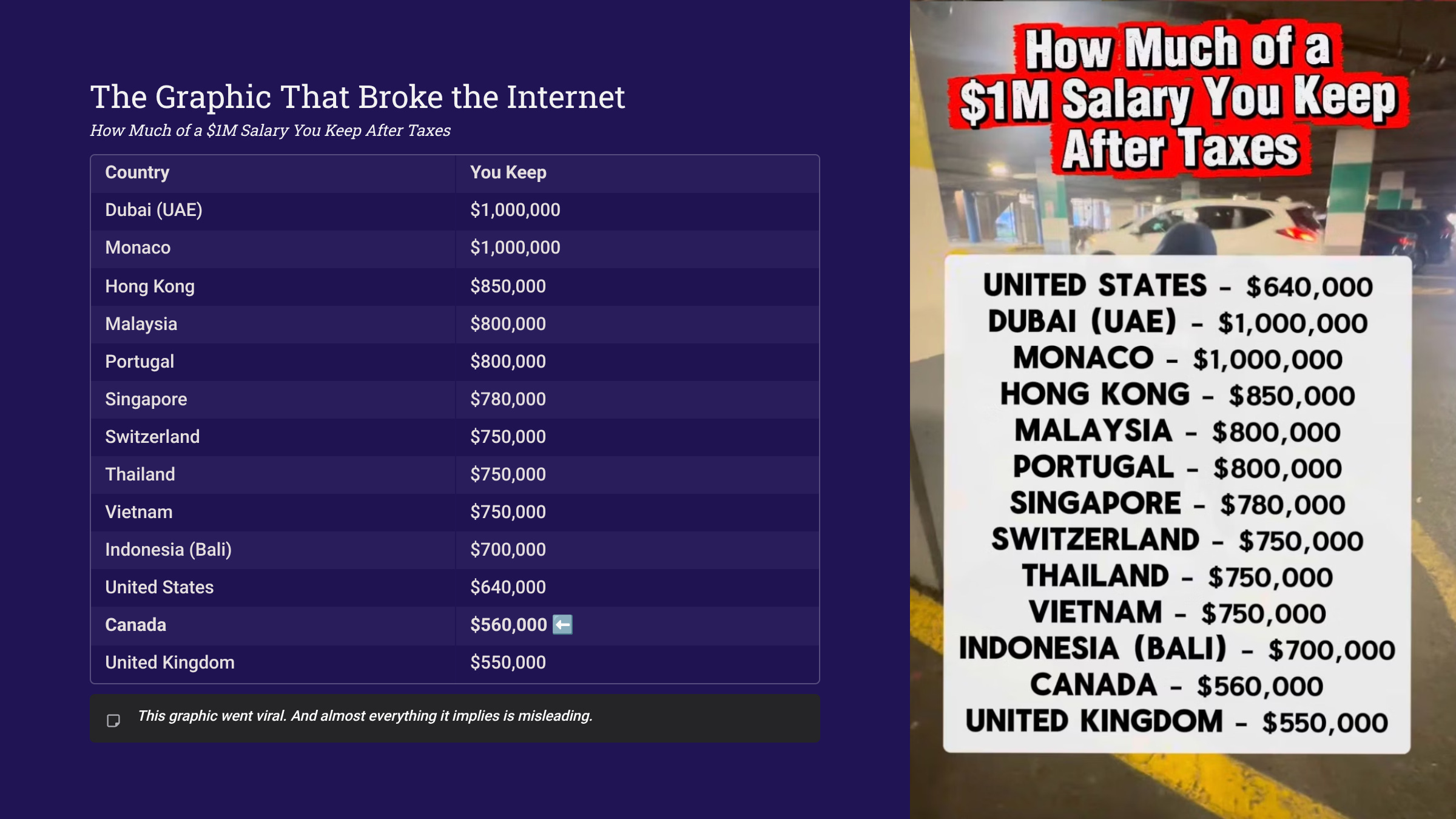
A few weeks ago, a chart started circulating on social media. Clean, authoritative-looking. The headline: How much of a $1 million salary do you keep after taxes? Countries listed side by side. Canada and the UK are near the bottom. Dubai, Monaco, and Switzerland are near the top.
The comment sections went nuclear. People were outraged, furious, sharing it as proof that North America had become a punishing, broken system that penalized success.
Here’s what the graphic quietly forgot to mention.
🚩 Dubai and Monaco show zero income tax. Sounds incredible, until you realize Monaco requires hundreds of thousands of dollars sitting in a local bank account just to be allowed to live there. It isn’t a tax system. It’s a gated community with a flag.
🚩 Switzerland looks great on paper, too, right up until you discover that Switzerland has a wealth tax applied every single year to everything you own: your home, your savings, your investments. That part didn’t make the infographic.
🚩 The US vs. Canada comparison shows roughly an $80,000 difference in take-home pay on a million-dollar salary. That number made people lose their minds. But in the United States, a serious illness, cancer, a cardiac event, or major surgery can cost between $500,000 and $1 million out of pocket, even with private insurance. Medical bankruptcy is one of the leading causes of personal financial ruin in America. The Canadian millionaire in that comparison walks into any hospital in the country. No bill. No GoFundMe. No negotiating with a billing department from a hospital bed.
That $80,000 gap doesn’t just disappear when illness hits. It flips entirely.
The graphic wasn’t a comparison of tax systems. It was a curated collection of tax havens, European principalities, and emerging economies lined up next to Canada and the US to make a single number look outrageous. Comparing tax rates without comparing what those taxes actually fund is like comparing two cars and forgetting to mention one of them doesn’t have an engine.
But here’s the question worth sitting with. Even if everyone in those comment sections had known all of this, would it have changed anything? Would they have stopped?
Probably not. And the reason tells us something important about how people actually work.
The Dream They Sold Him
John Steinbeck wrote something in 1966 that I keep coming back to.
“People don’t see themselves as poor. They see themselves as temporarily embarrassed millionaires.”
Read that again slowly.
Steinbeck wasn’t describing ignorance or foolishness. He was describing a belief so powerful, so carefully maintained, that it overrides self-interest, overrides lived experience, and overrides the numbers sitting directly in front of you.
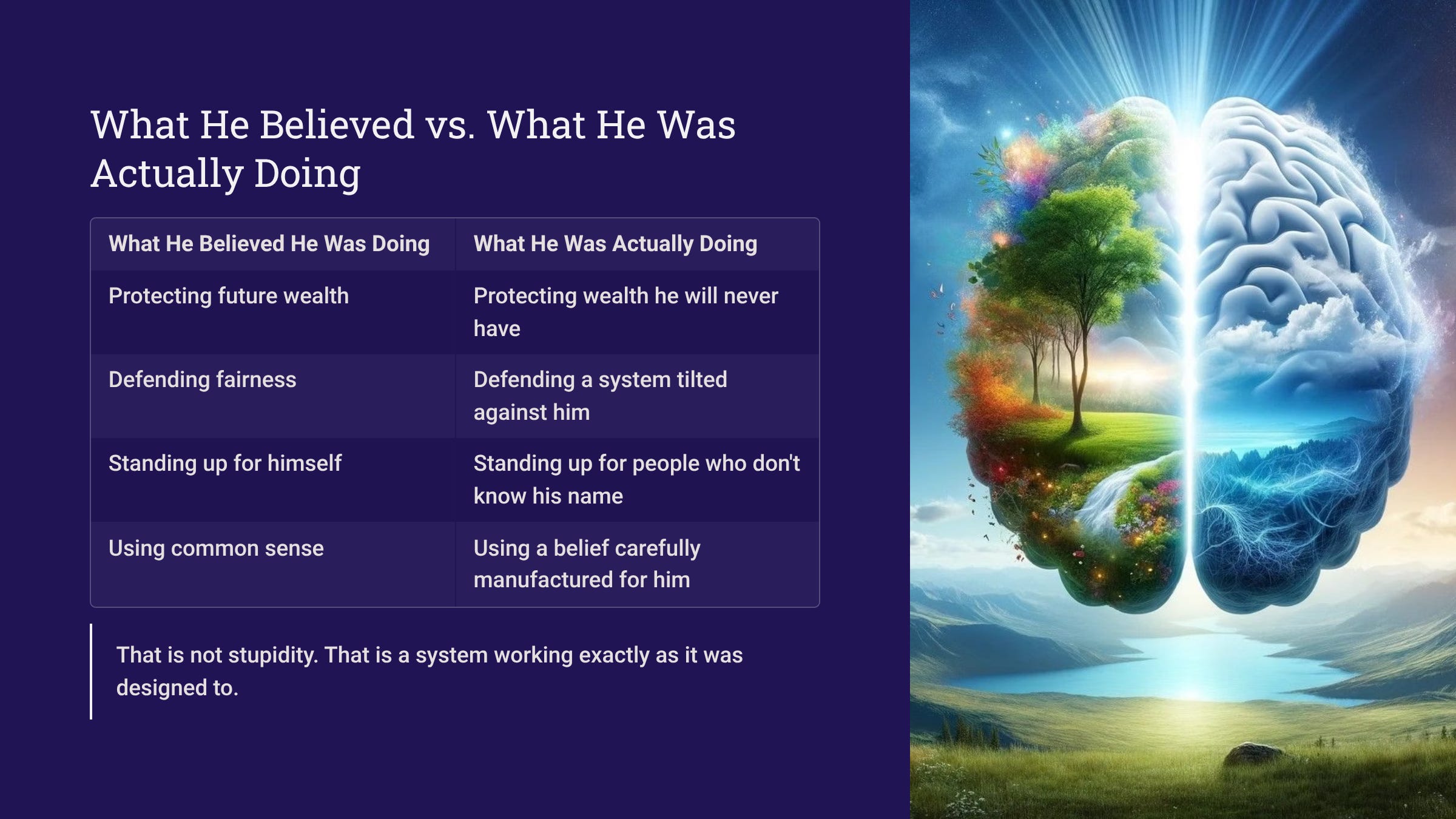
My friend wasn’t defending a millionaire’s tax rate. He was defending the version of himself he believes he’s about to become. And that hope was sold to him deliberately, at significant expense, by people who needed him to keep holding onto it.
Researchers call the underlying mechanism system justification theory. The human brain has a deep need to believe that the system is fair, that success is earned, that the game isn’t rigged. Because the alternative is genuinely devastating.
If the system isn’t fair, if success isn’t purely earned, then your struggles weren’t just bad luck. They were by design. The game was tilted before you sat down. The deck was stacked before you picked up a card.
The brain doesn’t want to accept that. So it rewrites the story. It finds evidence that the system works. It defends the rules of a game it believes it can still win. It protects the hope even when the data says otherwise.
That isn’t a character flaw. That’s a survival mechanism. And it is enormously useful to the people at the top of that system.
There’s another layer underneath this one, and it’s the part that surprises people most. Researchers at the National Bureau of Economic Research set out to understand which income group most strongly opposes policies that help low-income people. The answer isn’t the wealthy. It’s the people just above the bottom, the ones closest to the lowest rung of the ladder.
They call it last-place aversion.
No matter how little someone has, there is almost always someone below them. Any policy that raises the floor for people at the bottom feels like a direct threat, because the one small advantage that remains, the one thing still intact, is not being last. These people aren’t voting against themselves out of stupidity. They are voting to protect the one rung they are still standing on.
The people who designed the messaging around tax policy have always known this. They built their entire strategy around it.
The Pipeline Nobody Talks About
This didn’t happen by accident. Here’s exactly how it works, step by step.
💰 Corporate donors — large companies and ultra-wealthy individuals with a direct financial interest in lower tax rates — fund think tanks and lobby groups.
🏛️ Think tanks generate talking points engineered to sound like common sense, then distribute them to partisan media networks across North America and beyond.
📺 Media networks turn those talking points into content: articles, segments, opinion pieces, all reinforcing the same narrative.
📲 That content becomes viral graphics that flood your social media feed, looking like data and objective truth.
🙋 And then you — a regular person just trying to get through the month — end up in a comment section passionately defending a tax policy that has never benefited you and almost certainly never will.
You became an unpaid lobbyist. No meeting. No salary. No idea the handoff even happened.
The message repeated until it felt like your own opinion. The government is the enemy. Taxes are theft. The wealthy earned everything they have. You could be next.
None of those things is entirely true. But all of them are useful to the people who paid to have them repeated endlessly until they felt like common sense.
They don’t need you to be uninformed. They don’t need you to be foolish or gullible. They only need you to be human. To want to believe the system is fair. To want to believe your situation is temporary. To want to believe that one break, one lucky moment, could change everything.
That hope is real. That desire is real. And it is being used against you with precision.
Here’s the number that was deliberately left off that viral graphic. According to tax data, fewer than one-tenth of one percent of people earn a million dollars or more in a year.
Not one percent. One tenth of one percent.
Picture a room with a thousand people in it. Statistically, not a single person in that room earns a million dollars a year. Not one. The number rounds down to zero.
Now, picture the comment sections. Hundreds of people, furious, passionately defending millionaire tax rates. Almost none of them will ever be touched by those rates in any meaningful way.
They weren’t defending their money. They were defending an idea. And that idea was manufactured and distributed with remarkable precision by people who had every financial reason to make sure it spread.

What They Actually Took From Him
I keep thinking about my friend.
He’s not a bad person, not a foolish one. He’s a person who was handed a story that felt true, the same story that millions of working people across North America are handed every day through the content they consume, the media they trust, the graphics that land in their feed looking like data.
The cruellest part isn’t that they took his money. He doesn’t have enough for that to matter to them.
The cruellest part is that they took his anger.
A completely legitimate, completely justified frustration about a system that is failing him. And they aimed it in the wrong direction. They handed him a target and made sure it was the government, the tax collector, the faceless bureaucrat wasting his hard-earned dollars.
Not the donor class. Not the think tank. Not the media network. Not the people who built the pipeline and keep it running.
The people who benefit most from his loyalty will never know his name.
That, more than any tax rate or viral graphic or policy debate, is the thing worth being angry about.
The way out of this isn’t rage. It isn’t cynicism, or deciding the whole thing is broken, and nothing matters.
The first step is simply knowing the machine exists. Recognizing the pipeline when you see it. Read the fine print on the graphic before you share it.
That’s the whole move. It really is.
My friend is still out there, defending people who will never defend him back. I’m not going to argue with him. That’s not how any of this changes.
But I might send him this.
If this made you think, share it with one person who might be ready to hear it. Not to fight, just to think. That’s what The Sanity Project is for.
Listen to the Audio Podcast

Listen
To put the cherry on top of the shit Sundae this friend is also super Christian. Reads a couple of pages of the Bible every day. Must skip the parts about 'helping your fellow man'...
I believe these are people who have little to no empathy for anyone but themselves and lack the ability to think critically.