


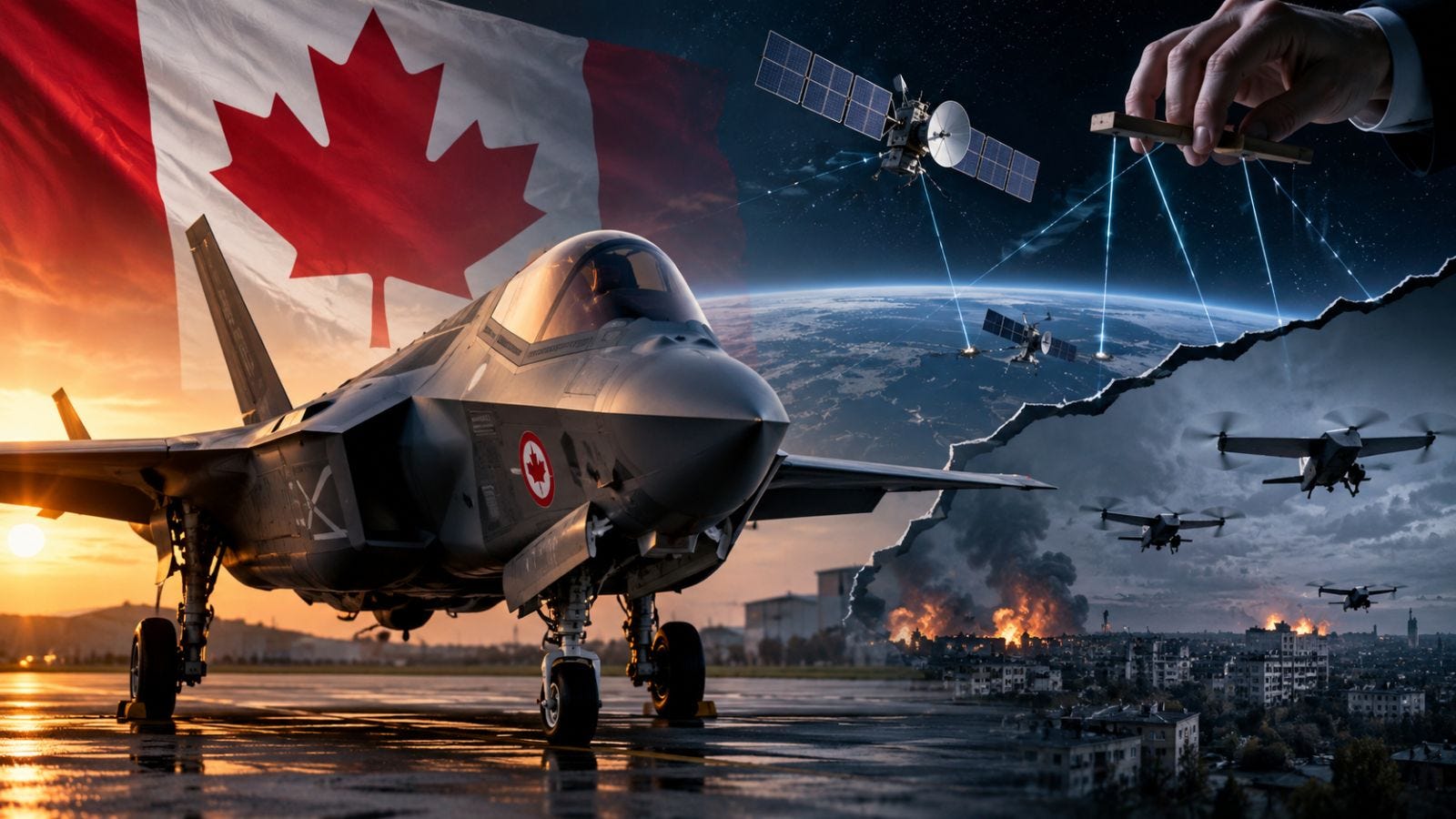
Canada's F-35 Debate: The Hidden Risks of American Military Dependence
Last week, Ukrainian drone crews discovered their equipment had a speed limit. Not one imposed by physics, engineering, or a shortage of batteries, but by restrictions apparently introduced thousands of kilometres away, on the satellite communications they depend on to fight a war.
And if you’re Canadian, that should make you uncomfortable.
On October 14, Ukrainian forces discovered that equipment using SpaceX’s military satellite communications service was losing connectivity at speeds above roughly 160 kilometres an hour. That’s a serious problem when your drones are trying to intercept Russian attack aircraft travelling considerably faster than that. As the Associated Press reported, Ukrainian officials suddenly began negotiating with SpaceX and the Pentagon to restore capabilities they had previously relied on.
Then came the finger-pointing. Elon Musk suggested that the United States military, and ultimately President Donald Trump, controlled such restrictions. Trump denied ordering them, while the White House disputed reports suggesting that Musk and Trump had discussed the decision beforehand.
By October 20, the story had become more revealing. CBS News reported, citing people familiar with the matter, that Musk himself had directed the restrictions after conversations with administration officials. Reuters separately reported similar findings from the Wall Street Journal. Exactly what Trump knew, approved or directed remains contested, but the available reporting now points more directly toward Musk’s involvement.
Think about what that means. Ukraine is defending its cities against Russian missiles and drones, yet an essential part of that defence can be restricted through decisions made by an American company and, potentially, the American government. Whether the immediate motivation was political, contractual or something else, the vulnerability was real.
And Canada is preparing to spend billions on fighter aircraft that raise an uncomfortable version of the same question.
When Someone Else Controls the Equipment
The timing of the restrictions deserves attention. They followed growing American pressure on Ukraine to stop attacking Russian energy infrastructure, including threats involving intelligence sharing. That sequence doesn’t prove the satellite restrictions were meant as punishment, but it does explain why Ukrainian officials suspected a political motive.
Ukraine’s experience with Starlink had already raised concerns about depending on privately controlled military communications. In 2022, reports emerged that satellite connectivity had been restricted around some Ukrainian operations, although SpaceX disputed aspects of those accounts. Then, in March 2025, Musk publicly promised that Starlink would never be turned off as a bargaining chip against Ukraine.
Nineteen months later, Ukraine was confronting another controversy over restrictions on the very communications network it needed to fight.
To be fair, that’s longer than some trade agreements with Washington have survived lately.
The latest restrictions were particularly troubling because they affected defensive operations, not simply Ukrainian strikes against Russian targets. Interceptor drones need reliable communications to pursue incoming threats, and some Russian attack drones travel well beyond the imposed speed threshold. A sudden loss of connectivity can mean losing the interceptor altogether, leaving civilians and infrastructure more exposed to Russian attacks.
Satellite services sometimes have legitimate technical and security restrictions. Nobody should assume that every service limitation is evidence of a political conspiracy. What makes this incident different is the combination of its sudden implementation, its battlefield consequences and the uncertainty surrounding who authorized it.
The broader lesson is difficult to escape. Ukraine owns many of the drones it flies, but it doesn’t independently control everything those drones need to operate. When a critical military capability depends on another country’s government or a foreign company’s decisions, national sovereignty comes with terms and conditions.
And those terms can change without much warning.

Why Canadians Should Care About a Ukrainian Drone
Canada isn’t Ukraine. We’re not fighting an invasion, and our military relationship with the United States is considerably deeper than a commercial arrangement involving satellite terminals. We share NORAD, continental defence responsibilities, intelligence networks and generations of successful military cooperation.
Those relationships matter, and Canadians shouldn’t casually discard them because the current American administration has made itself difficult to trust. But cooperation and dependence are very different, and recent events have given us good reason to examine where one ends and the other begins.
Canada selected the American-made F-35 in January 2023 to replace its aging CF-18 fighter fleet. The original plan called for 88 aircraft, providing the Royal Canadian Air Force with a modern stealth fighter capable of operating alongside American and other allied forces.
And the F-35 is an extraordinary aircraft. Its sophisticated sensors, stealth capabilities, and ability to exchange battlefield information make it one of the world’s most advanced fighter jets. Canada has entirely legitimate reasons to want those capabilities, particularly when defending North American airspace or contributing to NATO operations.
But purchasing a modern fighter aircraft isn’t like buying a pickup truck. You don’t take delivery, change the oil every few months and expect to operate independently for the next thirty years. Today’s combat aircraft depend on enormous networks of software, specialized parts, mission data, weapons integration, technical support and continuing upgrades.
In the F-35’s case, much of that support is organized through an American-led international program. Participating countries share certain responsibilities and industrial benefits, but they don't have complete independence over every system required to maintain and modernize the aircraft.
That doesn’t mean Washington can press a button and instantly shut down Canada’s fighters. No established evidence shows a secret remote kill switch, and suggesting otherwise would undermine a legitimate argument about the aircraft’s real dependencies.
The vulnerability is quieter and potentially more consequential over time. What happens when Canadian aircraft require specialized components, software changes or technical assistance from a partner whose government is involved in a serious political dispute with Ottawa? What protections exist against interrupted support, delayed deliveries or restrictions on future capabilities?
A fighter jet that can’t be properly maintained or updated eventually becomes a very expensive lawn ornament. Canadians deserve to understand who controls the maintenance shed before we buy an entire fleet.
And that brings us to the decision sitting on the federal government’s desk.

Canada Is About to Make a Multibillion-Dollar Decision. Who Will Really Hold the Keys?
Ukraine just discovered what happens when another country controls technology your military depends on. Canada has a chance to learn that lesson before it’s too late.
Ottawa is reconsidering its F-35 purchase. Sweden is offering an alternative. And Canadian companies are developing technology that could give us something we haven’t had enough of: genuine control over our own defence.
But there’s a catch. The Swedish option isn’t as independent as you might think, and the F-35 has advantages Canada can’t afford to ignore.
So which choice actually makes Canada safer, more independent, and less vulnerable to Washington’s political whims?
The answer isn’t nearly as simple as politicians would have us believe.
🔓 Subscribe FREE to keep reading. The rest of this investigation examines Canada’s options, the hidden trade-offs, and what it would really take to keep Canadian sovereignty in Canadian hands.
No paywall. No payment. Just independent Canadian journalism and a little healthy skepticism.

A fulsome and helpful piece. But are you being unduly deferential to the US military and the stability of its professional relationship with the Canadian military? The US has a military that, despite its avowed refusal to follow “illegal” orders, has bowed to the dictates of its commander in chief by following orders to murder small craft mariners off South America, even committing the war crime of showing no quarter. So Canada is to rest assured that they’ll be all good comrades and ignore orders by the commander in chief to degrade the operability of a Canadian ally’s new F-35s? It’s not what they say: it’s what they do.