


Canada-US Trade War 2026: While Trump Watched UFC, Carney Was Winning
The Sanity Project · June 23, 2026 · Bo Kauffmann
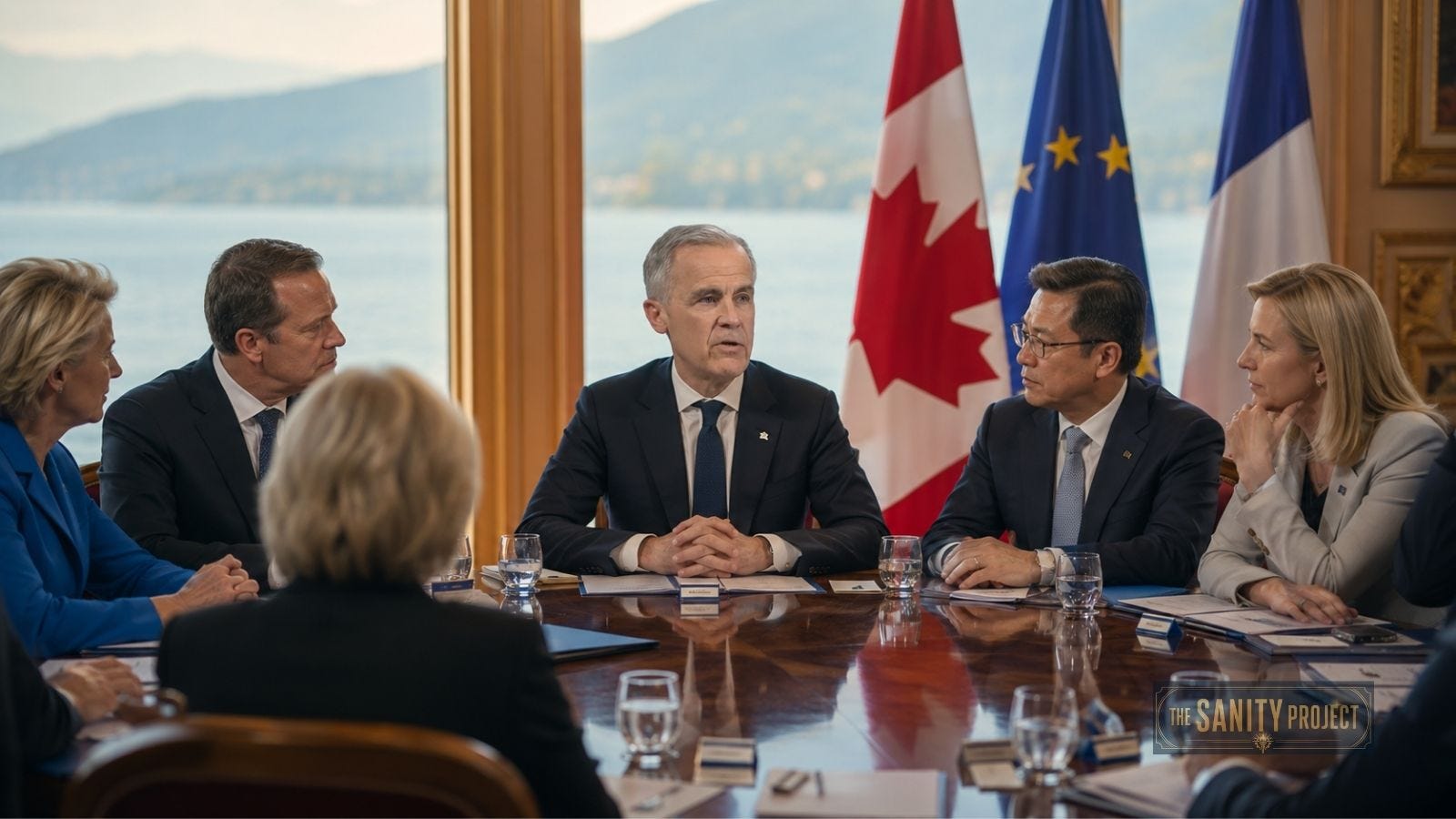
There’s a scene that keeps playing in my head from the week of June 15, 2026. Donald Trump arrived at the G7 summit in Évian, France — reportedly travelling directly from a UFC birthday celebration at the White House. Mark Carney, by that point, had already been in Europe for three days.
While the Canada-US trade war was being narrated in conservative media as Canada retreating, isolating, and panicking, Carney was in working sessions. Finalizing mineral deals. Signing defence contracts. Coordinating with the country that would assume the EU Council Presidency in nine days. And adding 162 new sanctions to Russia’s war machine.
In five days, Canada signed 13 partnerships across eight countries, unlocked more than $5 billion in capital investment, and became the first non-European country in history to access the EU’s €150 billion defence procurement mechanism.
None of this is speculation. All of it is publicly verifiable. And almost none of it received the coverage it deserved in North American media.
So let’s fix that.
If you’re tired of the spin and want the actual story — subscribe. We do the research so you don’t have to.
What America Actually Gets From Canada (The Numbers Nobody Quotes)
Key Insight
Canada is not a junior partner begging for American favour. It is America’s single largest energy supplier — and those numbers don’t reroute overnight, or at all.
Let’s start with the claim that sparked this whole conversation. On June 10, 2026, Donald Trump said out loud that America does not need Canada for anything. In the same breath, he suggested he wasn’t looking to renew CUSMA.
Here is what the Canada Energy Regulator’s 2025 data actually shows:
63.4% of all crude oil imported into the US came from Canada in 2025
~100% of all natural gas imported by the US came from Canada
81.3% of all electricity imported by the US came from Canada
$157.5B total value of Canadian energy flowing into the US economy in 2025
Canada’s crude oil exports to the United States run at 3.9 million barrels per day — 90.1% of Canada’s total crude output, flowing south through a continent-spanning pipeline network that cannot be redirected overnight. Or next year. Or possibly ever, given the realities of the infrastructure.
And that’s before we get to the rare earth minerals, potash, uranium, and the critical mineral supply chains that underpin American electric vehicles, defence systems, and communication infrastructure.
America does not need Canada for anything. Except, you know. Heat. Light. Fuel. And the raw materials that define American power in the 21st century. But sure. Nothing important.
The Canada-US Trade War Has a Historical Precedent — And It Didn’t End Well for America
Key Insight
The last American president who confidently believed in his trade leverage over Canada signed the Smoot-Hawley Tariff Act in 1930. He lost the next election in a landslide. Canada pivoted anyway.
History doesn’t repeat. But it rhymes with uncomfortable precision.
On June 17, 1930, Herbert Hoover signed the Smoot-Hawley Tariff Act into law — one of the most catastrophically misjudged pieces of economic legislation ever written. Before the ink was dry, 1,028 American economists had signed an open letter begging him not to do it. He signed it anyway.
Canada retaliated. Europe retaliated. Global trade collapsed by 66% over the following three years. The United States entered the deepest trough of the Great Depression. Hoover lost the 1932 election to Franklin Roosevelt by carrying six states.
But here’s the part of this story that matters for 2026: what happened in Ottawa, not Washington.
Canadian Prime Minister R.B. Bennett didn’t wait for American rationality to return. He hosted the 1932 British Empire Economic Conference and drove through a policy of “imperial preference” — preferential tariff rates among Commonwealth nations that effectively rerouted Canadian trade toward Britain, Australia, South Africa, and the wider empire. Canada didn’t collapse under Hoover’s tariffs. It pivoted.
Mark Carney has read this history. He’s cited it. And he has spent fifteen months executing a 21st-century version of exactly what Bennett did — except with one critical difference.
Canada in 2026 holds something Canada in 1930 couldn’t have imagined: a vault of critical minerals that every major industrial democracy on earth needs to build its future, and that no other stable, democratic, rule-of-law nation can supply at scale.
The Sanity Project covers the stories that get buried beneath the noise. Join thousands of readers who want the real analysis.
Fifteen Months of Canada Trade Diversification: How Carney Built the Architecture
Key Insight
The G7 summit in Évian was not an improvisation. It was the public closing of a file that had been accumulating signatures, agreements, and relationship capital since Carney took office — across nine trips to Europe in fifteen months.
This is the part that the “all talk, no action” crowd needs to sit with for a moment.
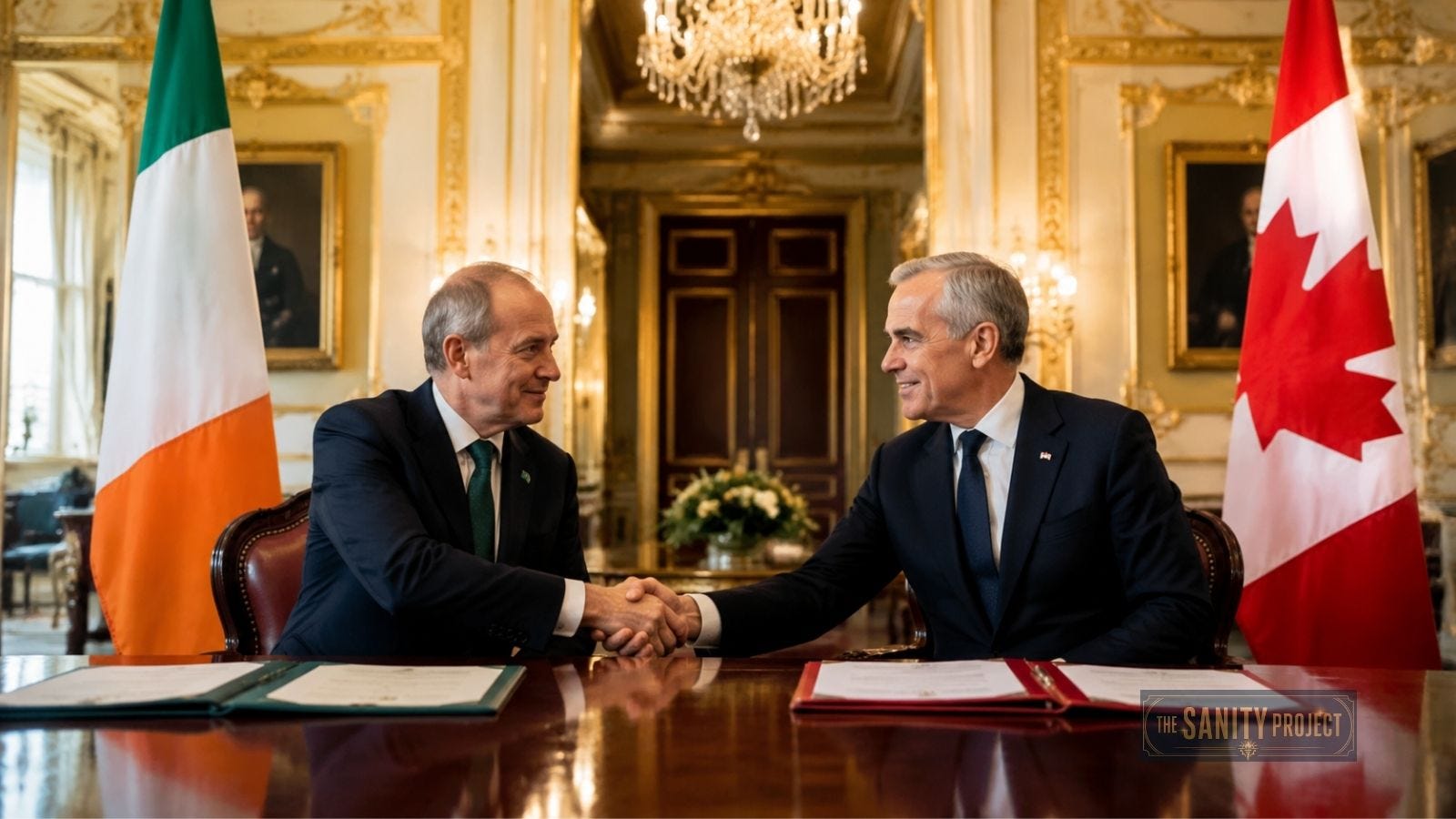
Carney appeared at Davos in January 2025, framing Canada’s offer to the world’s financial elite. He attended the EU Political Community Summit in May 2026, establishing Canada as a formal participant in a European security architecture it had never previously entered. He arrived in Dublin on June 13, 2026, not as a tourist in his ancestral homeland, but as the head of government of a country that Ireland now ranks as its 14th-largest investment partner.
The numbers behind that relationship are worth pausing on. Canadian companies employ 26,000 people in Ireland. Irish companies employ over 30,000 people in Canada. These are not honorary relationships. They are structural economic ties that took decades to build — and Carney was in Dublin nine days before Ireland assumed the rotating Presidency of the EU Council on July 1, 2026.
The joint statement from Dublin Castle contained a detail that virtually no North American outlet covered: both leaders explicitly committed to using Ireland’s Council Presidency to deepen the Canada-EU partnership. Carney was coordinating the agenda of European institutional power — while conservative commentators were still asking whether his trip was “worth it.”
Apparently, the answer was yes.
The Canada EU Trade Deal That Changed the Rules: The SAFE Mechanism
Key Insight
On February 14, 2026, Canada became the first non-European country in history to access the EU’s €150 billion SAFE defence procurement framework. At Évian, that agreement produced its first concrete contract — made-in-Canada military radios for the Polish Cyber Command.
Let me tell you about the story nobody is covering.
The EU’s Security Action for Europe (SAFE) is a €150 billion defence procurement mechanism built on a specific assumption: that defence supply chains must remain within trusted allies. It was designed as a European instrument — exclusive, restricted, closed. The EU Council concluded its SAFE agreement with Canada on February 14, 2026. The European Parliament ratified it in May.
Canada is the only non-European country ever granted this access. Not the UK. Not Australia. Not Japan. Canada.
At Évian, that agreement produced its first real output. Montréal-based Marconi Technologies will manufacture made-in-Canada ORION tactical radios for the Polish Cyber Command, with deliveries running through 2030 and nearly 100 Canadian suppliers across skilled trades and advanced engineering involved in production. Canada also opened formal negotiations to purchase Italy’s M-346 advanced jet trainer aircraft from Leonardo — deepening the industrial defence relationship with a major NATO ally while upgrading Royal Canadian Air Force training capacity.
This is not trade diversification. This is defence integration. The kind that normally takes decades of patient alliance-building under normal diplomatic circumstances.
Carney did it in fifteen months.
Canada Critical Minerals: The $5 Billion Vault the World Is Now Unlocking
Key Insight
The 13 deals signed at Évian weren’t memoranda of understanding or framework agreements. They were capital commitments — named companies, named projects, named Canadian communities, specific delivery timelines, and more than $5 billion in unlocked investment.
Here’s where the “it’s all symbolic” argument collapses completely.
Through the Critical Minerals Resilience and Production Alliance — a buyers’ club Carney himself launched during Canada’s 2025 G7 Presidency — Canada welcomed 13 new partnerships and initiatives with more than eight countries at Évian.
Not framework agreements. Not MoUs. Actual capital commitments:
Germany’s RCT Solutions is partnering with Manitoba’s Sio Silica to build a 99.9%-pure silica extraction and fully integrated solar manufacturing hub in Manitoba. Japan’s Hanwa Co. Ltd. is partnering with Ontario’s KAP Minerals to develop phosphate and rare earths. Italy’s Eni — one of Europe’s largest energy companies — is investing in Nouveau Monde Graphite’s Matawinie Mine in Québec. France’s Schneider Electric is partnering with Torngat Metals to advance rare earths mining in Québec. Japan’s Sumitomo Corporation is partnering with Ucore Rare Metals to supply rare earth elements for magnet manufacturers across Japan and North America. Portugal’s Lithium Energy is licensing Canadian lithium-refining technology for operations in Portugal.
France, Germany, Italy, and South Korea additionally committed to strategic stockpiling of Canadian critical minerals — a long-term security buffer that signals dependency, not deal-making theatre.
The CUSMA Trade Agreement Threat That Backfired
Key Insight
When Trump threatened not to renew the CUSMA trade agreement, Carney’s response was three words long: “It’s no secret.” Then he went back to work. That is what calm leverage looks like.
The conservative narrative about this week follows a script so predictable you could set your clock by it. Carney is abandoning America. Canada is isolated. The trade pivot is a stunt.
Let’s run each claim against the facts.
“Carney is abandoning America.” Canada’s trade with the United States remains the largest bilateral trade relationship in Canadian history. 85% of Canadian trade remains tariff-free under CUSMA. Carney is not abandoning the U.S. He is refusing to be held hostage by a single market when that market’s leadership has explicitly threatened to terminate the agreement governing it.
“Canada needs America more than America needs Canada.” See the energy numbers above. Every crude oil, natural gas, electricity, and NGL import dependency figure points in the same direction. The leverage is not symmetric.
“The deals are symbolic.” Thirteen named partnerships. Eight named countries. Five billion in committed capital. Named Canadian companies. Named Canadian communities. Specific delivery timelines. If that’s symbolism, someone needs to redefine the word.
“Carney is weak on Trump.” When asked about the CUSMA termination threat, Carney’s entire response was: “It’s no secret that Trump dislikes CUSMA.” He did not escalate. He did not retreat. He stated a fact and returned to work. This is the discipline of a central banker who has managed systemic crises — not the rage of a politician performing for a base.
The Sanity Project exists to cut through the noise. If this kind of analysis matters to you, there’s more where it came from.
The Closing Argument
When Herbert Hoover signed the Smoot-Hawley Tariff Act in 1930, 1,028 economists told him he was wrong. He signed it anyway. The world paid for that arrogance for a decade.
When Trump told the world in June 2026 that America doesn’t need Canada for anything, Carney was already in Dublin, coordinating a continental trade architecture with the country that would assume the EU Council Presidency in nine days. When Trump arrived in Évian, reportedly from a UFC party, Carney was in working sessions.
Thirteen deals. Eight countries. Five billion dollars. First-ever non-European SAFE defence procurement. Full trade diversification with real capital commitments. One hundred and sixty-two new Russian sanctions. All in five days.
R.B. Bennett faced an American president who believed his own propaganda about trade leverage. He turned to partners who needed what Canada had. He was right. The people who called it a retreat were wrong.
Mark Carney is not retreating. He is executing.
The question is not whether the strategy is working. The question is whether Canadians are paying enough attention to notice.
— The Sanity Project | June 23, 2026 | Bo Kauffmann
Sources: PM.gc.ca — G7 Partnerships · Canada-Ireland Joint Statement · EU SAFE Agreement · Canada Energy Regulator 2025 · Global News — CUSMA · Britannica — Smoot-Hawley
Good read. It’s like one country is dealing with reality and the other country is in fantasyland. Yes, the US doesn’t need anything from Canada. In addition to energy and other critical inputs mentioned here, take the example of aluminum, a crucial input for the auto, defence and other manufacturing industries. The US consumes approximately 5 million metric tonnes of aluminum annually, but internal production is less than 1 million tonnes. Of the balance it imports more than half of total imports from Canada. The largest producers of aluminum in the world are China, India, Russia and then Canada. Who would replace Canada as a source? China? Russia? Yeah, but go ahead and implement tariffs on Canada and threaten to attack our sovereignty. Good plan. I can’t see that backfiring at all. A coherent administration would have PARTNERED with allies to address the growing Chinese economic power. But no, this administration (and I use that description in jest) had to attack its allies and tariff the world. And critics of PM Carney question why we should pivot away from the US.
Damn,I love our Prime Minister Mark Carney. He is absolutely relentless in his pursuit of increasing our resilience,sovereignty,security and diversification with many other trading partners. He is calm, strategic,intelligent, respected and patriotic. Canadians are blessed with this man in our current difficult situation . The Liberal government is knocking it out of the ball park with all the new trade and investment agreements, investments for our children and grandchildren. Dealing with the insane psychopath narcissist president is no easy task. Mark Carney is calm and deliberate in his actions, he doesn’t get rattled or intimidated by the psychopath’s insults and threats. Canada True North Strong and Free. Plus PP is a frickin moron.