


Canada-EU Future — Part 1 of 3
Canada-EU Future: Canada Already Governs Like Europe — Not Like Trump’s America
Ottawa thinks like Brussels, not Washington. Here are the receipts.
Key Takeaways
Canada runs a Westminster Parliament under a constitutional monarchy; the US runs a presidential system built for the branches to fight each other.
Charter Section 1 allows “reasonable limits” on rights; the American rights tradition leans closer to absolute.
Elections Canada draws federal ridings through independent, non-partisan commissions. In 2025, six US states redrew their maps mid-decade for partisan advantage.
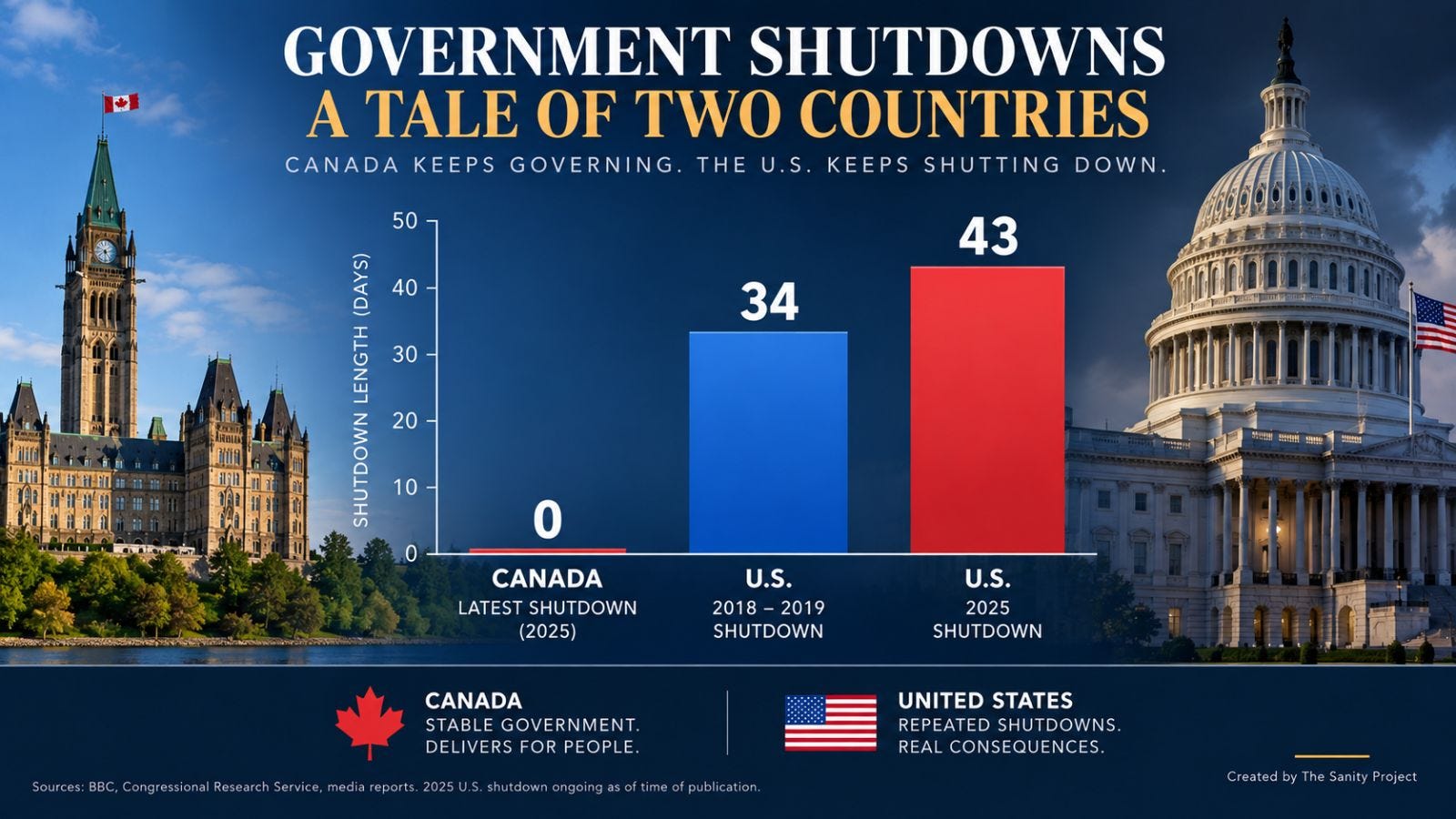
Mark Carney has governed with a minority in the House of Commons since April 2025 without a single shutdown. Washington’s 2025 shutdown ran 43 days, the longest in US history.
Forty-three days.
That’s how long Washington shut its own government down last fall, the longest funding lapse in American history, beating the 2018-2019 record by more than a week. Nearly a million federal workers went unpaid. Food assistance for tens of millions of Americans got tangled up in the standoff. The fight wasn’t really about the money. It was about whether two parties that no longer trust each other could agree on anything at all.
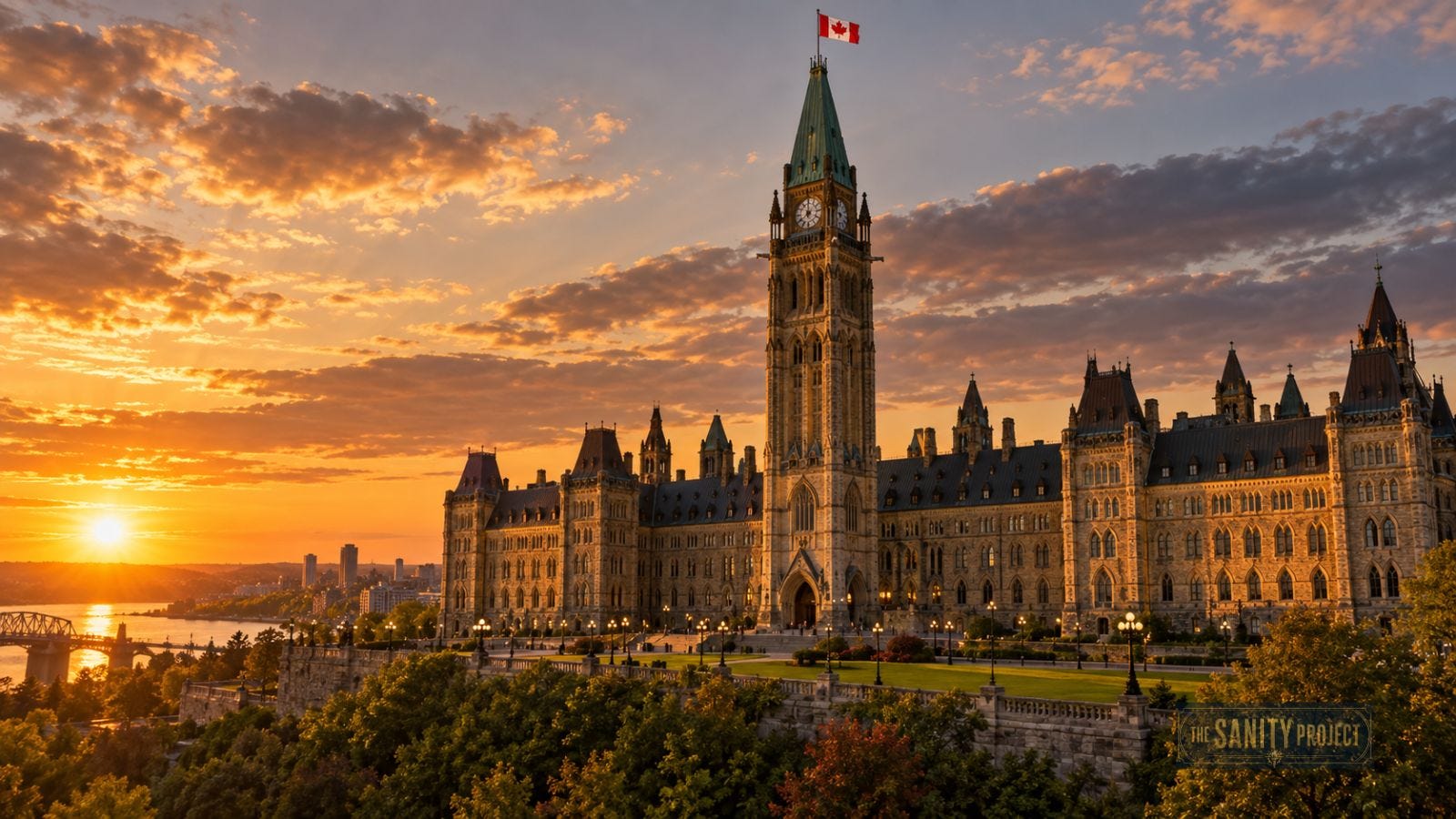
Meanwhile, up here, Mark Carney had been running a government with 169 of the 343 seats in the House of Commons, three short of a majority, since April 2025. No shutdown. No furloughed civil servants. No 43-day standoff over a budget. That went on until several Conservative MPs realised their leader was an ineffective tool and crossed the floor to join the Liberal Party, swelling their numbers to the current 173 seats, enough for a majority.
That’s not a difference in personality. It’s a difference in architecture, and it’s the first reason Canada looks less like the United States than it looks like the parliamentary democracies of Europe.
Every one of these comparisons gets a full breakdown, no spin.
Subscribe to The Sanity Project so you don’t miss Part 2.
Ottawa Thinks Like Brussels, Not Washington
Canada operates under a Westminster Parliament within a constitutional monarchy, where the executive answers to the legislature every single day. The US runs on a presidential system built to make the branches fight each other.
Canada is a Westminster parliamentary democracy under a constitutional monarchy, the same basic architecture as the UK, and closer in spirit to the parliamentary systems across Western Europe than anything in Washington. The prime minister isn’t a separately elected executive facing off against Congress.

The prime minister is a member of Parliament who holds office only as long as the House of Commons has confidence in them. Lose a confidence vote, lose government. There’s no scenario where the executive and the legislature glare at each other for six weeks while paycheques don’t go out, because the system doesn’t let that kind of stalemate just sit there. It gets resolved fast, one way or another: a deal, or an election.
The Charter of Rights and Freedoms works the same pragmatic way. Section 1 guarantees rights and freedoms “subject only to such reasonable limits prescribed by law as can be demonstrably justified in a free and democratic society.” That’s the whole Canadian approach in one sentence: rights matter, but so does the fact that people have to live together. Germany, France, and the Nordic countries build their constitutions on the same premise. The American First Amendment tradition, by contrast, treats rights as nearly absolute, which sounds noble until it collides with a country that can’t agree on almost anything else.
Washington hit a wall and simply stopped functioning.
No Gerrymandering, No Voter Purges, No Games
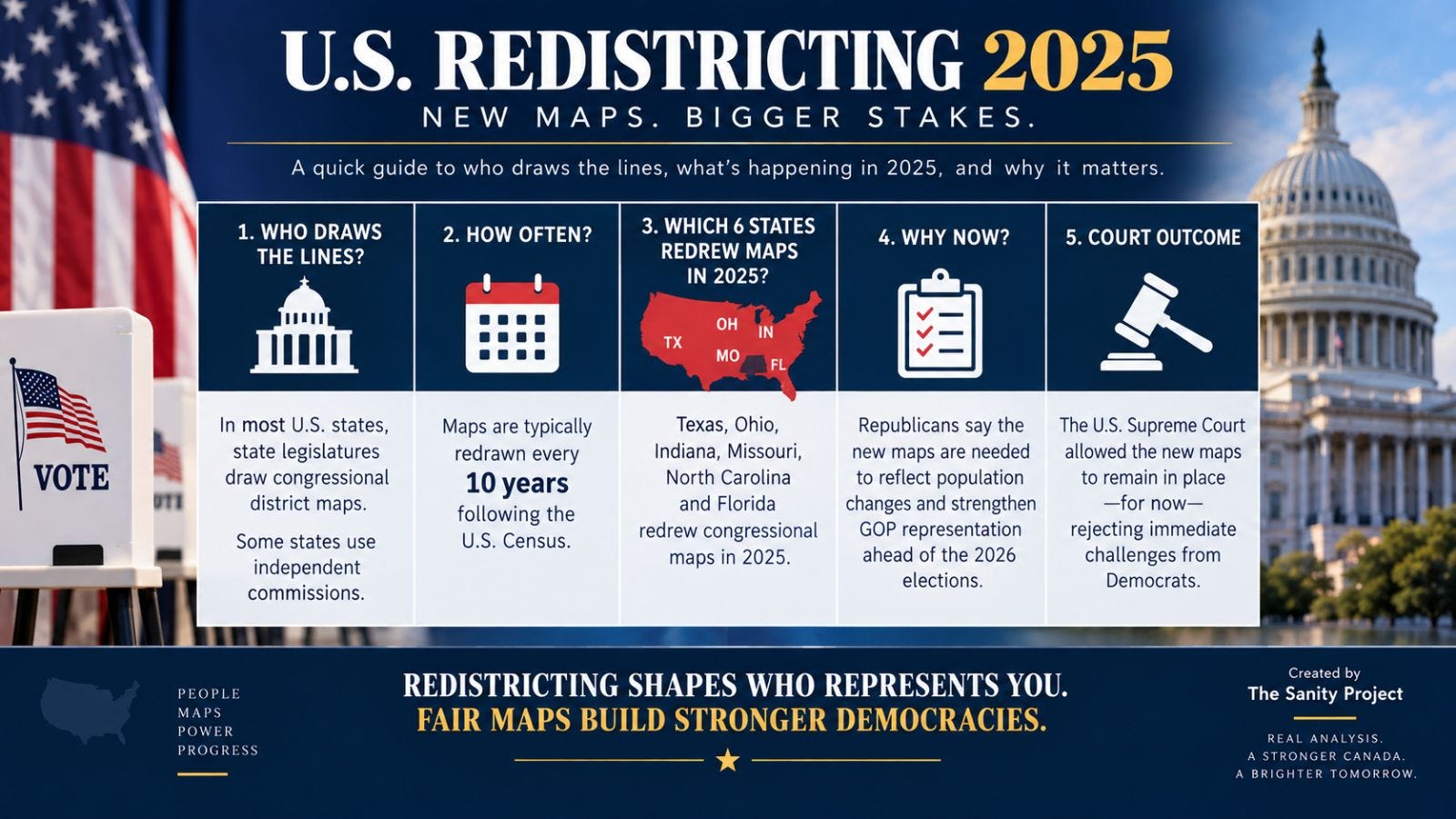
Elections Canada draws federal riding boundaries through independent commissions with no political staff on the payroll. In 2025, six US states redrew their maps mid-decade for the express purpose of winning more seats.
Elections Canada is a non-partisan federal agency. It doesn’t answer to whichever party currently holds power. It runs the vote count, and Canadians still mark paper ballots that get counted by hand in front of scrutineers from every party in the room. Riding boundaries get redrawn every ten years by independent commissions, and no elected official gets to touch the pen.
Now look south. In 2025, Texas Republicans, at Donald Trump’s explicit request, redrew the state’s congressional map mid-decade, outside the normal once-a-decade census cycle, specifically to manufacture five additional Republican seats ahead of the 2026 midterms. A federal court blocked it in November, ruling the map was likely racially gerrymandered; Texas is appealing to the Supreme Court. California, Missouri, Ohio, Utah, and North Carolina all redrew their own maps that same year, mostly in direct retaliation. Six different states decided within the same twelve months that districts should be a weapon rather than a formality.
Canada isn’t a perfect democracy. Nobody’s claiming that. But nobody in Ottawa gets to redraw a riding because the polling looks bad.
What Canadians Can Actually Do About It
Defending boring institutions is the whole job. Elections Canada, the CBC, and the local paper down the street don’t run themselves.
None of this holds up on its own. Elections Canada needs to remain independent and properly funded, not be treated as a political football whenever a sitting government wants to tinker with how elections are run. The CBC, whatever complaints Canadians have about it — and there are plenty — is part of the same infrastructure: a public broadcaster that isn’t owned by whoever bought it, in a media environment where local newsrooms keep closing, and trust in American cable news keeps sliding.
Pierre Poilievre has promised to defund it outright; that fight isn’t hypothetical, it was a live issue in the last election, and it will be one again.

And local journalism, the unglamorous stuff, city council meetings and school board votes and the reporters who actually show up, is what keeps any of this honest at the level Canadians actually live at.
Nobody in Ottawa gets to redraw a riding because the polling looks bad.
That’s not partisan. It’s maintenance.
The Verdict
CLEAR WINNER: CANADA
Not because Canadian politics is calm (it isn’t) or because Ottawa never fights about anything (it does). Because when Canadians disagree, the system produces an answer. When Americans disagree right now, the system produces a shutdown, a gerrymander, or both. Ottawa thinks like Brussels. Washington, lately, can’t think past its own shutdown clock.
Editor’s View
I don’t say any of this to be smug about it. But structure matters, and ours is designed to force resolution rather than stalemate. That’s worth saying out loud right now, because there’s a real appetite in some corners of Canadian politics to import the American playbook wholesale: presidential-style leadership, culture-war absolutism, distrust of the referee.
We should be exporting our playbook, not importing theirs. Part 2 of this series looks at why Canadians live longer, safer lives and have a more robust social safety net than Americans do, and it’s no coincidence.
Part 2 drops soon: why Canadians live longer than Americans, and what it costs to get there.
This is Part 1 of a 3-part Canada-EU Future series from The Sanity Project. Part 2 covers health, safety, and the social contract. Part 3 covers the CETA trade case for looking east across the Atlantic instead of south.
Corrections & Updates Protocol
The Sanity Project corrects errors transparently. Any factual correction to this piece will appear here as an inline “Update (Month Year):” note rather than a silent edit.
Publications Consulted
The Washington Post, NPR, Al Jazeera, USAFacts, Bloomberg Law, CBC News, CTV News, Global News, Common Cause, Government Executive.
My only issue is Alberta’s QUEEN Danielle IS gerrymandering our 2027 election
Thanks and wrote a similar piece earlier about this - https://canadianreturnee.substack.com/p/why-canadas-system-works-when-others?utm_source=publication-search