



And most Canadians have absolutely no idea.
There’s a particular kind of irony that only shows up in national politics. It goes like this: a country gets told, loudly and repeatedly, that it is weak. The pundits say it. The op-ed pages say it. The guys on political podcasts say it with great confidence and very few facts. Meanwhile, that same country is quietly sitting on one of the most strategically valuable resource bases on the planet.
That’s Canada right now.
For the better part of two years, one narrative has dominated the airwaves and the comment sections. Canada is fragile. Canada is over-regulated. Canada is economically dependent on American goodwill and has almost no cards to play. When Trump’s tariff pressure hit in 2025, plenty of pundits were practically lining up to suggest we should accept our place as a subordinate trading partner and be grateful for what we get.
Compelling story. Completely wrong.
Here’s what those same pundits weren’t telling you: at the exact moment commentators were describing Canada as a weakling at the negotiating table, Canada was in Toronto hosting the world’s largest mining conference, announcing $12.1 billion in new partnerships with twelve nations, and chairing a global body it had built from scratch to govern the most strategically important supply chains of the 21st century.
Not a participant. The chair.
That’s not a weakness. That’s leverage. And the story of how Canada got here, and why it matters for every single one of us, is one of the most important economic stories almost nobody is actually telling.
The Minerals That Run the Modern World
Start with the basics, because this is where it gets genuinely fascinating.
The global clean energy transition, electric vehicles, wind turbines, solar panels, batteries, and small modular reactors are not really an engineering story. It’s a materials story. Every EV battery pack is a concentrated mass of lithium, cobalt, nickel, graphite, and manganese. Every offshore wind turbine contains rare earth elements in its magnets and copper running through its wiring. Every solar panel needs silver and silicon. You cannot build any of this without the raw materials. Full stop.
The International Energy Agency has done the math on what this actually means for global demand:
Lithium demand is projected to grow by over 40 times by 2040
Graphite, cobalt, and nickel demand will grow 20 to 25 times in the same period
Copper, needed to wire every renewable energy system on the planet, faces extraordinary demand growth across every scenario the IEA has modelled
Forty times. Sit with that for a second. The demand for lithium alone will be forty times what it is today within fifteen years. And that’s the conservative projection from the world’s leading energy authority.
So, the obvious question is: where do these minerals come from? And who controls them?
Right now, the answer to that second question is almost entirely: China.
China produces 92% of the world’s rare earth elements, 91% of natural graphite, 77% of cobalt refining, 65% of lithium processing, and 44% of copper refining. This is true even when the raw ore comes from elsewhere. China doesn’t just mine these materials. China controls their processing, and that’s where the real power in the supply chain lies.
And China has already shown, publicly, that it will use that control as geopolitical leverage. Export controls on graphite, gallium, and germanium weren’t trade policy footnotes. They were a message: we own this, and we can turn it off.
Every allied nation on Earth, the United States, the European Union, Japan, South Korea, Australia, and India got that message at the same time and drew the same conclusion.
We need an alternative. Fast.
Canada’s Geological Lottery Win
Here’s where Canada walks into the story. And honestly, the timing is almost too perfect to believe.
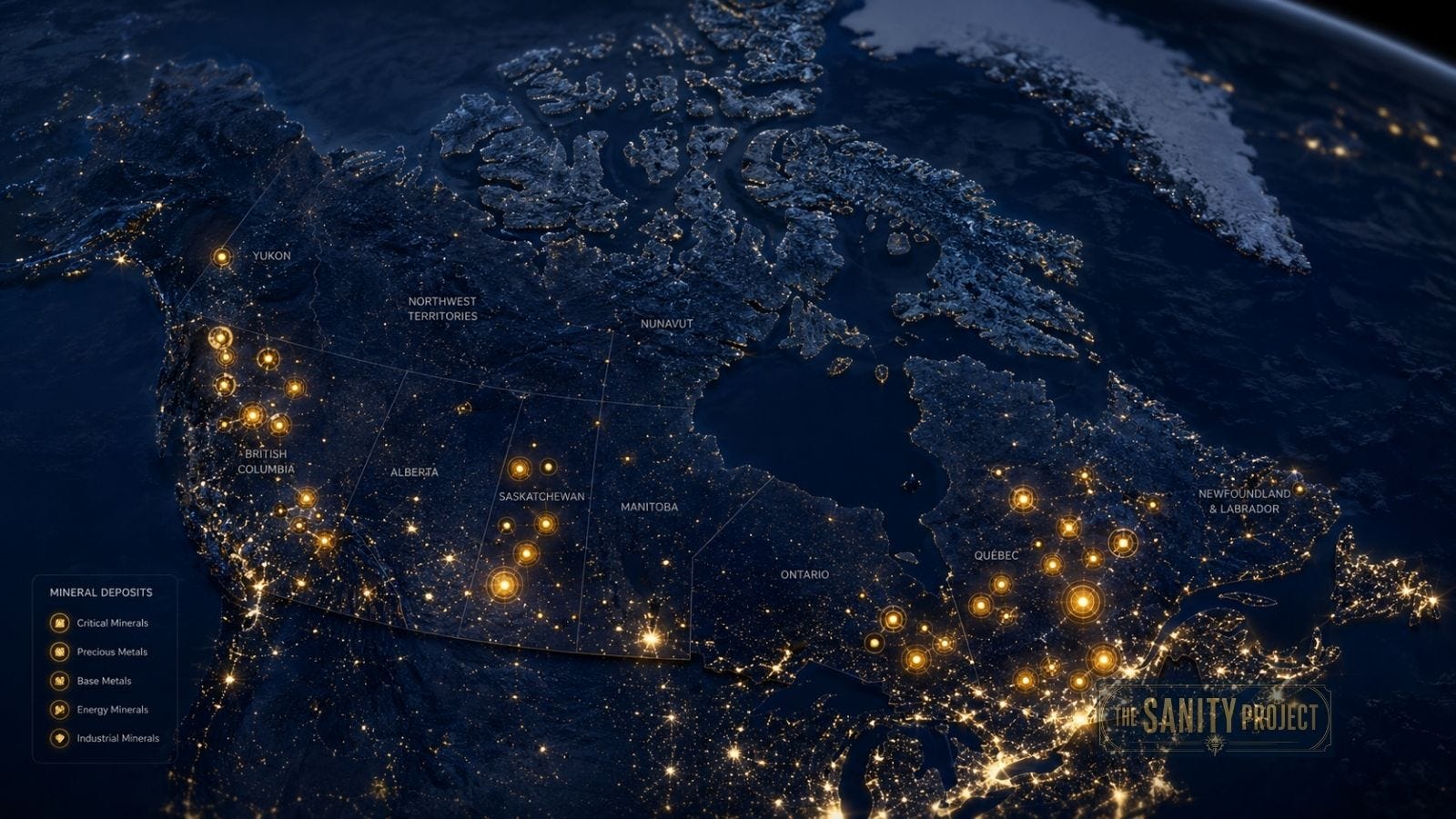
Canada sits atop one of the most extraordinary mineral endowments on the planet. Not metaphorically. Literally. The Canadian Shield, the ancient Precambrian rock underlying most of central and northern Canada, contains concentrated deposits of virtually every critical mineral needed for the clean energy transition.
Look at what we actually have:
Lithium -- Quebec holds one of the world’s largest deposits of spodumene ore, the primary source of lithium. Sayona’s North American Lithium mine in Quebec is already in commercial operation. Frontier Lithium’s PAK Lithium project in Ontario has a signed offtake agreement with Panasonic Energy of Japan.
Nickel and Cobalt -- Canada is a world-leading producer of both. Ontario’s mining corridor and Newfoundland’s Voisey’s Bay are among the most significant nickel-cobalt operations anywhere on Earth.
Uranium -- Canada is the world’s number two uranium producer, in a world increasingly turning back to nuclear as a clean grid-balancing tool. Saskatchewan’s Athabasca Basin holds some of the highest-grade uranium deposits ever discovered.
Graphite -- Canada ranks 4th in global graphite production. Quebec alone holds 14 advanced-stage graphite projects.
Potash -- Canada is the world’s number one producer. Saskatchewan potash feeds roughly one in five people on Earth. If you ate bread, pasta, or rice today, there’s a decent chance Saskatchewan helped grow the grain it was made from.
Rare Earth Elements -- Cyclic Materials Inc. in Kingston, Ontario, is building a rare earth recycling Centre of Excellence, backed by a $9.1 million federal investment and a US$25 million equity stake from the Canada Growth Fund.
All told, Canada produces 60 minerals and metals at almost 200 mines, with total mineral production valued at $64.3 billion in 2024 according to Natural Resources Canada. Canada lists 31 minerals on its official critical minerals list and ranks among the top 5 globally for cobalt, diamonds, gold, nickel, niobium, platinum, and titanium concentrate.
Oh, and Canada is home to nearly half of the world’s publicly listed mining and mineral exploration companies. The world’s mining industry doesn’t just sell to Canada. It operates from Canada.
Starting an online business?
Canadian businesses deserve Canadian hosting. If you’re building a website or blog, this is where I’d start: Web Hosting Canada

The $3.8 Billion Strategy Nobody’s Talking About
In 2022, the federal government launched the Canadian Critical Minerals Strategy, an $3.8 billion, eight-year commitment to transforming Canada’s position in global mineral supply chains. Not just by digging more holes, but by capturing more of the value chain.
This is the part that gets completely lost in the political noise. There’s a massive difference between a country that digs up ore and ships it out and a country that refines minerals, produces battery-grade materials, and manufactures the clean energy inputs the world needs. The difference is measured in jobs, in GDP, and in strategic independence. The Strategy is explicitly designed to move Canada up that ladder.
Three pillars hold it up.
Domestic production and processing. Canada should be refining its own lithium into battery-grade material, producing its own cathode active materials, and building the processing capacity to be not just a miner but a manufacturer. Twenty-eight processing projects are currently in development across the country.
Sovereignty protection. The Strategy includes provisions to block foreign takeovers of Canadian critical mineral assets by state-owned enterprises that conflict with Canadian values and security interests. Several such acquisitions have already been reviewed or blocked under these rules.
Indigenous partnership. This is framed not as a legal checkbox but as a cornerstone of project success. Indigenous Peoples are recognized as rights holders, stewards, and in many cases title holders of the land where development occurs. Projects that genuinely partner with Indigenous communities move faster and carry greater ESG credibility globally, which matters enormously to the European and Asian buyers Canada is courting.
Here’s what the scoreboard looks like so far:
Domestic production of critical minerals increased by more than 10% for 9 different minerals by 2024
Critical mineral exploration spending hit $2.1 billion in 2024, which is 51% of ALL mineral exploration spending in Canada
Canada cut its net import reliance for 38% of previously import-dependent critical minerals between 2020 and 2024
14 critical mineral projects advanced through the federal impact assessment process
That 38% import reduction figure is the one the “weak Canada” crowd never mentions. Canada isn’t becoming more dependent. It’s becoming more sovereign. Those are opposite directions.
📥 Before We Go Further...
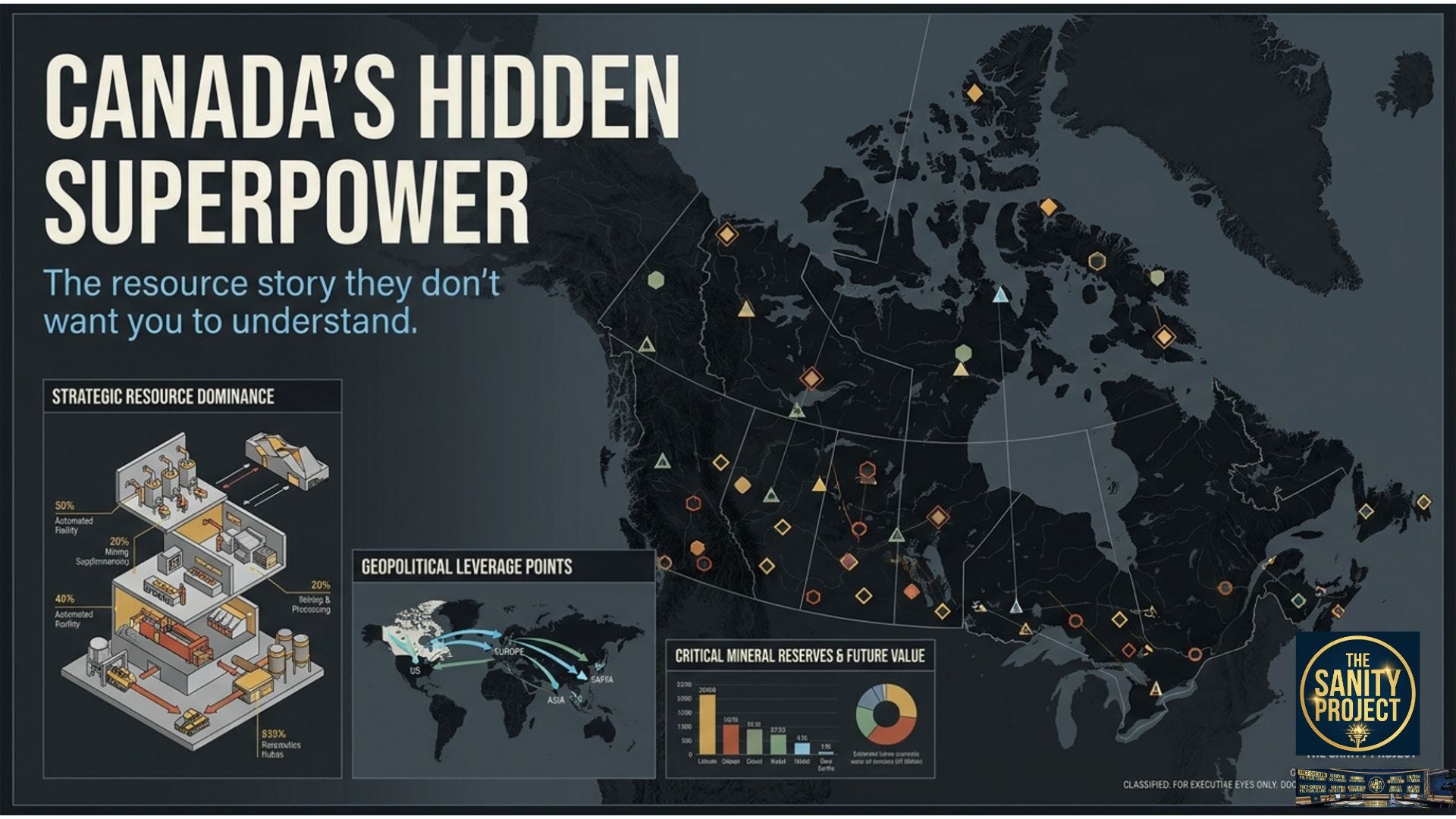
I put together a companion piece to this article. It’s called Canada’s Hidden Superpower: The Critical Minerals Intelligence Guide, and it’s a 15-slide visual briefing that maps every major mineral Canada holds, shows exactly where the deposits are, lays out the threat matrix (where China still has the upper hand in processing), and breaks down the ingredients list for every clean energy technology running on Canadian geology.
Think of it as the visual version of everything you’re reading right now, designed for people who want to actually understand this story rather than just skim a headline.
You get it free when you subscribe to The Sanity Project.
The World Lines Up at Canada’s Door
Now, here’s the part of the story that, frankly, should be making headlines every single day. Somehow it isn’t.
In June 2025, Canada launched the Critical Minerals Production Alliance at the G7 Leaders’ Summit in Kananaskis, Alberta. Canada didn’t join this body. Canada created it. Canada chairs it. Canada convenes it. The world’s democratic economies are sitting around a table that Canada built, discussing supply chain strategies that Canada wrote the agenda for.
Let that sink in for a moment, because the “weak Canada” story doesn’t really survive contact with that sentence.
What happened next was even more interesting.
Round 1, October 2025, Toronto. Canada announced 26 new investments, partnerships, and measures at a G7 Energy and Environment Ministers’ meeting. Bilateral agreements were signed with Australia and Sweden. The democratic world started lining up.
Round 2, March 2, 2026, PDAC Conference, Toronto. Natural Resources Minister Tim Hodgson announced 30 new partnerships and investments with 12 allied partners, unlocking $12.1 billion in critical mineral projects. The names on this list are not small players:
Panasonic Energy (Japan) -- a memorandum of understanding for lithium offtake from Frontier Lithium’s Ontario refinery
Siemens Canada -- a strategic partnership for domestic lithium conversion infrastructure
Outokumpu (Finland) -- a US$2 billion, 10-year offtake agreement
Apple (United States) -- commercial agreements for a BC mineral extraction and site restoration project
India -- a minerals collaboration MOU signed during PM Carney’s bilateral visit
European Union -- a Joint Declaration on Critical Minerals Collaboration
Companies from Germany, Italy, Austria, Denmark, Belgium, Sweden, and Finland -- across multiple project partnerships
Combined with the October 2025 round, the Critical Minerals Production Alliance is now mobilizing $18.5 billion in Canadian critical minerals projects.
Panasonic. Apple. Siemens. The EU. India. Japan.
None of these actors signed these deals out of charity or goodwill toward Canada. This is strategic desperation meeting geological reality. Every one of them looked at their critical mineral supply chains, saw 60 to 80 percent exposure to China, and made the same calculation: Canada is the answer.
When Apple signs a resource partnership with you, you are not a weakling. You are a supplier.
Looking to grow your YouTube channel?
One of my favourite tools is vidIQ. It helps take the mystery out of YouTube growth by providing keyword research, channel audits, AI-powered content ideas, and competitor insights.

The Numbers That Should Change the Entire Conversation
Let’s talk scale, because the political conversation in Canada is almost never calibrated to what’s actually at stake.
$117.1 billion in planned or proposed Canadian mining projects from 2024 to 2034. Nearly half specifically target critical minerals.
$64.3 billion in total mineral production in 2024 alone.
$40 billion contribution to Canada’s GDP from the critical minerals sector in 2023, and remember, most of the Strategy’s investments haven’t matured yet.
109,000 jobs are currently supported by the sector, with significant expansion coming as projects move from exploration to production.
GDP attributable to critical mineral production grew 63% nominally between 2019 and 2023.
For context, the fossil fuel narrative that right-wing commentators keep invoking as Canada’s economic salvation represents an extraction-based model competing against structurally falling clean energy costs. It is a story of declining demand. Critical minerals are a story of demand that can only go up, driven simultaneously by climate policy, the electrification of transport, and military and defence technology that cannot function without them.
Nearly 140 mining projects are planned or proposed in Canada between 2024 and 2034. That’s not a boom. That’s a generational industrial transformation.
Why the “Weak Canada” Story Fails the Facts Test
Let’s be direct about something, because it matters.
The narrative that Canada is economically fragile, resource-cursed without the will to exploit its resources, and fundamentally dependent on American goodwill to survive serves a political purpose. It’s designed to suppress Canadian confidence in our own sovereign economic capacity. It makes people feel we have no choice but to accept whatever terms we’re offered in any negotiation, with anyone.
The evidence, not the rhetoric, the actual evidence, fails this narrative on five separate grounds.
Resource power has shifted. The 21st-century resource economy is defined by critical minerals, not petroleum. Canada ranks among the top 5 globally for the most-in-demand clean energy minerals. This is new leverage, not inherited weakness.
Canada is the convener, not the supplicant. Twelve allied nations are investing in Canadian projects. Canada didn’t go looking for partners. Partners came looking for Canada. There’s a difference.
The alternative to Canada is China. Every nation diversifying away from Chinese supply chains is choosing between China and a small number of democratic alternatives. Canada’s Rule of Law, ESG standards, governance framework, and Indigenous partnership models make it the premium supplier in this market. The “weak Canada” framing conveniently ignores the fact that Canada’s only serious competition is an authoritarian state that has already demonstrated it will weaponize its mineral dominance.
The investment numbers are contracted. $18.5 billion mobilized through the Alliance. $117.1 billion in projected domestic mining investment. These aren’t government projections or wishful thinking. They are signed capital commitments from Panasonic, Apple, Siemens, Outokumpu, and sovereign export credit agencies across Europe and Asia. Real money. Real signatures.
Canada is reducing dependency, not increasing it. Net import reliance for 38% of critical minerals was cut between 2020 and 2024. The trajectory is toward supply sovereignty. That is the opposite of the story being sold.
What You Used Before You Finished Your Morning Coffee
Here’s where this gets personal.
This morning, before you finished your first cup of coffee, you almost certainly used somewhere between 9 and 15 critical minerals. Your phone alarm ran on lithium, cobalt, and rare earth elements. Your coffee maker operates on copper wiring. If you drove to work in an EV or charged one overnight, you used lithium, nickel, graphite, cobalt, and manganese. Solar panels on your roof? Silicon, silver, and copper.
Critical minerals aren’t abstract geopolitical commodities. They’re the physical foundation of modern daily life. And Canada holds an extraordinary share of the raw material that modern life runs on.
The World Bank has estimated that mineral production for clean energy technologies could increase by nearly 500% by 2050. Five hundred percent. Canada doesn’t just have a seat at that table. Canada’s geology is the table.
Listen to the Sanity Project Podcast

The Kicker
Here’s what I keep coming back to.
At the exact moment that certain voices were telling Canadians they were powerless, that Canada was a second-tier economy that should be humble and careful not to upset anyone, Canada was busy:
Launching and chairing a new global body at the G7
Closing a $2 billion deal with a Finnish steel company
Signing a minerals agreement with India
Getting Apple to put its name on a Canadian resource partnership
Announcing $12.1 billion in new deals at a single Toronto press conference
None of this was an accident. It happened because Canada’s geological reality collided with a global supply chain crisis, and Canada, for once, actually had a strategy ready when the moment arrived.
The question isn’t whether Canada holds the cards. The question is whether Canadians understand the hand they’re holding.
Because a Canada that understands its leverage is a Canada that doesn’t accept a subordinate position in any trading relationship, with anyone.
That’s not nationalism. That’s arithmetic.
If you found this useful, share it with someone who still thinks Canada has nothing to offer at the negotiating table. The receipts are above.
And if you want the full visual breakdown, the mineral map, the China threat matrix, the clean energy ingredient list, subscribe below, and I’ll send you Canada’s Hidden Superpower: The Critical Minerals Intelligence Guide as my welcome gift.
Sources:
Do you know who wanted to keep Canada weak, who made us feel weak? AMERICA. From the moment we were born, it was always about American power, American exceptionalism, American heroism, someone referred to Canada once as ‘America’s poor cousin’. AMERICA needs Canada to appear weak because we are too close for comfort for one thing, they only dominate and start wars with countries in far away lands NOT on their own shores. It is all a farce, a pretend show of world dominance. I am just going to say this now and I can tell you truthfully I, as a fellow Canadian will never trust America again. Carney told us in one if his early speeches that America was never really a genuine friend to Canada for a very long time, but particularly after WWII. It was a false frienship in order to control us. The U.S. needs Canada now because it is running out of water, its oil reserves will only last another 10-15 years. Most of the northern states across the U.S. needs our electricity. The U.S. wants our Arctic shores for our minerals, our natural power respources, our water and Greenland would complete the picture. I still see American hero worshipping in this country and FEAR OF America. NO MORE. Canada is BETTER than that. I no longer grieve a false relationship and I no longer trust America. Stop grieving something that never was. 🇨🇦🇨🇦🇨🇦 I think we need to worry about CANADA now, CANADA FIRST.