

The Canadian AI Strategy Has a Sovereignty Problem.
Manitoba drew the line. Ottawa named the standard. Now someone has to hold it.

The Canadian AI Strategy Has a Sovereignty Problem. Here’s the Test it has to pass.
Canada announced a bold national AI strategy on June 4, 2026. Manitoba rejected a massive data centre on the same day. Together, they define a question the country still hasn’t answered: what does sovereignty actually mean, and who’s going to hold the line when the money gets serious?
Bo Kauffmann|The Sanity Project|June 2026
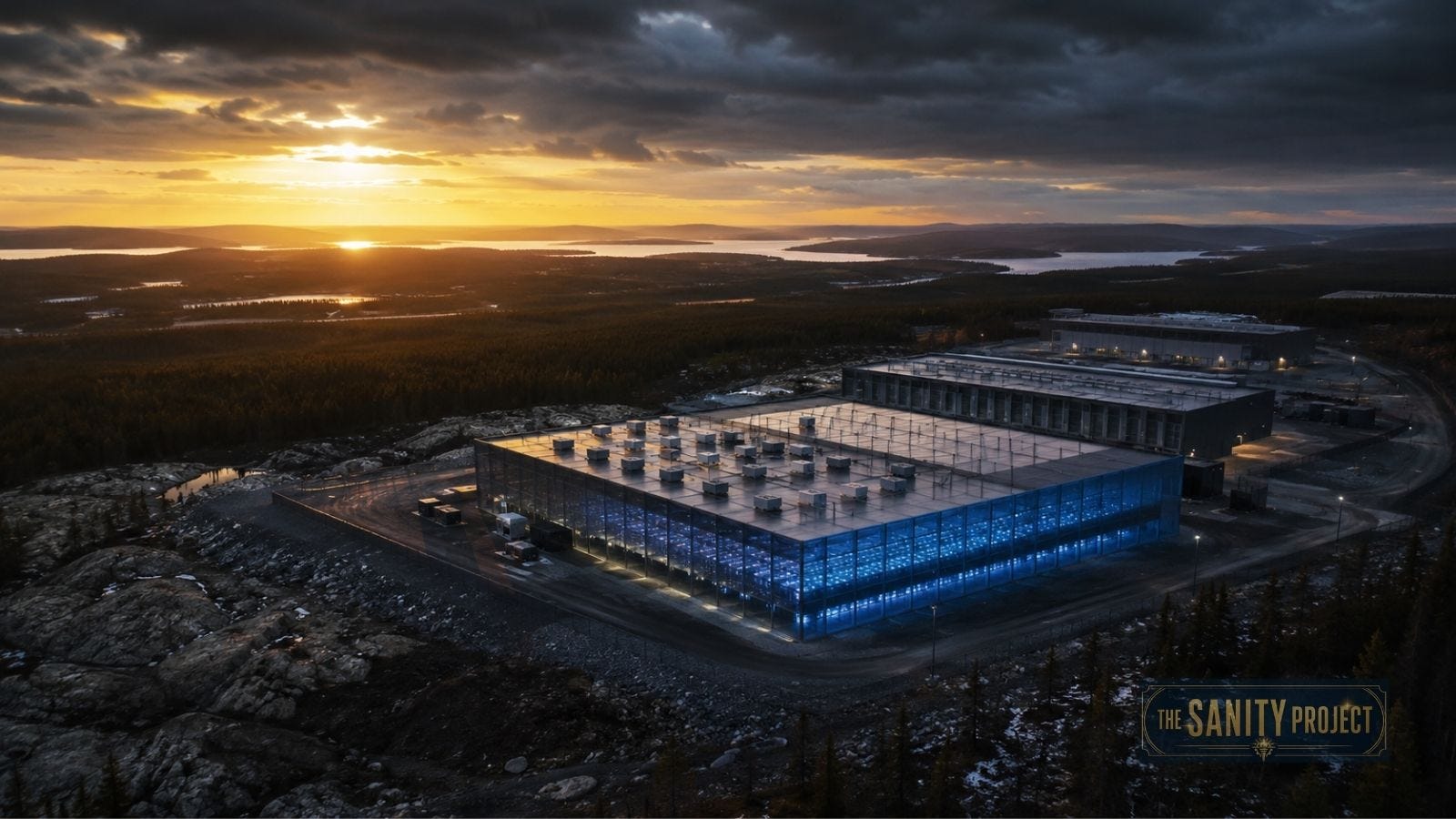
On June 4, 2026, two decisions were made in Canada that most Canadians noticed separately, connected by almost no one, and that together define the entire shape of what this country is actually deciding about its future.
Manitoba Premier Wab Kinew rejected a massive hyperscale AI data centre near Île-des-Chênes. Hours later, Ottawa released AI for All — Canada’s new national AI strategy, a six-pillar federal framework built around one organizing principle: sovereignty is not an obstacle to AI development. It is the foundation of it.
One provincial government drew a line. The federal government named a standard. What’s left is the harder question: does Canada actually have the will to hold both?
The Canadian AI strategy is the right document. The federal investment is serious money. Strategy is an input, not an outcome, though. And the gap between what Canada says about AI sovereignty and what Canada’s data infrastructure actually delivers is wide enough to drive a server farm through.
The Sanity Project Newsletter
If you’re tired of narratives that fall apart under basic scrutiny, this is the newsletter for you. No ads. No corporate sponsors. Just the uncomfortable version of the story.
Two Decisions, One Day, Zero Coverage Connecting Them
Key Insight
Manitoba’s data centre rejection and Ottawa’s AI strategy weren’t contradictions. They were a definition. Canada is saying it wants sovereign AI infrastructure. Manitoba showed what saying no to non-sovereign infrastructure actually looks like in practice.
The Manitoba rejection wasn’t subtle. Kinew did not dress it in bureaucratic language. “There’s a big threat to the environment and not much benefit to the economy,” he said, and that was more or less that.
The project, proposed by U.S.-based Jet.AI and Consensus Core Technologies out of B.C., would have consumed hundreds of megawatts of electricity, largely from natural gas turbines, while delivering mostly temporary jobs and routing most of its economic value south of the border. The corporate structure was foreign-majority controlled.
Read it again: foreign-controlled capital. Foreign legal jurisdiction. Canadian energy. Canadian land. Minimal lasting local benefit. In the language of sovereignty, that’s not a data centre. That’s a branch office with a Manitoba mailing address.
On the same day in Ottawa, the federal government released a strategy that, without naming the Manitoba project specifically, described exactly why rejecting it was the right call. AI for All commits Canada to raising business AI adoption from 12 percent to 60 percent by 2034, building sovereign compute infrastructure that Canadians actually control, creating 250,000 AI-related jobs over five years, and deliberately reducing dependency on a single foreign jurisdiction.
That last phrase is doing a lot of work. It’s a quiet acknowledgment that Canada has a dependency problem, and that the strategy is, in part, designed to address it.

Canada Data Sovereignty: What a Postal Code Won’t Protect
Key Insight
A data centre on Canadian soil, operated by an American company, is not Canadian infrastructure in any legally meaningful sense. Under the CLOUD Act, U.S. authorities can compel American firms to hand over data they control anywhere in the world, without going through a Canadian court.
Here is where most of the Canadian data centre debate goes wrong, and it goes wrong confidently, which is the most annoying kind of wrong.
The conversation almost always focuses on physical location: which province, which city, whether the server is humming in Rimouski or Winnipeg or Richmond. Location matters. But location is not sovereignty. It never has been.
The Clarifying Lawful Overseas Use of Data Act, better known as the CLOUD Act, was passed by the U.S. Congress in 2018. It gives American law enforcement and intelligence agencies the legal authority to compel any American company to produce data it controls, regardless of where that data is physically stored. Not data in the United States. Data controlled by a U.S. company, anywhere in the world.
Legal scholar Barry Appleton has been unambiguous: this law allows U.S. authorities to compel American companies to hand over data stored anywhere in the world, regardless of national laws. Canadian privacy law doesn’t override a CLOUD Act request. Canadian courts cannot block it.
The consequences are worth sitting with. In early 2026, a Canadian citizen became the subject of a Homeland Security data request directed at Google, triggered by social media posts critical of the Trump administration. The request was processed under the authority of the CLOUD Act. The data was Canadian. The servers may have been Canadian. The legal jurisdiction was American.
This is not a hypothetical. It happened.
So: a data centre operated by Amazon Web Services, Microsoft Azure, or Google Cloud is not Canadian infrastructure in any legally meaningful sense. It is an American infrastructure located in Canada. And as of right now, over 80 percent of Canada’s cloud services run on foreign-operated platforms. Over 80 percent of Canadian data is, in a meaningful legal sense, accessible to U.S. authorities without going through a Canadian court.
Sovereignty is not a postal code. It is a legal structure. The test is not where the building is. It is the law of which country that governs the data inside it.
“A data centre on Canadian soil that can be searched by U.S. law enforcement without a Canadian court order is not Canadian infrastructure. It is a branch office.”
Canada Invented This. Then Watched the Value Leave.
Key Insight
Canada launched the world’s first national AI strategy in 2017. As of 2025, only 12 percent of Canadian businesses had adopted AI in any meaningful operational sense. The researchers stayed. The products went elsewhere. The economic value followed.
Here is the most disorienting fact about Canada’s position in global AI: it isn’t falling behind despite lacking the foundations. It’s falling behind because it has all the foundations in place and keeps letting the value drain away.
Geoffrey Hinton, the Godfather of deep learning and a 2024 Nobel Prize winner in Physics, taught at the University of Toronto for decades. Yoshua Bengio, his former student and one of the most cited AI researchers in history, leads Mila in Montreal. Canada launched the world’s first national AI strategy in 2017, years before the United States, the EU, or China had equivalent frameworks. It funds three world-class AI institutes. Mila. Vector. Amii.
And yet. Statistics Canada reported that as of Q2 2025, only 12.2 percent of Canadian businesses had adopted AI in any meaningful operational way. The OECD ranked Canada 20th among member nations in AI adoption in 2023, well behind the United States, the United Kingdom, and several countries with considerably smaller AI research footprints.
Canada is producing researchers. Someone else is building the products. And the economic value of those products is accruing elsewhere.

The talent dimension makes it self-reinforcing. A study of STEM graduates from the University of Toronto, Waterloo, and UBC found that one in four opted to work outside Canada after graduation. For software engineering graduates specifically, the exit rate was 66 percent. Canada is training two engineers and keeping one.
The signal from early 2026 was pointed. Y Combinator, the world’s most influential startup accelerator, briefly announced it would no longer invest in Canadian-incorporated companies, requiring founders to reincorporate in the United States, Singapore, or the Cayman Islands before receiving funding. They walked it back under pressure. But the signal was already out: Canada is perceived, in some corners of the global venture community, as a jurisdiction that makes it harder rather than easier to build and scale technology companies.
The structural advantages are real and durable all the same. RBC’s analysis is plain about this: Canada has the energy, the climate, the talent density, and the political stability to compete as a sovereign AI infrastructure provider. The paradox isn’t that Canada lacks the assets. It’s that Canada has consistently allowed the value of those assets to flow elsewhere, not because it was forced to, but because it never built the domestic infrastructure to capture it.
Enjoying the read?
The Sanity Project publishes investigative essays on the political and economic narratives that don’t survive basic scrutiny. Join the readers who prefer the uncomfortable version of the story.
What the Canadian Sovereign AI Compute Strategy Actually Committed
Key Insight
The federal government has committed over $4 billion to sovereign AI compute infrastructure. The TELUS deployment, 60,000 NVIDIA GPUs running on 98% clean energy and fully sold out within months of opening, is proof the demand is real. What remains to be seen is whether the sovereignty standard holds as the program scales.
The money is real. It is worth being precise about what has been committed.
The Canadian Sovereign AI Compute Strategy, announced in 2024, committed $2 billion to domestic compute infrastructure. Budget 2025 added $925.6 million for large-scale sovereign public AI infrastructure, $700 million through the AI Compute Challenge to spur private-sector participation, $1 billion for public supercomputing, $300 million for the AI Compute Access Fund, and $66 million in immediate compute access for active projects.
Taken together, this is a multi-billion-dollar federal commitment to infrastructure that Canada will own, govern, and operate.
The first major successful applicant was TELUS. The company is deploying 60,000 NVIDIA GPUs across three British Columbia facilities, powered by 98 percent clean electricity, with waste heat recapture systems capable of warming 150,000 homes. The projected economic contribution is USD $9 billion over the life of the deployment. TELUS’s first Sovereign AI Factory opened in Rimouski, Quebec, in September 2025, became Canada’s fastest supercomputer, and was fully sold out within months of opening.
Bell Canada CEO Mirko Bibic has described the vision plainly: “We can have something built and made in Canada, for Canadians, in a sovereign way.”
These companies are not building this because they were told to. They are building it because they believe there is a real market for compute that isn’t subject to a foreign court order. The Rimouski sell-out is early evidence that they are right.
AI Minister Evan Solomon has been explicit: data centres receiving federal support are subject to a real sovereignty requirement. Canadian operational control. Canadian legal governance. Not just a Canadian corporate registration on a Delaware-incorporated entity’s letterhead.
The question is whether that standard holds as the program scales, or whether commercial and political pressure gradually dilutes it into something that sounds good at a press conference and means very little by the time the lease is signed.

The Cohere Problem: Canada’s AI Champion and the Infrastructure It Uses
Key Insight
Cohere, Canada’s most celebrated AI company, has historically deployed on U.S. cloud infrastructure subject to CLOUD Act jurisdiction. That’s not a moral failing. It’s a structural fact about how hard it is to meet the sovereignty standard when the global market runs on American rails.
There is no credible version of this story that omits this part. Any analysis of Canadian AI sovereignty that skips past Cohere is not an analysis. It is a press kit.
Cohere was founded in Toronto in 2019 by Aidan Gomez, Ivan Zhang, and Nick Frosst, all of whom were trained in Geoffrey Hinton’s research group at the University of Toronto. The company builds enterprise-grade large language models. It is valued at $6.8 billion and has surpassed $100 million in annual recurring revenue. When Canadian politicians want to point to proof that Canada can compete in global AI, Cohere is the company they name.
Here is the complication. Cohere has historically deployed its products on U.S. cloud infrastructure: Amazon Web Services, Google Cloud, and Microsoft Azure. Enterprise customers using Cohere’s models to process sensitive data may be doing so on infrastructure subject to the CLOUD Act. The very problem that sovereign AI infrastructure is designed to solve is potentially present in the deployment stack of Canada’s most celebrated AI company.
Building on AWS is not a moral failure. It is a rational business decision in the current environment. The major cloud providers have network scale, geographic distribution, and reliability guarantees that no Canadian alternative currently matches. Cohere took a rational path.
In August 2025, Cohere launched a private AI platform specifically designed for sensitive enterprise data, with no reliance on external cloud providers. That is a meaningful step toward the sovereignty standard, and it signals real market demand for infrastructure that isn’t legally accessible to U.S. authorities.
But the larger structural question remains open. Can Canadian sovereign compute, TELUS’s Rimouski facility, the planned federal supercomputing centres, eventually offer the reliability, scale, and geographic redundancy that enterprise customers require? Will it become an infrastructure layer that makes the choice between performance and sovereignty a false one?
The answer is not no. It is not yet, either. Sovereignty requires more than Canadian ownership. It requires Canadian infrastructure at every layer of the stack. Canada is building toward that. It has not arrived.
Why Canada’s Structural Advantages Are Actually Real This Time
Key Insight
Canada has cheap, clean electricity, a cold climate, political stability, and a growing international demand for computing not subject to U.S. jurisdiction. The pessimistic read, that Canada is too small to compete, misses the moment entirely. The appetite for a credible alternative to American digital jurisdiction has never been higher.
The pessimistic read on all of this is that Canada is too small, too resource-dependent, and too integrated with the American economy to build and sustain independent digital infrastructure. That read is wrong. Not because the challenges aren’t real, but because it misses what Canada actually has.
Data centres are extraordinarily energy-intensive. A single large-scale AI training run can consume as much electricity as a small city. The cost and carbon intensity of that energy are among the largest variables in AI infrastructure economics, and Canada has hydroelectric and nuclear power that offer some of the lowest-cost, lowest-carbon electricity of any major economy. That is a durable competitive advantage, not a temporary one.
Cooling is the second-largest operating cost for AI data centres. Canada’s climate reduces those costs significantly in most major population centres and dramatically in its northern regions. The waste heat recapture system TELUS is deploying, warming 150,000 homes with heat that would otherwise be vented into the air, is not a publicity stunt. It is a model for how Canadian AI infrastructure integrates into community energy systems in a way that no other jurisdiction can easily replicate.
The geopolitical moment compounds this. The European Union is actively de-risking its digital infrastructure from American cloud providers, driven in part by concerns about the CLOUD Act and in part by the accelerating economic nationalism under the current U.S. administration. Middle Eastern sovereign wealth funds are investing in Canadian AI infrastructure. Qatar has entered partnership discussions on AI and clean energy. The UAE is directing investment into Canadian data facilities. These are not countries doing Canada a favour. They are countries that want compute governed by a jurisdiction that is not the United States.
Canada, with its energy, its legal stability, and its research depth, is positioned to provide exactly that. The window will not stay open indefinitely. The EU is building its own sovereign compute infrastructure. Australia and the United Kingdom are investing in domestic AI capacity. The moment when Canada can credibly position itself as the world’s preferred sovereign AI jurisdiction is now, not in five years.
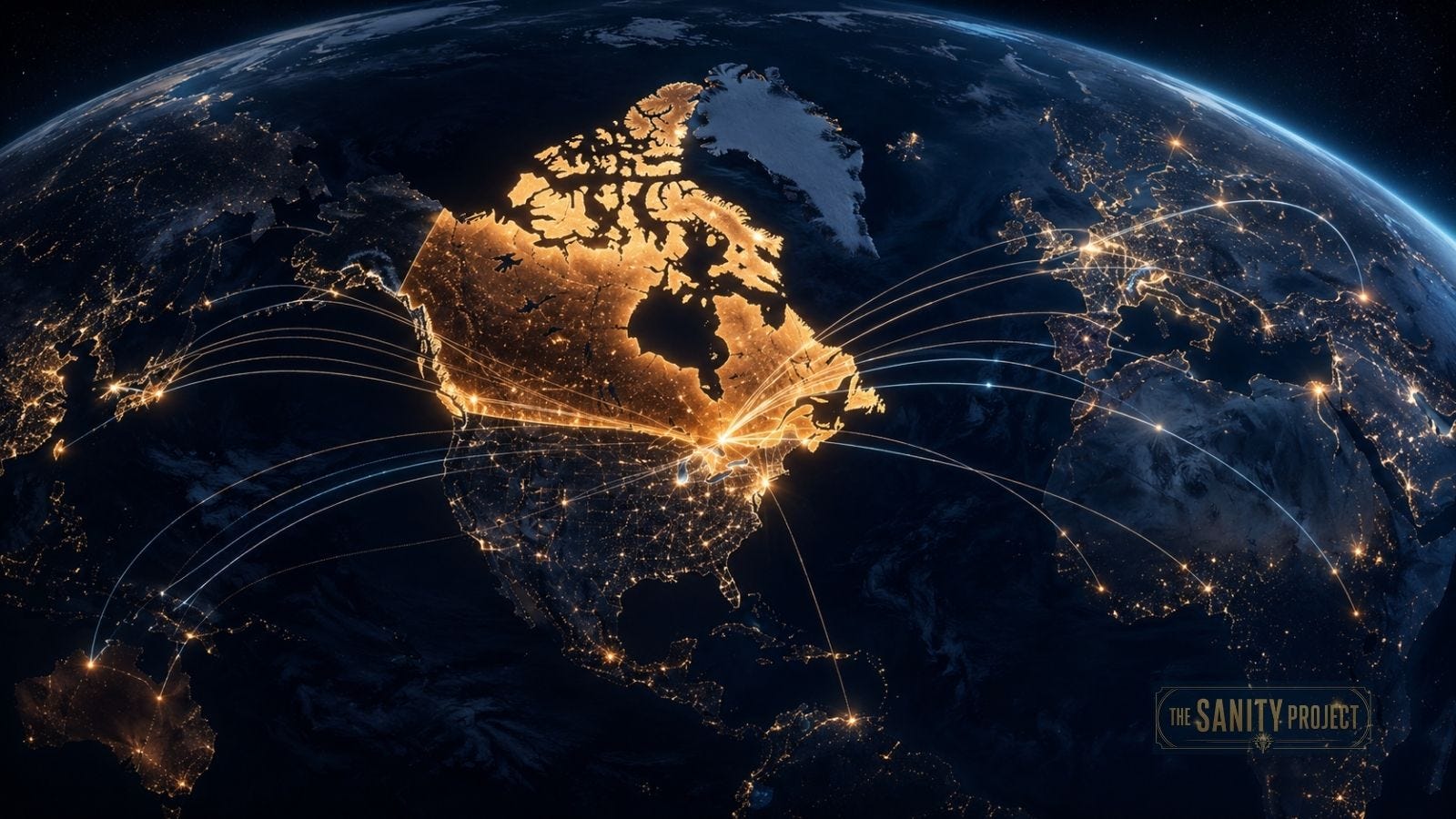
The Three Tests Canada’s AI Strategy Still Has to Pass
Key Insight
The federal investment is serious. The strategy is the right framework. What remains are three concrete tests: Is the sovereignty standard real? Does the adoption plan reach SMEs and the public sector? And can Canadian sovereign compute become genuinely competitive with U.S. cloud?
The AI for All strategy is the right document. The federal investment is serious money committed to coherent goals. Strategy and funding are inputs, not outcomes. What Ottawa must now deliver is the consistent application of the sovereignty standard it has named, not just in the projects it funds directly, but in the regulatory and procurement environment it creates for the broader economy.
There are three tests for whether Canada’s sovereign AI bet actually succeeds.
The Infrastructure Test. Are the data centres receiving federal support genuinely operated under Canadian legal governance, not just located on Canadian soil, but protected from foreign legal access? Critics at the Information Technology and Innovation Foundation already note that funding alone won’t close the adoption gap. If the sovereignty requirement gets diluted over time to accommodate larger commercial partners, the entire investment fails the test it was designed to meet.
The Adoption Test. The CD Howe Institute has been clear that Canada’s AI adoption gap is not primarily a large-enterprise problem. It is an SME problem, a public sector problem, and a skills problem. Does the 12-to-60-percent target come with a credible, funded plan for small and medium businesses, the public health system, and the federal public service? Or is it a headline number attached to a research budget that primarily benefits large enterprises that were already adopting AI? The strategy has to meet Canadians where they actually are.
The Champion Test. Will Canada produce AI companies in the next decade that deploy on sovereign infrastructure, not just incorporate in Canada while running their products on AWS? This is the hardest test, because it requires sovereign infrastructure that is genuinely competitive with the global alternatives in reliability, scale, and cost. TELUS’s Rimouski facility being fully sold out is a real demand signal. Turning that signal into a stable, scalable alternative to U.S. cloud infrastructure is the work of the next five years.
The Window Is Open. What Remains Is the Will.
Let’s be clear about what Canada is sitting on. The country invented modern AI, trained the researchers who built the field, and, as of June 2026, has a federal strategy that names sovereignty as its foundation. It has the cleanest energy, the coldest climate, and the most stable legal framework of any major AI-producing nation.
The question is no longer whether Canada can build sovereign AI infrastructure. The question is whether Canada will hold itself to what sovereignty actually means.
A data centre that can be searched by U.S. law enforcement without a Canadian court order is not Canadian infrastructure. A nationally celebrated AI company deploying its flagship products on American cloud infrastructure is not a sovereign AI champion. Not yet. A federal strategy that funds the right kind of infrastructure and then quietly dilutes the standard under commercial pressure is not a strategy. It is a press release with a budget attached.
Manitoba drew the line. Ottawa named the standard. The international demand for a credible alternative to American digital jurisdiction has never been higher. The energy is clean. The investment is committed. The technology exists.
What remains is the will to hold the standard consistently and specifically, without the kind of convenient flexibility that turns a sovereignty requirement into a sovereignty suggestion.
The window is open. The question is whether Canada will walk through it.
Before You Go
The Sanity Project is an independent, ad-free newsletter. No corporate sponsors. No editorial interference. If this kind of analysis is useful to you, the best way to support it is to keep it free.
Wow, is all I can say and thx for all that information.