


The Plain-Language Guide to Canadian Government That Should Have Existed Years Ago
You’ve probably sat through a dinner conversation where someone confidently explained why the Prime Minister “lost the election” or why a province can “just ignore federal law,” and you nodded along because correcting them felt like more effort than it was worth. You’re not alone. Canadian politics is genuinely confusing, and the news cycle doesn’t help. It’s designed to generate heat, not light.
This piece is the opposite of that. No spin, no outrage bait. Just the actual mechanics of how the Canadian government works, explained the way a patient friend would explain it over coffee.
The news cycle is designed to outrage you. This is designed to inform you.
If you’ve ever wondered why we vote for a local MP but end up with a Prime Minister nobody directly chose, or why your province controls your hospital but Ottawa controls your passport, keep reading. The answers are less complicated than the pundits make them sound.
The Foundation: What Kind of Country Is Canada, Exactly?
Canada is a federal constitutional monarchy with a parliamentary democracy. That sentence sounds like it was designed to make people stop reading, so let’s break it apart.
A constitutional monarchy means Canada has a monarch as head of state. Since September 2022, that’s King Charles III. In practice, the King doesn’t run anything. His role in Canadian governance is almost entirely ceremonial, carried out in Canada by the Governor General (currently appointed on the advice of the Prime Minister). The Governor General swears in governments, reads the Speech from the Throne, and signs bills into law. Think of the role as a constitutional referee who only blows the whistle in a genuine crisis.
Parliamentary democracy means Canadians elect representatives to a legislature, and the government is drawn from that legislature. You don’t vote for a Prime Minister the way Americans vote for a President. You vote for your local Member of Parliament, and the PM is whoever can command the confidence of the House.
Federal means powers are split between the national government in Ottawa and ten provincial governments (plus three territorial governments with somewhat different arrangements). More on that split in a moment.
How the House of Commons Actually Works
Canada is divided into 343 electoral districts called ridings. Each riding elects one Member of Parliament in a general election. The system used is first-past-the-post: whoever gets the most votes in a riding wins the seat, even if that’s only 34% of the vote, with the remaining votes split among three other candidates. It’s a system with real critics, and debates about electoral reform have surfaced and stalled repeatedly over the decades.
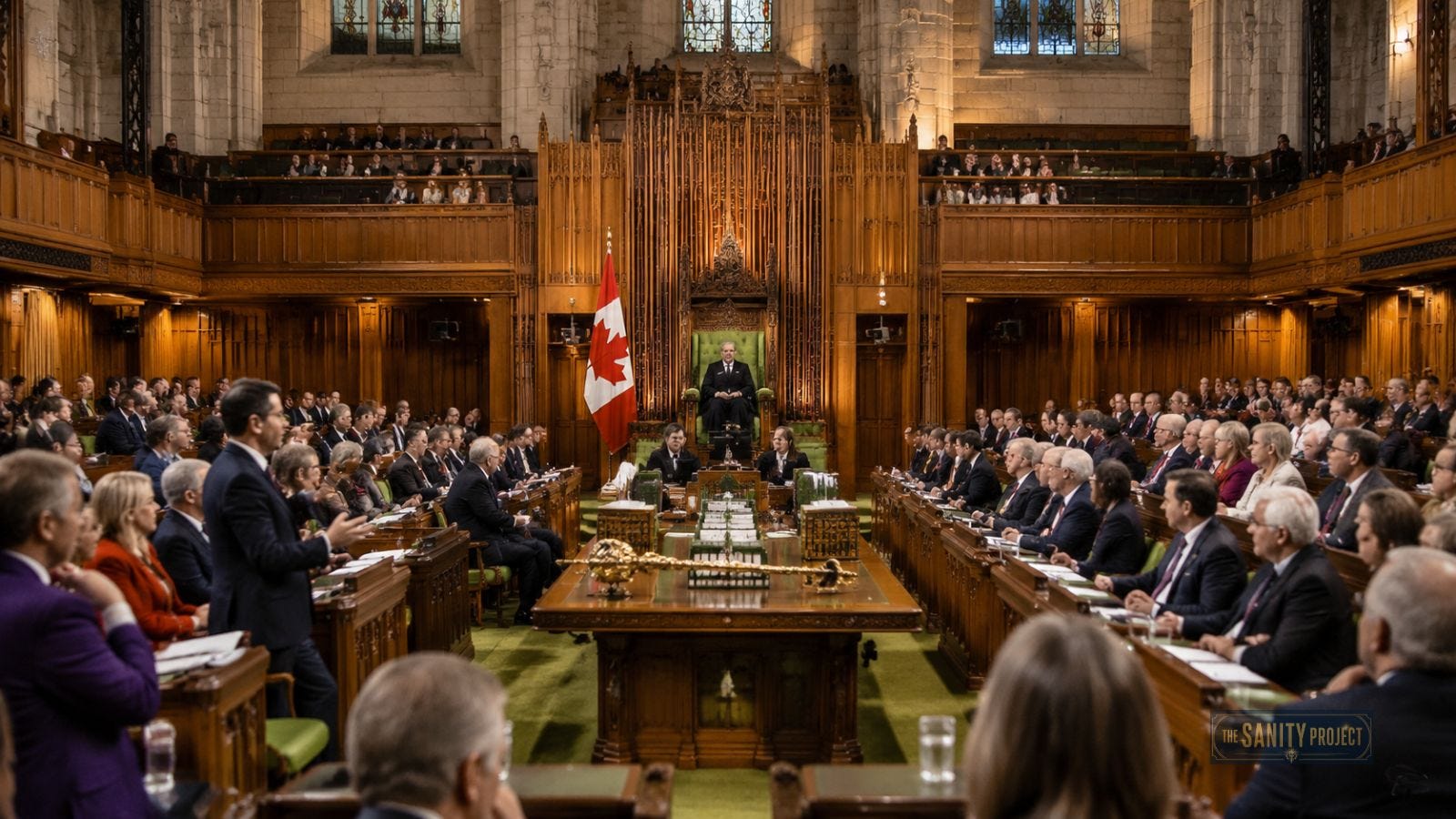
Those 343 MPs sit in the House of Commons in Ottawa. The House is where federal laws are debated, passed, and rejected. It’s the center of gravity in Canadian federal politics.
How Does Someone Become Prime Minister?
Here’s the part that trips people up most often. The Prime Minister is not directly elected by Canadians as a whole. The leader of the party that wins enough seats to command the confidence of the House becomes Prime Minister.
In practical terms, if one party wins 172 or more seats (a majority of 343), its leader becomes PM and can govern with considerable authority. If no party wins a majority, the party with the most seats typically gets the first opportunity to form government and must win the House's confidence to remain in office.
The Governor General plays a role here. Technically, the GG invites someone to form a government. In practice, this is almost always automatic. The constitutional referee rarely needs to blow the whistle.
Majority vs. Minority: Why It Matters
A majority government holds more than half the seats. It can pass legislation without negotiating with other parties. It’s stable, sometimes frustratingly so if you’re in opposition.
A minority government holds the most seats but not a majority. It needs support from at least some opposition MPs to pass legislation and, critically, to survive confidence votes. Minority governments are more volatile. They tend to produce more negotiation, more compromise, and more elections.
Canada has had quite a few minority governments in recent decades. They’re not a sign of dysfunction; they’re a feature of the system when voters don’t hand one party a clear mandate.
The Senate: The Appointed Chamber
Canada has a Senate with 105 seats. Senators are appointed by the Governor General on the advice of the Prime Minister, and they serve until age 75. Nobody elects them.
The Senate’s job is to provide “sober second thought” on legislation. It reviews bills passed by the House, can propose amendments, and technically can block legislation entirely, though it rarely does and faces significant political pressure when it tries. Senate reform has been a recurring topic of political debate in Canada for decades, with little structural change to show for it.
The Senate is not a rubber stamp, but it’s also not where Canadian politics is decided. Think of it as a quality-control layer with a complicated history.
How a Bill Becomes Law
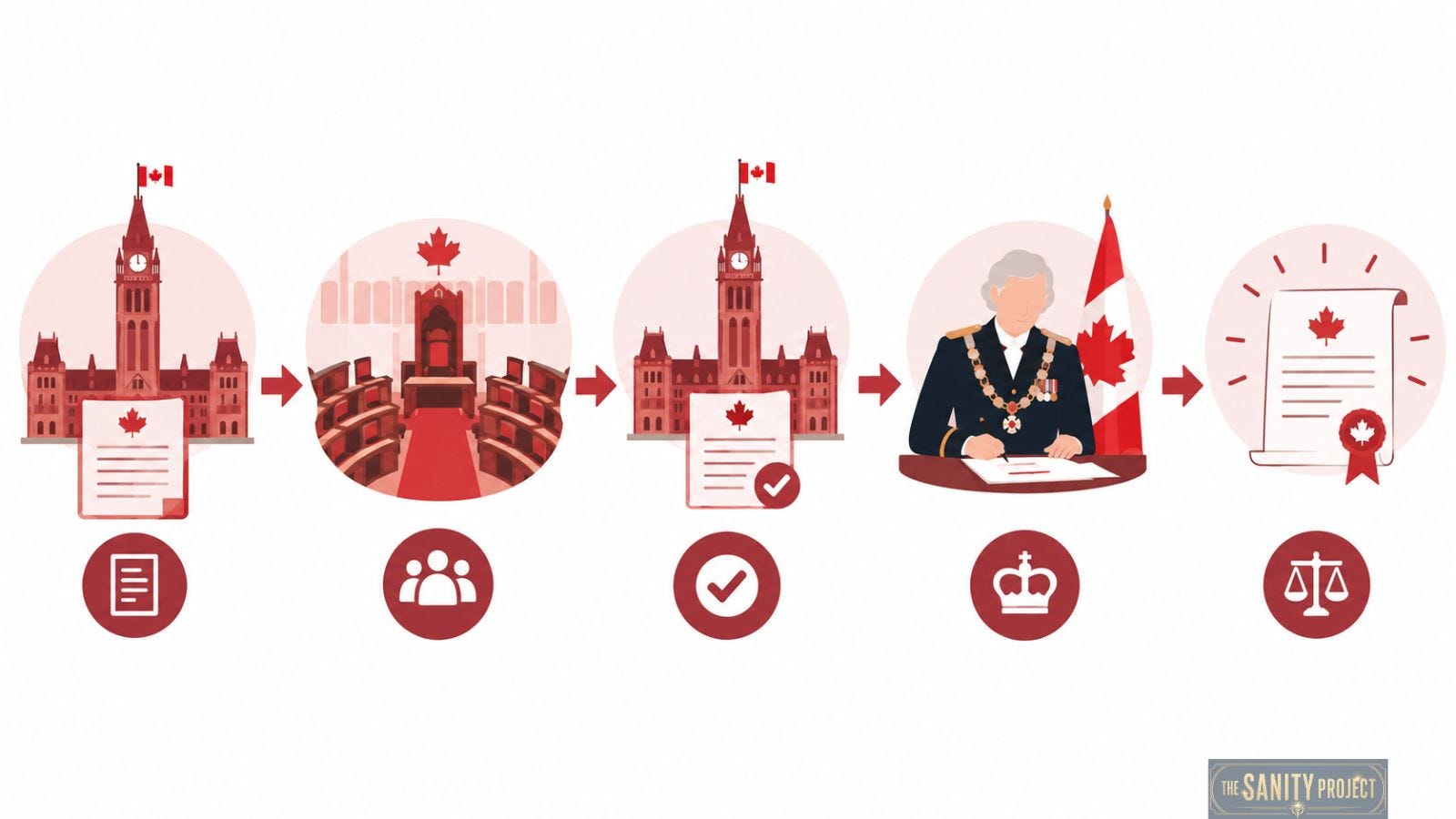
A bill can be introduced in either the House of Commons or the Senate, though most significant government legislation starts in the House. It goes through three readings in the House (introduction, debate and amendment, final vote), then the same process in the Senate. If both chambers pass it, the Governor General grants Royal Assent, and it becomes law.
The whole process can take days for non-controversial legislation or years for contentious bills. Bills that don’t pass an election before are called dead on the order paper and must be reintroduced in the next Parliament. This matters for understanding why some policy changes move so slowly.
How Can a Prime Minister Be Removed?
Two ways, neither of which involves a recall vote.
The first is a confidence vote. If the House passes a motion of non-confidence, or defeats a budget or the Speech from the Throne, the government has lost the confidence of Parliament. The PM must either resign (thereby triggering the formation of a new government) or ask the Governor General to dissolve Parliament and call an election.
The second is the party itself. A PM who loses the support of their own caucus or party membership can be replaced as party leader, which effectively removes them as PM. This is what happened to Justin Trudeau in early 2025, when caucus pressure and polling realities made his position untenable. His successor, Mark Carney, became PM without a general election because the position flows from party leadership and parliamentary confidence, not from a direct public vote.
Federal vs. Provincial: Who Controls What?
This is where a lot of everyday confusion lives. The Canadian Constitution (primarily the Constitution Act, 1867) divides powers between Ottawa and the provinces.
Provinces control: health care, education, natural resources within their borders, property and civil rights, and municipal institutions.
Ottawa controls: national defense, criminal law, trade and commerce between provinces and internationally, immigration (shared with provinces), banking, and telecommunications.
This is why your province decides how your hospital is run, but the federal government negotiates trade deals. It’s also why interprovincial trade is more complicated than it sounds. A brewery in Manitoba faces different rules for selling beer into Saskatchewan than for selling into the United States. That particular absurdity is getting more attention lately, and it’s worth a dedicated look. That piece is coming.
When jurisdictions overlap or conflict, the courts sort it out. The Supreme Court of Canada has the final word.
What This Means for Reading the News
Once you understand these mechanics, much of the political coverage makes more sense, and much of it looks flimsier than it did before. When a pundit says the PM “has a mandate” after a minority win, you know to ask: a mandate to do what, with whose support? When a province threatens to “ignore” federal legislation, you know the Constitution has something to say about that. When someone says Canada needs to “elect” its senators, you understand that’s a constitutional amendment requiring substantial provincial agreement.
Canadian politics explained simply isn’t about dumbing it down. It’s about removing the fog that makes people feel like this stuff is beyond them. It isn’t.
Editor’s View
I spent twenty years selling houses in Winnipeg. In that job, you learn fast that most people aren’t confused because they’re not smart. They’re confused because nobody ever explained the basics clearly. Canadian politics works the same way. The system isn’t that complicated. Its coverage is often like that. That’s what The Sanity Project is here to fix, one article at a time.
Bo Kauffmann, Editor
Thanks Bo, sending this to my kids.
That was very well laid out and simple to understand! Good job!