


Canadian Thanksgiving History: Frobisher’s 1578 Voyage to Today’s Tables
A dangerous trip through the Arctic, a group of thankful survivors, and the long path that led to our October celebration.
When the ship Dennis hit the ice, the expedition faced a much bigger problem than searching for gold. The crew had to escape a sinking ship in the Arctic, far from home.
Other ships sent out boats, and the men got away, but some of the timber meant for a winter shelter sank with their ship. In the summer of 1578, Martin Frobisher’s big plans met a land that did not care about them.
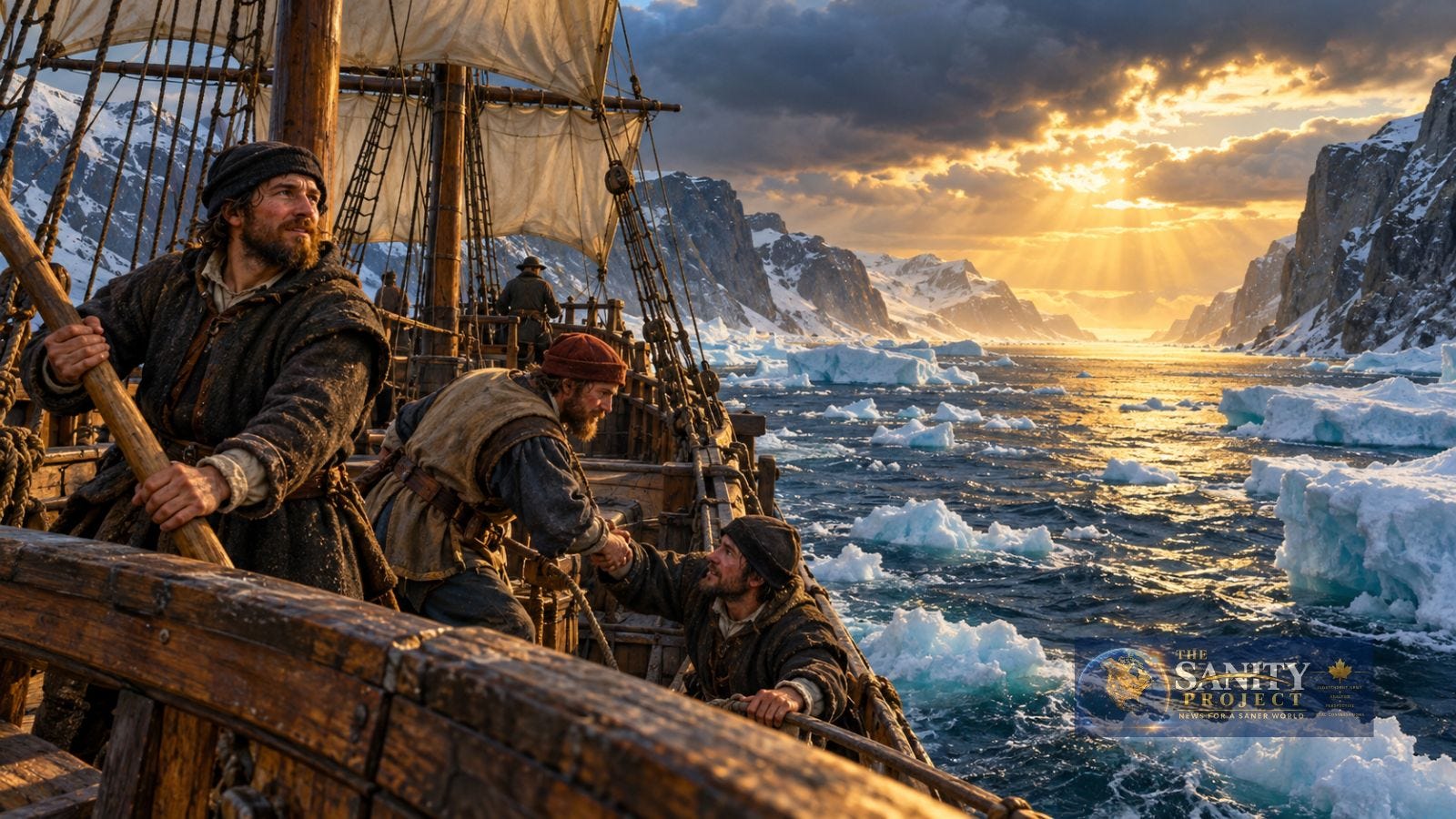
Storms separated the ships. Ice blocked their path, and sailors tried to protect the wooden hulls with anything they could find. According to Edwin M. Bacon’s account of the voyage, men hung cables, bedding, and planks over the sides of the ship and pushed ice away with poles and oars.
We can imagine the scene: men standing at the rail, using whatever they had to protect the ship from the ice, unsure if the other ships would make it to safety. It was a tough way to make a living.
Before we think about turkey and pumpkin pie, the history of Canadian Thanksgiving starts in a much colder place. One of the earliest stories is about people who were simply thankful to be alive.
Frobisher Was Chasing a Fortune
Frobisher had already travelled to the area twice. At first, he wanted to find a northern sea route to Asia, known as the Northwest Passage, but a piece of dark rock he brought back to England changed his plans.
Some people thought the rock contained gold. According to Royal Museums Greenwich, this hope helped fund more trips. By 1578, the expedition had grown to fifteen ships, and they planned to mine ore and leave a group there for the winter.
Investors hoped to get rich. The men who carried timber, worked on the ships, and dug for ore had the hard job of making those dreams possible. The Arctic quickly made things more difficult.
Losing building materials was a big problem, as were missing supplies and the short time before winter. In the end, the expedition gave up on leaving a colony, but the crews kept loading the ships with the rock they had travelled so far to get.
And what about the gold? The ore turned out to be worthless. The ships returned with a huge amount of rock, but it did not bring the riches the investors had hoped for.
Sometimes, history has its own sense of irony. Sadly, the men still had to do all the hard work before finding that out.

A Minister and a Reason to Give Thanks
One of the people on the expedition was Robert Wolfall, an English minister. According to an early account quoted in Frank Jones’s nineteenth-century biography of Frobisher, he left behind a settled life, a wife, and children to join the voyage.
Wolfall preached and held communion services during the journey. He carried out his religious duties in conditions very different from his comfortable parish back home.
Different accounts and later histories disagree about exactly when and where the services took place. Historian Donald D. Hogarth’s study of Wolfall’s thanksgiving gatherings found that there was more than one in 1578. We should not try to fit them all into one neat dinner scene.

The real meaning of the story is why they gave thanks: they were saved from danger and relieved to reach a safe harbour. Their dreams of wealth were still uncertain, but they could be grateful to have survived.
People often call this the first Canadian Thanksgiving, which took place in what is now Nunavut. According to Canada’s History, it happened 43 years before the well-known Plymouth harvest feast of 1621.
That comparison is a great fact to share at dinner, but the whole story deserves to be remembered, too.
Indigenous peoples had their own thanksgiving traditions long before Europeans arrived. Frobisher’s expedition was not the first European example either; the U.S. National Park Service notes a Thanksgiving Mass and meal in what is now Florida in 1565.
Frobisher’s records also show that he took Inuit captives to England on earlier trips. Bristol Museums documents a man, a woman, and a young child who were brought there in 1577. The survival story does not excuse everything the expedition did.
We can remember this remarkable history and tell it truthfully. Frobisher did not invent gratitude, and his expedition did not start an annual holiday that lasts to this day.
The Shipwreck Was Only the Beginning. Save Your Seat for the Rest.
How do we get from sailors battling Arctic ice to families arguing over the last slice of pumpkin pie?
The next chapter takes us to a winter settlement where supper became an event, neighbours helped newcomers survive, and an Order of Good Cheer gave people something to look forward to.
Discover how Thanksgiving found its home in October, and bring a story to this year’s table that goes well beyond “Canada did it earlier.”
Subscribe for free to keep reading. The best stories deserve company, and there’s a chair here for you.