


Data Center Cooling Systems Are Quietly Outdrinking Toronto
Every AI data center brags about its renewable energy percentage. None of them mention how much water it took to keep the lights on.
Key Takeaways
Global data centers already consume more water annually than Toronto’s entire water system delivers to every tap, hospital, and business in the city, combined, and that gap is set to triple by 2030.
The three main cooling methods each trade one resource for another. The cheapest option on the water bill is rarely the cheapest option on the electricity bill.
Cooling itself can account for anywhere from 7 percent to 40 percent of a data center’s total power bill, which is exactly why water-hungry cooling remains so common: it’s the cheap way to keep that number low.
Global data centers used 415 terawatt-hours of electricity in 2024, enough to power every household in Canada twice over, much of it spent fighting heat rather than computing anything at all.
The City of Toronto delivers just over a billion liters of treated water a day. Every tap, every hospital, every restaurant kitchen, car wash, and fire hydrant in Canada’s largest city runs off that same billion-liter daily allowance. Add it up over a year, and you get roughly 365 billion liters: the entire water footprint of 2.9 million people.
Global data centers already drink more than that. In 2023 alone, they consumed 560 billion liters of water, more than the entire Toronto water system delivers to all residents, hospitals, and businesses combined in a year. And that number is projected to more than double by 2030.
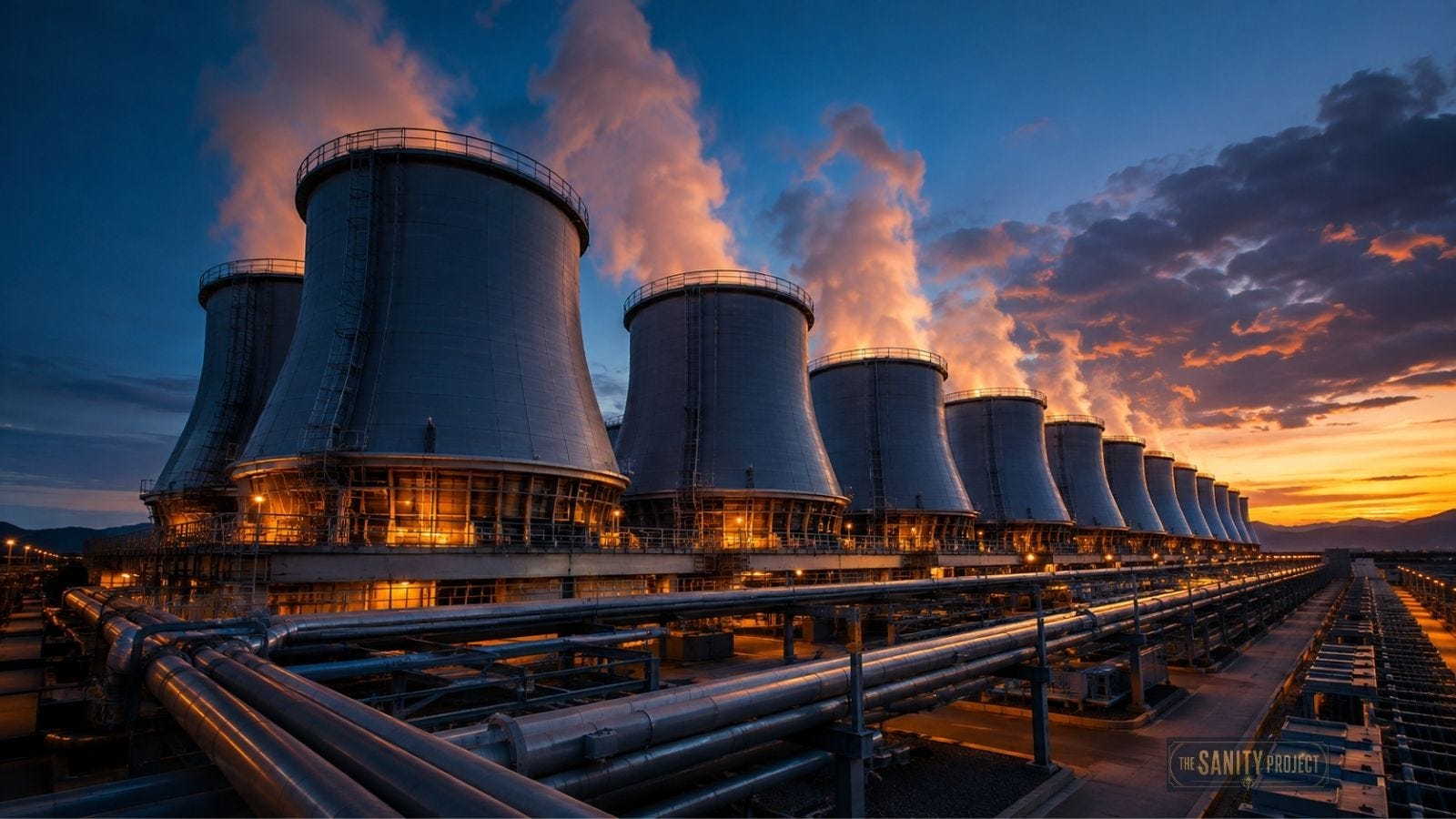
Somewhere in Inner Mongolia, in Loudoun County, and increasingly in a stretch of Alberta or Quebec, there’s a warehouse-sized building running an argument it cannot afford to lose. Push the temperature too high for too long, and racks worth more than most people’s houses cook themselves into landfill. So the building doesn’t lose. It just spends whatever it takes, and increasingly, that's water.
Here’s what almost nobody explains clearly: data centers don’t drink water because someone forgot to build a better fan. They drink water because water is the cheapest, most electricity-efficient way to move an enormous amount of heat, and the industry has spent thirty years optimizing for the electricity number, not the water one.
So let’s actually do the math on data center cooling systems, water first, because the industry’s favorite number, the renewable energy percentage, only tells you where the electricity comes from. It says nothing about what came out of the tap to keep the lights on.
Enjoying this? Subscribe to The Sanity Project for fact-checked breakdowns of the stories everyone else skims past.
Why AI Heat Broke the Old Rules
A modern AI training rack can now draw more than 100 kilowatts, with next-generation designs pushing past 250. The office-building fans that used to cool data centers stopped being a serious option years ago.
For thirty years, data center cooling meant CRAC units: big metal boxes blowing cold air through a raised floor, not much more sophisticated than a very serious air conditioner. That worked fine when a server rack pulled 5 to 10 kilowatts. It stopped working somewhere around the point Nvidia’s newest chip generations started shipping.
A single modern AI rack can now draw 100 to 140 kilowatts, and the next generation of hardware, the kind already being deployed by China Telecom and every major cloud provider, is targeting 250 kilowatts and beyond. At that density, a fully loaded rack throws off heat comparable to roughly 30 residential furnaces running flat out, all within the footprint of a walk-in closet.
Air simply cannot move heat fast enough at that scale. It isn’t an engineering failure; it’s physics: water conducts heat roughly twenty-five times better than air at rest, and the gap widens further once both are actually circulating. That single fact is why the entire industry, not just China, has spent the last three years racing toward liquid cooling, cold plates, and full immersion. It isn’t a sustainability initiative. It’s the only way to keep the chips from melting.
Why Water Is the Cheap Way to Solve an Electricity Problem
Cooling can account for as little as 7 percent of a data center’s total power bill, or as much as 40 percent. Water-hungry cooling exists specifically to keep that number closer to 7.
Data centers measure their overhead with a metric called PUE, power usage effectiveness: total facility power divided by the power actually reaching the servers. The industry-wide average, according to the Uptime Institute’s latest global survey, is roughly 1.54. Google’s fleet, by contrast, runs at 1.09. That gap is almost entirely a cooling story, and it’s the real reason water shows up in this conversation at all.
The International Energy Agency puts cooling’s share of electricity at roughly 7 percent for an efficient hyperscale facility, climbing past 30 percent for a less-efficient one. McKinsey’s estimate, cited in Eaton’s own research, lands closer to 40 percent industry-wide. Evaporating water is a cheap, electricity-light way to remove heat. That’s precisely why so many facilities still choose it, and precisely why the water bill quietly grows while the electricity bill stays flat.
Cooling a data center can eat as little as 7 percent of its power bill, or as much as 40. The difference is a choice, not a law of physics.
Worth sharing? Pass this along to someone who still thinks “renewable” means “resource-neutral.”
Three Ways to Cool a Server, and What Each One Actually Costs You
The cheapest option on the electricity bill is often the most expensive one on the water bill. There is no cooling method that’s simply free.
Strip away the marketing, and there are really only three families of cooling technology, each of which trades one resource for another.
Evaporative cooling towers are the oldest and still the most common. Water circulates through the system, and a portion of it evaporates, carrying heat away as vapor. It’s cheap and energy-efficient, which is exactly why so many facilities still use it. But according to the MOST Policy Initiative, up to 85 percent of the water an evaporative system withdraws never comes back. It doesn’t leak. It leaves as vapor and won’t refill the reservoir or aquifer it came from.
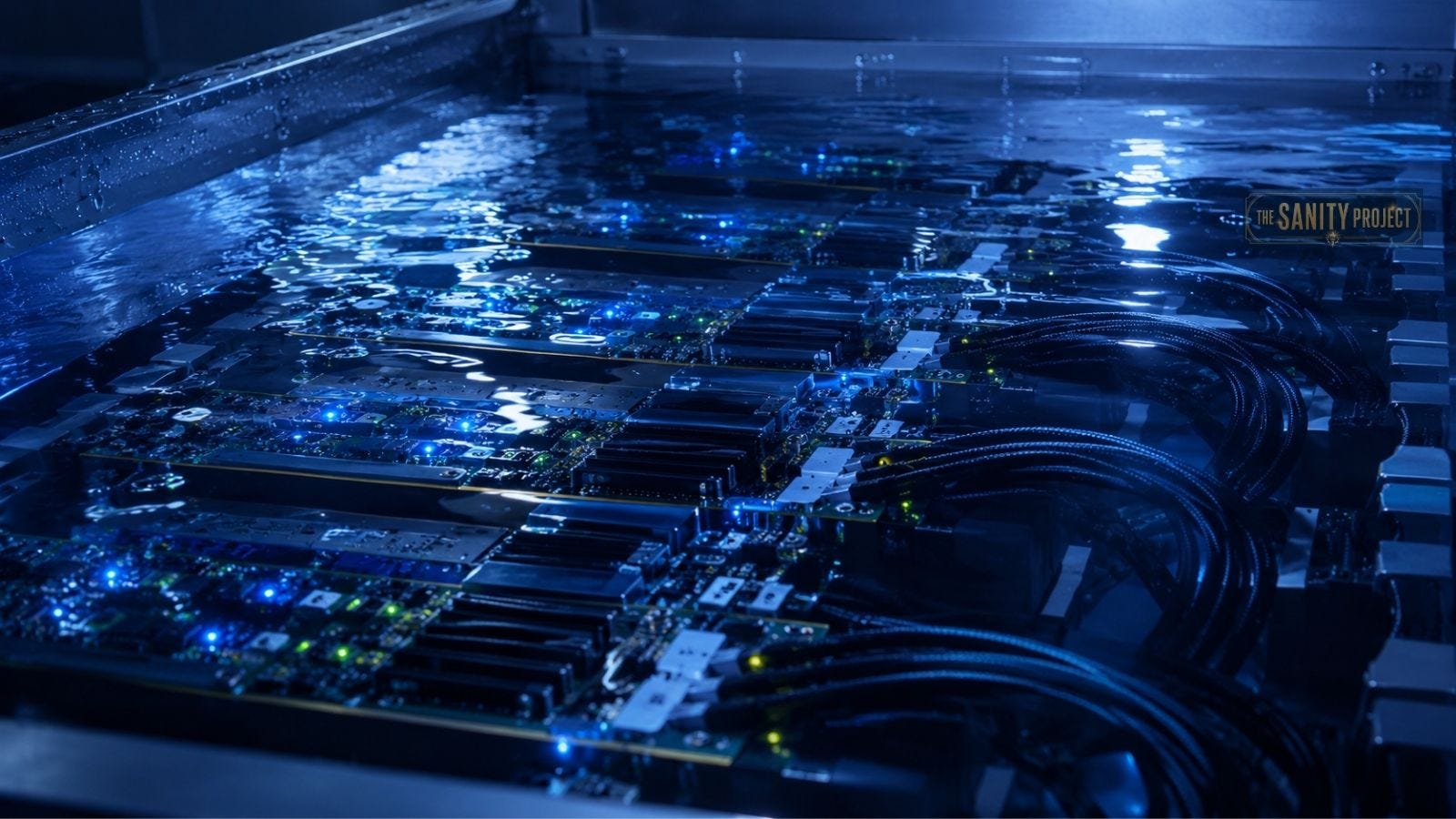
Closed-loop and immersion cooling recirculate the same fluid continuously instead of evaporating it. Water losses drop to almost nothing, just occasional leaks and maintenance refreshes. Industry estimates suggest freshwater draw falls by 70 percent or more compared to open evaporative systems, and some closed-loop deployments claim reductions closer to 95 percent. The tradeoff here isn’t water; it’s capital and complexity: these systems cost considerably more to build and retrofit.
Once-through systems, including seawater cooling, pull huge volumes of water, pass it through the facility, and discharge it back out, usually warmer. The withdrawal numbers look enormous on paper, but very little of that water is actually consumed; most of it returns to its source. The real cost here isn’t scarcity; it’s thermal pollution—warmer discharge water that changes conditions for whatever lives near the outflow.
There’s no cooling method that’s free. There’s only a choice about which bill you’d rather pay and in what currency.
Up to 85 percent of the water an evaporative cooling tower withdraws never comes back. It doesn’t leak. It leaves.
The Renewable Energy Headline Has Nothing to Say About Water
By 2030, global data centers are projected to consume more than three times the amount of water that Toronto uses per year. The 80 percent renewable energy pledge behind the headlines says nothing about any of it.
China’s commitment to source 80 percent of new data center electricity from renewables by 2030 is real. It’s a binding target under the country’s 2025 action plan for green data centers, backed by the 15th Five-Year Plan, which targets 6 trillion kilowatt-hours of annual renewable generation. That isn’t a greenwashing press release, and it would be dishonest to pretend otherwise.
But a clean electricity supply and a resource-neutral cooling system are two completely different engineering problems, and only one of them shows up in the renewable percentage. Nowhere in that 80 percent figure is there any accounting for water, in China or anywhere else.
Remember the 560 billion liters data centers drank globally in 2023, a figure that already beat Toronto’s entire annual water delivery. The International Energy Agency projects that the number will more than double, to 1,200 billion liters, by 2030. That’s not a gradual creep. That’s more than three Torontos’ worth of water a year, on a six-year clock, running in parallel with, not accounted for by, every renewable electricity pledge currently making headlines.
By 2030, global data centers are projected to drink through more than three Torontos’ worth of water every year.
None of this makes AI infrastructure some unique villain. Every water-intensive industry, aluminum smelting, thermal power generation, has been trading water for electricity efficiency for a century. What’s different here is the pace and the pretense. The renewable energy number gets the press release. The water number gets left for researchers at organizations like China Water Risk and the MOST Policy Initiative to dig up months later, buried in reports nobody outside the industry reads.

The technology to fix this already exists, and some of it is stranger than fiction. Immersion cooling, closed-loop systems, even the increasingly literal step of moving the entire cooling problem into the ocean, are real, deployed solutions, not hypotheticals. Engineers in China have already begun building facilities that treat water as seriously as they treat electricity.
That’s worth its own story. For now, the next time a data center brags about its renewable energy percentage, ask the question the press release conveniently skips. Not where the power comes from. Where the water goes, and whether it comes back. If there’s a data center proposal anywhere near your own watershed, that’s the number worth asking your local council for before the permit gets approved, not after.
Don’t miss Part Two! Subscribe to catch the follow-up on how China is actually trying to solve this, ocean floor and all.
Editor’s View
Here’s what actually bothers me about how this story usually gets told: everyone asks where the electricity comes from; almost nobody asks where the water goes. I think that’s backward. Electricity is fungible. You can always build another wind or solar farm, sign another power purchase agreement, or buy another certificate.
Water doesn’t work the same way. A watershed doesn’t scale as a power grid does, and once a region’s groundwater or reservoir gets drawn down hard enough, there’s no green certificate that refills it.
So here’s my actual question for you: if a data center proposed setting up in your watershed tomorrow, promising 80 percent renewable power and saying nothing about water, would that satisfy you? Because right now, that is more or less the pitch most communities are getting, and most of them are saying yes without ever asking the second question.
Follow for more fact checks that cut through the noise.
Corrections and Updates
None yet. Check back here as this story develops.
Publications Consulted
International Energy Agency, McKinsey & Company, Uptime Institute, ABI Research, Google Data Centers, City of Toronto, Statistics Canada, China Water Risk, MOST Policy Initiative, IAEI Magazine