


District Heating Is Quietly Turning Data Center “Waste” Into Warm Pools and Greenhouses
A reader’s question turned out to have a real answer. The heat data centers throw away is already warming condos, greenhouses, and community pools, and Alberta shows exactly why that’s harder than it sounds.
Key Takeaways
The heat a closed-loop data center absorbs from its chips doesn’t vanish. It gets pumped to air-cooled chillers and released outside, unless something captures it first.
Real, already-running Canadian examples exist: an Equinix data center in Markham heats nearby condos, a university campus, two high schools, and two community pools through district heating. Toronto’s Telehouse feeds Enwave’s district energy system. Quebec’s QScale pipes surplus heat to greenhouses.
Alberta is the cautionary counterpoint. A University of Calgary study named the province’s limited district heating infrastructure as the main barrier to doing this at scale there.
The heat itself is low-grade, requiring a heat pump and more electricity to become useful, and nobody has fully resolved the seasonal mismatch between excess heat in summer and insufficient capture in winter.
Two readers contacted me after Part Two, and their questions really got to the heart of what this piece is supposed to be about.
One person shared a truly good story. They spent years managing an IT department and described how a server closet became incredibly hot, like a furnace, after they upgraded the VoIP system. Meanwhile, the clerks on the other side of that wall wore sweaters and shivered all winter because it was so cold. That instinct you had back then was correct. Why not take that heat and pipe it somewhere useful instead of just working against it?
Another p͏erson, they asked a much more direct question. They wanted to know where they could find a clear explanation of how Microsoft's closed-loop cooling system actually works.
Both questions highlight the same issue: a gap in what we discussed during Part Two. We did explain that closed-loop cooling means water stays sealed within the system and is not evaporated. Also, we mentioned that Microsoft’s specific version is being tested in both Phoenix and Mount Pleasant, Wisconsin. What was not explained, however, is what happens to all th͏at heat the water picks up as it moves through the system. Or if anyone is actually using that heat for anything productive. Turns out, yes. And the locations where this is happening are probably closer to where you live than you might imagine.
Catching up? Subscribe to never miss interesting articles like this one!

How the Loop Actually Works
Microsoft’s closed loop is filled once, during construction, and the same water recirculates between the chips and the chillers for the life of the facility. No evaporation required.
Steve Solomon, Microsoft’s VP of datacenter infrastructure engineering, laid it out plainly in a company blog post: the system pipes coolant directly to the hottest point on each chip, absorbs the heat right at the source, then carries it to air-cooled chillers that dump the heat into the outside air before sending the water back to do it again. The whole loop fills once at construction and then recirculates indefinitely, rather than constantly drawing in a fresh supply, as an evaporative tower does.
That’s the part we covered in Part Two: no evaporation, no ongoing freshwater draw, water usage effectiveness that Microsoft says has improved 80 percent compared to its older facilities. What that explanation left out is the chillers themselves. Air-cooled chillers work by rejecting heat into the atmosphere, using the same basic principle as a car radiator or the coils on the back of a refrigerator. The heat has to go somewhere. Right now, for almost every facility running this design, that somewhere is just outside, the same PUE-driven logic from Part One in reverse: instead of asking how much electricity cooling costs, this is about what happens to the energy once it’s already been spent removing it.
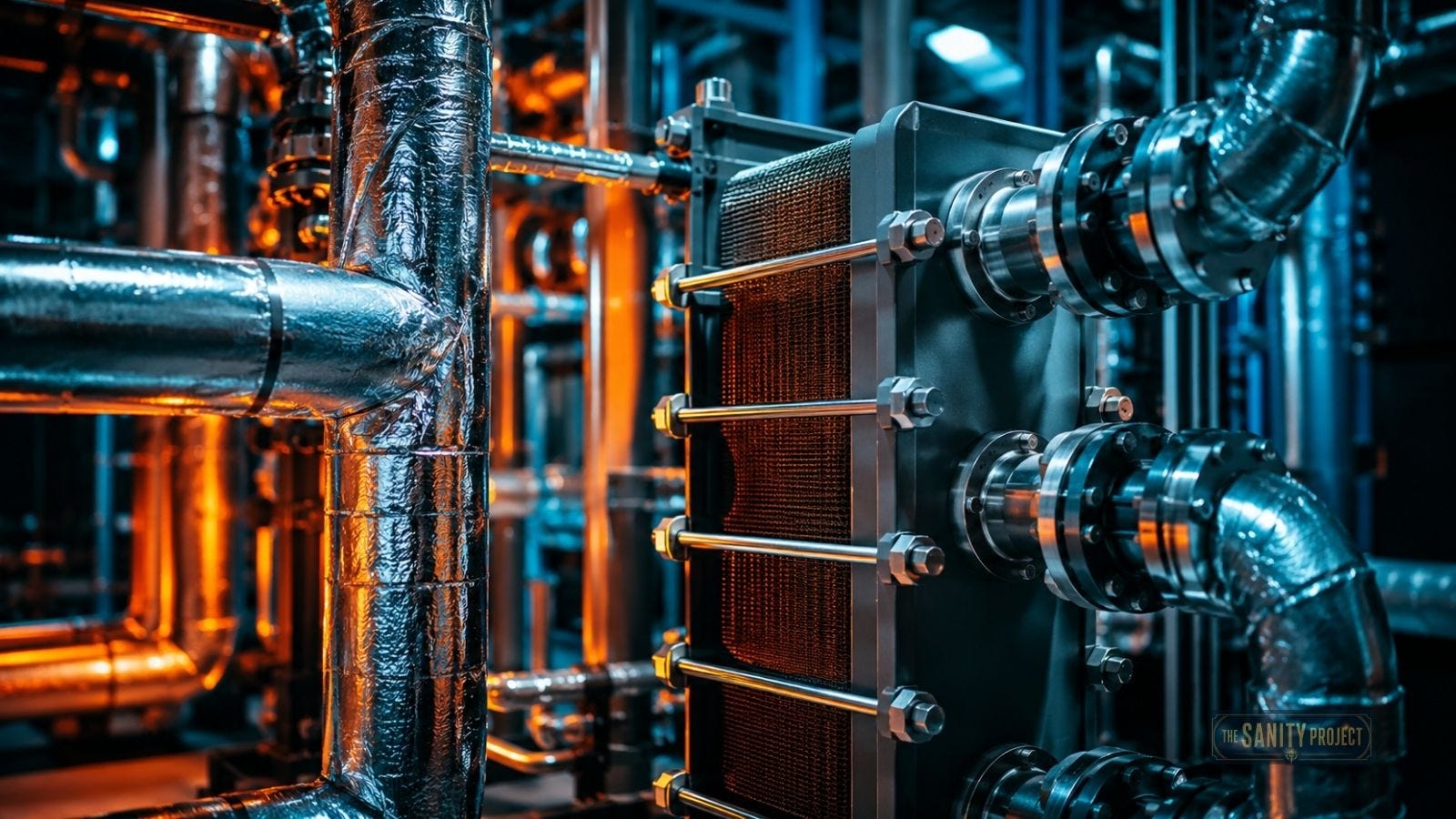
The heat inside a closed loop doesn’t vanish. It just moves to wherever the chillers send it, unless something captures it first.
Worth sharing? Pass this along to anyone who’s ever asked what actually happens to a data center’s heat.
The Heat Doesn’t Disappear. It Goes Into District Heating.
An Equinix data center in Markham, Ontario, already heats nearby condos, a university campus, two high schools, and two community pools through an operational district heating system.
Instead of rejecting that heat into open air, a handful of facilities are piping it into a district energy network, essentially a shared hot water loop that serves an entire neighbourhood instead of one building. Markham District Energy takes waste heat from a local Equinix data center and distributes it to nearby condominiums, a university campus, two high schools, and two community pools. The utility itself dates back to the 1998 ice storm that knocked out power across eastern Ontario and Quebec, and was built specifically so the community wouldn’t be that vulnerable again. This isn’t a pilot or a press release. It’s infrastructure that residents are already living and swimming next to.
Toronto has a version of this too. Telehouse Canada’s data centers on Front Street feed into Enwave’s district energy system downtown, pairing the same waste heat capture with Enwave’s deep lake-water cooling on the other side of the loop. And in Quebec, QScale’s data center campus near Lévis pipes its surplus heat directly to neighbouring commercial greenhouses expected to grow more than 80,000 tonnes of tomatoes a year, essentially running the same idea a reader proposed for an office building, just scaled up and aimed at produce instead of a clerk’s department.
None of this is uniquely Canadian either. Stockholm runs the most mature version anywhere: nearly 90 percent of the city’s buildings are already connected to district heating, a network that predates data centers by decades, and Stockholm Exergi’s Open District Heating platform now recovers enough waste heat from more than 20 data center suppliers to warm roughly 30,000 apartments a year. That scale isn’t available everywhere, and it’s worth saying plainly that many companies have promised waste heat reuse and quietly failed to deliver. Apple and Meta both have unfulfilled commitments on this exact front. Stockholm works because the pipes were already there first. That’s the detail that matters for what comes next.
An Equinix data center in Markham now heats two community pools.
That’s not a pilot project; it’s already running.

Listen to the Sanity Project Podcast

Why Alberta Can’t Just Copy This
Alberta isn’t missing the technology. A University of Calgary study found it’s missing the pipes already in the ground to actually use it.
Here’s the honest limitation, and it’s exactly the one a reader flagged after Part Two: none of this works without a physical network already in place to distribute the heat. Markham, Toronto, and Lévis could plug data center waste heat into district systems because those systems, or the will to build purpose-made ones, already existed. A University of Calgary study examining Alberta’s data center potential identified the province’s limited district heating infrastructure as the main obstacle to doing the same there.
Alberta isn’t short on cold winters or data centers looking to build. What it’s short on is the shared pipe network that makes capturing and distributing waste heat economically sensible, rather than a one-off engineering favour for whichever building happens to sit next door. The same University of Calgary research estimated that a single megawatt of data center IT load can generate close to 5,875 megawatt-hours of recoverable waste heat annually, enough to make a difference to a neighborhood’s heating bill if there’s anywhere for it to go. Retrofitting that kind of distribution infrastructure into an existing city is close to what our reader described trying, and failing, to justify on a single office building’s budget, just at a scale several orders of magnitude larger.
Alberta doesn’t lack the technology. It lacks the pipes already in the ground to use it.

Following this series? Subscribe so you don’t miss where we take it next.
None of this is a free lunch, and it’s worth being honest about why. The heat coming out of a closed loop is what engineers call low-grade, typically somewhere around 35 to 40 degrees Celsius, well short of the roughly 65 degrees most district heating systems actually want. A heat pump has to boost it the rest of the way, and it runs on electricity. It’s the same tradeoff we’ve traced through this entire series: you rarely eliminate a cost; you just move it downstream.
Nobody’s fully solved the seasonal half of this either. Data centers throw off heat at a constant rate all year, but neighbourhoods only want it in winter, and want the opposite, more cooling, during the exact months a data center has the least trouble staying cool on its own. A few projects are experimenting with storing summer heat underground in boreholes, pulling it back out months later when it’s actually needed, but that’s still early, unproven engineering at the scale a real city would require, not a deployed answer.
What we covered in Part One still holds: the renewable energy number never mentioned the water. Turns out it never mentioned the heat either. If a data center gets proposed near you, the water question from Part One and the heat question from this piece are really the same question, asked twice: what’s actually happening to everything this building takes in and gives off, and is anyone besides the company building it keeping track?

Editor’s View
I’ll be honest about where I land on this one, because I don’t actually know yet. Waste heat reuse has the kind of story that’s almost too satisfying: a company’s byproduct becomes someone else’s free heating; everybody wins. That’s exactly the kind of narrative that makes me want to check twice before I believe it.
What I can tell you is that Markham, Toronto, and Lévis are real and running, not hypothetical. What I can’t tell you yet is whether this becomes standard practice everywhere a data center is built, or stays a boutique win limited to the handful of cities that already have district heating pipes in the ground. That answer probably depends less on the technology, which clearly works, and more on whether municipalities start requiring it, as some are already requiring water disclosure. I don’t have a confident prediction there. I just think it’s the actual question worth watching.
Follow for more fact checks that cut through the noise.
Publications Consulted
Microsoft Cloud Blog, Equinix, Data Center Knowledge, QScale, Stockholm Exergi, University of Calgary, DataCenterDynamics, Markham District Energy
I had made some comments in your other article on this issue, and still thinking about structuring further thought on this. For the moment, then, one thought and a question:
1) This problem / opportunity of low-grade waste heat is not unique to data centres - the other big place to look is in all thermal electricity plants (or at least those that run on the steam cycle, which is most). Our nuclear and gas plants in particular - and coal-fired where we still have it, too. And it's a related issue in another way - in at least one of those famous studies/articles that identified how much water data centres / AI use, the majority of the water usage was actually attributed to the electricity used to run them (because the thermal plants use the steam cycle). [And obviously as a side note the estimate was based on mixes of power - so using renewable energy in almost all cases is actually the best way to reduce water usage.]
2) I'd be interested in sources that have data on how much waste heat we are talking about (eg converted to waste heat/nominal plant consumption and some real-world), and particularly if they also estimate eg theoretically/practically recoverable/useable amounts.
I'm still confused as to why we can't apply the energy directly to heating and growing food instead of giving it away to Meta then feeding on its waste products, like so many little dung beetles. ?????
Somebody help me out here. It's hurting my brain.