



The Real Question Isn’t Whether Canadian News Is Biased. It’s Whether It’s Honest.
You open your news app in the morning, and within four minutes you’re angry at someone you’ve never met, about a policy you don’t fully understand, reported by an outlet whose funding model you’ve never thought about. This is not an accident. The news cycle is designed to outrage you, and the architecture of most Canadian media, like most media anywhere, is built to keep you clicking, not necessarily to keep you informed.
The question isn’t whether bias exists. It does, in every outlet, including this one. The question is what you’re going to do about it.
“Unbiased” Is a Marketing Claim, Not a Description
Every news organization has a point of view. It’s baked into which stories get assigned, which sources get called, which quotes make the final cut, and what ends up in paragraph one versus paragraph twelve. Pretending otherwise is itself a form of bias, the kind that’s hardest to spot because it wears the costume of objectivity.
The more useful standard is transparency. A source that tells you who owns it, how it’s funded, where its editorial perspective sits, and how it handles corrections is far more trustworthy than one that simply declares itself “fair and balanced.” That phrase, as history has demonstrated, tends to function as a red flag rather than a credential.
The goal isn’t finding a source with no bias. The goal is finding sources that are honest about theirs.
When you’re evaluating what qualifies as the best Canadian news sources for your regular reading, this reframing matters enormously. It shifts the question from “is this outlet biased?” (yes, they all are) to “does this outlet earn my trust through transparency and rigor?” That’s a question you can actually answer.
A Quick Map of the Canadian Media Landscape
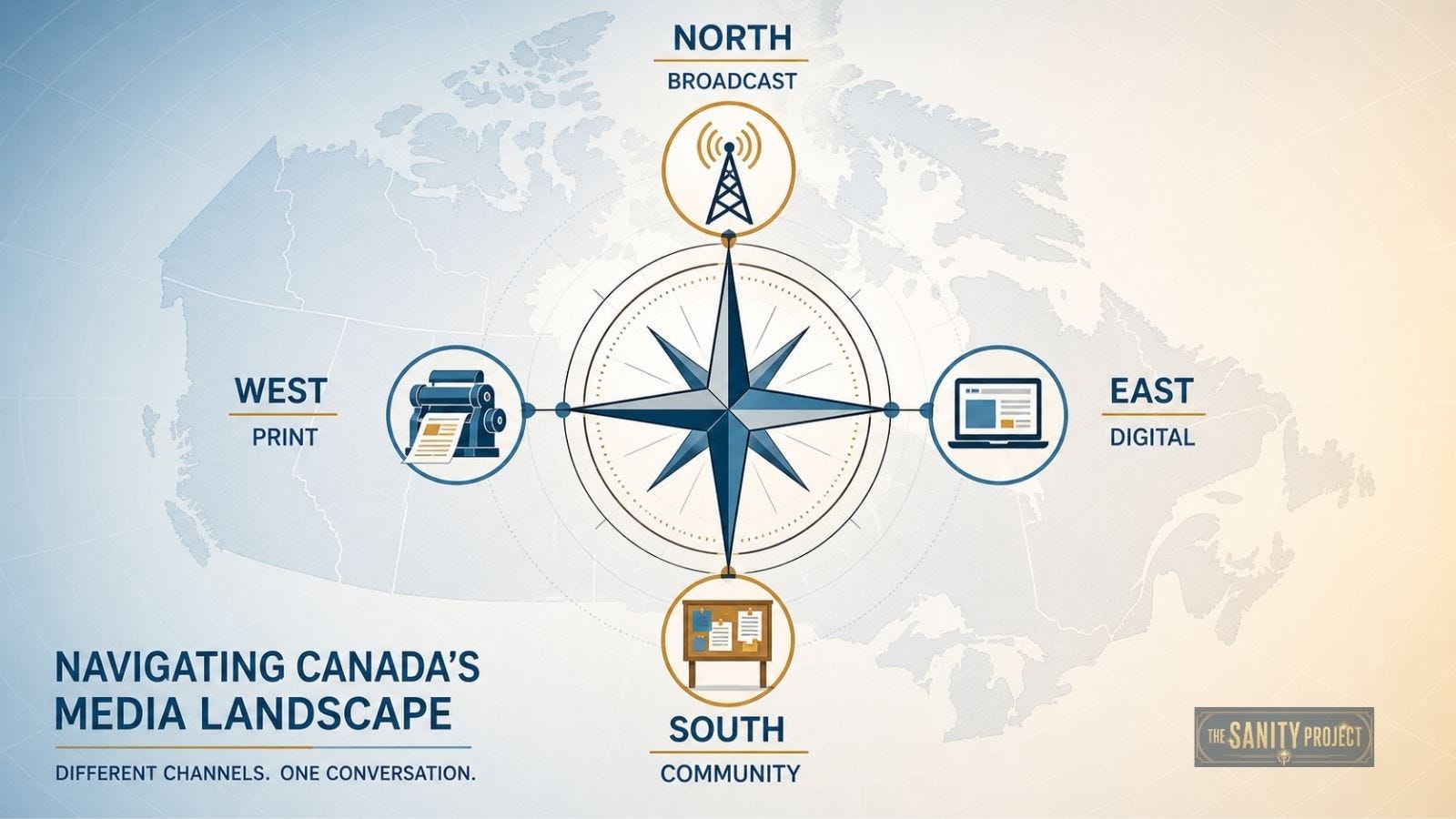
Canada’s media environment is smaller and more concentrated than most Canadians realize. A handful of ownership groups control a significant share of what gets published across print, digital, and broadcast. That’s not a conspiracy; it’s an economics problem. Local journalism has been hollowing out for fifteen years, accelerated by the collapse of print advertising revenue and the gravitational pull of platforms that distribute news without paying for it.
Here’s a rough map of what’s available and what each category is genuinely good at and genuinely limited at.
The Public Broadcaster
The CBC is the most politically contested institution in Canadian media, which is itself informative. It receives federal funding, which creates a legitimate structural question about editorial independence, and that question deserves honest engagement rather than reflexive dismissal or reflexive defense. The CBC’s national political reporting is generally well-resourced and well-sourced. Its local coverage, where it still exists, often fills gaps that private media has abandoned. Its opinion and analysis content is more variable. The criticism that it skews toward a particular political sensibility is worth taking seriously; so is the counter-argument that the alternative is less coverage of public affairs, not better coverage.
Legacy National Papers
Canada’s major national newspapers bring decades of institutional knowledge and, in some cases, serious investigative capacity. They also carry the editorial perspectives of their ownership, which is worth knowing. Reading a national paper’s news section and its editorial board are two different experiences, and conflating them is a mistake many readers make. The news desks of established papers generally operate with separation from ownership opinion, though that separation is never perfect and varies by outlet.
Wire Services
The Canadian Press is the wire service that most Canadians have never heard of but read every day. When a local outlet publishes a story about a federal court ruling or a parliamentary vote, there’s a reasonable chance it came from CP. Wire services aim for factual accuracy and speed, with less interpretive framing than feature journalism. They’re not exciting, which is precisely why they’re useful. Treat CP copy as a reliable baseline for what happened; look elsewhere for what it means.
Independents and Newsletters
This category has grown substantially. Some independent outlets do original, rigorous journalism that the larger players ignore. Some are advocacy operations wearing the costume of journalism. The quality range is genuinely wide. Funding transparency matters here more than anywhere: who pays for this, and what do they expect in return? An outlet funded by reader subscriptions has a different set of incentives than one backed by a single ideological donor network. Neither is automatically good or bad, but you should know which one you’re reading.
Local Outlets
Whatever’s left of them. Local journalism is where the press's accountability function is most directly felt and most acutely missed. A city council that never sees a reporter shows up differently than one that does. If you have a functioning local outlet in your community, it’s worth supporting, even if it’s imperfect, because the alternative is not better local journalism. It’s none.
The Framework for Judging Any Source
Rather than memorizing a list of approved outlets, build a short mental checklist you can apply to any source you encounter. This is what “objective Canadian news analysis” actually looks like in practice.
Ownership and funding. Who owns this outlet, and what else do they own? How is it funded? Advertising, subscriptions, government grants, foundations, donors? None of these automatically compromises editorial independence, but all of them create pressures worth understanding.
Corrections policy. Does the outlet publish corrections when it gets things wrong? Can you find them? A newsroom that issues corrections is not admitting weakness; it’s demonstrating that accuracy matters enough to protect. An outlet with no visible corrections history is either supernaturally accurate or not particularly interested in the question.
Sourcing and primary documents. Does the reporting link to or reference primary sources: court documents, government data, transcripts, scientific studies? Journalism that keeps you one step away from the evidence is asking you to trust the journalist rather than verify the claim. Good journalism lets you check.
Separation of news and opinion. Is it clear which content is reported fact and which is editorial perspective? Some outlets blend these well enough that readers can’t tell the difference. That’s a design choice, and not a flattering one.
Track record. Has this outlet published things that turned out to be significantly wrong? How did it handle that? One bad story doesn’t disqualify a newsroom; how it responds to error tells you more than the error itself.
Building a Source Diet, Not a Source
The single biggest mistake in news consumption is treating one outlet as the complete picture. No outlet is. The best Canadian news sources aren’t a list of perfect publications; they’re a set of complementary perspectives that, read together, give you a more accurate map of reality than any one of them provides alone.
A reasonable source diet might include a wire service for baseline facts, one or two national outlets with different editorial orientations, a credible independent or newsletter covering a beat you care about, and whatever local journalism still exists in your area. Reading across that range doesn’t mean treating all perspectives as equally valid. It means you’ll notice when something is missing from one account that appears prominently in another.
Red Flags Worth Knowing
Some patterns reliably signal that a source deserves extra skepticism. Anonymous sourcing used as the primary basis for significant claims, rather than as a supplement to documented evidence, is one. Headlines that don’t match the story underneath them are another, and it’s more common than it should be. Consistent absence of named sources or primary documents. A corrections record of zero, ever. Strong emotional framing in what’s presented as straight news reporting. Content that’s designed to confirm what you already believe, framed as revelation.
That last one is the most insidious. The news cycle is designed to outrage you, and outrage feels like information. It rarely is.
The Short Vetting Checklist
When you encounter a source you haven’t evaluated before, run through this before you share or rely on it:
Who owns it, and who funds it?
Can you find a corrections or ethics policy?
Does the reporting cite primary documents or named sources?
Is opinion clearly labeled as distinct from reporting?
Has the outlet been caught publishing significant errors, and how did it respond?
Five questions. Two minutes. The answers won’t always be clean, but the exercise of asking them is what separates informed reading from passive consumption.
The goal of facts-first analysis on politics, power, and the stories behind the headlines isn’t to tell you what to think. It’s to give you better tools for thinking. A reliable set of sources is the foundation of that. You don’t need a perfect outlet. You need an honest one and the judgment to know the difference.