


Labor Day in Canada: How a Century of Strikes Built the Country We Live In
From Toronto’s print shops to Windsor’s assembly lines, the same instinct built almost every workplace right Canadians now take for granted, and it might be exactly what the country needs again.
Key Takeaways
Labour Day in Canada's history dates back to 1872, with a Toronto printers’ strike that made unions legal in the first place.
Over the following century, general strikes and mass walkouts from Vancouver to Windsor to rural Quebec forced Ottawa and the provinces to build the labor protections most Canadians now take for granted.
The 1919 Winnipeg General Strike remains the largest single labour action in Canadian history, and it ended with two men dead on what’s remembered as Bloody Saturday.
The Canadian labour movement’s real wins rarely showed up in the strike itself; they showed up years later, as pensions, employment insurance, and bargaining rights written into law.
As Canada heads into a fresh round of tariffs against the United States this week, that same story of collective leverage feels less like history and more like a rehearsal.
Tomorrow, most of us get the day off. A long weekend, one last barbecue before the kids go back to school, maybe a drive out to the lake. Almost nobody will spend that Monday thinking about the printers who got arrested for striking, the workers who got shot at in the street, or the relief-camp labourers who rode boxcars halfway across the country just to get Parliament to listen.
Labour Day Canada didn’t start as a picnic. It started as a protest, then dozens of protests, spread across a century and from coast to coast, until the fight got won so completely that people forgot there was ever a fight.
And this year the timing feels almost deliberate. As we’re firing up the grill, the federal government is also flipping the switch on a fresh round of counter-tariffs against the United States, set to land September 8. Same instinct, different century: Canadians deciding, collectively, that they will not simply absorb whatever gets thrown at them from south of the border. That thread runs in a fairly straight line from a printer’s picket line in 1872 to a customs schedule in 2026, and it’s worth pulling on before the burgers go cold.
What Labour Day in Canada Started As
Labour Day in Canada traces back to an illegal union winning Canadians the legal right to organize, twenty-two years before it became a holiday.
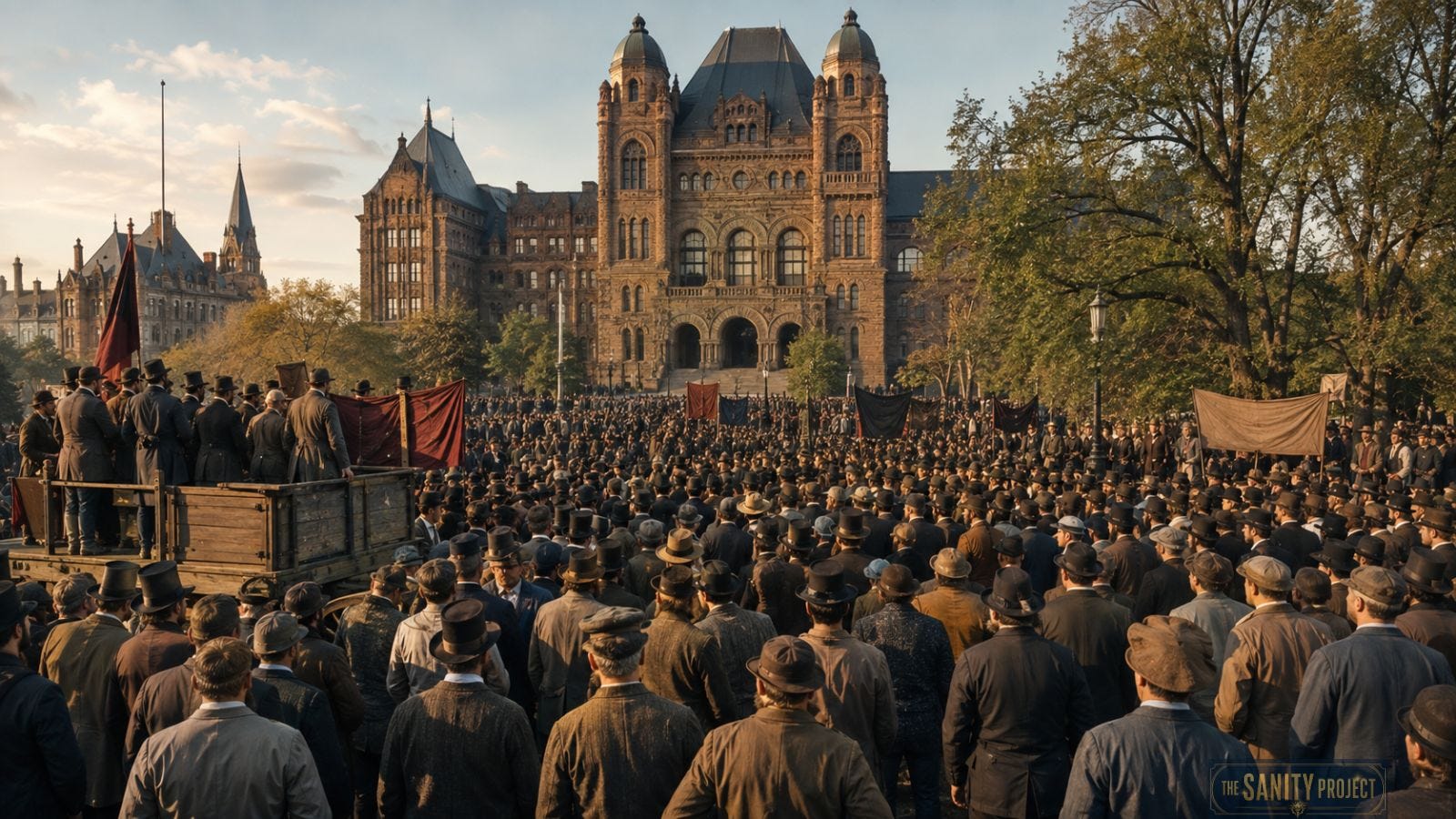
So what is Labour Day, actually, underneath the mattress flyers and the long weekend? It goes back to 1872, two decades before Ottawa made it official. The Toronto Typographical Union, the printers who set type for the city’s newspapers, wanted a nine-hour day instead of twelve. They walked out on March 25. On April 15, roughly 10,000 supporters showed up for a rally at Queen’s Park, in a city of about 50,000 people. Sit with that math for a second. Roughly one in five Torontonians turned out for a labour rally a century and a half ago.
George Brown, who owned the Globe (yes, that Globe, the one still publishing today as the Globe and Mail), had the strike committee arrested on charges of criminal conspiracy. Under Canadian law at the time, unions were flatly illegal, a leftover from an old British statute nobody had bothered to update. Prime Minister John A. Macdonald, watching his political rival Brown overplay his hand months before an election, made a move that was both politically shrewd and historically significant. He passed the Trade Union Act, legalising unions across the country.
Those printers never got their nine-hour day out of that particular strike. They got something bigger instead: the legal right to organise at all. Ottawa didn’t formally recognise Labour Day as a national holiday until 1894, under Prime Minister John Thompson, but the fight that earned it happened two decades earlier, in a public park, against a newspaper owner who thought he could jail his way out of a labour dispute.
The printers lost their strike and won the right to unionise instead,
which turned out to be the better deal.
The Strikes That Made the Whole Country Pay Attention
Between 1919 and 1949, general strikes in Manitoba, British Columbia, Ontario, and Quebec each forced Canada to rewrite its own rules on who gets a say at work.
Once workers had the legal right to organise, the fights got bigger, and they stopped staying in one city.
The biggest of them hit Winnipeg in 1919. Soldiers were home from the First World War, jobs were scarce, and the city’s building and metal tradespeople had already been on strike for weeks over wages and bargaining rights. At 11 a.m. on May 15, roughly 30,000 workers across dozens of trades walked off the job together, and sympathy strikes broke out in cities as far away as Vancouver and Toronto.
Ottawa treated it as the opening act of a revolution rather than a labour dispute, arrested ten strike leaders, and on June 21, a day now remembered as Bloody Saturday, the Royal North-West Mounted Police charged a crowd of protesters with clubs and revolvers. Two men were killed. The strike ended five days later, without the wage gains or bargaining recognition the workers had walked out for.
Sixteen years after that, in 1935, unemployed men living in federal relief camps in British Columbia went on strike over their pay and conditions, then boarded freight trains and headed east toward Ottawa to make their case directly. The On-to-Ottawa Trek got as far as Regina before it was stopped, but the pressure it built helped push the federal government toward Canada’s first Unemployment Insurance Act five years later.
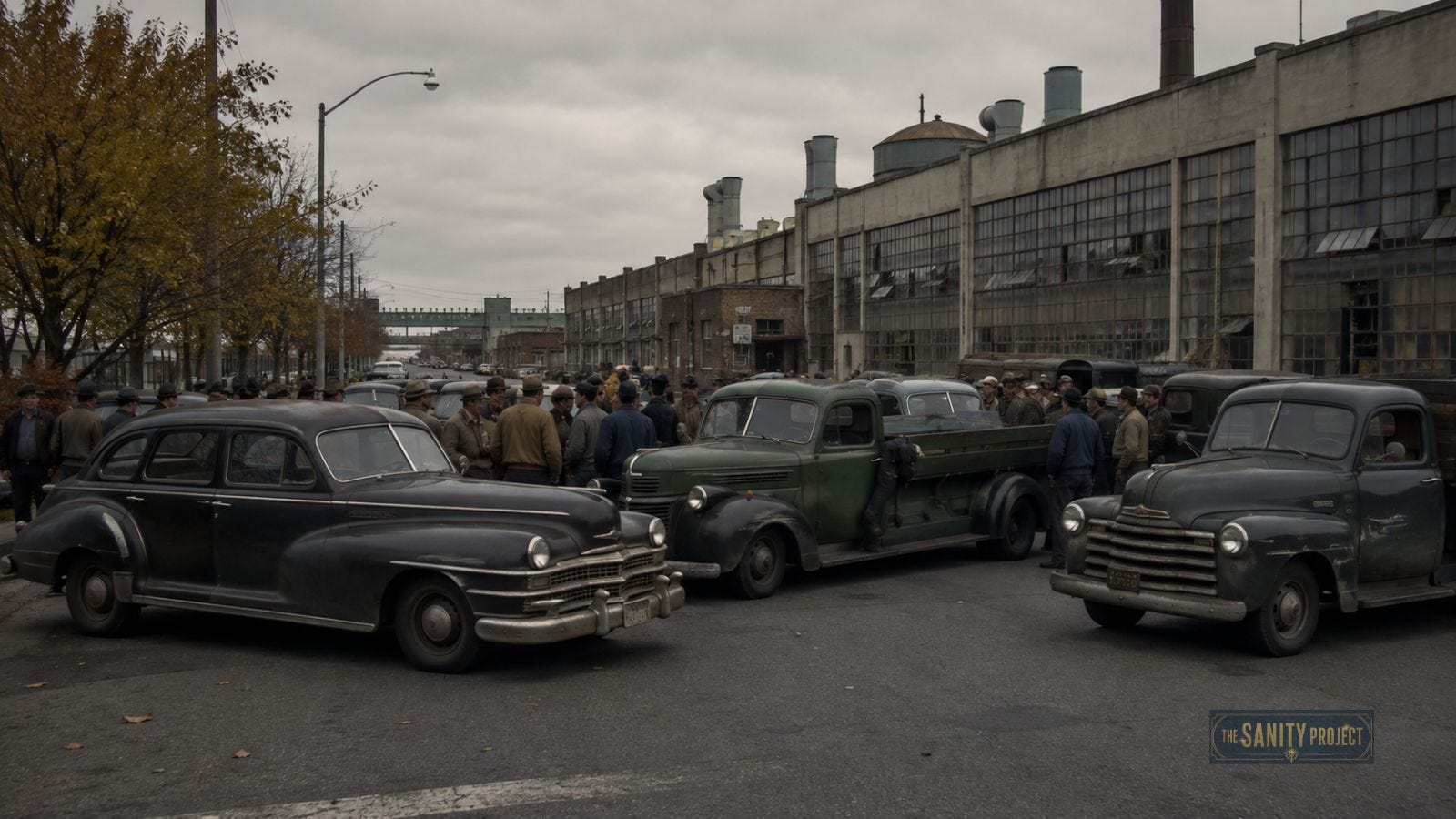
A decade after that, in 1945, eleven thousand autoworkers at Ford’s plant in Windsor, Ontario, walked out for ninety-nine days demanding union security, backed by another eight thousand workers who struck in solidarity at nearby plants. The dispute was settled by Supreme Court Justice Ivan Rand, whose arbitration decision, the Rand Formula, made it mandatory for every worker covered by a union contract to pay dues, whether or not they had joined the union. It remains standard practice in Canadian labour law today.
Then, in 1949, roughly five thousand asbestos miners in Quebec’s Eastern Townships walked out over wages and the lung disease their own workplace was giving them. Quebec’s government sided with the American company that owned the mines and sent police to break the strike, but the conflict exposed the cracks in the province’s old alliance between church, state, and business. Historians still point to the Asbestos Strike as one of the sparks that lit the Quiet Revolution a decade later.
Four provinces, four decades, one recurring argument: the people doing the work deserve a say in how it gets done.
Four provinces, four decades, one argument that kept winning: workers deserve a say in the work.
What the Movement Built
The movement’s real payoff showed up years later, in pensions and bargaining rights, through a political party built by the men Ottawa tried to silence.
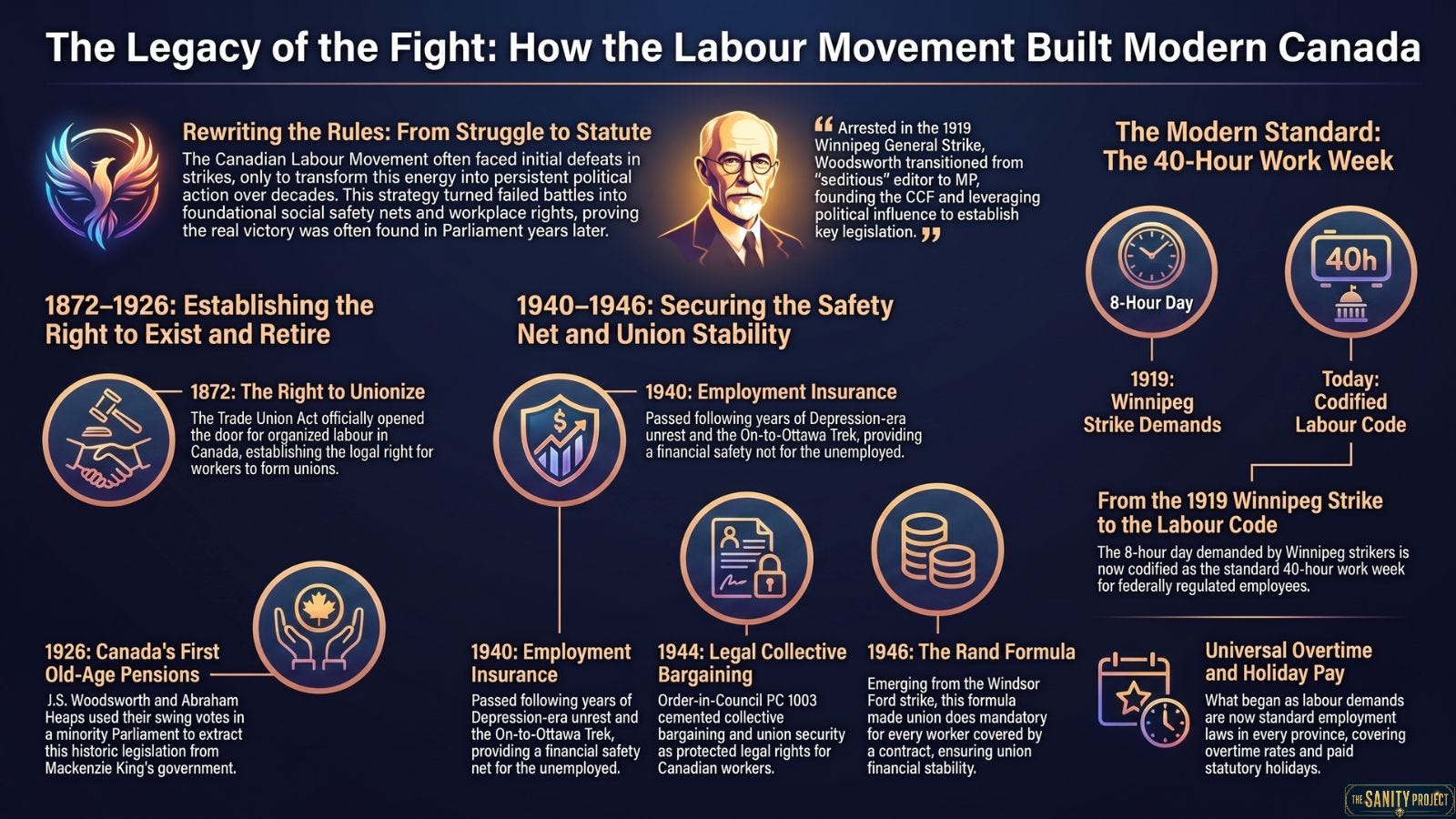
One of the men swept up in the Winnipeg strike was J.S. Woodsworth, a former Methodist minister who had stepped in as editor of the strikers’ newspaper after the previous editor was arrested. Woodsworth himself was charged with seditious libel; the charges were eventually dropped, but the arrest made his name nationally. He ran for Parliament in 1921 and won, representing Winnipeg North Centre for the next two decades. In 1932, he helped found the Co-operative Commonwealth Federation, the socialist party that would eventually become the NDP. Along the way, he helped push Mackenzie King’s government toward Canada’s first old-age pension legislation.
That’s the pattern with the Canadian labour movement more broadly: it rarely wins the fight it’s in. It loses that one, sometimes badly, and then spends the next decade quietly rewriting the rules so the next generation doesn’t have to fight the same battle. Follow the thread forward from these strikes, and it runs straight into legislation still on the books:
The right to unionise dates back to the 1872 Trade Union Act that opened this story.
Collective bargaining and union security as legal rights, cemented in 1944 under Order-in-Council PC 1003 and extended in 1946 by the Rand Formula out of the Windsor Ford strike, which made union dues mandatory for every worker a contract covered.
The eight-hour day, the exact demand Winnipeg workers walked out for in 1919, is now written into the Canada Labour Code as a standard 40-hour workweek for federally regulated employees.
Employment Insurance was established in 1940 after years of Depression-era labour unrest, including the On-to-Ottawa Trek.
Old-age pensions were forced through in 1926 when Woodsworth and fellow Labour MP Abraham Heaps used their swing vote in a minority Parliament to extract Canada’s first pension legislation from Mackenzie King.
Overtime pay and paid statutory holidays are now standard employment law in every province, though the exact hours and rates still vary depending on where you work.
Worth saying plainly: these are legislative wins, not union contracts, and the labour movement shared the credit with the CCF, wartime politics, and governments that mostly acted because losing the next election looked worse than losing the fight. But the pressure that put all of it on the table came from the same place, again and again, in cities most of us will never live in: workers deciding, collectively, that individual complaints weren’t going to cut it.
If this is the kind of history that explains the present, subscribe.

Why That Same Instinct Matters Again Right Now
As Canada’s newest counter-tariffs against the United States take effect September 8, the country is once again betting on collective leverage over quiet acceptance.
Here’s where the patriotism part comes in, and I’ll be upfront that it’s not the flag-waving kind. It’s the harder kind, the kind that shows up when a country decides it would rather absorb short-term pain than quietly accept a bad deal.
On September 8, days after this Labour Day, Canada’s federal government is set to impose fresh counter-tariffs on more than 700 categories of American goods, ranging from 15 to 50 per cent, matching Washington dollar for dollar after the U.S. imposed a 50 per cent levy on $27.6 billion worth of Canadian exports. Steel, dairy, appliances, farm equipment, pulp and paper, electronics: entire industries are bracing for a fight that neither side particularly wanted, and neither side is backing away from either. Prime Minister Mark Carney has framed it plainly: Canada didn’t start this fight, but it isn’t going to sit still for it.
Strip away the years,nd the mechanics look oddly familiar. In 1919, it was 30,000 Winnipeg workers deciding that collective refusal was the only leverage they had left. In 1945, it was 11,000 industrial workers making the same calculation on a factory floor. In 2026, it’s a federal government making the same bet on behalf of an entire economy. None of these situations was comfortable. None came with a guarantee that it works out cleanly, and the Winnipeg strikers found that out the hard way. But all of them rest on the same wager: that Canadians standing together and absorbing some short-term cost beats letting somebody else dictate every term of the relationship.
This isn’t really a policy position. It’s closer to a personality trait, and it’s one worth being a little proud of.
Winnipeg in 1919, Windsor in 1945, Ottawa in 2026: same bet, same nerve, different scale.
Editor’s View
I’ve spent forty-some years in Winnipeg, first wearing a badge, then selling houses in some of the same North End neighbourhoods where workers walked out in 1919. You can still walk past the old Ukrainian Labour Temple and stand roughly where a streetcar burned on Bloody Saturday. But the same pattern played out in a hundred other neighbourhoods I’ve never set foot in: a picket line in Windsor, a church basement meeting in Asbestos, a boxcar rolling toward Regina full of men with nothing left to lose.
I won’t pretend the labour movement got everything right, or that every fight since 1872 has been noble. Plenty haven’t been. But the instinct underneath all of it, that a country is stronger when its people refuse to be squeezed quietly, is the same instinct showing up in Ottawa’s tariff schedule this week. It’s a very Canadian habit, and one I think we don’t give ourselves enough credit for.
When the barbecue’s going tomorrow and the last long weekend of summer is winding down, it’s worth remembering that the day itself is a receipt. Somebody already paid for it, in jail time, in lost jobs, and more than once, in blood.
Winnipeg lost that summer’s fight. So did the relief-camp workers on the Trek, and the miners in Asbestos. Windsor’s autoworkers were the rare ones who won outright. But together, win or lose, they built the century that followed. Whatever comes out of this month’s tariff standoff, a win, a loss, or the usual Canadian compromise nobody’s fully happy with, the country making that bet is the same one that has shown up again and again for a hundred and fifty years and decided some things are worth more than an easy Monday.
Happy Labour Day, Canada. You earned it the hard way, more than once.
Corrections and Updates Protocol: The Sanity Project verifies every claim against primary sources before publication. If you spot an error or an update is needed, it will appear here as “Update (Month Year):” rather than a silent edit. No corrections have been logged for this piece as of publication.
Publications Consulted: The Canadian Encyclopedia, Canadian Labour Congress, Canadian Museum for Human Rights, Parks Canada (The Forks National Historic Site), Wikipedia, Manitoba Historical Society, PIPSC, Unifor, Government of Canada (Department of Finance), Al Jazeera, NPR, CNN Business.
Follow for more fact checks that cut through the noise.