



Welcome to Part 1 of a 4-Part Deep Dive.
On the morning of June 4, 2026, Manitoba Premier Wab Kinew appeared on CBC Radio and said, essentially, no thanks.
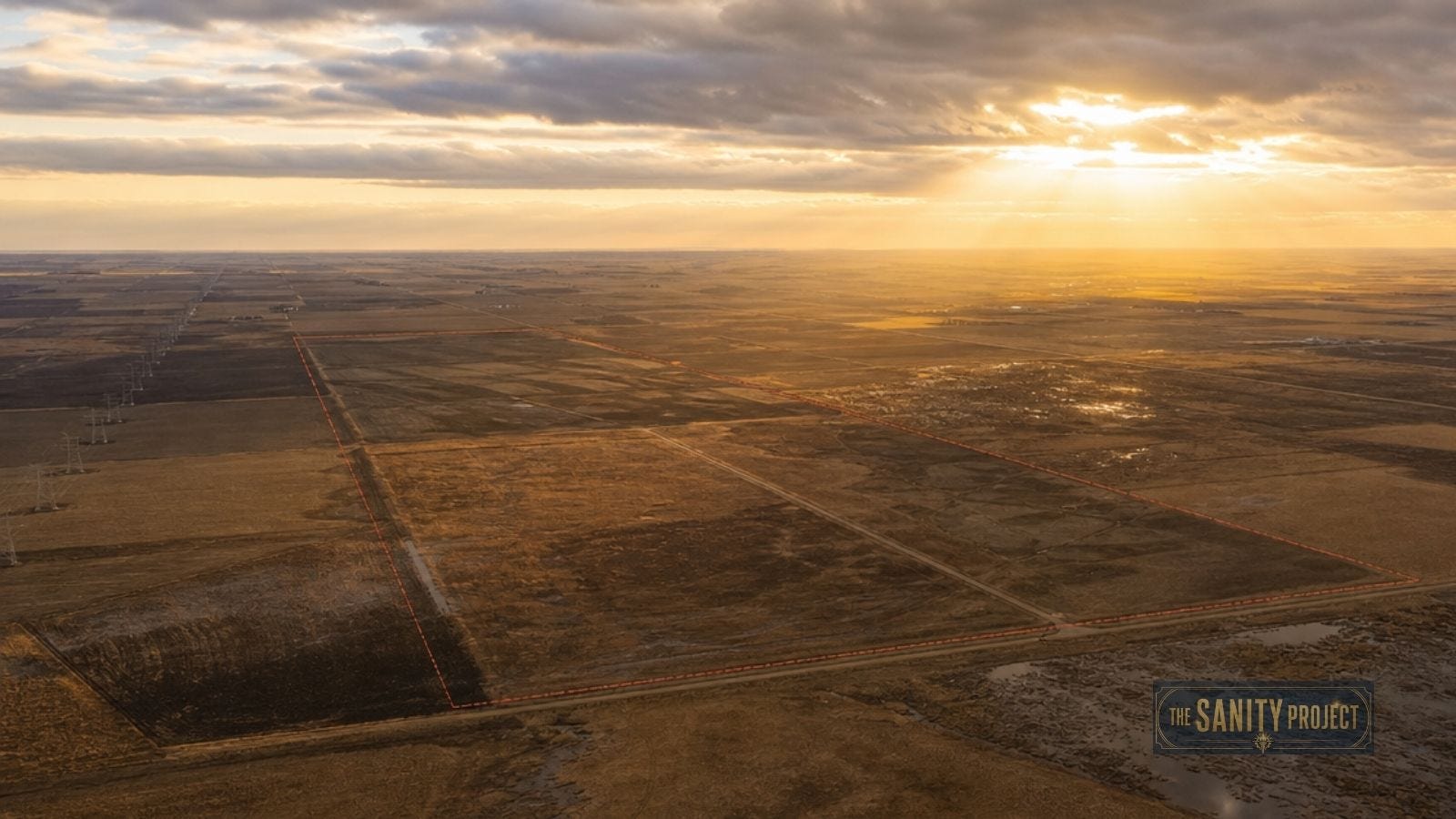
Not a hedged “we need more study.” Not a “we support responsible development, but.” Just a clean, plainspoken no to a proposed 500-megawatt hyperscale AI data centre backed by a Las Vegas company called Jet.AI and a Vancouver firm called Consensus Core. The facility would have consumed 141 hectares of farmland near Île-des-Chênes, burned natural gas around the clock, and made promises about jobs and tax revenue that Kinew clearly didn’t buy.
Hours later, in Toronto, Prime Minister Mark Carney unveiled “AI for All,” Canada’s national artificial intelligence strategy, anchored on building sovereign AI infrastructure. Specifically, it called for “large-scale AI data centres with total planned capacities greater than 100 megawatts.”
The federal government launched its biggest technology bet of the decade on the same day a province told that bet to find somewhere else.
That collision wasn’t accidental. And the tension it exposed isn’t going away.
What Manitoba Actually Said No To
The tech industry’s framing has been predictable: Manitoba said no to jobs and innovation. That narrative doesn’t survive contact with the actual numbers.
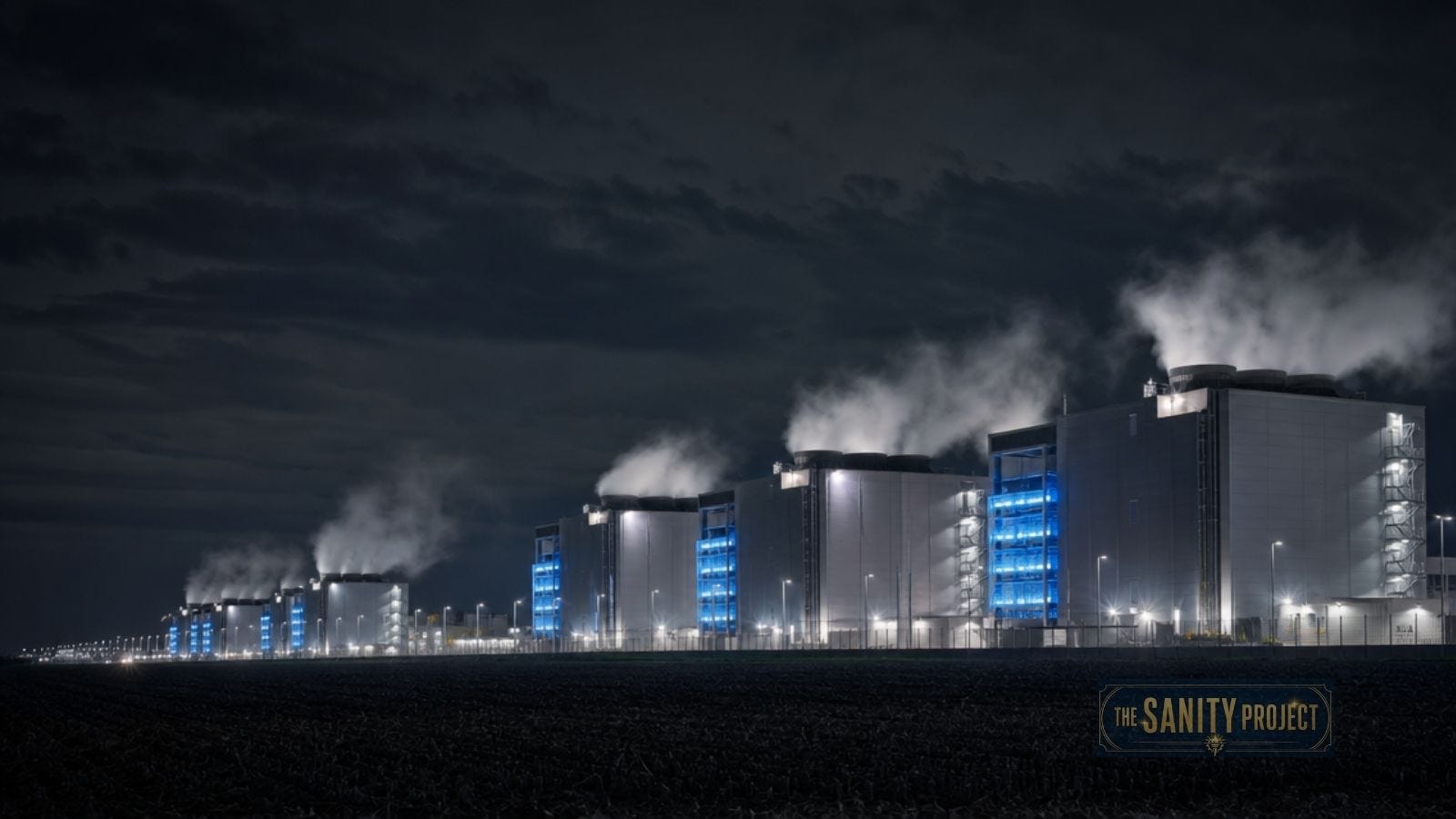
The Jet.AI/Consensus Core project was not a clean-energy facility drawing from Manitoba Hydro’s predominantly renewable grid. It was a gas-fired operation. Six natural gas turbines, self-generating power on-site, capable of scaling into the hundreds of megawatts. The companies argued this shielded Manitoba Hydro from demand pressure. Kinew’s government concluded it introduced a different problem: burning fossil fuels at an industrial scale in a province that has pledged to phase out natural gas-fired electricity generation by 2035.
The economic case was equally thin once you looked past the headline numbers. Construction jobs, yes. Permanent jobs? Minimal. Data centres are among the most capital-intensive, least employment-dense investments in the infrastructure world. The computing output serves clients outside the province. The profits flow to Nevada and British Columbia.
“Most of the economic benefit probably leaves the province.” — Premier Wab Kinew
That one sentence does more damage to the industry’s pitch than any environmental objection. It names the extraction model plainly: Manitoba absorbs the noise, the gas combustion, the land conversion, and the grid complexity. The money leaves.
A community of roughly 2,000 people near Île-des-Chênes gathered 13,500 signatures opposing the facility. Climate Action Team Manitoba had filed a formal position statement months earlier. The politics were not subtle.
The Grid Problem Nobody Wanted to Say Out Loud
Here’s what makes Kinew’s decision rational, even if you set the gas combustion question aside entirely. Manitoba Hydro has been quietly telling the province for the past year that it’s running out of room.
The Crown corporation’s own Integrated Resource Plan is unambiguous. Peak demand will exceed generating capacity by 2029 or 2030. Manitoba Hydro has already filed a $1.36 billion preliminary estimate with the Public Utilities Board for a new 500-megawatt dispatchable capacity resource. Translated from utility-speak: a fuel-burning generating station, needed to prevent what the filing calls “sustained winter peak capacity deficits.”
Manitoba’s total generating capacity is approximately 6,120 megawatts when all stations are running, and reservoir levels are optimal. One hyperscale data centre draws roughly 13% of that total. Kinew put it in terms anyone could understand:
“We use about one to 1.5 megawatts of compute as the entire government… so the idea of building, like, a 500-megawatt facility, it doesn’t really make sense.” — Premier Wab Kinew
Let that sit for a moment. Every health record in Manitoba. Every school network. Every government administration system, every public institution in the province. All of it runs on 1.5 megawatts. The proposed data centre would have demanded 333 times that amount.
If Manitoba already can’t meet projected residential and commercial demand without burning gas by 2029, adding a facility of that scale to the queue isn’t a tension to manage. It’s a crisis to absorb.
Starting an online business?
Canadian businesses deserve Canadian hosting. If you’re building a website or blog, this is where I’d start: Web Hosting Canada

The Bubble Nobody in the Industry Wants to Name
Kinew didn’t stop at environmental and economic objections. He said something more uncomfortable: the whole thing might be a bad bet regardless.
“I have the feeling that maybe these $30-billion hyperscale data centres are going to be albatrosses in the future, when people can run the AI that’s necessary for their day-to-day use on their local MacBook.” — Premier Wab Kinew
Albatrosses. That’s the word a sitting premier used to describe what the federal government is now calling national strategic infrastructure.
He’s not alone. Ed Zitron, whose newsletter and podcast have become essential reading for anyone trying to understand AI’s actual financial model, published an analysis on June 2 arguing that every major AI subscription is effectively subsidized. Users are conditioned to ignore the true cost of compute, and the entire infrastructure buildout rests on demand projections that have never been tested against real pricing. One enterprise client accidentally spent $500 million in a single month on AI model calls after failing to set spend limits. GitHub Copilot burned through 50% of its monthly credits in a single prompt after Microsoft moved to consumption-based billing.
University of Manitoba economics professor Fletcher Baragar put it more carefully but arrived at the same neighbourhood: “It’s not clear how long that demand will last, whether it’s sustainable or whether it is, perhaps, a bubble. These are relatively new. We haven’t got a good body of evidence.”
If the infrastructure boom is built on demand projections that don’t account for actual prices, whoever committed land, energy, and water to these facilities ends up with stranded assets. The costs don’t vanish when a facility goes dark. They move to ratepayers and taxpayers.
Manitoba just declined to be first in line for that scenario.
Manitoba Wasn’t Alone. It Just Went First in Canada.
Kinew’s announcement felt abrupt in the Canadian context. South of the border, the backlash had been building for months.
On the very same day Kinew said no, and Carney launched his AI strategy, Portland General Electric filed a request to raise electricity rates on data centres by 29% while lowering rates for residential, commercial, and industrial customers. Oregon had already passed the Power Act, a law specifically designed to prevent data centre costs from being spread across ordinary ratepayers.
Oklahoma’s governor signed the Data Center Consumer Ratepayer Protection Act on May 13. Tulsa imposed a construction moratorium through the end of 2026. Oklahoma City passed a similar moratorium in May. Sedgwick County, Kansas, recorded 96% negative sentiment toward hyperscaler proposals in local government meetings. At least 14 U.S. jurisdictions enacted data centre restrictions between March and April 2026 alone.
GatherGov, a civic analytics firm, analyzed over 3,300 mentions of data centre proposals in local government meetings across 46 states. The breakdown: 54% negative, 37% neutral, 9% positive. Among members of the public who actually showed up to speak, negativity reached 77%.
Jobs, the industry’s primary argument, registered 77 positive mentions in those meetings. Utility rates and energy consumption drew 729. Infrastructure strain: 680. Water usage: 560.
People are not rejecting artificial intelligence. They’re rejecting the deal being offered: absorb the noise, the carbon, the water consumption, and the grid pressure, while the financial returns flow to shareholders in Nevada and Silicon Valley. That deal is losing almost everywhere it’s proposed. Manitoba is just where it lost loudest in Canada.
The Sovereignty Argument and the Question It Can’t Answer
Carney’s national strategy deserves to be taken seriously. The case for sovereign compute infrastructure isn’t invented. If Canada depends entirely on U.S.-controlled cloud infrastructure, a trade dispute or security crisis creates a different kind of vulnerability. His warning that “AI could be weaponized against us” lands differently in a country that has spent the past year absorbing American threats of economic annexation.
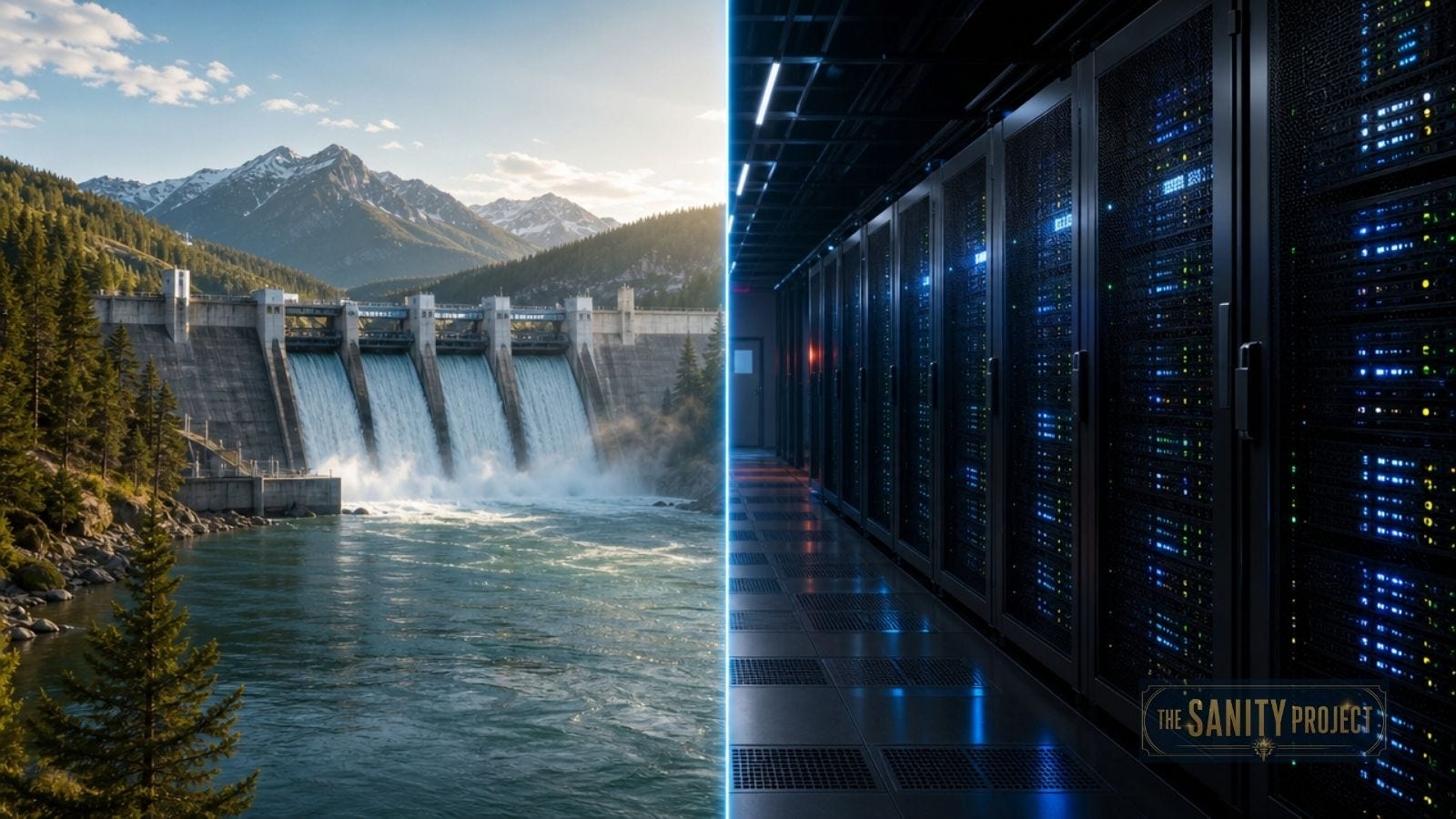
But the sovereignty argument rests on a premise nobody has examined: that hyperscale centralized infrastructure is the only path to sovereign AI capability.
Kinew offered a different model. Manitoba bought its own rack of GPUs and upgraded MERLIN, the Manitoba Education, Research and Learning Information Networks, to handle sensitive provincial data on provincial infrastructure. Sovereignty at the scale the province actually needs, for the data the province actually generates, at a cost the province can actually manage.
The federal strategy sets goals without showing its work. Two hundred billion dollars in additional growth. 250,000 new jobs. AI adoption is rising from 12% to 60% by 2034. None of the strategy documents quantifies the energy demand those targets would require. None of them addresses ratepayer risk. None of them engage seriously with the possibility that the underlying economics of AI infrastructure might not hold up.
Kinew framed the choice in language no one in Ottawa has come close to matching:
“I reject the idea that we have to be slaves to surveillance capitalism in order to participate in the modern economy.” — Premier Wab Kinew
That’s not a technophobe talking. That’s someone with a different theory of what technology is actually for.
Listen to the Sanity Project Podcast

The Question Ottawa Still Hasn’t Answered
There’s one more Kinew line, and it’s the one the federal government will eventually have to respond to. Not because it scores political points, but because it’s economically correct:
“If we could do 100 Selkirk steel mills or a data centre, which one is going to create more long-term benefits, which one is going to create more happiness, which one’s going to create more jobs?” — Premier Wab Kinew
The AI data centre industry has operated on the assumption that jurisdictions with surplus renewable capacity will line up eagerly for hyperscale facilities. Manitoba has some of the cleanest, cheapest electricity in North America. If Manitoba declines to compete, the pool of willing host jurisdictions shrinks quickly.
And three days before the Manitoba decision, the Angus Reid Institute surveyed roughly 1,800 Canadians and found that 68% would oppose a large AI data centre being built near their home. Rural and urban residents were equally resistant. Only 46% agreed that Canada needs domestic AI data centres to maintain digital sovereignty.
The federal government launched its most ambitious technology strategy into a public that, by a two-to-one margin, is ready to say no.
That’s not a messaging problem. It’s a legitimacy problem.

What the Math Is Going to Require
Manitoba’s rejection shifted the burden of proof. The question stopped being “why would a province say no?” It became “what evidence would actually justify a province saying yes?”
That question now follows every proposed hyperscale facility in Canada.
Promises of tax revenue won’t close it. Not when communities can watch Oregon charging data centres 29% more to protect ratepayers, and 14 U.S. jurisdictions pausing to study what they’re being asked to give away.
Sovereignty arguments won’t close it on their own. Not when provincial sovereignty, in practice, looks like one rack of GPUs on MERLIN rather than a 500-megawatt gas-burning operation on 141 hectares of farmland.
What’s required is a public, verifiable cost-benefit analysis. One with honest numbers on energy demand, permanent job creation, ratepayer exposure, and how much economic value actually stays in the province. The kind of analysis Kinew said his government ran. The kind that doesn’t appear anywhere in Ottawa’s June 4 strategy document.
Canada is not anti-AI. It’s asking for receipts.
The industry should get ready for that conversation.
Coming next in this series: The AI data centre gold rush has arrived on Canada's doorstep, and one premier just slammed the door. In Deep Dive 2, we go inside Manitoba's rejection of a $30-billion hyperscale facility and the continental revolt it just joined.
Fourteen U.S. jurisdictions have already enacted restrictions. Oregon utilities want to hike data centre rates by 29%. And the federal government launched a national AI strategy on the same day Kinew said no. Let's talk facts.
The Sanity Project explores the collision between technology, power, and the people who get to decide none of it.
Looking to grow your YouTube Channel?
One of the tools I’m committed to is vidIQ. It helps take the mystery out of YouTube growth by providing keyword research, channel audits, AI-powered content ideas, and competitor insights. Check it out here!

Clone Wab…a thinking man who has the best interests of his province at heart, not a politician posing at the photo ops and mindless of the legacy of disaster left long after he has shuffled off the podium… unlike a certain wanna be PM…. oh, the bullet we dodged.
https://glenroberts911399.substack.com/p/location-location-location?r=1pgr4n&utm_medium=ios