


Mark Carney’s Pipeline Bet Is Canada’s Oxygen Mask Moment
Before Canada can save the planet, Ottawa is betting it needs to save itself first, with a pipeline, a carbon capture deal, and a lot riding on the word “pragmatic.”
Key Takeaways
Carney’s government has directly linked a new West Coast oil pipeline to the advancement of the $16.5 billion Pathways carbon capture project, the “quid pro quo” at the center of his energy strategy.
A $70 billion hydro deal for Churchill Falls and Gull Island, announced in August 2026, plus four small modular reactors under construction in Ontario, form the electrification half of the bet.
Carney has publicly admitted Canada’s emissions “will be higher” in the short term, and Ottawa’s own modeling shows the country falling short of its 2030 Paris target even with these projects.
The strategy has already cost Carney a cabinet minister and split his caucus, which raises the real question: is “pragmatic green” a coherent plan, or a convenient label for retreat?
Every flight attendant gives the same instruction before takeoff. In case of an emergency, secure your own oxygen mask before helping the person next to you. It sounds selfish until you think about the alternative: you pass out mid-rescue and help nobody.
Mark Carney’s energy strategy runs on roughly that logic, and it is making a lot of people furious for reasons that have nothing to do with oxygen.
Since taking office, Carney has pursued what I’ll call “pragmatic green,” not his phrase, but a fair label for what he’s actually doing: expand oil production and pipeline capacity now, use the revenue and political capital that buys to fund an enormous electrification build-out, and hope Canadians accept higher short-term emissions in exchange for a genuinely decarbonized grid later. It’s a bet. Like most bets, it looks either brilliant or reckless depending entirely on whether it pays off.
Here’s what’s on the table and what still needs to happen before anyone can call this a win.
Carney’s climate strategy is a trade: more oil and pipeline capacity now, in exchange for the political room and capital to fund a much larger electrification build-out later.
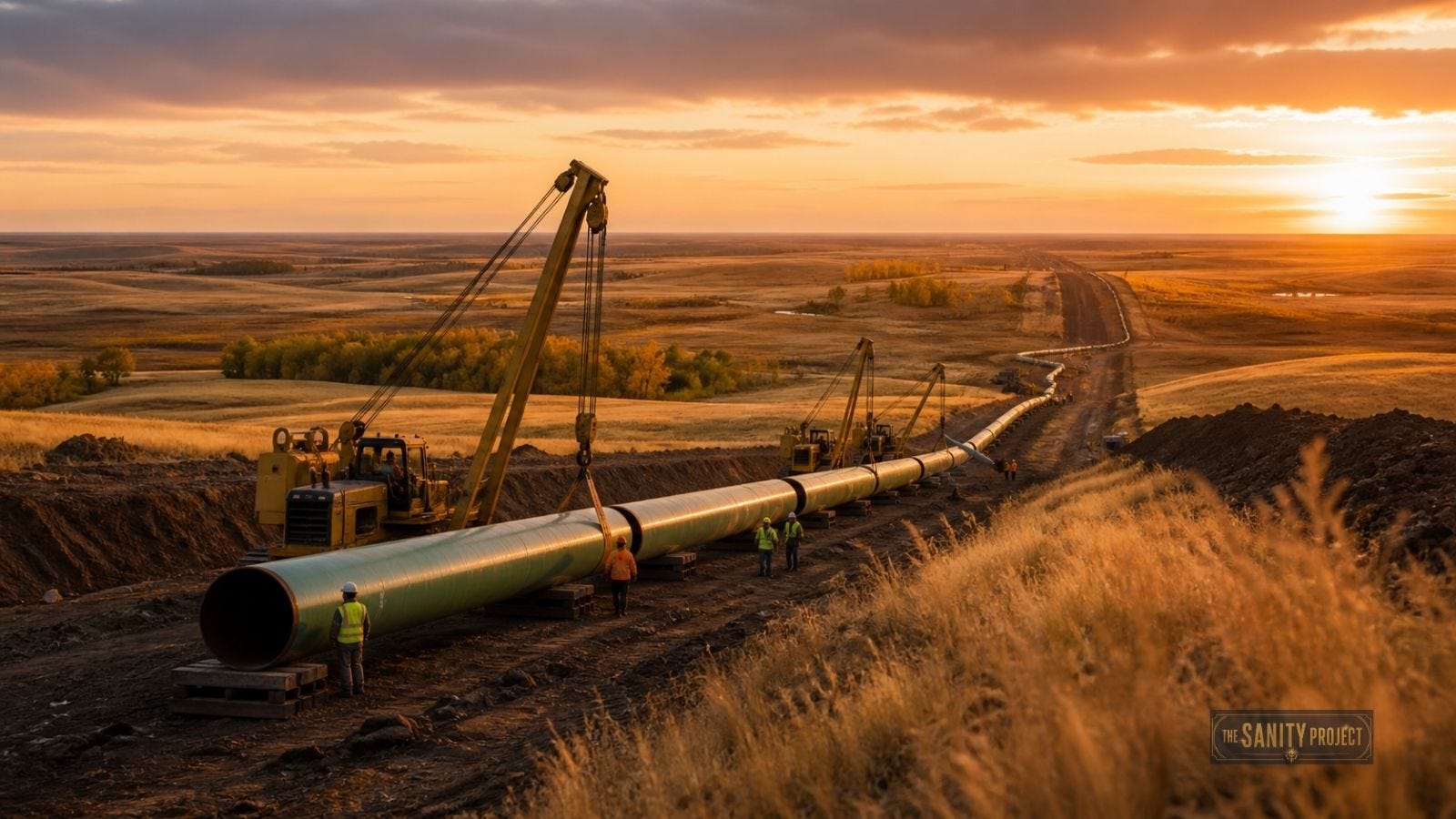
Subscribe to The Sanity Project for fact-checked Canadian energy and politics coverage.
The Pipeline and the Carbon Capture Quid Pro Quo
The pipeline and the carbon capture project aren’t separate initiatives. Ottawa has explicitly made progress on carbon capture a condition for the pipeline moving forward, which is the quid pro quo at the heart of “pragmatic green.”
In July 2026, Carney and Alberta Premier Danielle Smith unveiled a new oil pipeline running roughly along the existing Trans Mountain corridor, from Bruderheim to a new deep-water terminal at Roberts Bank, B.C. People are already calling it TMX2 or Trans Mountain 3, though neither name is official yet, more a placeholder for “the one after the one that tripled in cost.” The price tag sits somewhere between $35 and $44 billion for a line expected to carry over a million barrels a day.
That number alone would be a hard sell to a country that watched the original Trans Mountain expansion balloon from a promised $7.5 billion to nearly $34 billion. So Carney’s government paired it with something else: an agreement signed the same month, committing Alberta, Ottawa, and the five companies of the Oil Sands Alliance (formerly Pathways Alliance) to advance the $16.5 billion Pathways carbon capture project. The network would eventually pipe CO2 from more than a dozen oil sands facilities near Fort McMurray to an underground storage hub near Cold Lake.
This is the quid pro quo Rob, a reader who wrote in about exactly this strategy, described to me: the pipeline pays for increases in defense spending and buys energy independence from the U.S., while the carbon capture piece is supposed to make the emissions math survivable. It’s a real trade, not spin. The agreement itself frames carbon capture progress as a condition for the pipeline to move forward, not as a separate initiative running in parallel.
The pipeline and the carbon capture project aren’t running in parallel. One is the price of admission for the other.
What it isn’t, yet, is built. Both projects remain non-binding at the framework stage. The carbon capture project has no final investment decision and is fighting a coalition of First Nations and environmental groups seeking a judicial review over consultation, and the pipeline has no construction timeline despite Alberta hoping to break ground by 2027. Trans Mountain’s original pipeline has just reached full apportionment for the first time since its opening, strengthening the economic case. It doesn’t finish the political or regulatory one.

Electrification: The Other Half of the Bet
The electrification side of Carney’s bet, the Churchill Falls and Gull Island deal, the National Electricity Strategy, and the Darlington reactors, is real and enormous on paper. None of it is a completed project yet.
If the pipeline and carbon capture deal is the “secure your own oxygen” part of the strategy, the electrification build-out is supposed to be everyone else’s oxygen mask. It’s bigger than most Canadians probably realize.
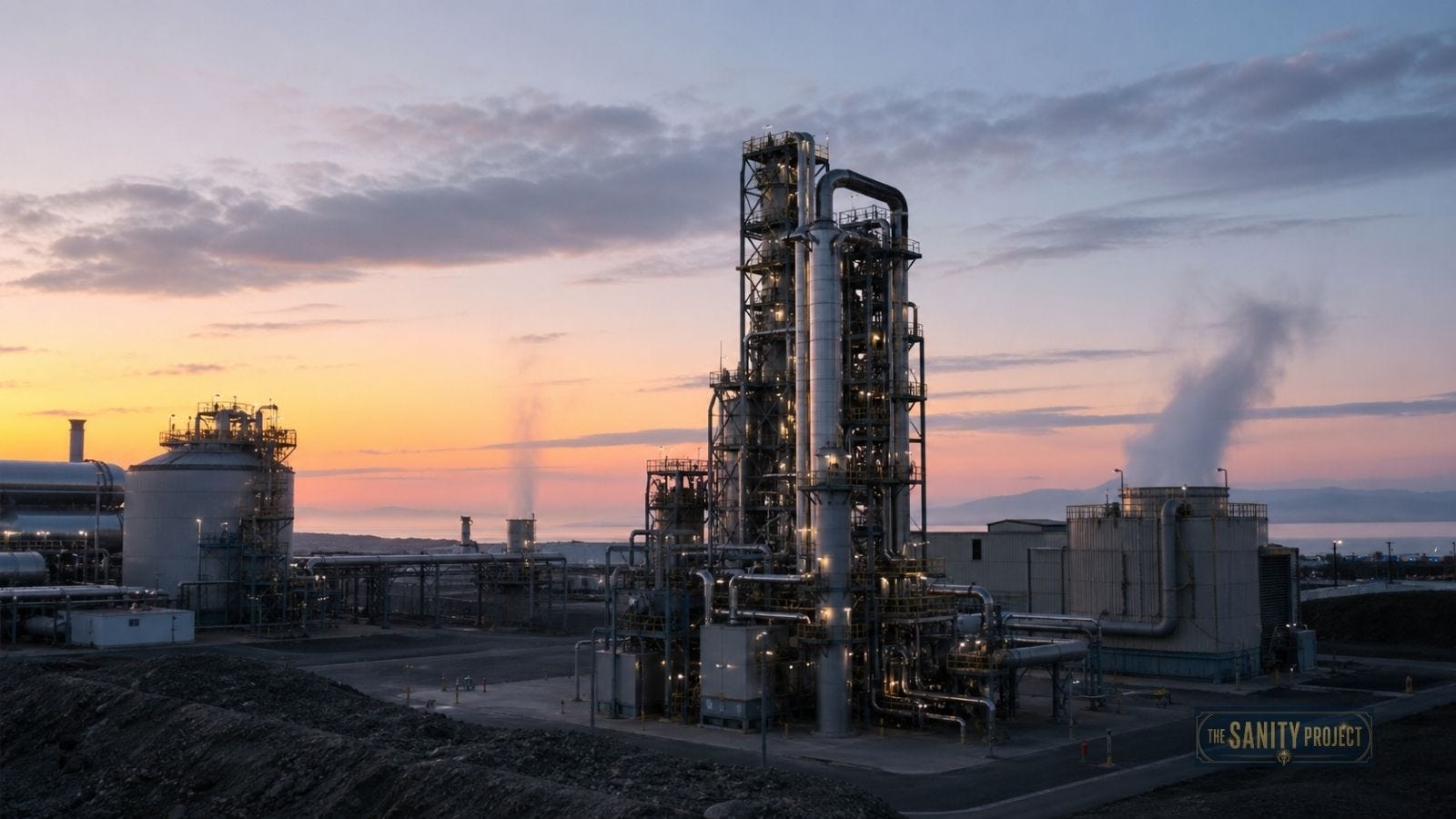
On August 17, 2026, Carney stood alongside the premiers of Quebec and Newfoundland and Labrador to announce a new deal replacing the notorious 1969 Churchill Falls contract. The package, upgrading the Churchill Falls generating station, building the long-stalled Gull Island hydro project, and adding a 2,000-megawatt wind farm, comes with up to $10 billion in federal financing and a loan guarantee for Gull Island.
Ottawa is calling it the largest clean energy investment in North American history, worth close to $70 billion. It’s genuinely a big deal. It’s also not finished: the deal signed in August is a framework agreement, and the parties are targeting final, binding contracts by the end of 2026, with Indigenous consultation in both Quebec and Labrador still ongoing.
Pair that with the National Electricity Strategy Carney launched in May, aiming to double Canada’s grid capacity by 2050 at a cost of roughly $1 trillion, and the four small modular reactors under construction at Darlington, the first grid-scale SMR project in the G7, with commercial operation targeted for 2030, and you get a genuinely coherent picture: more oil in the short term, funding and political room for a much bigger electricity system in the long term.
Whether it happens on schedule is a different question entirely. Canadian megaprojects have a well-documented habit of arriving late and over budget, and none of this is money in the ground yet.
Enjoying this? Subscribe for the next installment.
No spin, just sourced facts.
Mark Carney’s Climate Policies: Retreat or Strategy?
Here’s where the “pragmatic” label gets tested. In a video posted to his own YouTube channel in June, Carney told Canadians directly that “our emissions will be higher in the next few years,” calling the previous climate plan “not sustainable over the long term.” That’s an unusually blunt admission from a sitting prime minister, and it isn’t just rhetoric. A government progress report released in December 2025 showed Canada’s best-case scenario would reach only a 28 percent emissions cut from 2005 levels by 2030, well short of the 40 to 45 percent Paris commitment that Carney insists Canada is still chasing.
That gap is exactly what critics point to. Steven Guilbeault, the former Greenpeace activist who ran Trudeau’s environment file, resigned from cabinet and then from the House of Commons rather than watch the policies he built get rolled back. Fourteen Liberal MPs wrote directly to Carney, objecting to the Alberta energy agreement. To them, “pragmatic green” isn’t a strategy. It’s a rebrand for backsliding, dressed up in enough hydro dams and nuclear reactors to make it politically survivable.
The counter-argument deserves its due, though. Carney took office facing a trade war with a president openly musing about annexation, a country whose oil flows through American pipelines by virtue of geography, and a climate plan that, by the government’s own later admission, was never going to meet its targets anyway. “All of the above” isn’t a satisfying answer if you want a clean break, either toward fossil fuels or away from them.
It might, however, be the only answer that keeps Alberta and Quebec in the same federation while the electricity system actually gets built. Carney’s own framing, that electrification is the path to affordability, competitiveness, and sustainability all at once, is the argument that the short-term emissions bump is the price of buying enough political room to build the bigger thing.
All of the above isn’t a satisfying answer if you want a clean break. It might be the only one that keeps the country together.
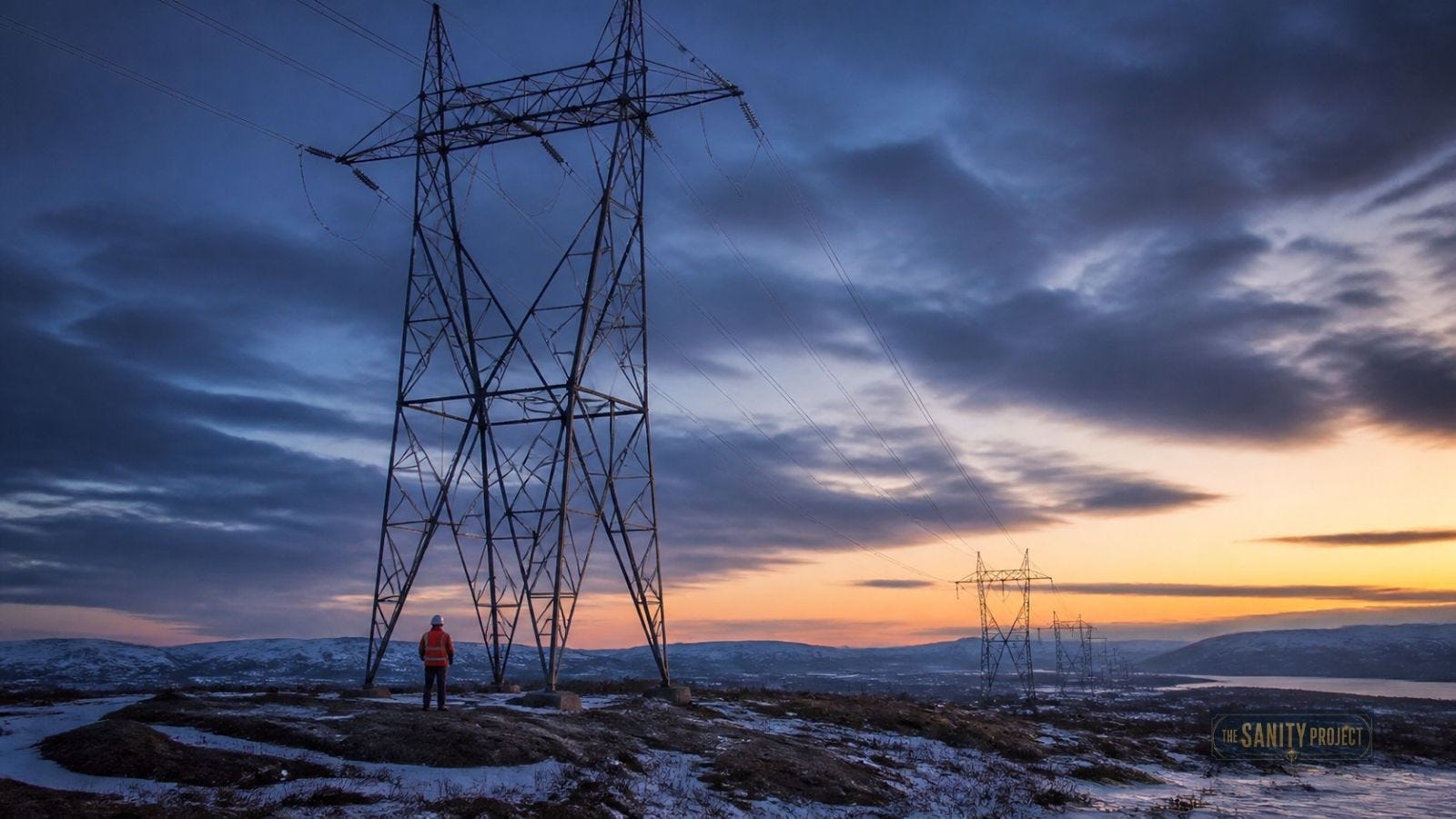
Listen to the Sanity Project Podcast

The Question That Actually Matters
Back to the oxygen mask. The instruction only makes sense with an unstated promise attached: that once your own mask is on, you turn and help the person next to you. Nobody straps on their own mask and then just sits there.
That’s the part of “pragmatic green” nobody can verify yet. The pipeline math is easy enough to follow, and the carbon capture project has a real, if contested, path forward. The electrification side is where the promise lives, and Canadian governments have a long history of announcing generational projects that arrive a decade late, if they arrive at all. Carney is asking Canadians to trust that this time the mask will come off and be shared.
So here’s the real question, and I mean genuinely think about it, not just nod along: if Gull Island and the Darlington reactors are still under construction in 2032, does “pragmatic green” still sound like a strategy, or does it start looking like the retreat critics already suspect it is?
I don’t know yet. Neither does anyone else. That’s kind of the point.
Follow for more fact checks that cut through the noise.
Editor’s View
Rob, the reader whose email sparked this piece, made an argument I hadn’t fully considered: that “pragmatic green” might genuinely be the adult-in-the-room answer, not a dodge. I think he’s half right. The logic holds up on paper better than I expected before I dug into the primary sources.
Where I get stuck is Canada’s track record on exactly this kind of megaproject. Trans Mountain went from $7.5 billion to $34 billion and was years late. Churchill Falls has been “almost happening” in various forms since the 1960s. Betting the country’s climate credibility on hydro dams and nuclear reactors landing on time and on budget is, historically, not the safe bet. I want to believe the oxygen mask gets shared.
I’ve just watched enough Canadian infrastructure promises to know the mask sometimes stays in the overhead bin for a decade. Ask me again in 2030.
Publications Consulted: CBC News, Canada’s National Observer, Global News, The Hub, Government of Canada (Natural Resources Canada, Office of the Prime Minister), Government of Newfoundland and Labrador, Ontario Power Generation, World Nuclear News.

As you said - we don’t know yet. Still too many unknowns. All I can do is hope that everything comes together and gets built and that by 2030 we’re on track for a greener economy. With climate disasters accelerating though, it may not be soon enough. Carney will have to ensure that climate disasters are met with adequate funding or Canadians may turn in the next election. If the Trump threat is dead.