


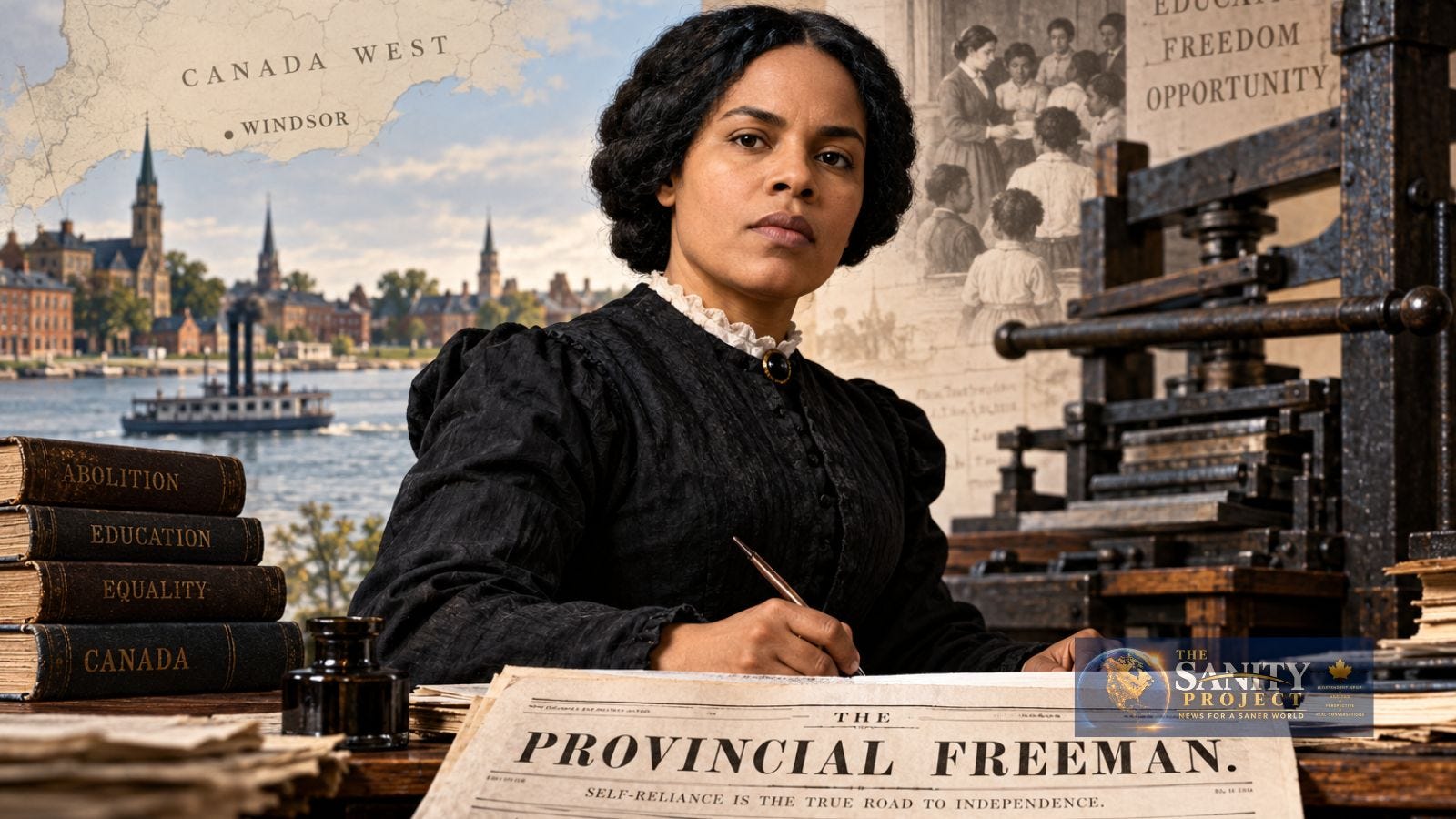
Mary Ann Shadd Cary turned the printing press into a weapon for freedom. In 1853, she founded The Provincial Freeman in Canada West, becoming the first Black woman in North America to publish a newspaper.
Mary Ann Shadd Cary: The Woman Who Fought Lies With a Printing Press
In 1848, Frederick Douglass asked readers of his newspaper a question: what, exactly, should Black Americans do to improve their situation?
A 25-year-old teacher from Delaware wrote back. She had watched conventions come and go, heard the speeches and read the resolutions condemning slavery and demanding equality. She wasn’t especially impressed with all the talking.
Her response could almost serve as a motto for anyone frustrated by politics today: “We should do more and talk less.” Her 1849 letter was published in Douglass’s North Star, a remarkable early glimpse of the philosophy she would spend the rest of her life putting into practice. Library of Congress: Mary Ann Shadd Cary
Her name was Mary Ann Shadd, and for the next four decades she did her best to live by those words. She taught children, challenged segregation, published a newspaper, recruited Black soldiers during the American Civil War and, at 60, earned a law degree.
Some of her most important work happened here, in what is now Ontario. It began because the country where she was born decided that even reaching a free state might no longer keep you safe.
Key Takeaways
Mary Ann Shadd Cary moved to Canada West in 1851 after America’s Fugitive Slave Act made life more dangerous for freedom seekers and the people who helped them.
In Windsor, she established a racially integrated school and challenged the idea that Black Canadians should accept segregated institutions.
In 1853, she founded The Provincial Freeman, becoming the first Black woman in North America to publish a newspaper.
Her newspaper promoted abolition, education, self-reliance and Black emigration to Canada while confronting racism and discrimination inside Canada itself.
She became naturalised in Canada West in 1862.
Her archives are now part of Canada’s Memory of the World Register, recognised as documentary heritage of national significance.
The Law That Changed Everything
Mary Ann Camberton Shadd was born free in Wilmington, Delaware, on October 9, 1823. That word, free, needs some context because Delaware was a slave state.
Her parents, Abraham and Harriet Shadd, were free Black abolitionists, and their home was a station on the Underground Railroad. They helped people escaping slavery, so Mary Ann grew up with the issue quite literally at her doorstep. Parks Canada: Mary Ann Shadd
Educational opportunities for Black children were severely restricted in Delaware. Shadd was educated in Pennsylvania and eventually became a teacher herself, beginning a career in education that would follow her for much of her life.
Then, in 1850, Washington changed the rules.
The United States Congress passed the Fugitive Slave Act, strengthening the machinery used to capture people who had escaped slavery and return them to enslavers. It also imposed serious penalties on people who helped them.
The most frightening part was that reaching a free state no longer guaranteed safety. For families like the Shadds, this wasn’t an abstract argument taking place in Washington. It changed the calculation of where freedom might actually exist.
Thousands of Black Americans began looking north, and Mary Ann Shadd did too. In 1851, she crossed into Canada West, the British colony that would later become Ontario, and settled in Windsor. The Dictionary of Canadian Biography records both her arrival and the extraordinary decade of activism that followed. Dictionary of Canadian Biography: Mary Ann Shadd Cary.
She had found greater legal freedom. Now she wanted to see what she could build with it.
Her First Canadian Fight
One of the first things Shadd did in Windsor was open a school, but not the kind some people expected. Her school was integrated, with Black and white children learning together. U.S. National Park Service: Learning from Mary Ann Shadd Cary
That distinction mattered because segregation existed in Canada too. This is where the comfortable version of Canadian history needs a little adjustment.
Canada offered Black Americans something enormously important. Slavery had been abolished throughout most of the British Empire in 1834, and people escaping American slavery could find legal freedom here. But freedom from slavery did not mean freedom from racism.
Black Canadians still encountered discrimination in employment, housing, public life and education. Separate schools existed in parts of Canada West, and Shadd wanted no part of the argument that segregation was an acceptable price for safety.
She believed Black settlers should participate fully in Canadian society. That put her into conflict with white Canadians who opposed integration, but also with some Black abolitionists who believed separate institutions offered Black communities greater independence and protection.
Shadd was never particularly frightened by disagreement.
Canada Wasn’t Just an Escape Route
In 1852, Shadd published A Plea for Emigration; or Notes of Canada West. It was an unusual combination of information guide, political argument and recruitment brochure.
She wanted Black Americans to know that Canada offered possibilities the United States increasingly did not. People could work, educate their children, own property, establish businesses and build communities without living under the institution of slavery.

A larger argument underpinned the practical advice. Every successful Black family in Canada West was evidence against the racist claim that Black people were incapable of independence.
Not everyone agreed with Shadd’s solution. Some Black American leaders opposed emigration because they believed leaving the United States meant surrendering their claim to equality in the country of their birth.
Others favoured separate Black settlements where refugees could build their own institutions. Shadd rejected that approach as well. She believed integration and self-reliance offered a better path.
Yet A Plea for Emigration had an obvious limitation: it was a pamphlet. Shadd wanted something that could answer critics regularly, report what was actually happening in Black communities and document the lives people were building.
She needed a newspaper.
The Provincial Freeman
On March 24, 1853, the first issue of The Provincial Freeman appeared. Fourteen years before Confederation, a Black woman was building an anti-slavery newspaper in Canada.
Eventually published in Windsor, Toronto, and Chatham, the paper promoted abolition, education, and self-reliance while encouraging Black emigration to Canada. Its motto made the philosophy pretty clear: “Self-Reliance is the True Road to Independence.” Digitised issues survive today in the Canadiana collection. Read The Provincial Freeman in Canadiana
The newspaper also reported something central to Shadd’s argument. Black people were succeeding in freedom.
That mattered because the fight over slavery was also a fight over information. Supporters of slavery had devoted generations to manufacturing arguments that Black people were incapable of independence and required white control.
Shadd had an answer that was difficult to dismiss because she could point to actual people. Black families were establishing homes, businesses, schools and communities across Canada West. The evidence was happening around her, and The Provincial Freeman gave her a way to publish it.
There was just one problem. In 1853, even many people sympathetic to abolition weren’t quite ready to take instructions from a Black woman.
So the woman running the newspaper couldn’t put her own name on it at first.
🔒 She Made It to Canada. That’s Where the Story Really Starts.
By this point, Mary Ann Shadd had already done more than most people accomplish in a lifetime.
She had watched American law make freedom less secure, crossed into Canada, opened an integrated school, challenged segregation and created a newspaper to prove that Black families could build successful lives in freedom.
And she was barely 30.
What happened next is even more remarkable.
Behind the free subscriber gate: the woman secretly running her own newspaper, her refusal to give Canada a free pass on racism, the wonderfully familiar problem of subscribers who wouldn’t pay, her return to America during the Civil War, a law degree at 60, and the fight for women’s voting rights that occupied the final decades of her life.
And there is one more Canadian detail that changes how we should remember her.
Subscribe for free to read the full story of Mary Ann Shadd Cary.

Thanks for writing this history. Find Freedom in Canada by promoting that Freedom.