


What Is the Notwithstanding Clause? How It Affects Your Rights
What the notwithstanding clause does, who it affects, and why Canadians should care.
Imagine a government telling us its new law is fair, necessary, and good for everyone. Then, in the same breath, it takes steps to prevent courts from striking down that law for violating certain rights.
That should get our attention. When politicians are that confident about their homework, we should wonder why they are so keen to stop anyone from marking it.
Canada’s notwithstanding clause allows legislatures to override certain Charter protections, preventing courts from striking down laws. It is legal, deliberate, and part of our Constitution. None of those facts makes every use of it wise or fair.
The question is bigger than whether a premier can use it. Which rights is the government overriding, and why should the rest of us accept that?
What is the notwithstanding clause, and how does it work?
Section 33 of the Canadian Charter of Rights and Freedoms allows Parliament or a provincial legislature to expressly declare that a law will operate notwithstanding specified Charter rights. Territorial legislatures can use it too.
An override can last up to five years, and the legislature can renew it. The declaration identifies which law or provisions the override covers. It does not switch off the entire Charter for everyone.
The federal government’s Charter guide explains which rights the clause can override:
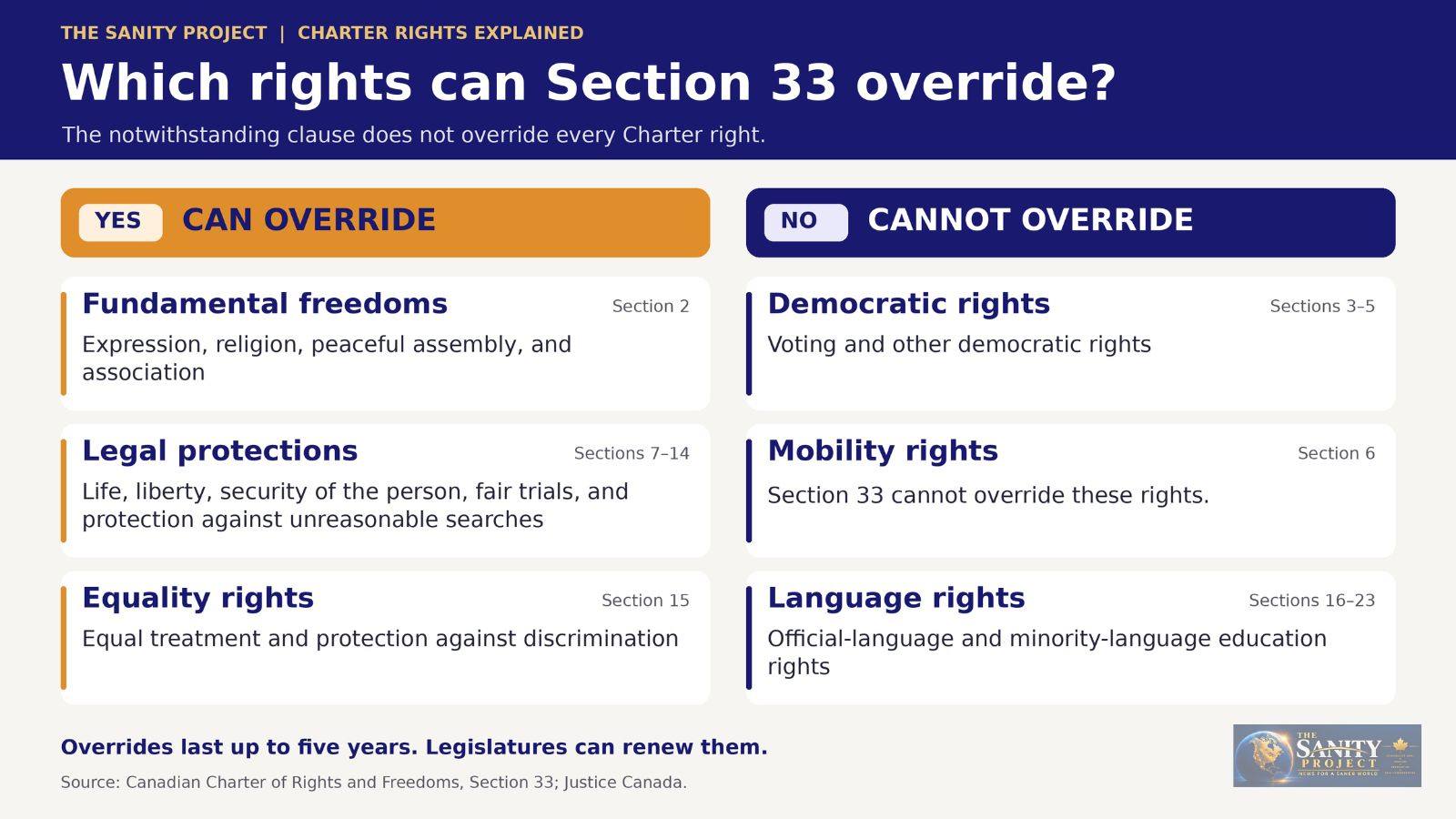
Those first three rows are hardly decorative. They concern our ability to speak, organise, receive equal treatment, and challenge government interference in our lives.
A premier also need not declare an emergency or wait to lose a court case. Justice Canada explains that invoking Section 33 does not require a substantive justification for the override.
That is a remarkably effective tool to put beside rights we describe as fundamental. Canadians should know exactly what it can do before accepting a government’s cheerful explanation of why it needs one.
The Charter already allows reasonable limits.
A familiar defence goes something like this: governments need flexibility, judges cannot run the country, and rights cannot be absolute. We can understand the need for practical government without swallowing that argument whole.
The Charter already provides a mechanism for addressing reasonable limits under Section 1. A government defending a rights-limiting law normally has to show that its goal matters and justify the approach it chooses.
Courts examine whether the measure serves that goal, limits rights no more than is reasonably necessary, and produces benefits that justify the harm. The test leaves room for governing while demanding evidence and a serious explanation.
Section 33 allows a legislature to prevent courts from invalidating a law on the grounds of the rights its declaration names, even if it doesn’t meet that justification test. Using it does not automatically prove the law would fail. It does, however, shield the government from that consequence.
We should expect more than a slogan when governments limit our rights. We should not mistake a press conference announcing that everything is fine for proof.
A constitutional compromise, with consequences
The clause emerged from the negotiations that produced the Charter in 1982. Provincial leaders wanted to preserve a role for elected legislatures alongside the courts’ new power to enforce constitutional rights.
Its supporters were not all conservatives. Historical research by Eric Adams and Erin Bower describes Saskatchewan NDP Premier Allan Blakeney’s concern about protecting people from harm arising from economic and social systems.
That history matters because it keeps us honest. Section 33 was a deliberate compromise, rather than a secret trick invented by today’s premiers.
But knowing why a power exists does not settle whether a government is using it responsibly. A constitutional bargain leaders struck more than four decades ago deserves scrutiny when it reaches into today’s classrooms, workplaces, and personal lives.

How Alberta, Saskatchewan, and Quebec use the notwithstanding clause
Quebec adopted Bill 21 in 2019. The law banned certain public officials, including teachers and police officers, from wearing religious symbols at work. It included a notwithstanding declaration.
Whatever our own religious beliefs, we should be able to distinguish a government that treats religions equally from one that restricts what certain employees can wear. A person’s qualifications do not vanish because their faith is visible.
In Saskatchewan, the government invoked the clause in October 2023 for its Parents’ Bill of Rights. It required parental consent before school staff could use a new gender-related name or pronouns for students under 16.
The Saskatchewan Human Rights Commission urged the government to reconsider, warning about the effects on vulnerable young people. Its objection was about the rights and welfare of real children, not an abstract legal puzzle.
Alberta provides more recent examples. Its government says it used the clause in October 2025 to end the teachers’ strike and impose terms for the central bargaining agreement.
Then, in December 2025, Alberta invoked it to shield restrictions involving gender-related health care, school names and pronouns, and participation in women’s and girls’ sports.

The government presents those measures as protecting children, parents, and fair play. We should judge them by the evidence and their effects, including what happens to the people whose rights the government pushes aside.
These examples show why the clause matters to ordinary Canadians. It can affect a teacher’s working conditions, a student’s treatment at school, or someone’s ability to work while wearing a religious symbol.
What can still stop a government that overrides rights?
An override is powerful, but Canadians still have ways to challenge it. Subscribe for free to read how workers and unions forced Ontario’s government to retreat, why the five-year limit offers less protection than it sounds, and the question we should put to every politician defending Section 33.


Bo, is there a limit to the number of times a government can use a notwithstanding clause in any given time frame? Does it matter?