


New Proposed Arctic Highway Route Won't Cross N.W.T.'s Biggest Diamond Mines, First Nations Say
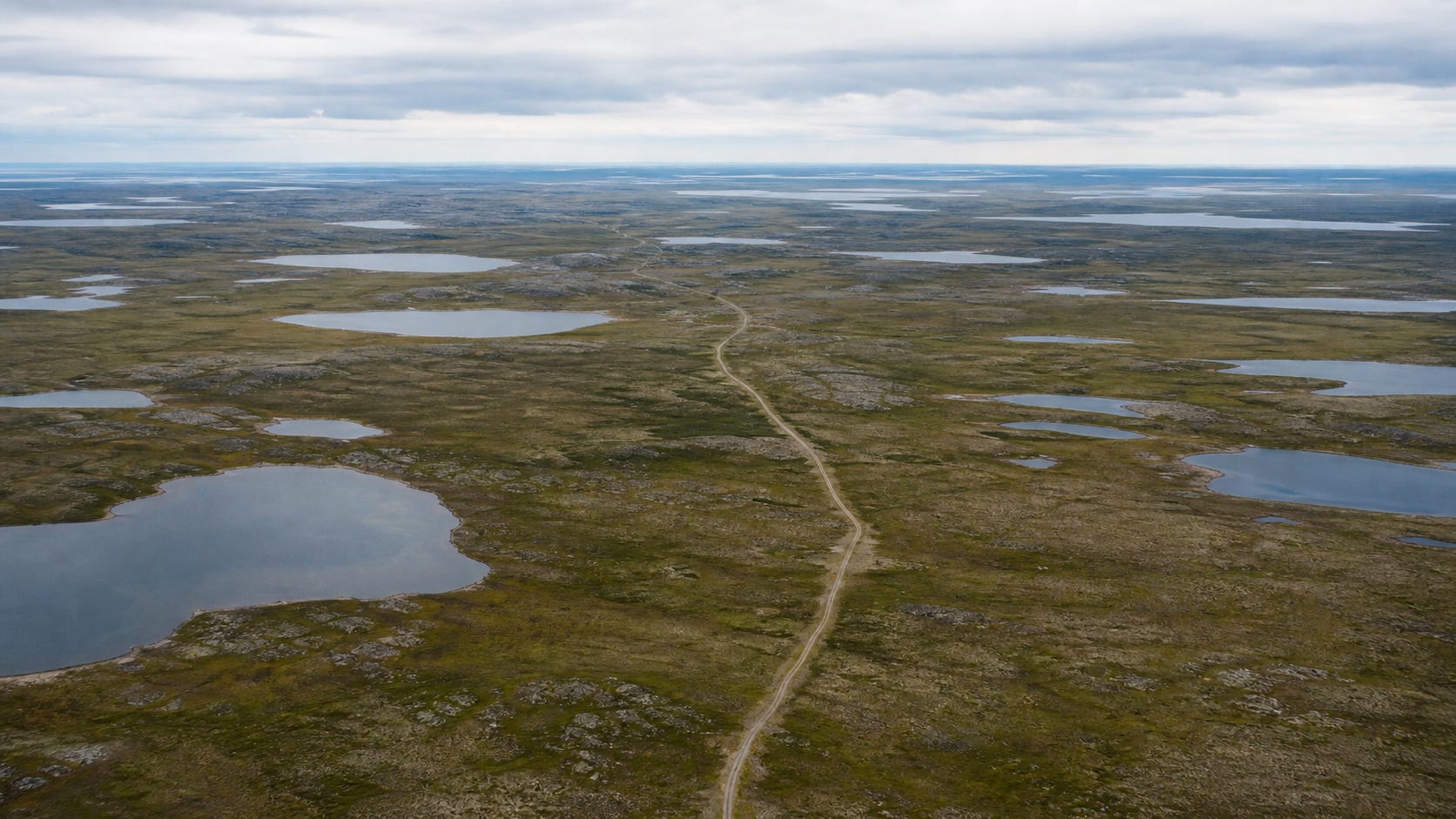
The Yellowknives Dene First Nation and the Tłı̨chǫ Government announced Saturday that they have reached consensus on a proposed corridor for the Arctic Economic and Security Corridor (AESC), a proposed all-season road through the Northwest Territories that would eventually connect to Nunavut’s Grays Bay Road and Port.
The AESC is an Indigenous-led project through the Slave Geological Province, a mineral-rich region in the North Slave region of the N.W.T. It is being advanced through a partnership between the Tłı̨chǫ Government and Yellowknives Dene First Nation, in collaboration with the Government of the Northwest Territories. If completed alongside the connecting Grays Bay project, it would become Canada’s first land-based link between the national highway system and the Arctic Ocean. The federal government referred the roughly 400-kilometer project to the Major Projects Office in March, as Prime Minister Mark Carney announced a broader plan to defend and build out Canada’s North.
The corridor released Saturday runs west of Yellowknife rather than through it, with a minimum 15-kilometer setback from the city’s boundaries, and is roughly 30 kilometers wide. The two Indigenous governments describe it as a proposed corridor for further route planning, not a final alignment. It runs west of Discovery Mine, Wekweètì, and Point Lake before ending near Izok Lake, avoiding the route originally proposed along the Tibbitt to Contwoyto winter road, which passes the Diavik, Ekati, and Gahcho Kué diamond mines.

Tłı̨chǫ Grand Chief Jackson Lafferty said the route was chosen “to reduce the harm to caribou as much as we can,” while acknowledging a road through the barrenlands will still have impacts that need to be managed. The two governments said the agreement follows more than a year of technical and community-led studies combining traditional knowledge with Western science, with caribou protection, long-term prosperity, and Indigenous leadership cited as priorities in choosing the route.
Engineering, environmental assessment and regulatory work will follow, along with engagement with neighbouring Indigenous governments, affected communities and other interested parties over the coming weeks and months. N.W.T. Premier R.J. Simpson and Infrastructure Minister Caroline Wawzonek said the territorial government supports proceeding with the corridor for further engagement. Wawzonek described the project as nation-building, saying it would open access to one of Canada’s most significant and still largely unexplored critical mineral regions while strengthening Arctic sovereignty.
Listen to the Sanity Project Podcast

Canada needs more of these nation building projects. They will improve our economy,sovereignty and pride in Canada and what Canadians can accomplish when we work together.
Wow. Thank you for informing us about this. I'm really happy to see that the indigenous communities are fully involved in the decision making process.