


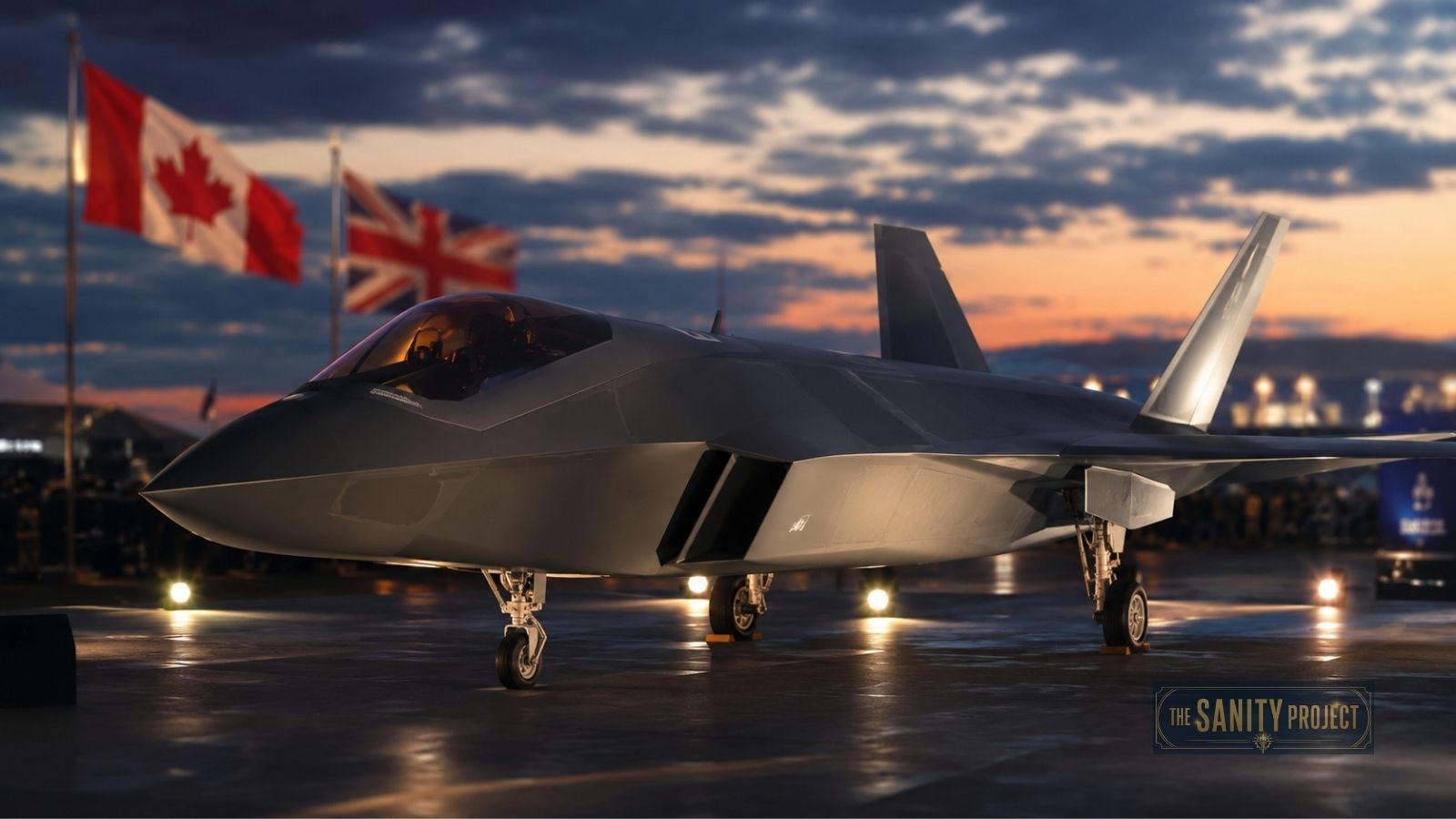
Ottawa Is Building An Escape Hatch From America’s Fighter Jets, And It Hasn’t Cost A Cent
Canada is expected to formally join the Global Combat Air Programme as an observer this week, according to multiple defence outlets that are tracking the deal ahead of an announcement in London at the Farnborough International Airshow. The agreement costs Ottawa nothing today. No funding, no vote, no binding obligation. That is exactly the point.
GCAP is the sixth-generation stealth fighter being built by the United Kingdom, Italy and Japan, formed when Britain’s Tempest project merged with Japan’s F-X program in 2022. BAE Systems, Leonardo and Mitsubishi Heavy Industries are building the airframe, with Rolls-Royce, Avio Aero and IHI supplying engines. The jet is meant to enter service by 2035, flying alongside drones and fusing sensor data across what the program calls a combat cloud, according to Breaking Defense’s reporting on the Canadian talks.
Observer status gets Canada a look inside that programme: classified operational concepts, industrial structure, technical parameters, all without a euro committed and without a seat at the voting table. Defence Minister David McGuinty is expected in London this week alongside his British, Italian and Japanese counterparts to make it official, SOFX reports. Ottawa itself has not confirmed the deal.
Timing helps Canada’s case. A rival European fighter project between France, Germany and Spain collapsed earlier this year, leaving GCAP as the last major Western alternative outside the American defence-industrial base, per Shephard Media’s coverage of the deal. Saudi Arabia wants the same observer door Canada is walking through, drawn by the chance to build its own defence manufacturing base. Carney has spent 2026 talking about middle powers building leverage together rather than relying on a single patron, and this is that idea showing up in a procurement memo rather than a speech.
That caution is not the real story. The real story is what this continues. Carney’s government has already opened a review of its multi-billion-dollar F-35 contract with Lockheed Martin amid trade tensions with Washington, and picked Sweden’s Saab GlobalEye for Canada’s next airborne early warning platform. GCAP adds a third thread: a possible sixth-generation alternative that never puts Ottawa in a room where only one country gets to decide yes or no.
None of this ends Canada’s F-35 program tomorrow. Eighty-eight jets are on order, with the first sixteen furthest along and four already paid for in full, and Canadian pilots begin training in Arizona this year. But defence procurement is a decades-long bet, and Carney’s government just bought itself the right to study a real alternative before it has to place the next one. Washington spent years assuming Ottawa had nowhere else to go, and that assumption just got a lot more expensive to hold.
9 years for the 6th generation platform dubbed GCAP is not a long time. The options being considered are prudent, given the instability of accepted procurement practices, the opportunity to rapidly develop a capable and domestically produced fighter with a proven record in like environmental arenas, and Canada's established cooperation with Saab. I imagine the framework is already in planning, and announcements will trail actual concrete actions. GCAP, aka 'Tempest+FX' is not a pipe dream or theoretical proposal. Canada has an opportunity to observe and perhaps integrate into future air defense, with stable and proven allies.
Where does Gripen fit in? Is this instead of the possibility of those, or alongside them as alternatives to the F-35s?