


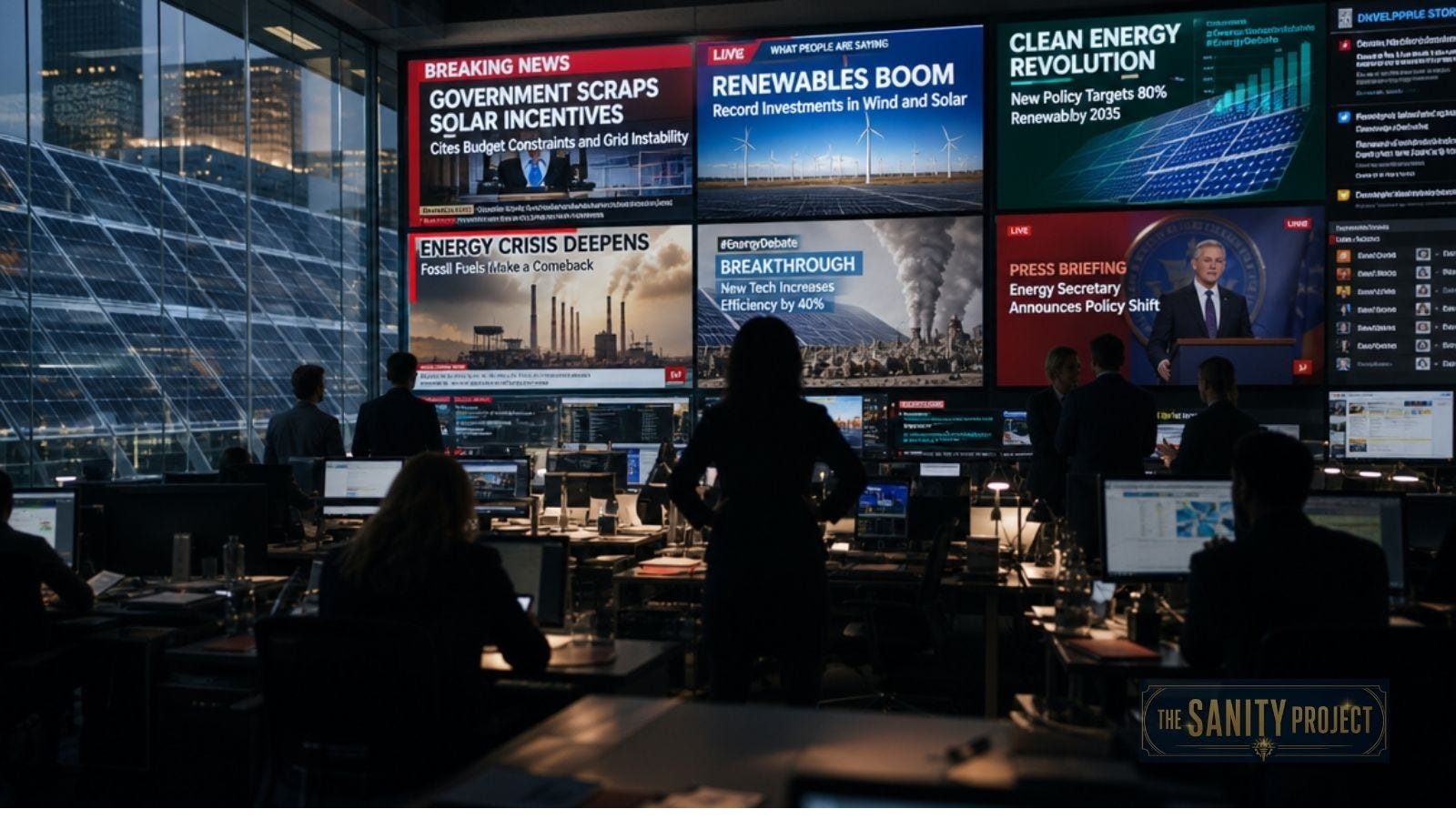
Renewable energy is now cheaper than fossil fuels across much of the world. Investment continues to pour into the sector, battery storage technology improves almost every year, and governments everywhere are racing to secure long-term energy independence. By almost every measurable economic indicator, renewables are winning.
And yet the public conversation surrounding renewable energy feels more hostile than ever.
That contradiction should concern people far more than it currently does. Because if wind and solar are becoming cheaper, more scalable, and more strategically valuable every year, why are governments freezing renewable projects? Why are television networks suddenly producing emotional hit pieces about battery storage? Why are solar panels and electric vehicles increasingly treated like political identity symbols instead of infrastructure?
The deeper you look, the stranger the disconnect becomes.
Eventually, you begin to realize this was never just about energy. It was about narrative control.
⚡ The Numbers No Longer Match the Story
For years, critics argued that renewable energy simply was not ready. The technology was supposedly too expensive, too unreliable, too dependent on subsidies, and too disconnected from the realities of modern industrial economies. That framing dominated political debate for well over a decade.
But the numbers no longer support it.
According to the International Renewable Energy Agency (IRENA), roughly 91% of new renewable energy projects worldwide are now cheaper than the least expensive fossil fuel alternatives. Utility-scale solar and onshore wind continue undercutting coal and natural gas in major markets around the world, while battery storage systems become increasingly affordable and efficient.
That is not a niche environmental milestone. It represents one of the most significant economic shifts of the modern industrial era.
Because once the cheapest form of energy changes, every political system, investment structure, and industry built around the old model starts feeling pressure simultaneously.
And that is exactly what we are watching happen now.
The public conversation around renewables has not become more hostile because the technology is failing. In many ways, the hostility appears to be intensifying precisely because the technology is succeeding faster than expected.
Under normal market conditions, a technology that becomes cheaper, scalable, investment-friendly, and strategically valuable tends to spread rapidly. Smartphones replaced flip phones. Streaming replaced DVDs. Digital cameras erased film almost overnight.
But renewable energy did not simply enter a competitive marketplace. It collided with one of the most politically connected and economically entrenched industries on Earth.
And when industries can no longer compete primarily on economic grounds, they often shift the conflict elsewhere entirely — into politics, media, identity, and culture.
That shift may be the real story unfolding around renewable energy right now.
🧠 How Renewable Energy Became a Cultural Flashpoint
One of the strangest aspects of the modern energy debate is how quickly renewable infrastructure became culturally loaded.
Solar panels stopped being discussed primarily as tools for generating electricity and began to become symbols in broader political identity wars. Electric vehicles became tribal markers. Wind turbines became emotional flashpoints in online culture battles that often had very little to do with energy itself.
That transformation did not happen naturally.

It was built through years of political messaging, media framing, and emotional association. Because once a technology becomes culturally divisive, people stop evaluating it rationally and begin evaluating it emotionally. Emotional reactions are significantly easier to manipulate than economic data.
A homeowner trying to lower electricity bills rarely asks whether rooftop solar is ideologically left-wing or right-wing. But if enough messaging repeatedly associates renewable energy with elitism, environmental extremism, urban politics, or government overreach, the discussion gradually stops being about infrastructure altogether.
It becomes about identity.
And identity changes the rules of debate entirely.
Once people feel that accepting or rejecting a technology says something about who they are culturally or politically, evidence alone starts losing persuasive power. At that point, the conversation no longer revolves around efficiency, affordability, or engineering. It revolves around belonging.
That dynamic increasingly shapes not only energy debates, but much of modern political life itself.
🇨🇦 Alberta Became a Warning Sign
Alberta provides one of the clearest examples of this contradiction playing out in real time.
For years, Alberta’s government positioned itself as aggressively pro-business, pro-investment, and strongly supportive of free-market economics. At the same time, the province possessed some of the best wind and solar potential in Canada, and a deregulated electricity market made it highly attractive to investors.
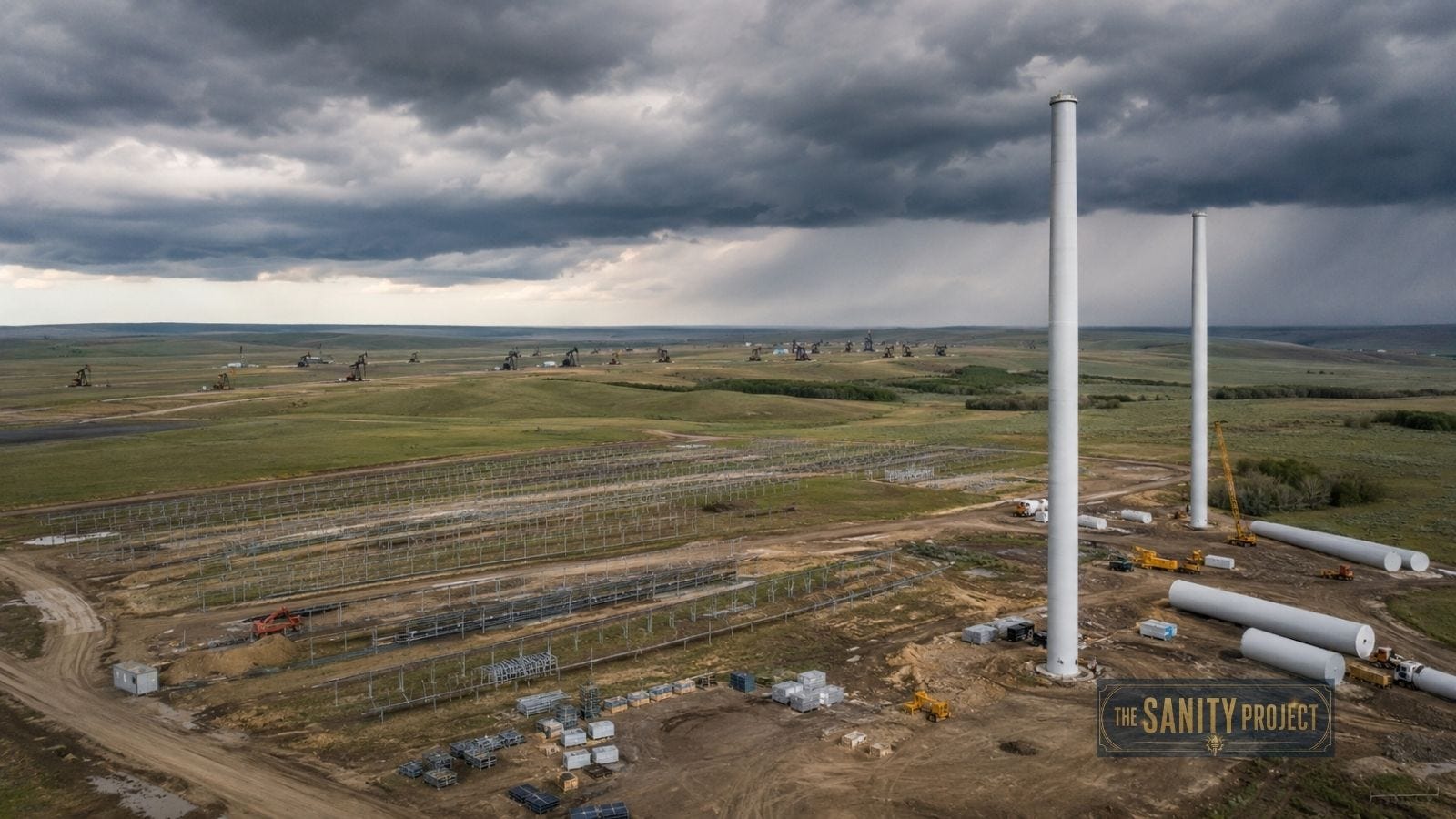
Private capital responded exactly as free-market theory would predict.
Renewable projects expanded rapidly. Major corporations signed long-term agreements for clean electricity generation. Rural landowners and farmers began earning stable lease revenue from wind and solar developments while continuing agricultural operations on the same land.
By 2022, Alberta had become the center of renewable energy growth in Canada.
Then the provincial government abruptly froze new renewable projects.
Officially, the concerns involved land reclamation, visual impacts, agricultural preservation, and regulatory oversight. But the broader contradiction was impossible to ignore. A government that had consistently promoted free markets suddenly resorted to direct state intervention to halt one of the fastest-growing sectors of private investment in the province.
Not because the market rejected renewable energy, but because the market embraced it too aggressively.
That distinction matters enormously.
The backlash was not triggered by technological failure. It emerged alongside accelerating momentum, growing investment confidence, and rapidly expanding market adoption. Once you recognize that pattern clearly, similar examples begin appearing elsewhere as well.
📺 The Media War Around Renewable Energy
The media landscape surrounding renewable energy has become equally revealing.
In Australia, several high-profile television segments framed battery storage systems and renewable infrastructure as environmentally destructive and morally compromised. Emotional footage of dangerous cobalt mining operations was repeatedly tied to modern renewable energy systems, creating the impression that the clean energy transition itself was built on exploitation and hypocrisy.
The problem was that much of the framing relied on outdated or incomplete information.
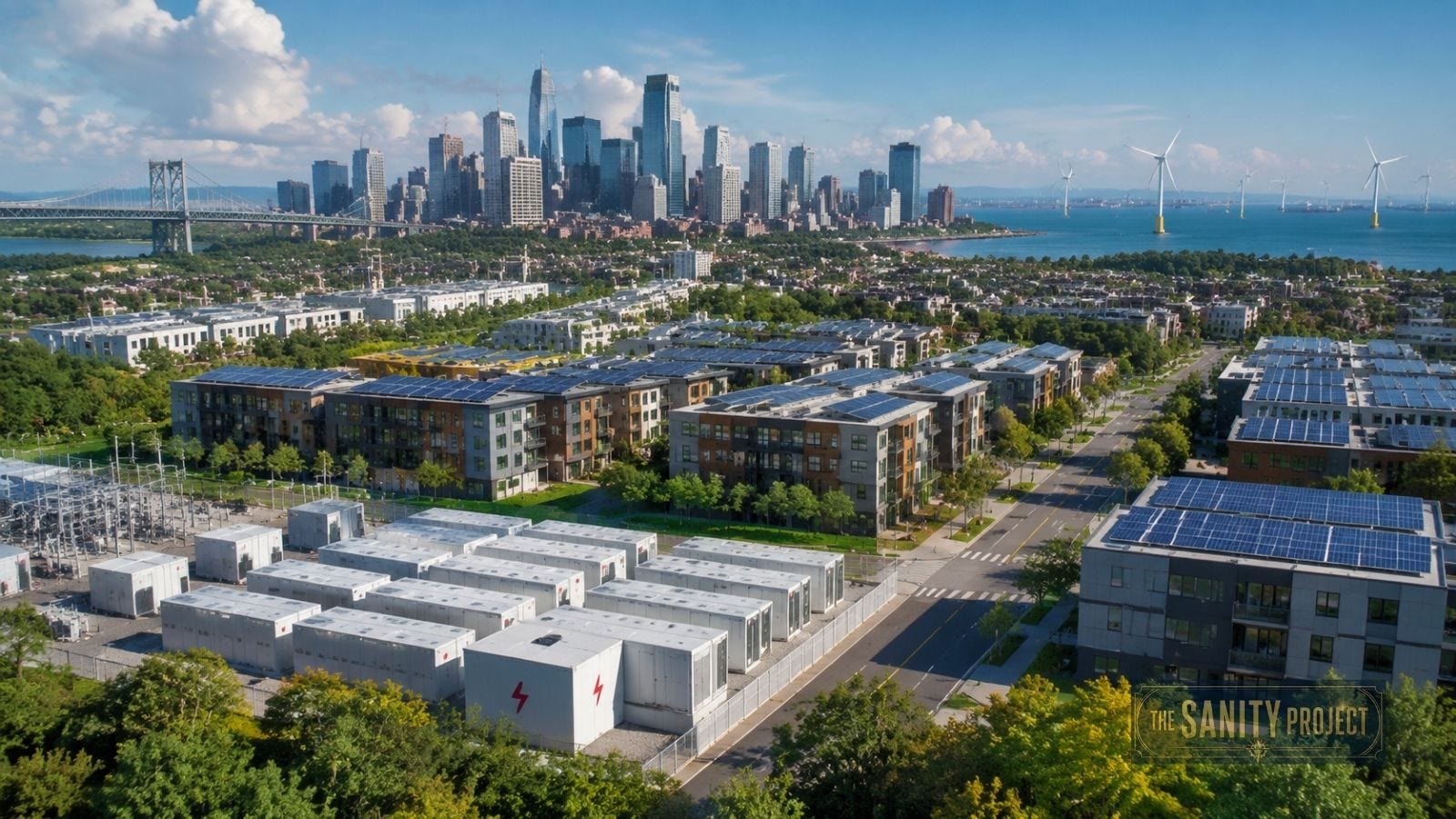
Modern grid battery systems increasingly use lithium iron phosphate (LFP) chemistry, which dramatically reduces or eliminates cobalt dependency altogether. But technical nuance rarely spreads as effectively as emotional imagery, especially in algorithm-driven media ecosystems that reward outrage and conflict over precision.
And that is what makes modern misinformation so effective.
It rarely relies on fabricated, giant lies. More often, it relies on selective framing, omission, emotionally charged visuals, partial truths, outdated data, and exaggerated conclusions. The objective is not always to convince people of a single falsehood. Sometimes the goal is simply to create enough confusion that people stop trusting anything.
Once that happens, the status quo survives by default.
That may be one of the most important dynamics shaping modern information systems. The real product being sold is not always fossil fuels or political ideology. Sometimes the real product is confusion itself.
Because confusion slows action. Confusion delays infrastructure. Confusion weakens political consensus. And exhausted populations rarely push for large-scale structural change.
🌍 Renewable Energy Is Also Becoming a National Security Issue
What makes this conversation even more significant is that renewable energy is no longer simply an environmental issue.
It is becoming a geopolitical one.
The war in Ukraine exposed how vulnerable fossil fuel dependency can make entire nations. Europe’s rapid acceleration toward renewable expansion was not driven solely by climate policy. It was also driven by national security concerns and the realization that energy dependence creates enormous geopolitical vulnerability.
Countries reliant on imported fossil fuels remain exposed to supply disruptions, shipping chokepoints, pipeline disputes, price shocks, and foreign political leverage.
Renewable energy offers something fundamentally different: localized generation.
No foreign government can embargo sunlight. No hostile navy can blockade the wind.
And once battery storage becomes cheaper and more scalable, decentralized energy systems will become significantly more resilient to external disruptions. That changes the strategic landscape in ways many political systems are only beginning to fully understand.
Which raises an uncomfortable question.
If renewable energy increasingly represents lower long-term costs, greater energy independence, improved grid resilience, and enhanced geopolitical security, why is so much political and media energy still being spent trying to slow public enthusiasm for it?
At some point, repeated contradictions stop looking accidental.
Patterns matter.
🔍 This Was Never Just About Energy
And this is where the story stops being only about renewable energy.
Because once you notice how narratives are manufactured around energy, you start noticing similar mechanics everywhere else. You begin recognizing how identity gets weaponized, outrage gets monetized, confusion gets amplified, and public perception becomes increasingly engineered through emotional framing rather than evidence.
The renewable energy debate is simply one of the clearest modern examples because the economic contradiction is now so visible. The technology works. The investment is real. The cost curves are measurable.
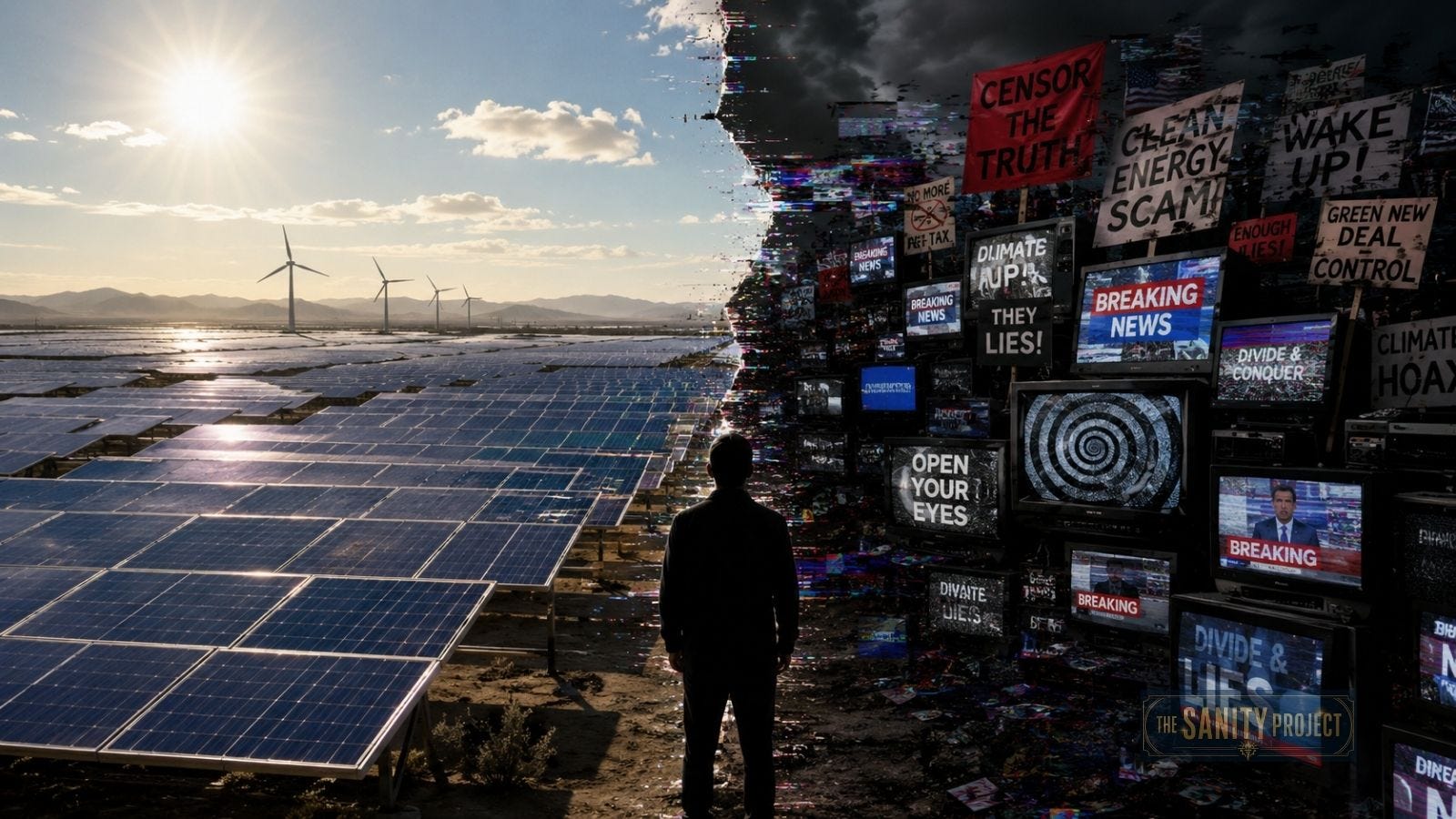
And yet, enormous political and media systems continue to treat renewable energy not primarily as infrastructure but as a cultural threat.
That should tell us something important about how modern information ecosystems actually function.
Because the battle over renewable energy is no longer fundamentally about electricity generation. It is increasingly about who gets to shape the public’s understanding of reality itself.
And once you realize that, the conversation becomes much larger than solar panels or wind farms. It becomes a question of how modern societies decide what is true, what is threatening, and who benefits when the public remains too confused to tell the difference.
🧠 Final Thought
When the data says one thing but the narrative says another, that gap rarely appears by accident.
And once you begin noticing how narratives are manufactured around renewable energy, you start recognizing the same machinery everywhere else, too.
That may be the most unsettling realization of all.
If you enjoy deep dives that separate data from narrative, subscribe to The Sanity Project for more investigations into the stories shaping modern politics, media, technology, and public perception.
Sources Used:
https://www.pembina.org/pub/investment-impact-albertas-renewable-energy-moratorium
https://thetyee.ca/Opinion/2024/08/06/UCP-Gutted-Alberta-Renewable-Energy-Future/
https://thetyee.ca/Opinion/2023/07/19/Smith-Presses-With-Handouts-Oil-Gas/
https://thenarwhal.ca/alberta-moratorium-renewables/
https://www.abc.net.au/mediawatch/episodes/spotlight/106613562
https://www.pewresearch.org/science/2026/04/03/americans-shifting-views-on-energy-issues/
https://www.sciencedirect.com/science/article/pii/S2542519626000082
https://www.nrdc.org/bio/zanagee-artis/unveiling-big-oils-campaign-lies
https://www.fractracker.org/2024/04/the-power-of-misinformation-in-blocking-clean-energy-reform/
https://www.gem.wiki/Kerry_Stokes
https://www.wri.org/insights/state-clean-energy-charted
https://edmontonjournal.com/news/politics/alberta-ucp-danielle-smith-renewable-energy-restrictions