


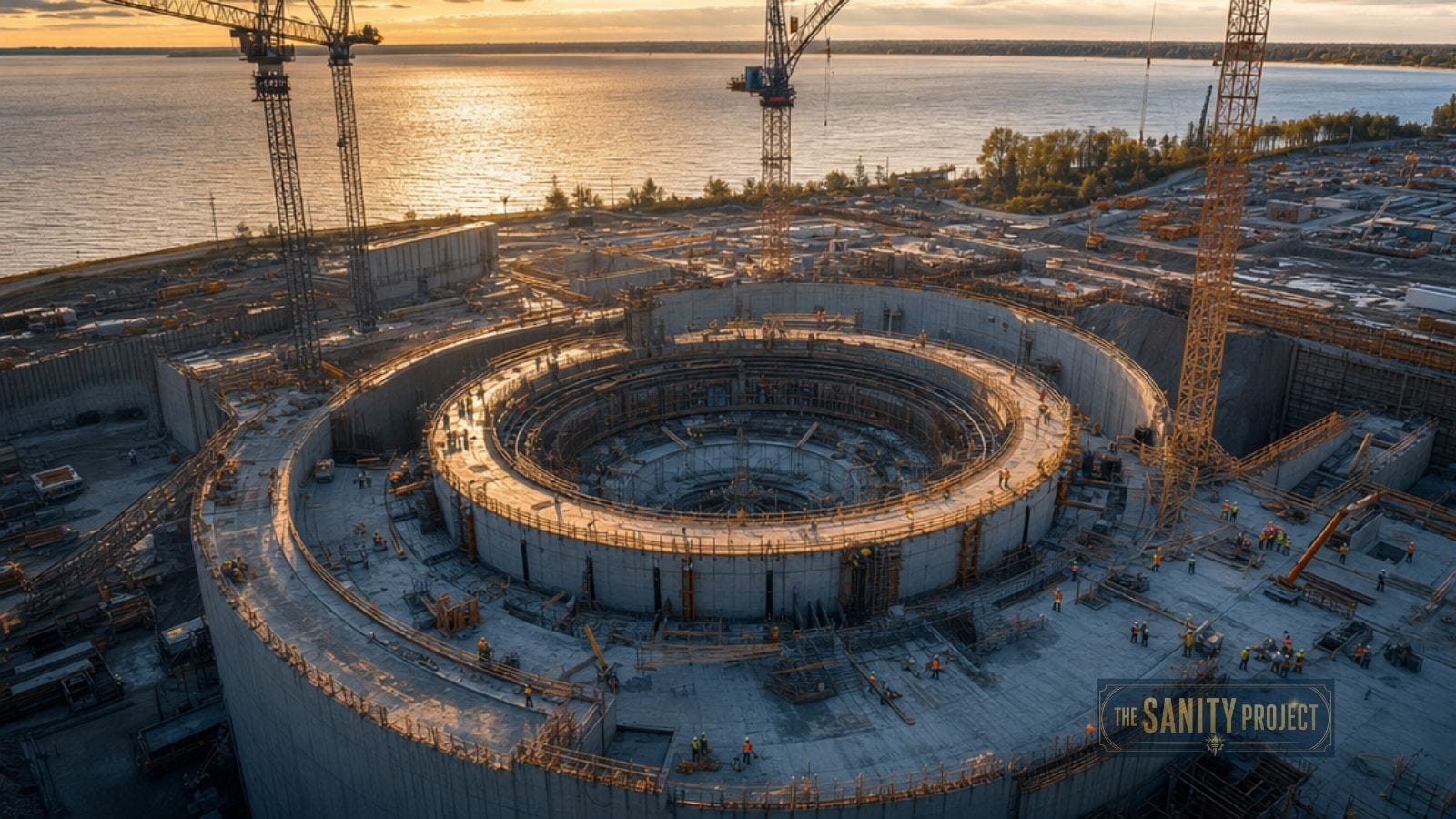
In the first week of May 2026, three things happened simultaneously that — in a more coherent media environment — would have been the top story on every national outlet for a week straight.
The federal government announced a new, transformative National Nuclear Energy Strategy, the first of its kind in a generation. The Ontario government signed a cost-sharing deal to begin pre-development on nearly 5,000 megawatts of new nuclear capacity. And Ontario Power Generation confirmed that the Basemat module at the Darlington site in Bowmanville was complete — meaning the physical foundation of Canada’s first commercial small modular reactor had just been poured into the ground.
The first G7 nation to build a commercial SMR. That’s Canada. That happened. Last month.
You probably didn’t see it trending.
What trended instead: tariffs, housing costs, and whatever was happening in Washington that day. Which, to be fair, was also a lot. But here’s what bothers me about that: the SMR story wasn’t bumped because something bigger happened. It was ignored because our media environment has lost the capacity to hold two things in frame at once. We can’t seem to watch a historic infrastructure milestone and a political drama simultaneously without one of them falling entirely off the screen.
So let’s talk about what fell off the screen.
What Is Actually Being Built
The Darlington New Nuclear Project is not a pilot program, a research experiment, or a government press release that will eventually fade into a commission report. It is a physical construction site. Concrete is being poured. Workers are on-site. Regulatory milestones are being met, documented, and publicly filed.
The reactor at its centre — the BWRX-300, built by GE Vernova Hitachi Nuclear Energy — is a 300 megawatt-electric small modular reactor. “Small” refers to its output: roughly one-third to one-quarter of a conventional nuclear plant. “Modular” refers to its design philosophy: key components are factory-fabricated and pre-assembled, dramatically reducing on-site construction time. It’s not a new or untested concept — the BWRX-300’s design lineage traces directly to GE’s Economic Simplified Boiling Water Reactor, which received U.S. Nuclear Regulatory Commission design certification back in 2014. This is 65 years of nuclear engineering evolution, not a startup’s whiteboard.
The safety architecture deserves its own moment. The BWRX-300 uses natural circulation — water cooling driven by gravity and convection, not pumps. In the event of a total loss of external power, the reactor transitions to a safe shutdown state without operator action, electrical power, or mechanical intervention. The nightmares that people associate with nuclear — the frantic operators, the failing pumps, the Chornobyl-era control panels with their ominous flashing lights — are a product of 1960s reactor design. The BWRX-300 is designed to fail safely on its own.
OPG plans four of these units at the Darlington site, with a combined output of approximately 1,200 megawatts — enough to power over a million Ontario homes and businesses. Unit 1 is scheduled to generate power by the end of 2030.
The first G7 commercial SMR. On time. In the ground.
The Number Everyone Gets Wrong
When critics talk about the Darlington SMR, the number that reliably appears is $20.9 billion. It lands in headlines like a verdict: proof that nuclear is expensive, impractical, and probably a boondoggle.
Here is what the $20.9 billion actually represents.
It is the all-in, nominal cost for all four reactor units combined, built over a ten-year construction horizon. It includes every licensing fee, every procurement cost, $1.6 billion in shared infrastructure — roads, sewers, cooling water tunnels, fibre lines — spread across all four units, not duplicated per reactor. It includes interest during construction: the financing cost that accumulates while capital is deployed before the plant produces a single watt of revenue. It includes forward inflation projections over ten years. And it includes a contingency reserve that OPG has described as the product of “highly detailed risk analysis.”
When independent financial analysts disaggregate the financing and inflation components to arrive at a comparable overnight cost — the standard measure used to benchmark nuclear projects internationally — the number is approximately CAD $16.28 billion. Still significant. But materially different from the $20.9 billion figure that critics deploy without context, and substantially different from the “cost of a nuclear plant” framing that implies a single reactor and a single budget line.
By unit: Unit 1 is the most expensive, at $6.1 billion, including shared infrastructure. By Unit 4, the projected cost drops to $4.1 billion — roughly 33% cheaper — due to the learning curve inherent in modular, repeated construction.
And here’s the piece that never makes the coverage: the operator has already demonstrated this learning curve in practice. The Darlington Refurbishment Project — the world’s largest nuclear refurbishment program — was completed in February 2026. Four months ahead of schedule. $150 million under budget. Each successive unit was completed faster than the previous one; Unit 2 was finished 250 days faster than Unit 1. This isn’t a projection or a promise. It is a recently closed construction file with verified outcomes.
You’d think that would matter to the conversation about whether OPG can actually build things. Apparently, it doesn’t make the cut.
Who Doesn’t Want You to Know — and Why
The organized opposition to nuclear energy is not, as it often presents itself, a grassroots environmental awakening. It is a strategically funded campaign with documented connections to fossil fuel interests and renewable energy investors who have a direct financial stake in nuclear’s failure.
This is not a fringe claim. It is a financial record.
The Sierra Club has accepted $136 million from natural gas and renewable energy interests, with direct commercial incentives to close nuclear plants. The Natural Resources Defence Council holds at least $70 million in oil, gas, and renewable assets that benefit from nuclear suppression. The Environmental Defence Fund has received at least $60 million from the same category of investor. More than 300 nonprofit organizations in the United States alone actively oppose nuclear energy, the single largest source of carbon-free electricity in North America.
The playbook is consistent and identifiable.
Label commercially-ready technology as “experimental.” (Greenpeace called the BWRX-300 “experimental” in 2020 — after the design had already received NRC certification and was deep in CNSC licensing review. Apparently quite the experimental program.) Point to cost overruns at projects in Georgia or the UK while carefully ignoring Darlington’s actual track record. Argue that nuclear takes too long to build while quietly funding advocacy organizations that cause most of the delays. Amplify safety fears rooted in 1960s-era reactor designs while declining to engage with passive-safety architecture that doesn’t require human intervention to remain safe.
The coal and gas industry doesn’t directly oppose nuclear. It funds organizations that do it for them, using environmental language as cover. Germany’s celebrated nuclear phase-out resulted in the country burning more coal and becoming structurally dependent on Russian gas — not a renewable energy utopia. When nuclear plants in Illinois and Ohio were slated for closure, the replacements were natural-gas peaker plants, not wind farms. The arithmetic is straightforward, even if the narrative is complicated.
The fossil fuel disinformation machine has a nuclear division. It has been operating in Canada for years. And it is very good at sounding like it cares about the environment.
Why Canada Built This Now
Canada’s decision to lead the G7 into commercial SMR construction was not made in a vacuum. Three forces converged and accelerated it.
Global data centre electricity demand surged 17% in 2025 alone, according to the International Energy Agency. Goldman Sachs projects a 165% increase in global data centre power demand by the end of this decade. In Ontario specifically, data centres are projected to account for 13% of all new electricity demand over the next 10 years. The grid needs dispatchable baseload — power available 24 hours a day, 365 days a year, regardless of cloud cover or wind speed. Nuclear is the only carbon-free source that fits that description at scale. Batteries can store a few hours of grid capacity. SMRs run for 60 years.
Then there is the geopolitical dimension, which the federal government’s new National Nuclear Energy Strategy makes explicit in a way that previous governments rarely did. Russia weaponized energy supply against NATO’s eastern flank following the Ukraine invasion — gas cut-offs, pipeline manipulation, cyber attacks on grid infrastructure. The Trump administration reminded Canada, clearly and repeatedly, of its structural economic vulnerabilities. A nation that cannot generate and export clean energy reliably is a nation that can be leveraged.
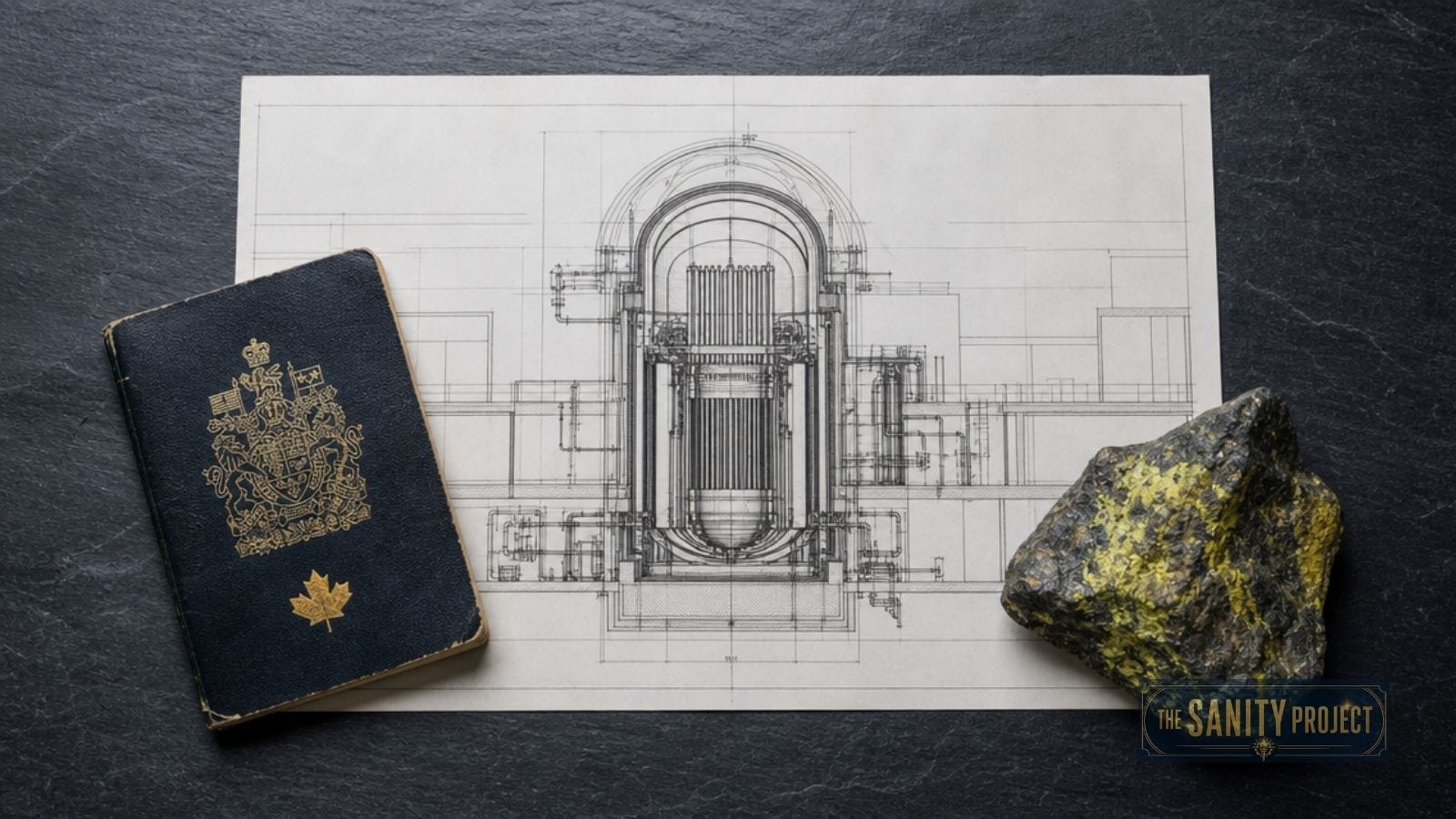
Canada is the world’s second-largest uranium producer, accounting for roughly 24% of global supply. It has a world-leading reputation in nuclear safety regulation and 65 years of nuclear engineering history. Poland is already planning 24 BWRX-300 reactors across six sites, drawing on the Darlington build as its reference project. The UK completed Step 2 of its Generic Design Assessment for the BWRX-300 in December 2025. Estonia, Sweden, and the United States all have active regulatory proceedings underway.
The Darlington SMR is not just a power plant. It is Canada’s market-entry strategy for a sector projected to reach $200 billion annually by 2030. Canada built the proof of concept that every other buyer on the planet is watching.
As federal Minister Tim Hodgson said on April 29, 2026: “Canada has long been a nuclear leader — but we will not remain one by standing still.”
The Foundation Is in the Ground
Here is where things stand.
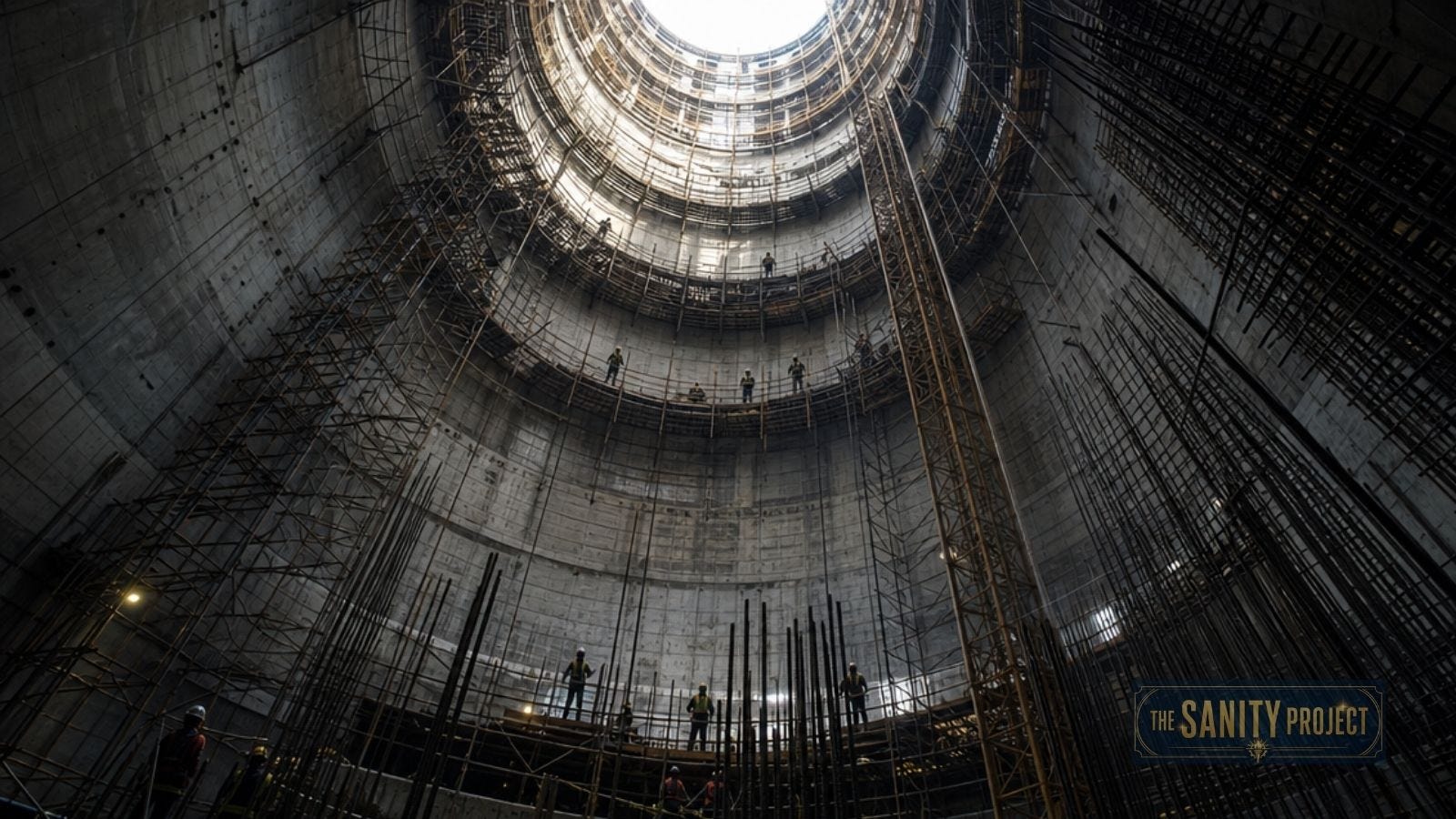
The basemat — the physical foundation of the reactor building — has been poured and confirmed. Regulatory Hold Point 1 has been lifted, indicating that the CNSC has reviewed and confirmed that OPG met all construction commitments for foundation installation. The construction licence was issued on April 4, 2025. Construction formally began in May 2025. The Canada Infrastructure Bank has committed $970 million. The federal government has, for the first time in a generation, framed nuclear energy explicitly as a sovereign strategic asset rather than a legacy liability.
The organized opposition funded by fossil fuel interests will continue its work. The media will continue to uncover this in favour of more proximate political noise. The $20.9 billion figure will continue to be misquoted without disaggregation or context. Greenpeace will presumably continue to describe a fully licensed, actively constructed reactor as “experimental,” and no one in the mainstream press will ask them to explain that particular choice of words.
But the concrete doesn’t care about any of that. The concrete is there. The reactor building is rising. And in 2030 — if the schedule holds, as OPG’s track record suggests it will — the first small modular reactor in G7 history will begin delivering clean, dispatchable, carbon-free electricity to Ontario homes and businesses. Sixty years of it.
That’s the story.
The question is why it took a Substack to tell it.
Sources: Canadian Nuclear Safety Commission, Ontario Power Generation, Natural Resources Canada, International Energy Agency, World Nuclear News, Capital Research Center, Environmental Progress, NATO Association of Canada, GE Vernova Hitachi Nuclear Energy, Ontario Energy Board Filing EB-2025-0297.