


Inside Canada’s 167 Investment Projects and the $1-Trillion Investment Push
We reviewed all 167 projects pitched to global investors. Now you can search for every one of them yourself.
Canada has spent a lot of time lately talking about building.
Building faster. Building bigger. Building trade routes that don’t always end at the U.S. border. Building energy infrastructure, mines, ports, manufacturing plants, data centres and transportation networks.
This week, some substance was put behind that rhetoric.
Prime Minister Mark Carney’s Canada Investment Summit, taking place in Toronto September 14–15, brings together Canadian business leaders and some of the world’s largest institutional investors. The federal government’s stated ambition is enormous: to catalyse $1 trillion in total investment in Canada over the next five years.
But tucked behind the speeches and headlines is something even more interesting.
A 66-page investment prospectus containing 167 Canadian projects.
So we did what any perfectly normal person does when confronted with a 66-page investment prospectus.
We turned the whole thing into a spreadsheet.
Then we cleaned it up, checked questionable entries, verified locations where possible, examined currencies and capital costs, standardised the development stages and ultimately built something far more useful for ordinary Canadians:
A searchable database of all 167 projects.
And once you put all 167 in one place, some fascinating patterns emerge.
First, What Exactly Are These 167 Canadian Investment Projects?
This distinction matters.
These are not 167 projects being funded by the federal government. Nor are they 167 construction crews waiting for someone to yell, “Start your bulldozers!”
The prospectus describes them as selected investment opportunities at various stages of development. The information was largely submitted by the project proponents themselves, and inclusion in the document does not constitute a government endorsement. The projects can also change.
Think of this instead as a window into the Canada we are trying to build.
The summit is bringing global capital together with Canadian companies and projects in hopes of getting more of them financed and moving. The official summit describes the objective as mobilising long-term capital into productive assets that strengthen Canadian growth, competitiveness and economic resilience.
That’s particularly important now.
For decades, Canada’s economic geography provided us with one enormous advantage: the world’s largest economy was conveniently parked right next door.
Recent events have also reminded us of the danger of allowing convenience to become dependence.
Canadian sovereignty isn’t merely about flags and borders. Economic sovereignty matters too.
The more customers, investors, markets, and trading partners Canada has around the world, the more control Canadians have over their own future.
What Does a $1-Trillion Investment Strategy Actually Look Like?
Here’s the first surprise.
Mining. Lots and lots of mining.
Of the 167 projects, 63 are classified as Minerals and Metals.
That’s 37.7% of the entire prospectus, making mining and minerals easily the largest category. Clean Energy comes next with 31 projects, followed by Advanced Manufacturing with 19 projects and Marine and Port Infrastructure with 16 projects. Independent reporting on the summit confirms the same 63-project mining concentration.
But there’s an even bigger story hiding in those numbers.
Combine Minerals and Metals, Clean Energy, Conventional Energy, and Power and Utilities, and you get:
116 of the 167 projects.
That’s 69.5%.
In other words, almost seven out of every ten projects in this investment playbook involve Canada’s resources or energy economy in one form or another.
And this isn’t the old binary argument of oil versus renewables.
We’re talking about copper, uranium, lithium, nickel, rare earths, LNG, nuclear power, hydroelectricity, wind, hydrogen, electricity transmission, carbon management and critical minerals.
Canada possesses an extraordinary collection of things the world increasingly needs.
The prospectus’s mining section makes that case explicitly: Canada produces more than 60 minerals and metals, including critical minerals required for advanced manufacturing, defence, clean technology and energy security.
The opportunity is to stop merely possessing them and start building with them.
Just How Big Are These Projects?
Some are enormous.
Among the largest proposed developments in the prospectus are:
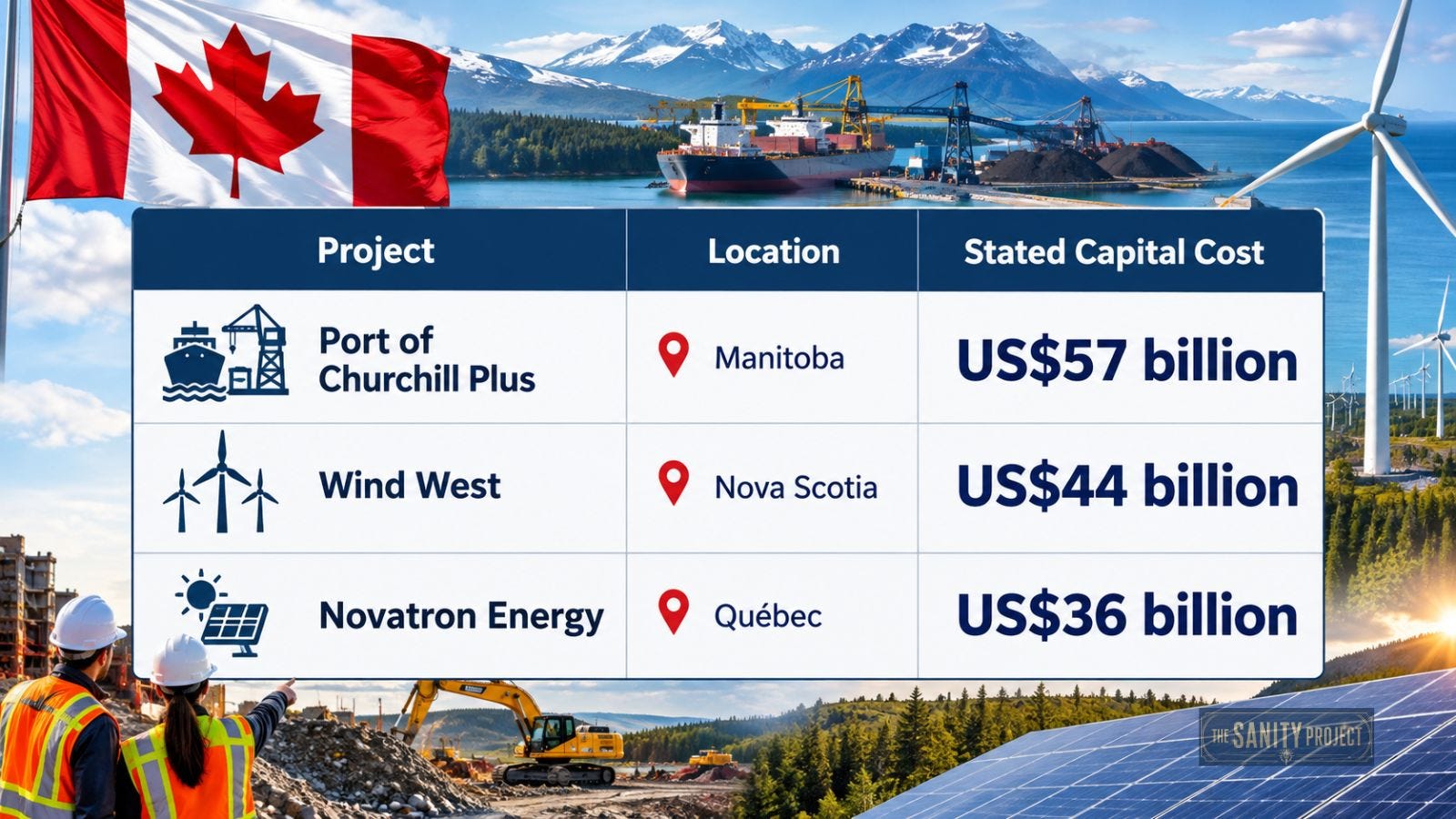
Those figures require context. These are proposed development or program values, not money already committed or construction spending already underway.
But they demonstrate the scale of what’s being contemplated.
Of the 152 projects for which we could establish a usable capital-investment scale, 63 are billion-dollar-plus proposals in their stated currencies.
Ten are $10-billion-plus.
Suddenly, “major project” doesn’t sound quite so much like government brochure language.
Which Provinces Have the Most Projects?
This was another interesting result.
Alberta leads with 29 project footprints.
British Columbia follows with 24.
Then comes a tie that caught my attention:
Québec: 20.
Nova Scotia: 20.
Ontario follows with 18.
There is an important qualification here. Some projects cross provincial boundaries, so we count them in each jurisdiction they touch. These figures, therefore, measure project footprints and won’t add neatly to 167.
But Nova Scotia deserves another look.
A province of roughly one million people appears in as many project footprints as Québec and more than Ontario.
Why? That’s an article all by itself, and we’ll be coming back to it.
From Offshore Wind to Copper Mines
The sheer variety of the list may be more interesting than the rankings.
Nova Scotia’s Wind West envisions an enormous offshore wind and transmission development with a stated scale of US$44 billion.
Newfoundland and Labrador’s EVREC Green Energy Hub carries a stated capital cost of US$10.6 billion.
Then there are mineral projects such as the Casino copper-gold project in Yukon, listed at US$2.89 billion, and B.C.’s Yellowhead Copper Project, at approximately C$2 billion.
And the prospectus goes well beyond resources.
There are AI data centres, quantum technology, satellite infrastructure, advanced manufacturing, port expansions, nuclear projects and even a proposed ultra-high-speed passenger and freight corridor between Calgary and Edmonton. Current reporting on the summit has highlighted the same extraordinary range, from quantum computing and data centres to mines and transportation projects.
This isn’t one vision of Canada’s economy.
There are several possible futures competing to be built.
How Many of the 167 Projects Are Actually Ready to Build?
Here’s where we apply the brakes slightly.
After standardising the development descriptions in the prospectus, we classified:
18 as Permitted/Shovel-Ready.
Another 7 are Under Construction, while 5 involve Operating/Expansion projects.
Add the 44 projects we’ve classified as Advanced Development, and 74 of the 167 have reached Advanced Development or beyond.
That’s substantial.
But it also means nobody should look at this database and declare that Canada suddenly has 167 shovel-ready megaprojects.
It doesn’t.
What Canada has is something potentially more important: a very large pipeline of investment opportunities at different stages of maturity.
Some will succeed.
Some will change dramatically.
Some will probably never be built.
And some may eventually reshape the communities, provinces and industries around them.
Our job over the coming months will be figuring out which is which.
Search All 167 Canadian Investment Projects Yourself
Here’s the part I’m most excited about.
Rather than asking you to take our word for what’s in this prospectus, we’re giving you the data.
We’ve converted the 167 projects into a searchable interactive table.
Search Alberta. Search Nova Scotia. Search nuclear, lithium, AI, LNG, rail, copper, wind, port or whatever interests you.
You’ll be able to see the project, location, sector, stated capital investment, development stage and a plain-language explanation of what it actually is.
One caution when exploring the numbers: capital figures are preserved largely as stated in the prospectus. The document contains U.S.-dollar, Canadian-dollar and unspecified-dollar figures, so we have deliberately not mashed them together into one giant, impressive-looking number and pretended arithmetic solved the problem.
Sometimes boring accuracy really does ruin all the fun.
This Is Just the Beginning of The 167
This database isn’t the conclusion of our investigation.
It’s the starting line.
Over the coming weeks, we’re going deeper.
Why are 63 projects devoted to minerals and metals?
Why does Nova Scotia appear in 20 project footprints?
What do Alberta’s 29 projects tell us about an economy that may become far more diversified than its political reputation suggests?
Which of the billion-dollar megaprojects are credible? Which are actually close to construction? Where is Canada’s clean-energy investment going? What role will Indigenous ownership and partnerships play?
And perhaps the most important question of all:
A year from now, how many of these 167 projects will actually have moved forward?
Canada is living through a moment when the comfortable assumptions of the past are being challenged. That can be frightening.
It can also be an opportunity.
We have the resources. We have the energy. We have the workforce, technology, institutions and access to global markets. The summit’s official pitch notes that Canada has preferential access to 1.5 billion consumers across 51 countries through 16 free-trade agreements.
The question isn’t whether Canada has something the world wants.
It clearly does.
The question is whether we have the confidence, ambition and national determination to build it, process it, manufacture it, export it and use it to make Canada more prosperous and more economically independent.
That’s the story we’re going to follow.
Subscribe for free to The Sanity Project so you don’t miss the next instalment of The 167.
Because there are 166 more stories hiding in this database.
And we’re just getting started.
Superb work Bo. Looking forward to follow how well Canada builds out the tangible opportunities.
Thanks for putting this together. I look forward to this series. It would be interesting to track these projects over time.