


The Canadian Food Paradox: Why We Import Food We Can Grow
Canada’s food security debate keeps assuming the problem is a lack of farms. The real story is stranger, and it starts in a produce aisle full of stickers from everywhere but here.
Key Takeaways
Canada’s field and greenhouse vegetable sectors are large and expanding, not the empty cupboard the “buy Canadian” conversation assumes.
Growing more vegetables domestically hasn’t meant more availability for Canadian shoppers, because greenhouse growers sell into whichever market pays best that week.
Grocery procurement runs on price, consistency and contract volume, not on where a vegetable happened to grow.
Canada’s population is scattered across a continent. The Netherlands’ isn’t. That geography gap matters more than any technology gap.
Real food security looks less like a slogan and more like cold storage, processing plants and diversified suppliers.
Stand in a Canadian grocery store in February and read the little flags stuck into the vegetable bins. Peru. Mexico. The United States. If you’re patient, you might find a lonely Ontario hothouse tomato holding the fort for an entire country.
Now consider that Canada is, by almost any measure, a serious vegetable-producing country. Field growers put more than two million tonnes of vegetables into the ground every year. Greenhouse operators added over 866,000 tonnes more in 2024 alone, and that number keeps climbing. We have the land, the engineers, and a greenhouse cluster in southern Ontario dense enough to rival anything else on the continent.
So why does finding a Canadian pepper in January feel like a small act of detective work?
That contradiction is the real story behind Canada’s food security, and it has almost nothing to do with whether we can grow vegetables. We clearly can. It has everything to do with what happens to them after they’re grown, who buys them, and why a bigger harvest doesn’t automatically mean a fuller Canadian shelf. Follow that thread and “buy Canadian” stops sounding like a slogan and starts sounding like an actual supply chain problem, which is a far more useful place to start.
Subscribe to The Sanity Project for the rest of this series →
Canada Already Grows an Enormous Amount of Food
Key Insight: Canada’s field and greenhouse vegetable sectors together produced well over three million tonnes of vegetables in a single recent year. Whatever is going wrong with Canadian food security, it isn’t a shortage in the ground.
Start with what’s growing here, because the numbers get buried fast in this conversation. Canada’s field vegetable industry produced more than 2.5 million metric tonnes in a recent year, according to Agriculture and Agri-Food Canada’s field vegetable statistics, anchored by tomatoes, carrots, dry onions and cabbage.
Layer the greenhouse sector on top of that. In 2024, Canada had 974 commercial greenhouse vegetable operations producing 866,484 metric tonnes, a 5% jump from the year before, per AAFC’s greenhouse industry report. Ontario alone accounted for 72% of that production, with British Columbia and Quebec picking up most of what’s left. Tomatoes, cucumbers and peppers make up the overwhelming bulk of it.
None of that reads like a country with no vegetable industry. It reads like a country with a seasonal, regionally concentrated industry that’s deeply wired into a much bigger North American market, which turns out to be exactly the problem.
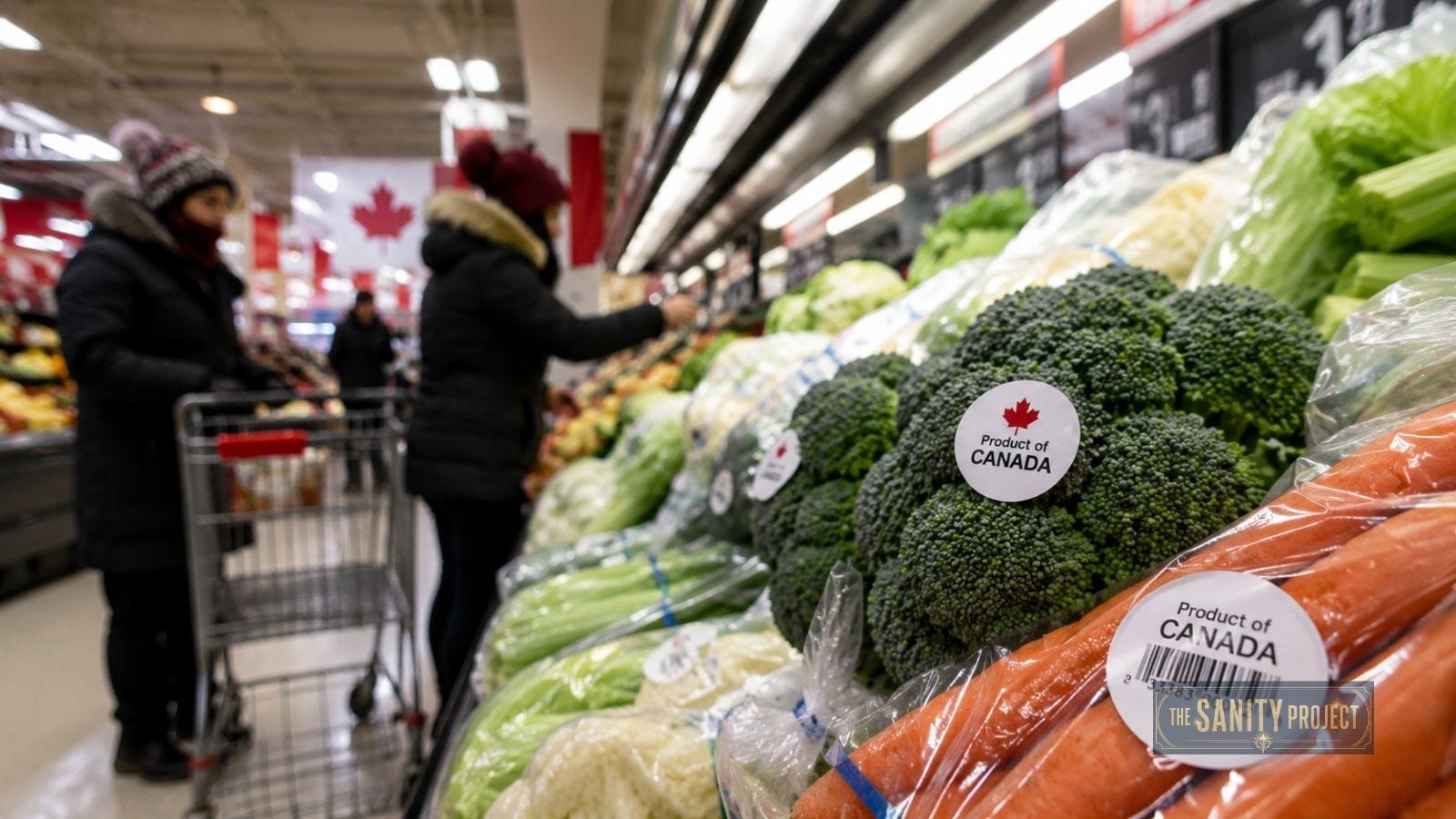
This is what Canada’s food security question looks like up close: a wall of stickers from everywhere except here.
The Export Paradox
Key Insight: A bigger greenhouse harvest and a bigger export number aren’t two separate stories. They’re the same story, and it’s the part every “just grow more food” argument tends to skip.
Here’s the part that trips people up. Canadian greenhouse growers don’t operate in a closed domestic market. They sell into an integrated North American system, and they go where the money is.
A 2026 analysis from Farm Credit Canada found that greenhouse vegetable production kept climbing while fresh vegetable availability for Canadian consumers kept sliding, because a growing share of that output is heading south. Almost all of Canada’s greenhouse vegetable exports go to the United States.
That’s not a scandal. Exports fund the next round of automation and expansion. But it means you can’t measure Canadian food security by total production alone. You have to track how much of that harvest actually stays here, at a price people can afford.
“More greenhouses doesn’t mean more vegetables on your plate. It means more vegetables for whoever pays the best price that week.”
Get Angle 2 of this series when it drops, subscribe free →
Why Grocery Stores Reach for Imports Anyway
Key Insight: Grocers aren’t rejecting Canadian produce out of spite. They’re buying to a spreadsheet, and imports usually win on price, consistency and guaranteed volume.
It’s tempting to picture a grocery buyer turning up their nose at a Canadian carrot. The reality is duller and more structural. Retailers sign contracts that guarantee volume and price stability months in advance, and imports from Mexico, Peru or California can promise exactly that, year-round, in a way a seasonal Canadian crop often can’t match.
Transportation plays its own role too. Getting lettuce from California to a Winnipeg shelf is often a more predictable, cheaper logistics problem than moving it between Canadian regions. Canada is enormous, and much of the country sits far from where the vegetables are grown.
It isn’t fixed in place out of necessity. The incentives currently point toward imports, and changing that means changing the incentives, not just growing more tomatoes.
The Netherlands Problem: Density Beats Distance
Key Insight: The Netherlands didn’t out-farm Canada. It out-positioned it, with 18 million people living within a short drive of nearly every greenhouse in the country.
Canada’s population sits at more than 41 million, spread across the second-largest country on Earth, according to Statistics Canada. The Netherlands has about 18 million people packed into a country you could tuck inside Nova Scotia several times over, sitting a few hours’ drive from some of the densest consumer markets in Europe, per Statistics Netherlands.
That gap matters more than any greenhouse technology gap. A Dutch grower can build one facility and reach tens of millions of nearby customers within a short haul. A Canadian grower building the same facility near Leamington is looking at a much smaller local market and a much longer trip to anywhere else.
This is the question at the heart of what we’re calling the Netherlands Test later in this series, and it deserves its own full treatment. For now, the short version is that Canada can copy plenty of what the Dutch do inside the greenhouse. It cannot copy their map.
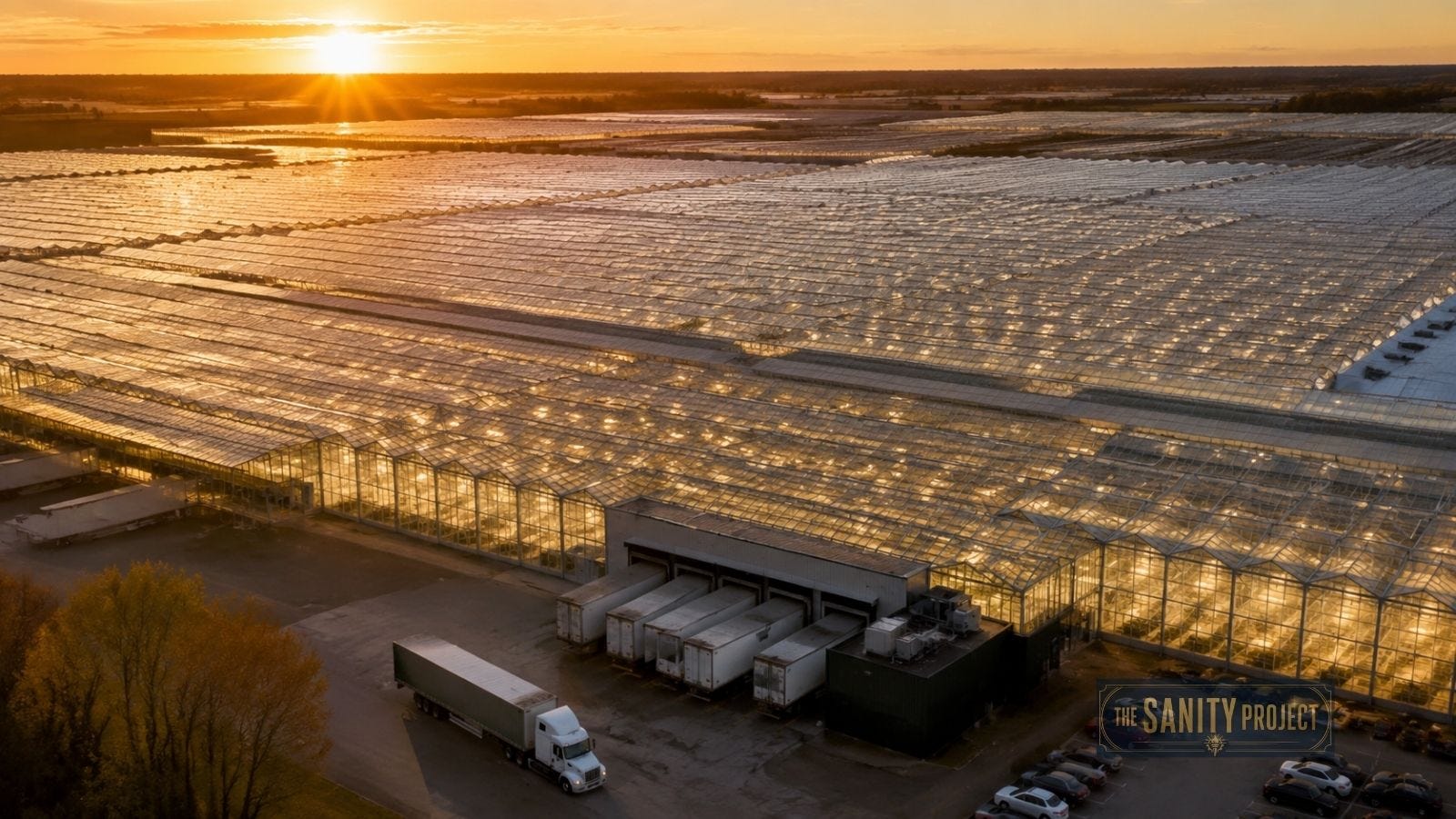
Every one of those trucks is a small vote on Canada's food imports versus exports, and right now, exports are winning more often than you’d think.
What Food Security in Canada Actually Requires
Key Insight: The missing piece in Canada’s food system usually isn’t a farm. It’s a cold storage warehouse, and nobody puts that on a bumper sticker.
Readers keep raising the political side of this, and it deserves a straight answer. Interprovincial trade barriers, CUSMA renegotiation and provincial energy policy all show up in the comments, and all plausibly affect how competitive Canadian produce is against imports. What the evidence doesn’t yet support is a clean, verified line connecting any single policy to the produce aisle, so treat it as a live question, not a settled villain.
What’s better supported is the infrastructure gap, and here the fix is specific enough to name. Canada’s National Food Security Strategy has proposed $750 million over seven years through a Controlled Environment Agriculture Growth Pathway, aimed at expanding year-round production and cutting import dependence. Money alone doesn’t fix a supply chain, so the program is only as good as what it’s measured against. A project backed by that funding should have to show its work on a short list of practical questions before anyone calls it a win:
What does it cost per kilogram to grow, not just to build?
How much energy and water does it use per kilogram of food produced?
Does it actually raise domestic availability, or does the harvest still end up on a truck heading south?
Is the crop suited to this growing method, or is it an expensive way to grow something a field already grows cheaply?
Does it have a path to standing on its own, or is it permanently dependent on the next round of subsidy?
That funding will do more good aimed at cold storage, processing capacity and regional distribution than aimed at another showcase greenhouse, because a bigger harvest that can’t be stored, processed or moved efficiently just turns into a bigger export number instead. Buy Canadian, taken seriously, means building the unglamorous middle of the supply chain. Not just more greenhouses, but the warehouses, the processing lines and the trucking routes that decide whether what gets grown here gets eaten here. It also means treating import diversification as a stated goal, not a side effect, so that a single trade dispute or a single country’s bad growing season can’t empty a specific aisle.
Subscribe for Angle 2: the real Netherlands comparison →
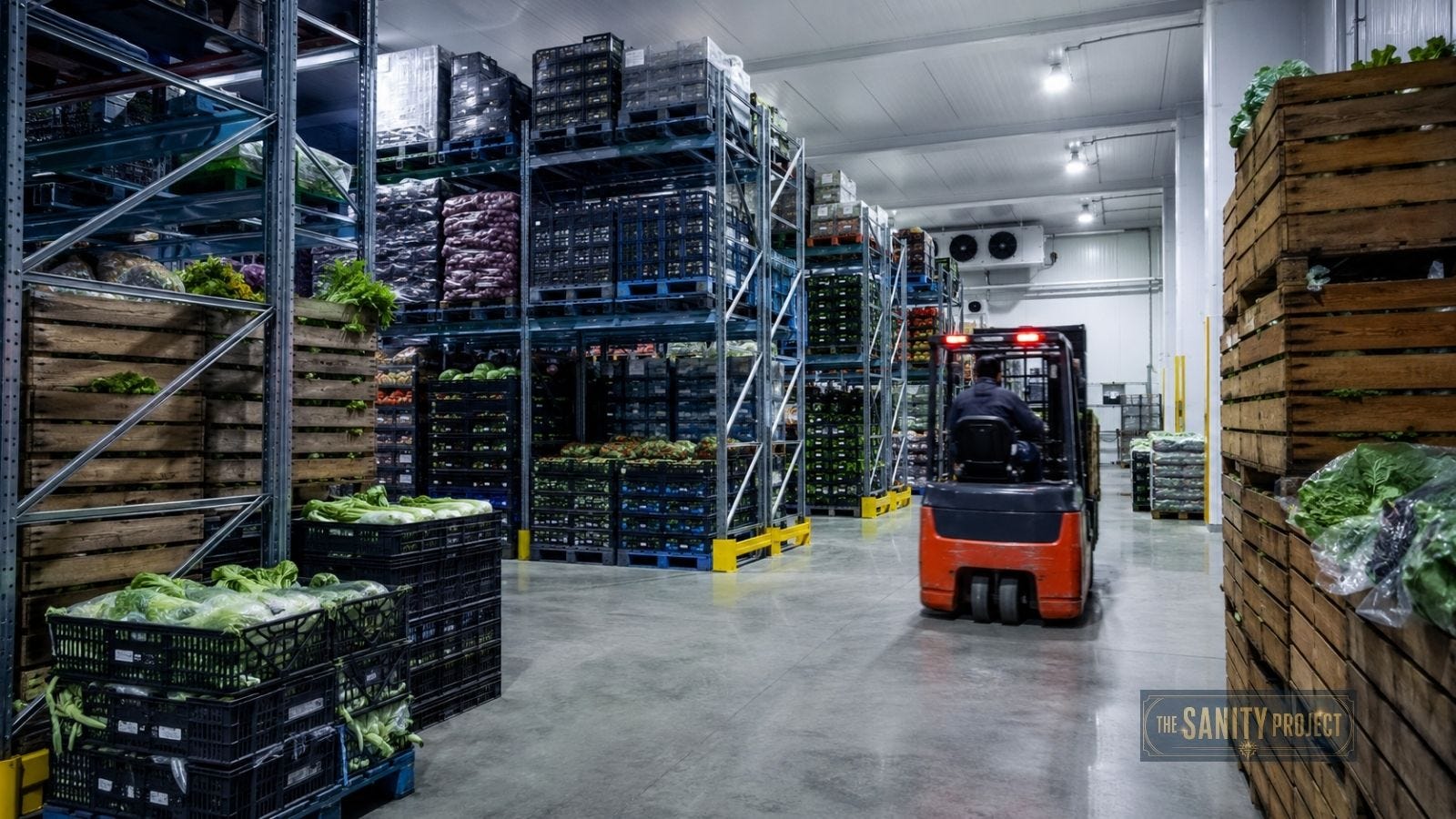
This unglamorous room, not another greenhouse, is where controlled environment agriculture in Canada succeeds or fails.
The Verdict
Canada doesn’t need to seal its border against a single foreign tomato. That would be expensive, and it would also miss the point entirely. What it needs is strategic vegetable resilience: more domestic production that stays domestic, diversified suppliers so no single country or crisis can empty a shelf, and enough storage and processing capacity to carry a Canadian harvest through a Canadian winter.
Fixing that doesn’t require one dramatic gesture. It requires treating the boring parts of the system- storage, processing, distribution, supplier diversity- as seriously as the greenhouse itself, and holding any new funding to the cost, energy and availability test above rather than a ribbon-cutting photo. That’s a slower, less satisfying answer than “just grow more food here.” It’s also the one that would actually move a Canadian vegetable from a field to a shelf in February.
The harder question is whether Canadians are willing to pay for that boring middle of the supply chain, in higher grocery bills or in tax dollars, rather than just asking for more greenhouses and calling it solved. I’d genuinely like to know where you land on that in the comments.
Editor’s View
I went into this expecting a villain, a bad trade deal, a lazy grocery chain, something to blame outright. What I found instead was a system where every actor behaves rationally, and the sum of it still leaves us short a Canadian carrot in March.
I don’t think that’s a satisfying place to land, and I’m not going to pretend it is. What I do think is that the Netherlands comparison everyone reaches for is more useful as a diagnostic than a blueprint, which is exactly what the next piece in this series digs into.
For now, I’ll say this plainly. If you want more Canadian food on Canadian shelves, the fight isn’t really in the greenhouse. It’s in the warehouse, the contract, and possibly your own grocery budget.
Corrections and Updates Protocol
This article will be updated if new data changes the picture. Corrections are noted inline using the format “Update (Month Year):” followed by the change. No corrections have been issued at the time of publication.
Publications Consulted
Agriculture and Agri-Food Canada, Farm Credit Canada, Statistics Canada, Statistics Netherlands (CBS)
Up Next: Part 2
The Winter Bill: Why Energy Is Agricultural Policy (Part 2)

The Winter Bill: Why Energy Is Agricultural Policy
Bo, I think you've hit the nail squarely on the head here. For your Netherlands comparator to even remotely work, you need a concentration of people & farms in a (relatively) small area. So maybe, possibly, you could achieve it in Southern Ontario, in a conventional sense.
The added cold storage, if not outright shipping logistics, will (and does) add significant cost. So Canadians here might need to do a bit of a balancing act:
- For true food security at a national level, I see only two options at play: Lots of cold storage and beefed up shipping/distribution supply chains, and/or lots of micro-greenhouses to produce everything a region needs all year around (with less cold storage, etc.). Your research suggests that both options will be expensive - and one way or another, that gets reflected on the sticker price.
- If we worry about food security (famine, weather, political unrest elsewhere), then only other options are to at least do SOME of what we're doing now - import with predictable suppliers who can produce all year round. If we don't want American produce (love those boycotts!) then Mexico is trying to fill the gap. But what happens if some hurricane or political rebellion happens there (and Trump keeps hinting at invading to stop the cartels (in Trump-speak, that means likely negotiating a "cut" for his family on the drug trade somehow)).
But an interesting take on the "cost" -- in my neck of Canada, we get greenhouse grown lettuce now (style, look, and feel is like romaine, but it behaves like iceberg), all year 'round from Alberta. Sure, it costs $1 more than the USA iceberg. But the quality is superb -- don't have to peel away half the head to get to the good leaves. And it lasts about twice (if not three times) longer in the fridge, because it's "living" lettuce (keep the stem moist and you're good!). So when you factor THAT into the equation, is it really more expensive?? I'm throwing out less waste.
As consumers, retired and on a fixed income, we’d still be willing to pay more to invest in a better distribution system for the long-term gain, with a mixed option system of imports where practicable and necessary.
By the way, Inspired Greens lettuce is listed as “consistently available” at Walmart 10 minutes from me. Today it’s $1.94. Time to check it out for myself.