


The First Time America Invaded Canada, It Lost in a Blizzard
The 1775 American invasion of Canada began with a promise of liberation and ended with a dead general in the snow below Quebec’s walls.
The Times America Came for Canada, Part 1 of 5
A note before we start: This is Part 1 of The Times America Came for Canada, a five-part series on every serious attempt by the United States to take Canada by force, by invitation or by pressure. Each part will be available in part to all subscribers. The fine details, including the full story, the sources and what it all means today, are reserved for paying supporters. Part 1 is the welcome mat: the first half is open to everyone, and the second half is free for anyone who subscribes.
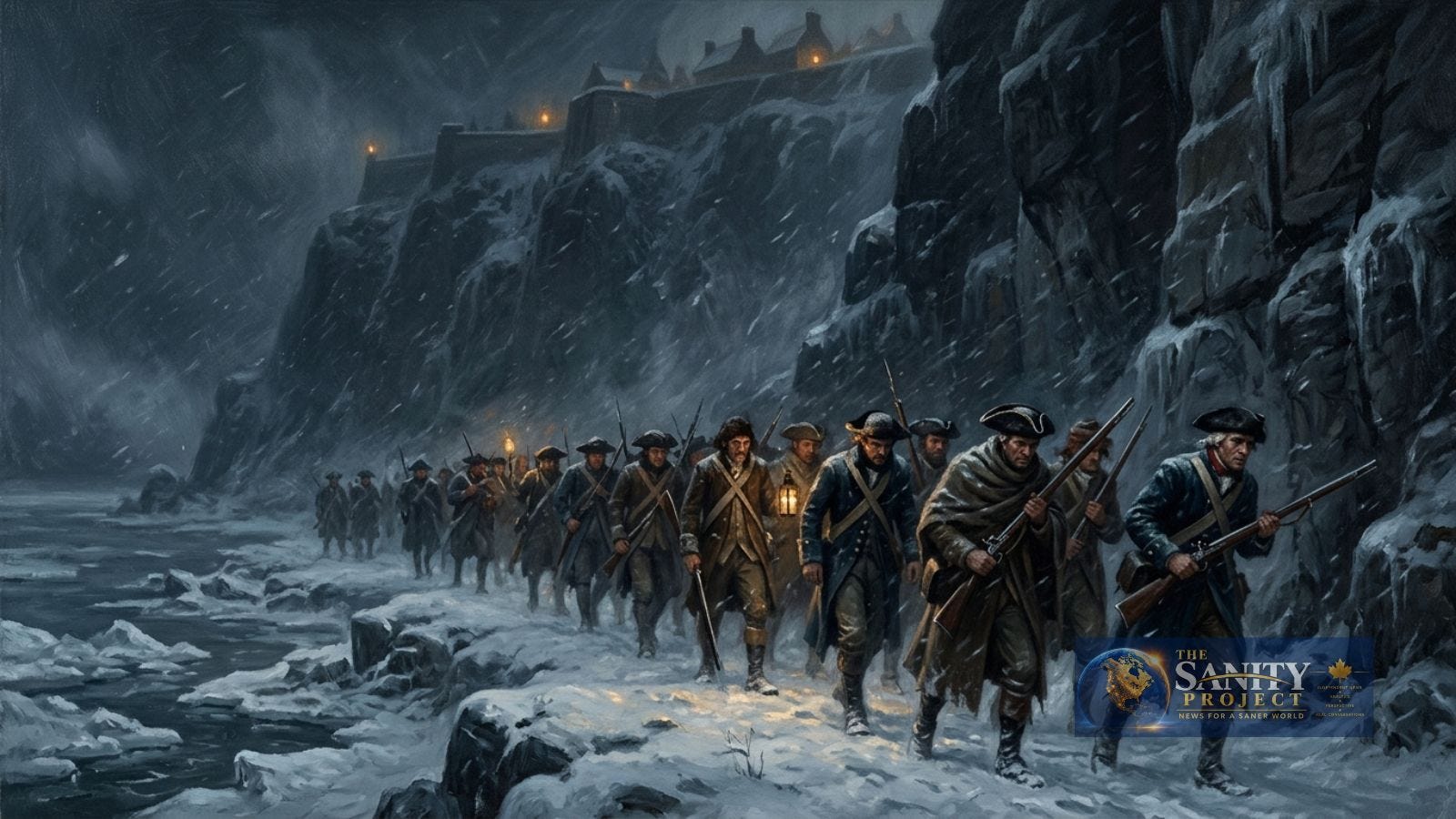
It was snowing sideways on the last night of 1775. Not the gentle kind of snow that shows up on Christmas cards, but the Quebec kind, driven off the St. Lawrence by a northeast wind that finds every gap in a wool coat. Somewhere below the cliffs of Quebec City, an American general named Richard Montgomery was leading a few hundred cold, sick, half-starved men along a narrow path between the river ice and the rock.
He had a good reason to attack that night and a terrible one. The good reason was the storm. Snow would hide his men from the sentries on the walls above. The terrible reason was the calendar. Many of his soldiers’ enlistments ran out at the end of December 31. If Montgomery didn’t take Quebec before the new year, a large part of his army would simply pack up and go home, and the American invasion of Canada would end without a serious attempt on the city it had come to conquer.
So he went. Along the shore at a spot called Près-de-Ville, the path narrowed at a barricade guarding the Lower Town. Behind it waited a small group of defenders and a few cannon loaded with grapeshot. Montgomery pushed to the front, urging his men on. The guns fired. When the smoke cleared, the general lay dead in the snow, along with several of the officers around him. The column behind him broke and fell back.
On the other side of the Lower Town, Benedict Arnold’s column was about to have an equally bad night. By morning, the first American attempt to take Canada by force had collapsed. It would not be the last.
Canada Must Be Ours
Before the guns, there were letters. The Continental Congress, meeting in Philadelphia, spent 1774 and 1775 trying to talk the people of Quebec into joining the rebellion. It published three open Letters to the Inhabitants of Canada, dated October 26, 1774, May 29, 1775, and January 24, 1776. The pitch was liberty. Join us, send delegates, throw off the British yoke, and enjoy the blessings of self-government.
There was a small credibility problem. Days before that first letter, the same Congress had sent an address to the people of Great Britain attacking Parliament for protecting the Catholic religion in Quebec, and describing that faith in language you would not want read aloud in a Quebec parish. The Canadiens could read. Some of them noticed that the people promising them freedom had just finished insulting their church.
The law Congress was attacking was the other problem. Britain’s Quebec Act of 1774 let Roman Catholic men in the province vote and hold office and kept French civil law in place. For a mostly Catholic, French-speaking population, London had just offered a better deal than anything coming out of Philadelphia.
Behind the public letters, the private motives were blunter. John Adams wrote that “the unanimous voice of the continent is Canada must be ours.” His reasoning was strategic. In British hands, Quebec was a base for threatening the colonies and influencing the Indigenous nations along the frontier. In American hands, it was a fourteenth colony and a closed back door.
This is the first lesson of the series, and it will keep coming back. When a larger neighbour says it will take your country as a favour, read the fine print. On June 27, 1775, Congress authorised General Philip Schuyler to invade if it seemed appropriate. The liberation would arrive carrying muskets.
Two Roads North
The plan was a pincer. Schuyler’s army would come up the old invasion highway of Lake Champlain and the Richelieu River toward Montreal. A second force would cut through the Maine wilderness and appear, unexpectedly, at the gates of Quebec City.
Schuyler fell ill almost immediately and handed command to Richard Montgomery, a former British officer who had fought in the Seven Years’ War and settled in New York. Montgomery was capable and well liked. He laid siege to Fort Saint-Jean on the Richelieu in mid-September, and the fort held out for weeks, burning through time, food and patience the Americans didn’t have. When it finally fell, the road to Montreal opened. Governor Guy Carleton slipped out of the city, and Montgomery occupied Montreal on November 13, 1775.
Then he ran into the problem that would haunt the whole campaign. His men’s enlistments were expiring, and plenty of them wanted to go home. By the time he pushed on toward Quebec, Montgomery had only a few hundred soldiers with him.
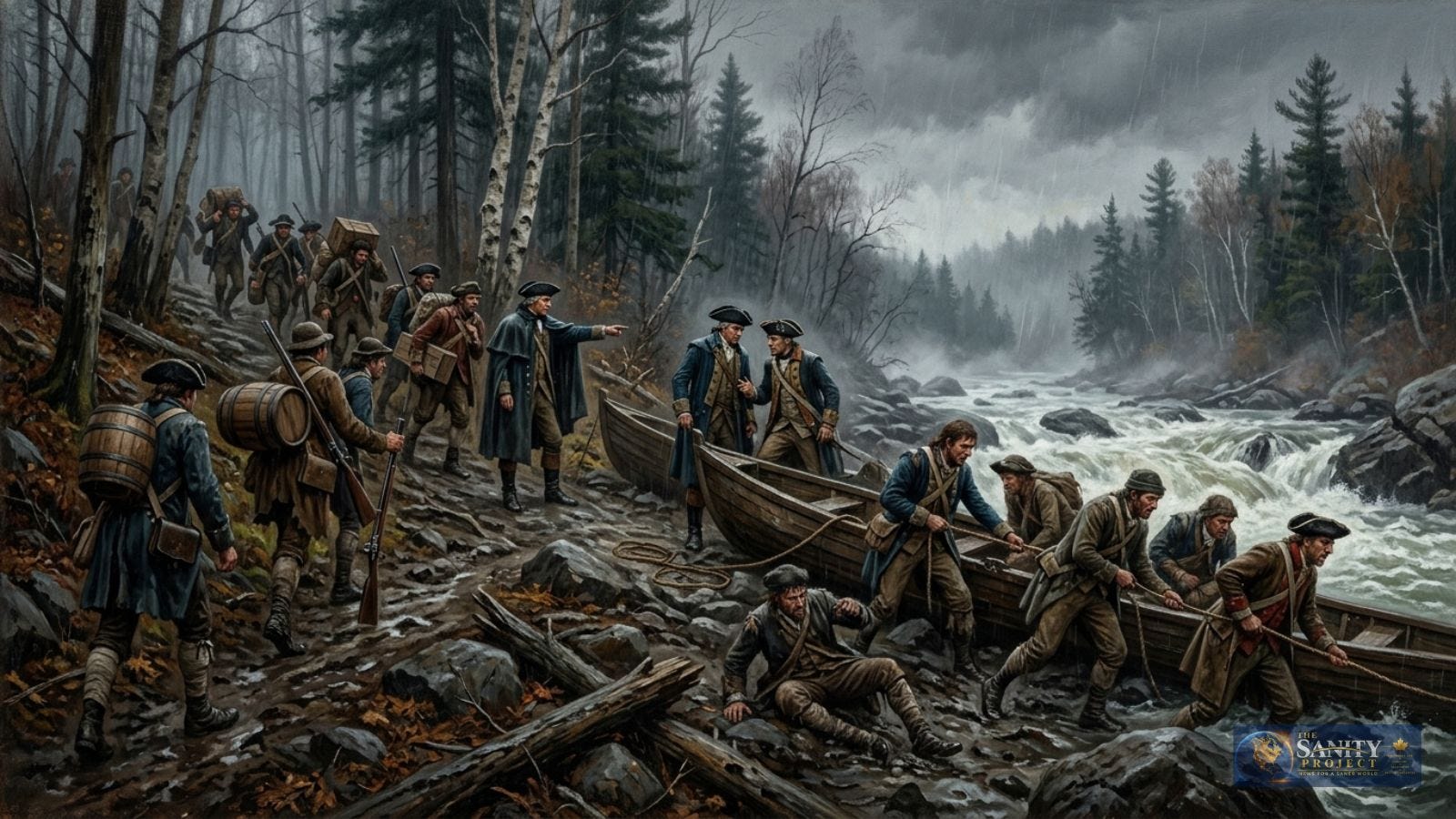
The second road north was worse. Benedict Arnold, the hard-driving colonel who had helped capture Fort Ticonderoga that spring, convinced George Washington to let him lead 1,100 men up the Kennebec River, across the height of land and down the Chaudière to the St. Lawrence. On paper, it looked manageable. Arnold figured it would take about 180 miles and 20 days.
The map lied. The bateaux, built in a hurry from green lumber, leaked and fell apart. The rivers were full of rapids that forced endless portages, with men hauling boats and barrels on their backs through swamp and forest. Floods on the Dead River swept away supplies. Food ran out. Men boiled shoe leather and ate candles. One entire division turned around and marched home.
When Arnold’s force finally reached the south shore of the St. Lawrence at Pointe-Lévis, across from Quebec, in early November, it had shrunk to about 600 starving men. They crossed in borrowed canoes in mid-November, but the city refused to come out and fight, and they had no artillery to batter the walls. They pulled back upriver to Pointe-aux-Trembles and waited for Montgomery.
On December 2, the two American forces finally met outside Quebec. Together they had about 1,200 men, many of them sick and all of them cold. Montgomery sent a demand for surrender. Carleton, who had escaped Montreal and slipped back into the capital, would not even deal with the messengers. Inside the walls were roughly 1,800 defenders: British regulars, sailors, English-speaking militia, and a large number of Canadien militiamen who apparently hadn’t been told they were supposed to welcome their liberators.
The Americans had three options. They could besiege a fortified city through a Quebec winter without heavy guns. They could wait for spring and watch their army evaporate on New Year’s Day. Or they could storm it.
They chose the blizzard.
The Americans have about 1,200 cold, sick men, a blizzard and a deadline. Quebec has 1,800 defenders and cannons loaded with grapeshot.
The second half is where it all goes sideways: the night attack, the trap in the streets of Sault-au-Matelot, Benjamin Franklin’s very bad business trip to Montreal, and the clause the Americans wrote into their founding document so Canada could join any time it liked.
It costs nothing. Subscribe for free, and the rest of the story will land in your inbox, along with the free half of each part that follows.

Sources
Quebec, Dec 31, 1775, American Battlefield Trust
Did the Founders Consider Adding Canada to the United States?, National Constitution Centre
Instructions and Commission from Congress to Franklin, Carroll and Chase, March 20, 1776, Founders Online
Franklin’s Failed Diplomatic Mission, Journal of the American Revolution
The Quest for the Fourteenth State, Journal of the American Revolution
Quebec (Canada Invasion), Encyclopedia.com
Arnold’s March to Quebec, Encyclopedia.com
American Invasion of Quebec, World History Encyclopedia
Battle of Quebec (1775), Wikipedia
Benedict Arnold’s expedition to Quebec, Wikipedia