


We Ranked Every Province’s Solar Payback. Albertans Win, Then Get Taxed For It.
Rate, sunshine, and what your utility pays you back. Run all three together, and one province wins clearly. These numbers are relative, not gospel, so treat them that way.
Key Takeaways
These numbers are relative estimates, not verified facts, and do not include rebates. Compare provinces to each other, not as a forecast for your own roof.
Quebec has the slowest payback in the country, not from bad solar policy, but because its electricity is already too cheap to save much on.
Saskatchewan has the best sun in Canada and still lands in the middle of the pack. Its below-retail export rate costs it years of payback.
Alberta wins outright: the best combination of rate, sun, and full 1:1 export, with no rebate required or available.
In British Columbia, Saskatchewan, and Manitoba, the three provinces that pay less than retail for exports, a battery is the biggest lever for improving real return.
Rebates aren’t in these numbers, but where they exist, they only help. Check what’s currently available in your own province.
Every solar payback number you’ve ever read, including the ones about Alberta solar panels below, rests on shakier ground than most articles admit. This piece started as a check on one installer’s math. It ended up rebuilding the whole comparison.
I, personally, am getting a solar system in Manitoba, and here are the numbers: $25,000 for a system, a $5,000 rebate, and an installer’s estimate of twelve years to break even. Checking that estimate against Manitoba’s actual electricity rate, its lower rate for power sold back to the grid, and a realistic split between what a home uses and what it exports, the twelve-year figure turned out to rest on one quiet assumption: that every kilowatt-hour gets valued as if it were used on-site, at full retail price. In Manitoba and a couple of other provinces, that’s not how billing works.
So instead of trusting any installer’s payback claim, we rebuilt the comparison from three verifiable things: provincial electricity rates, solar yield, and export payback rates. Combine those with one real, verified installed cost, and a ranking falls out. Here’s how it works and what it doesn’t account for.
Before We Rank Anyone, Here’s the Catch
These numbers are relative comparisons, not personal forecasts. The value is in how provinces stack up against each other, not in the precision of any single figure.
The cost baseline is real: $2,500 per installed kilowatt, before rebate, from an actual Manitoba quote for a 10-kilowatt system, applied evenly across all ten provinces. That assumes installed solar costs about the same everywhere in Canada. It probably doesn’t exactly, but it’s the only verified figure available, and it beats guessing.
Each province’s yield and rate come from utility filings and government data. Every payback assumes 40 percent self-consumption and 60 percent export, which is a reasonable average, not a measurement of your house. Rates climb 3 percent a year, consistent with recent history in Manitoba. Rebates aren’t included; more on that below.
That gives every province a number. It doesn’t give you a personal forecast. Two houses on the same block can produce very different self-consumption ratios depending on daytime occupancy, roof orientation, and household habits. Treat every figure here as a comparison between provinces, not a prediction for your own roof.
How We Stress-Tested This
Modeling the installer’s likely approach: 100 percent self-consumption at the retail rate with a 3 percent annual increase. This arrived at 13.1 years, close to his 12-year claim.
Swap in a realistic 40/60 (between use and export to the grid) split and Manitoba’s actual net billing rate, and the same system requires 15 to 18 years to pay for itself. One optimistic assumption, that every kilowatt-hour gets full value, was doing most of the work.
One more exclusion: rebates. Only three provinces currently have one a new applicant can claim: Manitoba (fifty cents per watt, up to $5,000), British Columbia (up to $5,000), and Ontario (up to $10,000 combined, with a catch covered below). New Brunswick, Nova Scotia, and Prince Edward Island each had one that’s since closed or paused.
Alberta, Saskatchewan, Quebec, and Newfoundland and Labrador never had one. A rebate only ever shortens payback. Check what’s available where you live before assuming these numbers are yours.
With that on the record, here’s the data.
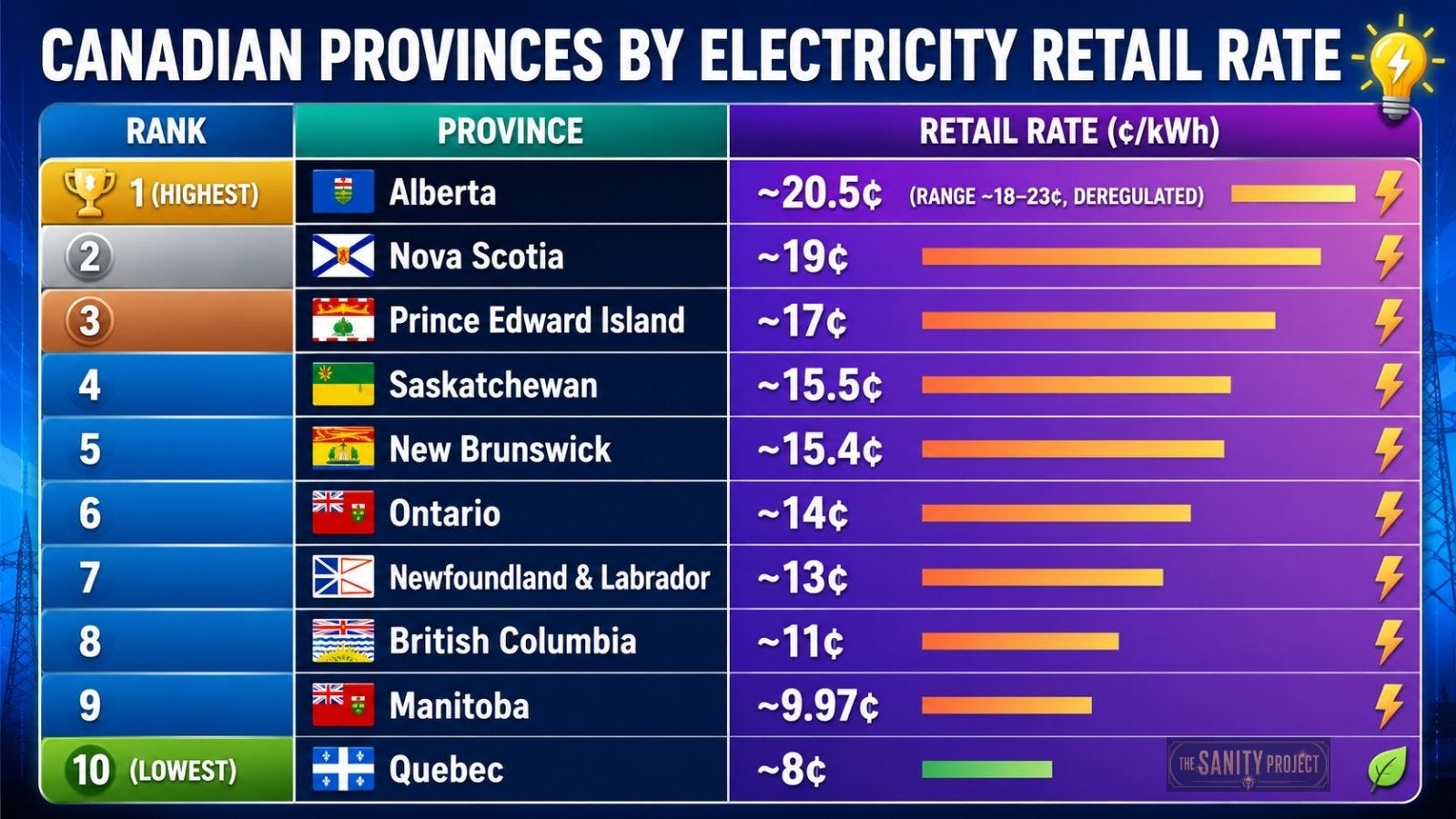
What Each Province Charges (most to least expensive)
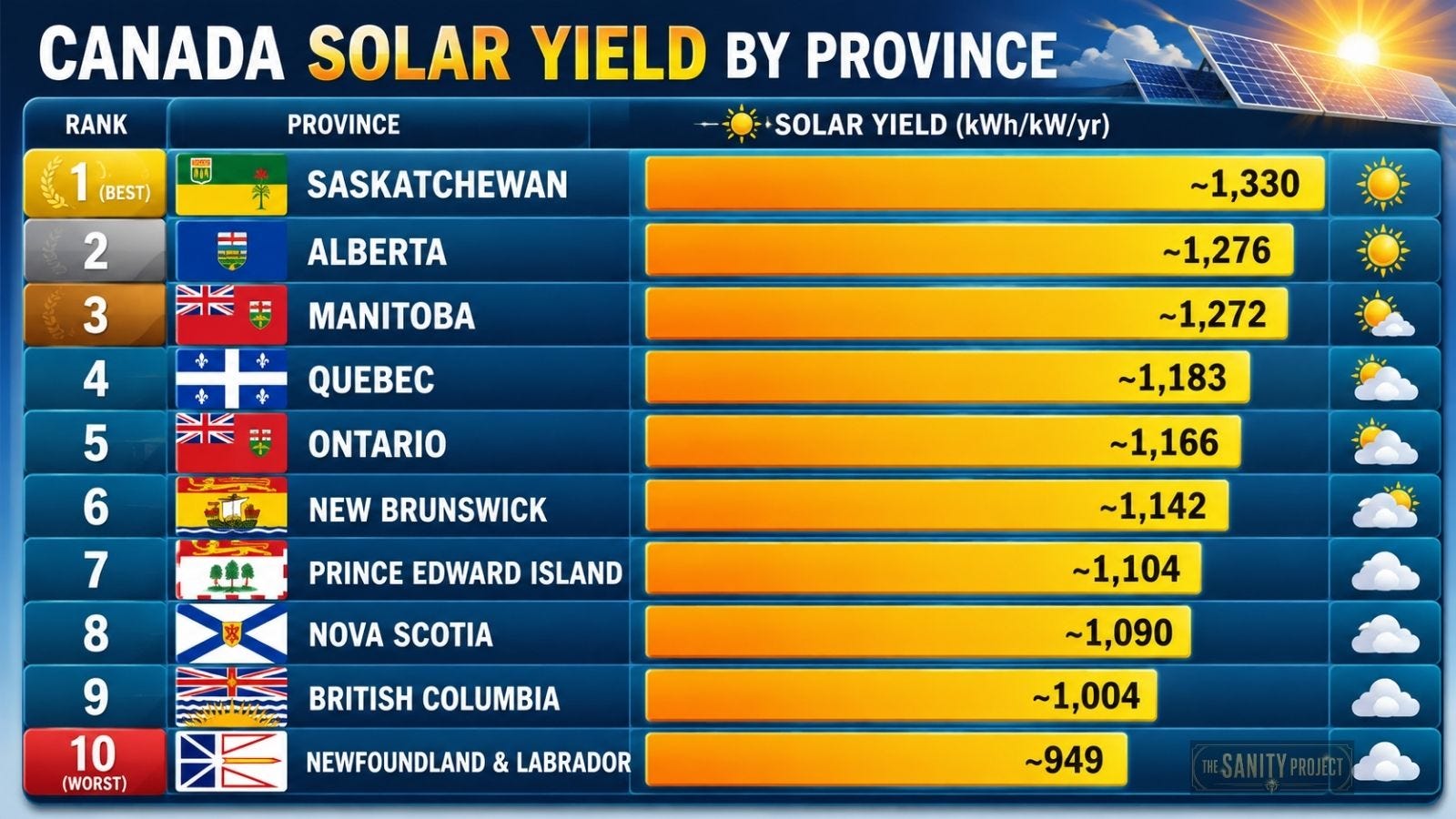
How Much Sun Each Province’s Panels Actually See (best to worst)
What Each Province Pays You Back For Exported Power (best to worst)
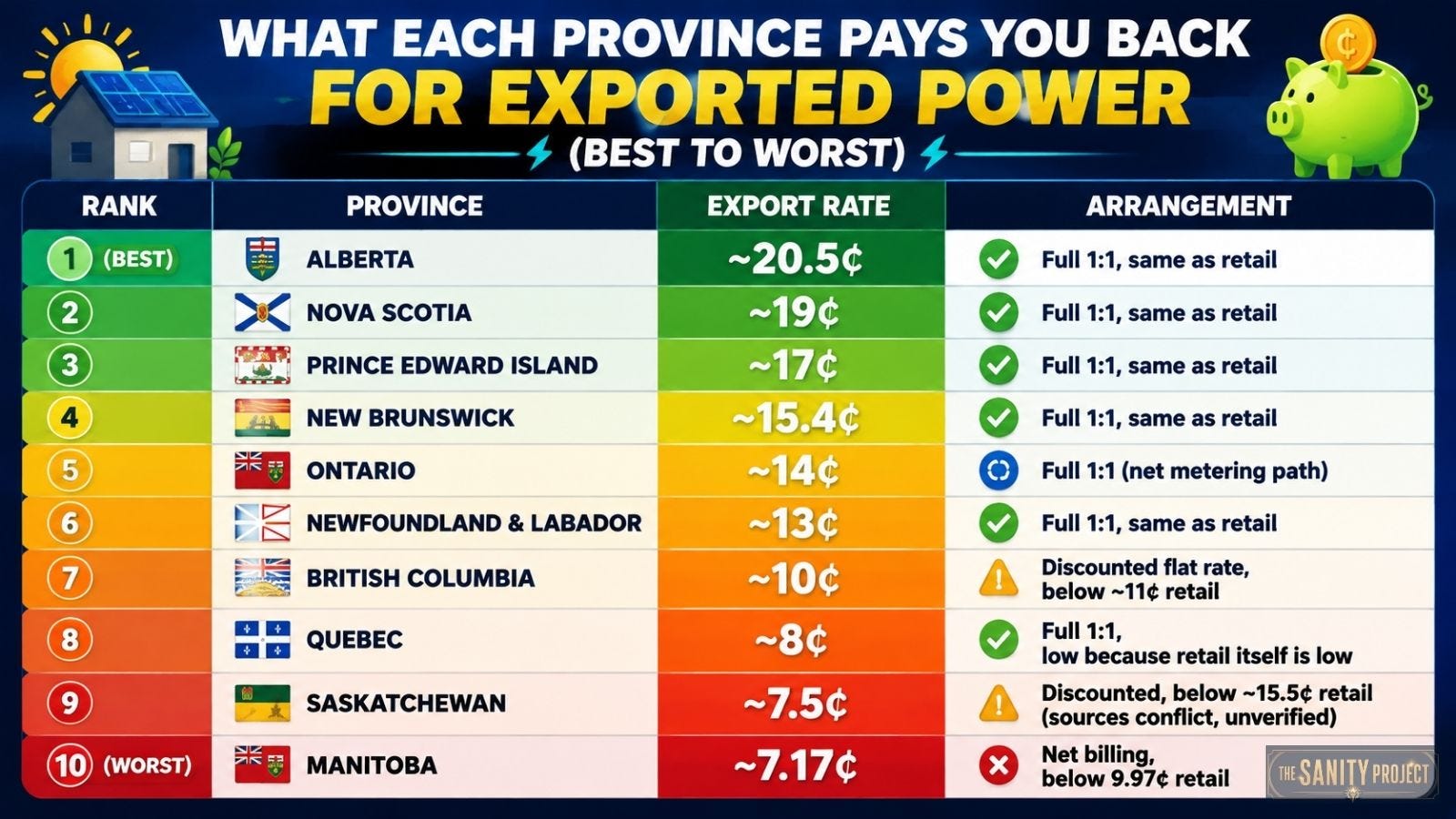
Seven of the ten provinces pay exactly what they charge, so for those seven, this table repeats the rate table above. Only British Columbia, Saskatchewan, and Manitoba dock you for exporting.
If Your Province Doesn’t Pay 1:1, Get a Battery
In British Columbia, Saskatchewan, and Manitoba, a battery converts electricity that would otherwise be sold at a discount into electricity worth full retail value. In the other seven provinces, that specific argument doesn’t apply.
Seven of ten provinces pay exactly what they charge: export a kilowatt-hour, and it’s worth what you’d pay to buy one. There, a battery changes when you use your power, not what it’s worth.
British Columbia, Saskatchewan, and Manitoba are different. Every kilowatt-hour exported there sells at a discount. A battery lets you store midday surplus instead of selling it cheap, then use it in the evening instead of buying it back at full price. For homeowners in these three provinces, storage isn’t a luxury; it’s the biggest lever available for improving real-world return.
Manitoba’s retail-to-export spread is about 2.8 cents. Saskatchewan’s, by the more pessimistic of two conflicting figures, is closer to 8 cents. That’s real money a spreadsheet can’t capture without knowing your storage setup. If you’re in one of these three provinces, ask an installer to model your numbers with and without a battery. In the other seven, that question matters less, since the utility pays you the same either way.
With that on the record, here’s how the ten provinces actually stack up, combining all three factors, starting with the slowest.
The Slow Lane: Quebec, British Columbia, and Manitoba
These three land in nearly the same place for three completely different reasons: one has cheap power, one has modest power and a new export discount, and one has decent power undercut by its export rate.
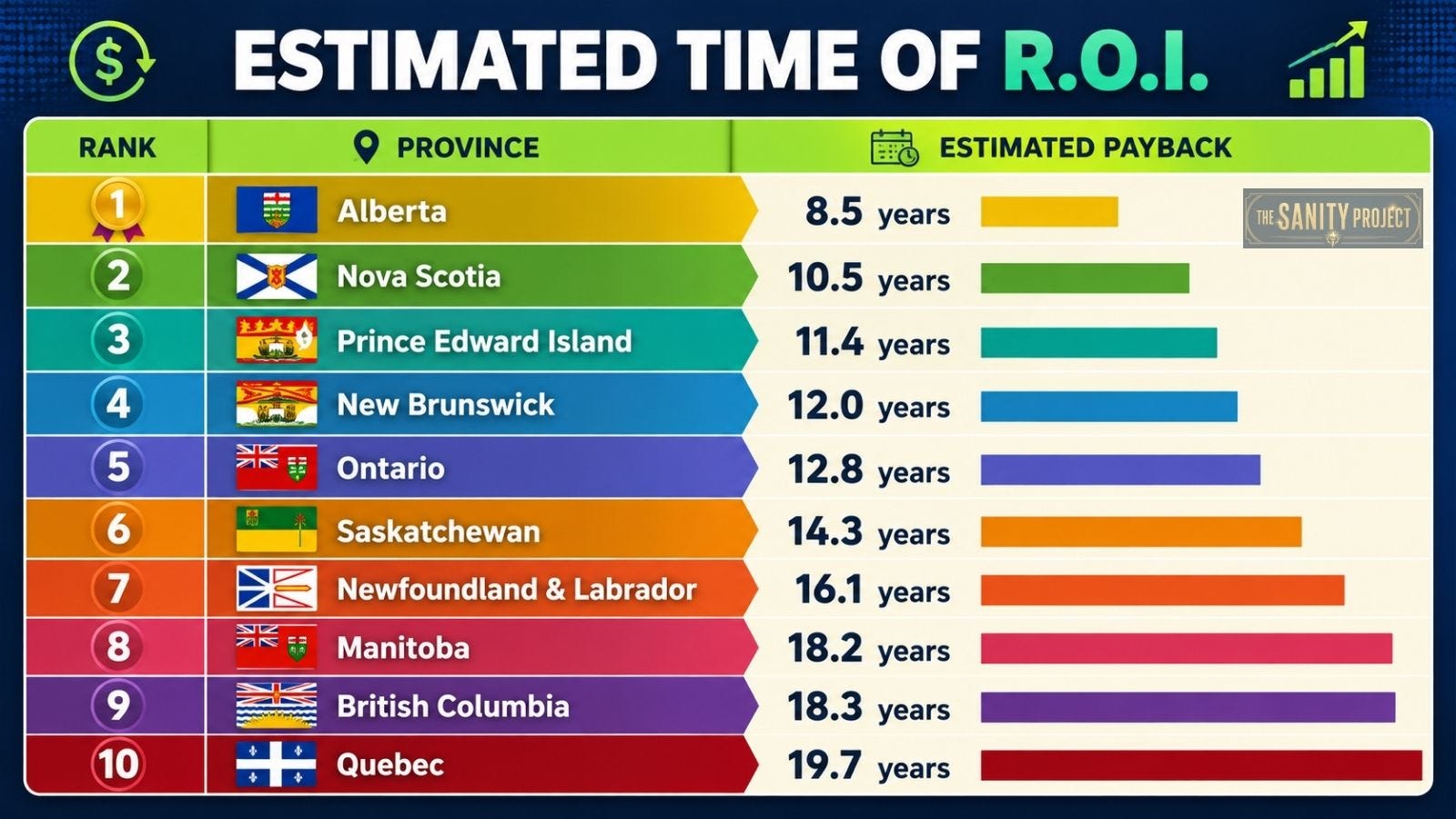
Quebec sits at the bottom, and there’s nothing wrong with that. Hydro-Québec’s dam network makes electricity so cheap, around 8 cents per kilowatt-hour, that solar has little left to save you from. Quebec pays full retail for exports too, but the rate itself is too low to generate much savings. Payback lands around 19.7 years, the slowest in the country, not from bad energy policy. Cheap, clean hydro is arguably the best outcome a province can have. It’s just the worst outcome for anyone selling (or buying) solar panels.
British Columbia used to be a simple story: modest rates, modest sun, modest payback. As of July 1, 2026, BC Hydro replaced its old 1:1 net metering with a flat 10-cent export rate for new customers, below its roughly 11-cent retail rate. Not a steep discount, but real, and it lands BC in the slow lane on rate structure alone. Payback under the new rules runs around 18.3 years.
And here’s Manitoba, whose real numbers built this model. Its rate is reasonable, and its sun is strong, close to 1,272 kilowatt-hours per installed kilowatt a year, so on paper it should do better.
What holds it back is net billing: exported power sells at 7.17 cents, while the retail rate is 9.97 cents. Run the honest math, and Manitoba lands at 18.2 years, just ahead of BC, and oddly just behind Newfoundland and Labrador, a province with far weaker sun. Sunshine lost to billing structure. (The current provincial rebate helps a lot)
The Middle of the Pack: Newfoundland and Labrador, Saskatchewan, and Ontario
Saskatchewan has the best sun in the country and still lands in the middle of this list. Its export rate is the reason, and it’s the single biggest reordering this whole exercise produced.
Newfoundland and Labrador has the lowest sun exposure of any province here, well under 950 kilowatt-hours per installed kilowatt per year, and still beats Manitoba and BC. The reason: it pays full retail for every exported kilowatt-hour, no discount. That’s enough to overcome mediocre sunshine and land at 16.1 years. There’s no province-wide rebate, and the rate here, around 13 cents, is itself kept artificially low by Muskrat Falls rate mitigation, a political fix for an infamously over-budget hydro project.
Saskatchewan is the biggest surprise here, and not a good one. It has the best sun in the country, and until you factor in its export rate, it looks like Alberta’s closest competitor. It isn’t. SaskPower credits exports around 7.5 cents against a roughly 15.5-cent retail rate, costing real years of payback. Worth flagging: sources conflict on this figure; some describe near-retail credit for older enrollees, others a steep cut for recent sign-ups.
We couldn’t resolve it cleanly, so treat 14.3 years as the conservative end of the range and confirm directly with SaskPowey. Either way, the lesson holds: the best sun in Canada isn’t worth much if the utility won’t pay for what you don’t use.
Ontario lands mid-table at 12.8 years, on a decent, not spectacular, 14-cent rate and full 1:1 net metering. One wrinkle worth knowing: Ontario homeowners can trade net metering for a rebate worth up to $10,000, but only by giving up grid export entirely and consuming everything on-site. That’s precisely the homeowner who needs a battery to make the trade pay off. Without one, unused midday production just gets wasted (If they opt for the 10K rebate).
“The best sun in Canada isn’t worth much if the utility
won’t pay for what you don’t use.”
Closing In: New Brunswick, Prince Edward Island, and Nova Scotia
By the time you reach these three, a simple combination of decent-to-good rates and full 1:1 export pushes payback comfortably under a dozen years.
New Brunswick’s rate, around 15.4 cents, and full 1:1 export combine for a payback of around 12.0 years. There was also a rebate, but registration for NB Power’s Total Home Energy Savings Program closed on May 27, 2026. If you’re reading this after that date, that door is shut, though the net metering deal is solid on its own.
Prince Edward Island runs hot on prices, around 17 cents, paired with full 1:1 net metering, for payback around 11.4 years. PEI ran one of the country’s more generous rebates before pausing new applications in September 2025 after the program blew through its budget. Funding for 2026-27 was still being sorted as of the latest update. Worth checking before you assume it’s there.
Nova Scotia’s electricity is expensive enough, around 19 cents, and its export credit matches it dollar for dollar, pushing payback to about 10.5 years despite middling sun. The SolarHomes rebate closed to new homeowners in April 2025. What’s left is simple: full retail value for every kilowatt-hour, produced or exported, one of the cleaner deals in the country even without a rebate.
Which brings us to the province that wins outright.
Alberta Solar Panels Have the Best Math in the Country
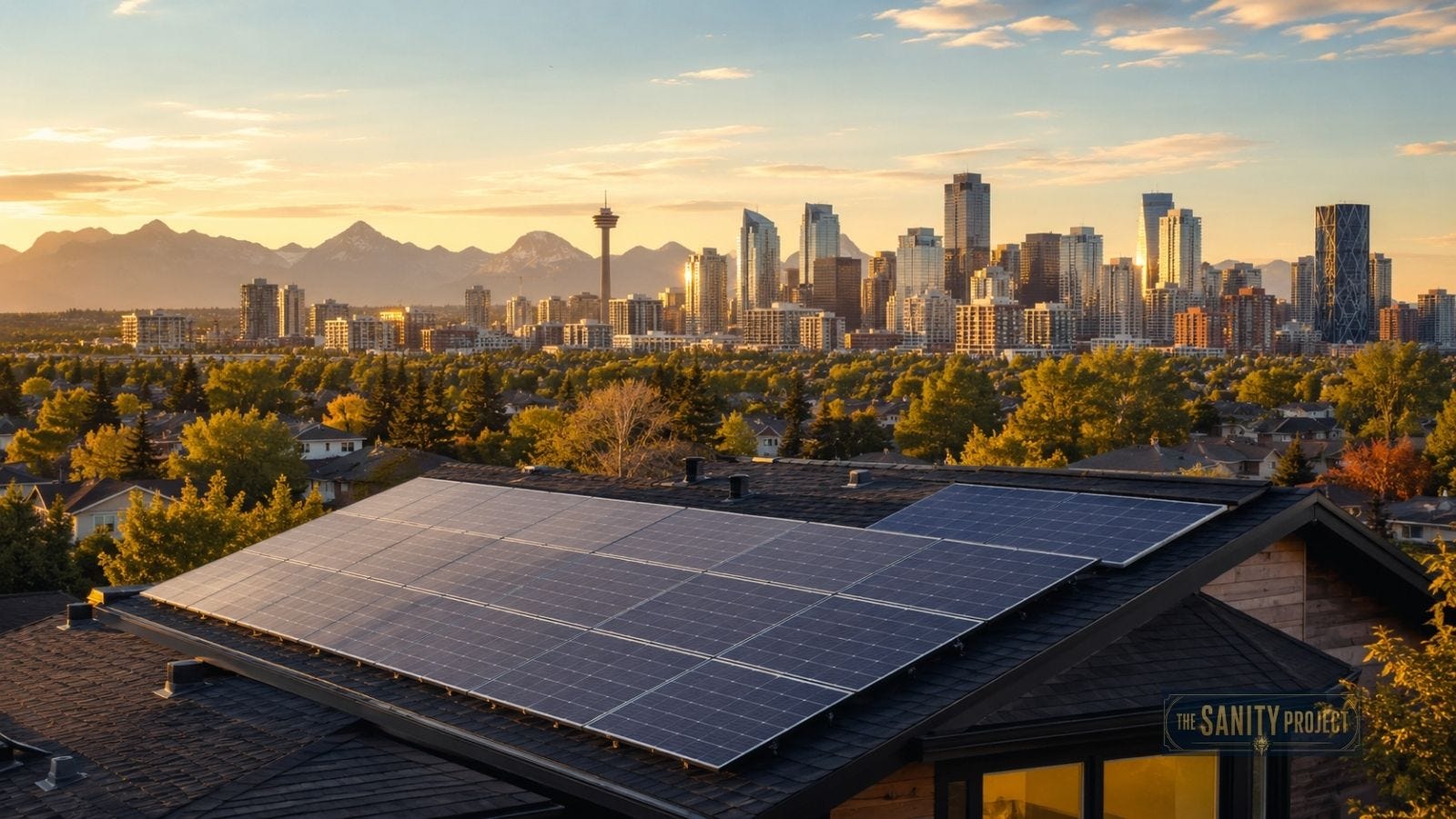
Alberta pairs some of Canada’s strongest solar production with some of its highest, most volatile electricity rates, plus full 1:1 export, the one province where every factor in this model points in the same direction.
Southern Alberta gets close to 1,276 kilowatt-hours of solar production per installed kilowatt a year, edged out only by Saskatchewan. Alberta electricity rates aren’t just high; they’re unpredictable, since Alberta runs a deregulated market instead of a crown utility with fixed rates like Manitoba or Quebec. Unlike Saskatchewan or Manitoba, Alberta pays full 1:1 for every exported kilowatt-hour, so none of the ground lost by those two provinces applies here.
Run the complete model, and Alberta’s payback lands at 8.5 years, the shortest in the country by nearly two years over its closest competitor. That’s without any rebate, because Alberta doesn’t have one.
No Rebate, By Design
None of the payback figures above include a rebate for anyone. But Manitoba, British Columbia, and Ontario at least have one on the books to layer on top. Alberta doesn’t.
Search for an Alberta solar rebate, and you’ll find nothing province-wide, just a patchwork of five municipal programs: Banff, Medicine Hat, Canmore, Wetaskiwin, and Edmonton. Banff’s is the strongest at $450 per kilowatt, capped at $9,000, and it only helps if you live in Banff.
What Alberta offers instead is financing. The Clean Energy Improvement Program lets participating municipalities add solar costs to your property tax bill over up to 25 years—useful, but a loan, not a gift. To be fair, connection rules are unusually generous: Alberta’s Micro-generation Regulation allows systems up to 5 megawatts, the most permissive cap in the country. The paperwork isn’t the obstacle. The absence of money on the table is.
The Moratorium Nobody Forgot
Corporate renewable energy investment in Alberta has collapsed 99 percent since the province’s seven-month approval freeze in 2023, and the rules that followed the freeze are still shaping the market.
In August 2023, Alberta paused approvals for every renewable energy project larger than one megawatt. The freeze lasted seven months, ending on February 29, 2024. What followed mattered more: new rules protected Class 1 and 2 agricultural land from large solar and wind development, established buffer zones around “pristine viewscapes,” and required developers to post financial security for reclamation.
The Pembina Institute’s Business Renewables Centre-Canada tracked the fallout: corporate renewable deals in Alberta have fallen 99 percent since 2023, and in 2025 alone, developers walked away from connection requests for more than 800 megawatts of construction-ready solar and 300 megawatts of wind.
To be fair, the siting rules followed a formal Alberta Utilities Commission inquiry into public concerns, and protecting farmland or requiring cleanup funding aren’t unreasonable asks. These rules also target utility-scale and ground-mounted projects specifically. A homeowner in Edmonton or Lethbridge was never subject to the agricultural land rules, and Alberta’s deputy premier has floated a rooftop-specific program still to come.
Now There’s a Tax on the Panels Themselves
Starting October 1, 2026, every solar panel sold in Alberta will carry a new $14 fee, nearly five times the cost of recycling a television in the same province.
As of October 1, 2026, the Alberta Recycling Management Authority will charge a $14 fee on every solar panel one square meter or larger, sold anywhere in the province. Recycling a television in Alberta costs $2.75; the solar fee runs almost five times that. The province says the fee funds future recycling infrastructure. Fair enough, except independent research commissioned by the Canadian Renewable Energy Association puts the true cost closer to $5, near three times less than what Alberta charges.
The fee isn’t enormous on its own, about $308 for a standard 22-panel system and $560 for a larger 40-panel one. What’s strange is the timing: 2026 panels carry 25- to 35-year warranties, so most won’t need recycling until the 2040s. No large-scale recycling program exists anywhere in Canada yet, according to Canada’s National Observer; spent panels are landfilled or shipped to the US. The fee collects money now for infrastructure that doesn’t exist, to recycle equipment that won’t need it for about three decades.
“A $14 fee on panels that won’t need recycling until the 2040s is politics dressed up as policy.”
Editor’s View
I set out to give every Canadian a straight number for their province. I ended up throwing out the one real number I started with, an installer’s 12-year quote, because it rested on an assumption that only holds true in seven of ten provinces. The bigger surprise wasn’t Alberta winning; everyone expected that. It was Saskatchewan falling out of contention and Manitoba trailing Newfoundland despite far better sun. The best sun in the country doesn’t matter if your utility won’t pay for what you don’t use. What Alberta does with its win, no rebate, a moratorium’s shadow, and now a fee on the panels, is a different, arguably more interesting story.
Update (August 2026): This piece reflects rate, yield, and policy details through early August 2026. Every payback figure is a comparative model: a real $2,500-per-kilowatt cost, provincial rate and yield data, a 40/60 self-consumption split, and 3 percent annual escalation, with no rebates included. These figures are accurate relative to each other, not in absolute terms. Treat them as a ranking, not a personal quote, and check your own province’s current rebates, which only ever shorten the real payback period. Homeowners in British Columbia, Saskatchewan, or Manitoba should specifically ask an installer to model a battery before finalizing a system. Saskatchewan’s export rate is reported inconsistently across sources and could not be independently confirmed.
Publications Consulted: CBC News. Canada’s National Observer. Canadian Renewable Energy Association. Alberta Recycling Management Authority. Alberta Utilities Commission. Canada Energy Regulator. Pembina Institute’s Business Renewables Centre-Canada. Osler, Hoskin & Harcourt LLP. Calgary Herald. Manitoba Hydro. Efficiency Manitoba. BC Hydro. Save on Energy Ontario. SaskPower. NB Power. Efficiency Nova Scotia. efficiencyPEI.
Follow for more fact checks that cut through the noise.
Does your solar yield number take into account the fact that solar electricity generation is massively reduced 6 months of the year?