



As electric vehicles (EVs) roll onto city streets in increasing numbers, a powerful narrative has emerged: the electrical grid just can’t keep up. Headlines blare about blackouts, and politicians warn that plugging in your car at night could be the final straw. But is the grid really at its breaking point? Or are we simply misreading—or misrepresenting—where the true strain is coming from?
The Grid Panic: Smoke and Mirrors
Much of the public debate around EV adoption centers on fears of grid overload. Policymakers in regions like Saskatchewan cite grid limits to justify slowing down EV mandates. The argument goes like this: with each new electric car, we inch closer to blackout territory. This doom-and-gloom narrative trickles into media coverage, town halls, and consumer sentiment.
Yet behind the scenes, there’s a striking contradiction. While regulators declare that residential EV charging is pushing infrastructure to its limit, those same officials are signing off on industrial projects demanding exponentially more power than cars ever could.

The AI Data Center Boom
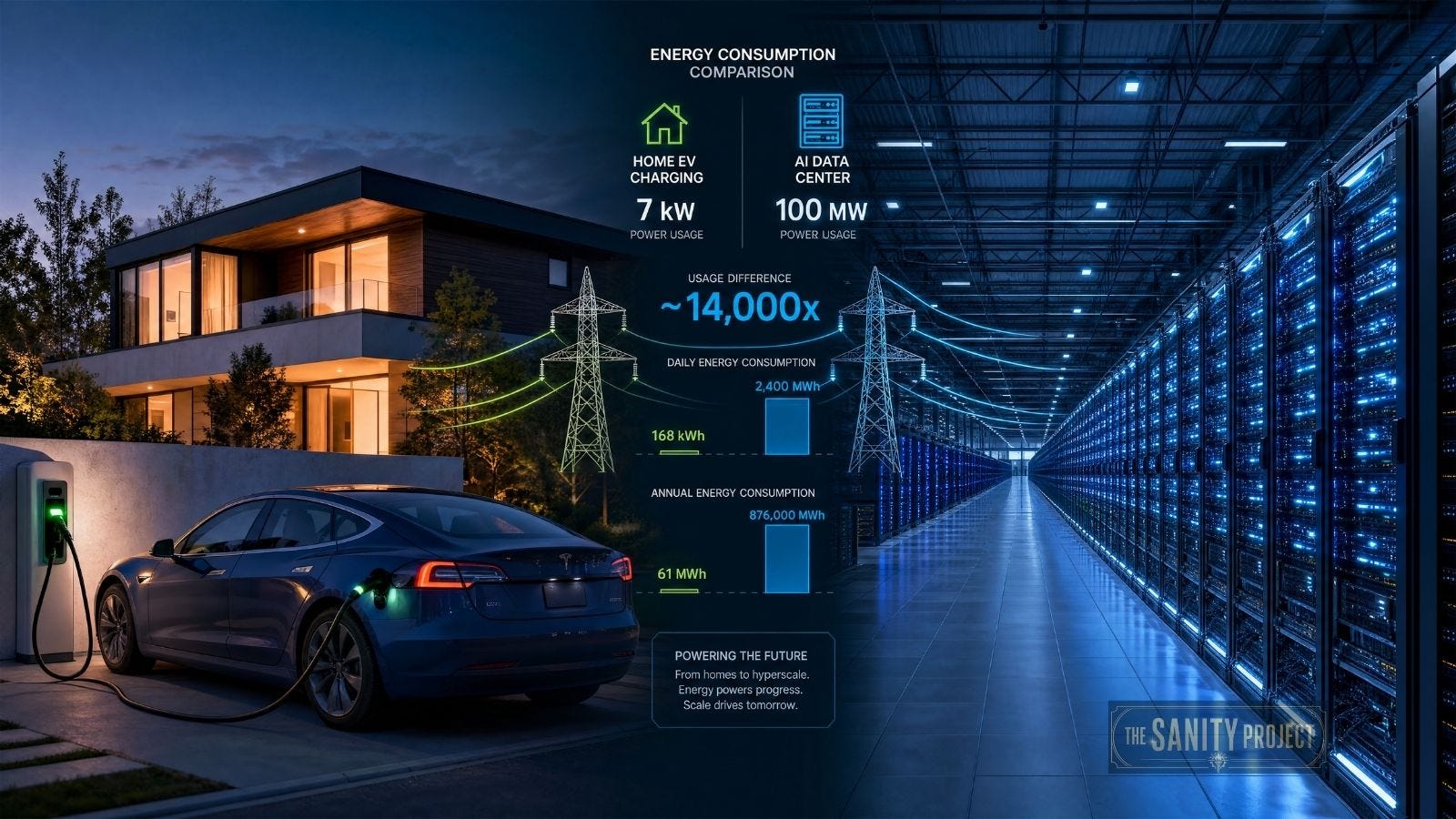
In Saskatchewan, a $1.7 billion, 90,000-square-foot artificial intelligence data campus is rising just outside Regina. Built by Bell Canada, this “hyperscale” facility is designed to house computing power not just for Canadian needs but also for U.S. tech giants. Here’s the kicker: once operational, the campus will require a continuous, unwavering 300 megawatts of electricity—enough to power tens of thousands of homes.
What sets data centers apart from other users is that their demand is not only massive, but also constant. Unlike residential loads, which ebb and flow throughout the day and often dip at night, these facilities need their electricity 24/7, regardless of shifting demand elsewhere on the grid.
Meanwhile, electric vehicles typically charge at home overnight, a period when demand on the grid is actually at its lowest. This creates a dispersed, flexible load—quite the opposite of the concentrated, inflexible pull of a single, always-on industrial campus.
Whose Interests Drive Policy?
This raises critical questions about how grid “capacity” is being allocated. The public is told that charging cars will crash the system, even as governments find vast energy reserves for private, profit-driven projects. In reality, the problem is not a technical limitation—it’s a political priority.
To deliver enough power to the new data center, Saskatchewan is pouring billions into refurbishing old coal plants. The financial risk falls squarely on local citizens, who see their rates rise and their tax dollars spent to guarantee uninterrupted energy for global tech companies. When these tenants leave, they take their hardware—and all the value it creates—with them, leaving local communities with the bill.
Moreover, key decisions about grid allocation, capital investment, and rate hikes are made with little transparency or public consultation. No meaningful guarantees are secured regarding local employment or data sovereignty, let alone the environmental impact of doubling down on coal power.
The Narrative Misdirect
The result? The spectre of grid collapse incited by EVs serves as a distraction—one that keeps voters’ eyes on their own driveways rather than on multi-billion-dollar deals happening in the background. This tactic has real stakes: ratepayers shoulder risks and costs, while powerful private actors reap immense benefits, all under the guise of prudent grid management.
The real question isn’t whether the grid can support new demand; it’s which demand matters most to those making the rules. The grid is a shared public resource. Who gets priority access reveals our true societal values—whether that’s individual mobility and clean local air, or digital infrastructure that might generate immense profits while leaving communities with financial and environmental burdens.

Taking Back the Conversation
It’s time to stop allowing the electric vehicle debate to be used as a smokescreen. Focusing only on the incremental household impacts of EV charging misses the story: the most significant strains—and the biggest choices—are happening at a scale that most consumers never see.
If energy scarcity is real, then every megawatt matters. But who gets those megawatts isn’t an engineering problem. It’s a policy decision. Recognizing this opens the door to a more honest, transparent, and democratic management of our public power grid.
For the in-depth report, go to our News Site @
https://blog.thesanity.org
The other big issue for Canada is that its electrical grids are entwined with those of the US. When the. US grids need power because of extra demand from too much heat, too many data centers or equipment failure, they draw from the Canadian grid. Like the US power in Canada is often provided by private companies, whose primary concern is profit...not building "unnecessary" belts and suspenders ( resilience). As a result ,the equipment is often antiquated and the grids are fragile. Data centers may be power hogs but the real danger comes from climate change, natural disaster and now perhaps war...all of which can place extreme demands on a system designed for another era, when not everything depended on electricity to function. Rather than finger pointing ( even if deserved) Canada would be well served to have governments and cooperatives develop small grid regional power because we aren't ready to give up our electricity based lives.
Thank you.