



I was scrolling through Facebook the other day when I saw yet another meme attacking a Canadian politician.
Nothing unusual there. Politics has always been rough around the edges. Canadians are not, despite the reputation, uniformly polite about the people who govern them.
But then I looked closer.
The meme wasn’t Canadian. The language wasn’t Canadian. The talking points weren’t Canadian. The image had clearly originated in the American political ecosystem and, with a few names swapped out, made its way into a conversation about Canada.
And that’s when a question occurred to me that I haven’t been able to shake since.
When did so much of Canadian political conversation stop actually being about Canada?
The Politics We Used to Have
It wasn’t that long ago that Canadian conservatism was, whatever you thought of it, distinctly Canadian.
The arguments were about issues such as fiscal responsibility, resource development, trade relations, and the perennial tension between Ottawa and the provinces. People disagreed, sometimes loudly, but they were disagreeing about Canadian things. The size of the federal government. The management of public finances. Whether a pipeline made economic sense.
You could set your watch by it. Budget debates. Transfer payments. The National Energy Program is still generating heat decades later. Senate reform. These were the fights.
They were our fights.

Then Something Changed
At some point, roughly a decade ago and accelerating sharply after 2016, a different vocabulary arrived.
Suddenly, Canadian political conversations were about the “war on woke.” About globalist elites. About fake news and legacy media. About protecting children from things that had not previously been considered threats. About freedom convoys and mandates and a creeping tyranny that, to many Canadians, seemed to have been imported wholesale from somewhere south of the border.
The concerns weren’t always illegitimate. Distrust of institutions has real roots. Media consolidation is a genuine issue. Government overreach is worth scrutinizing.
But the vocabulary — the specific framing, the grievance architecture, the us-versus-them structure — sounded less like it had grown organically from Canadian soil and more like it had been copied from a different country’s culture war.
A Saskatchewan town hall suddenly sounded like a Texas rally. An Alberta Facebook group suddenly sounded like it was run out of Florida. A school board meeting in Ontario suddenly featured talking points that had been field-tested in places like Loudoun County, Virginia.
The words were the same. The targets were different. But the anger was identical.
The Places Running the Experiment
Here’s a fair question to ask: if this political model produces good results, we should be able to see them somewhere.
The United States has had states governed by this approach, culture-war politics, anti-expert rhetoric, and aggressive grievance messaging long enough that we can start measuring outcomes. States like Mississippi, Louisiana, Arkansas, and Alabama have been running some version of this experiment for years.
The people who live there are not caricatures. Many live ordinary, decent lives and have priorities and values worth taking seriously. That’s important to say clearly.
But if we’re evaluating the political model and not the people, the data is sobering. These states consistently rank near the bottom of national measures for education outcomes, health coverage, life expectancy, and economic mobility. They have some of the highest poverty rates and some of the weakest public infrastructure in the developed world.
None of that is because the people are less capable or less deserving. It’s because a politics built primarily around grievance and culture war tends to be very good at winning elections and very poor at governing.
So when we ask what Canada hopes to achieve by importing this model, it’s a genuine question, not a rhetorical one.
Canada’s Version
Look across the Canadian political landscape, and you’ll see the pattern taking shape.
In Alberta, the dominant political conversation has shifted from managing oil revenues and negotiating with Ottawa to something that feels more like permanent conflict with the federal government, with renewable energy, with institutions, and with the very idea of compromise. The grievance is the point. The fight is the product.
In Saskatchewan, a similar posture has taken hold. In Ontario, a blend of populism and culture-war signalling has become the defining feature of provincial politics. The specific issues differ by region, but the underlying architecture is remarkably consistent and remarkably familiar to anyone who has watched American conservative politics over the past decade.
The strategy is the same: make voters feel surrounded, embattled, and disrespected, then position yourself as the only one willing to fight for them.
It works. Electorally, it works very well.
What it doesn’t do is build affordable housing, fix healthcare wait times, or raise Canadian productivity.
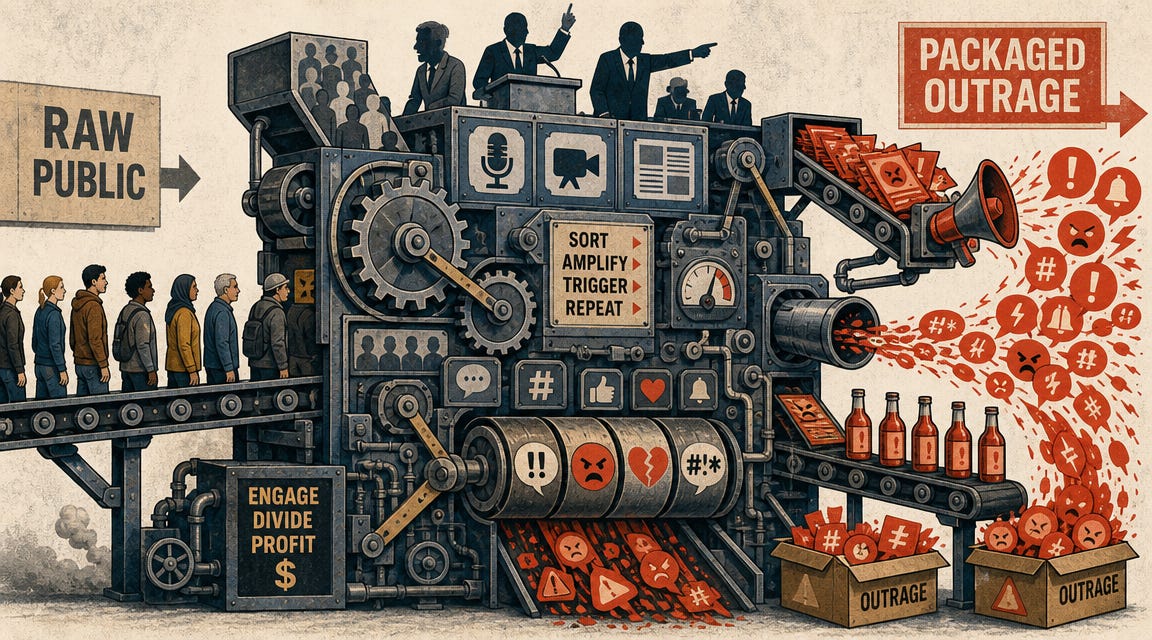
The Business of Keeping People Angry
Here is the part of this conversation that gets uncomfortable, because it stops being about left versus right.
Outrage has become a product.
Politicians have discovered that angry constituents donate more, show up more, and are easier to mobilize than satisfied ones. Media companies, traditional and digital, have discovered that rage drives more engagement than nuance. Social media platforms are optimized by design to surface content that produces strong emotional reactions. Influencers have discovered that a steady diet of manufactured crisis keeps audiences returning.
The algorithm doesn’t care whether a post is true, useful, or Canadian. It cares whether it makes you feel something.
And so content designed to inflame American audiences gets fed seamlessly to Canadian audiences. The platforms don’t distinguish. Why would they? The emotional response is the same.
Angry citizens have become the raw material for an attention economy that profits from their anxiety. The more we share, react, and engage with imported outrage, the more of it we’re served.
Nobody sat down and planned the Americanization of Canadian politics. The algorithm did it for free.

The Most Canadian Question of All
Canada has no shortage of real problems.
Housing has become genuinely unaffordable for a generation of younger Canadians. The healthcare system is under serious strain. Productivity growth has been weak for years. Infrastructure is aging. These are not small issues. They are the kind of structural challenges that will define what kind of country Canada is in twenty years.
But too often, the political energy that might be directed at these problems is being consumed by whatever culture-war controversy exploded south of the border yesterday. Because that’s what the algorithm served up. Because that’s what the political consultants, who are increasingly taking their cues from American counterparts, have learned generates the most noise.
The result is a politics that is very loud and very busy while somehow making very little progress on the things that actually affect Canada’s lives.

Back to the Facebook Meme
There is nothing wrong with criticizing Canadian governments. There is nothing wrong with taking sharp aim at Mark Carney, Pierre Poilievre, Danielle Smith, Doug Ford, or anyone else who holds public office.
That is democracy. That is exactly what it should be.
But there is a difference between criticism rooted in Canadian realities, criticism that wrestles with Canadian trade-offs and Canadian priorities, and criticism that has simply been imported, rebranded, and handed to us pre-assembled.
One asks us to think. The other asks us to react.
A country that continuously imports another country’s outrage eventually stops having its own conversation. The issues get blurry. The solutions get borrowed. The anger starts to feel familiar, but the problems never quite get solved, because the solutions were never designed for here.
If there’s one thing Canada doesn’t need right now, it’s more borrowed anger.
We have enough of our own problems to be angry about. The least we can do is be angry about the right ones.
Sources:
Listen To The Sanity Project Podcast

The Sanity Project is a publication about thinking more clearly in a world that profits from confusion. If this resonated, share it with someone who might need it.
Yes, Pierre, Jamil Javani, Andrew Lawton, This is about you
I agree news coverage between Canada and U.S srems to be tilting right, similar in nature, and is likely a worldwide, universal shift. Not just western hemisphere, but EU and U.K. However, I was going to say it was interesting to see Jon Osoff speaking at a rally in Georgia a few days ago and his speech and delivery was much like our Prime Minister Carney. It was very similar, I am sure there is politcal poaching regardless of news trends. Osoff is likely going to run for President in 2028, he is ‘off’ to a good start. CANADIANS need yo be mindful consumers and we need to make sure what we see or read is factual. I dont think streamlined news tilting left is any more reliable than broadcast news that tilts right. As far as print media and American ownership by Post media, dont read it, dont buy it. BOYCOTT it. I think like any product, the consumer decides. Unfortunately, I know I am slightly addicted to Substack but I do turn off news that bothers me, like when I see PP at a mic. 🇨🇦🇨🇦🇨🇦