


This is Part 2 of a 4-part deep dive!
On June 4, 2026, three things happened in three different places, and almost nobody connected them.
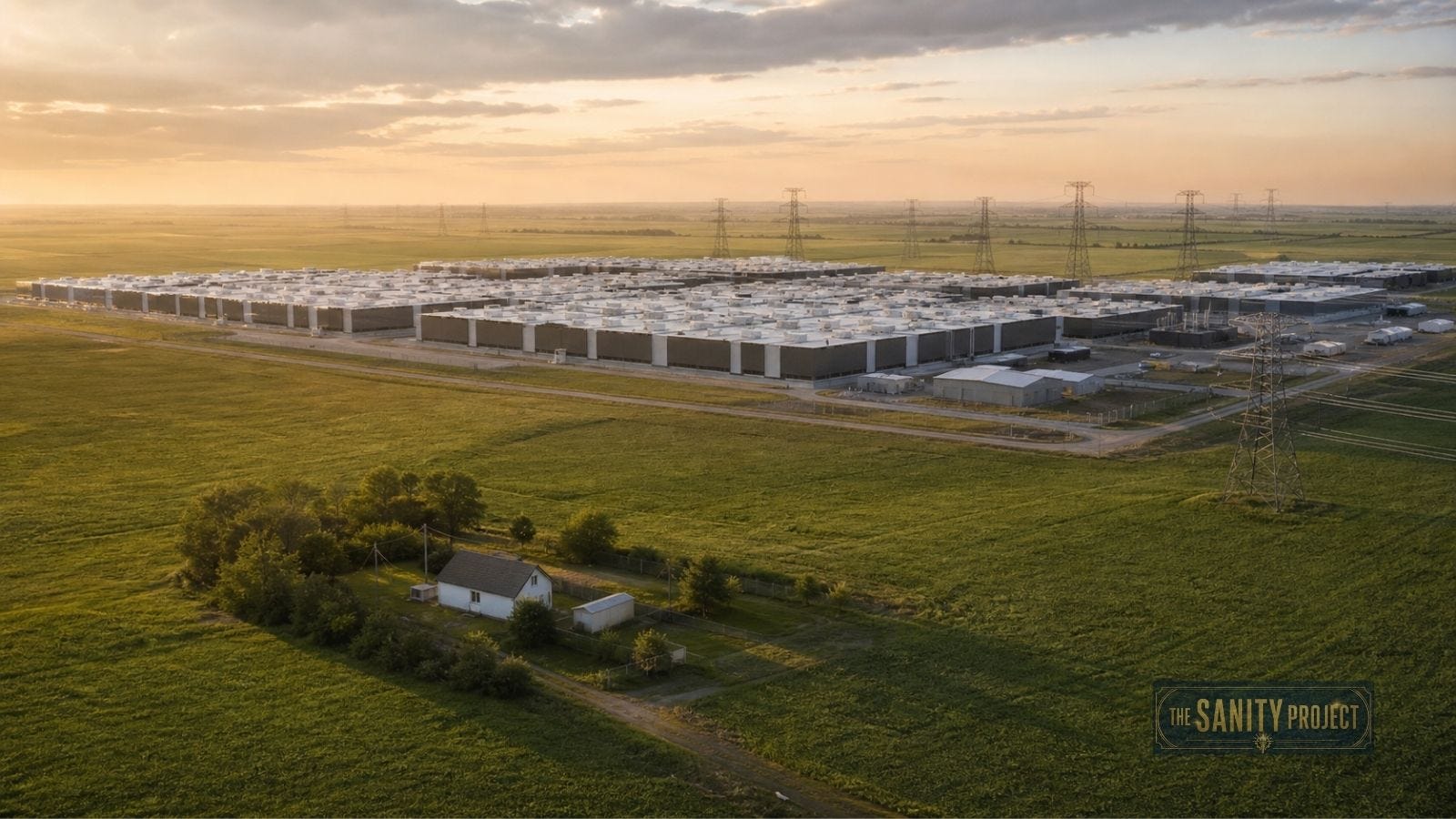
In Winnipeg, the Kinew government rejected Jet.AI’s application to build a natural gas-powered hyperscale AI data center, one that would have swallowed 13% of Manitoba Hydro’s entire annual generating capacity. In Ottawa, the federal government announced a $705 million sovereign AI compute strategy. And in Portland, Oregon, the local utility filed a proposal to raise residential electricity rates by 29%, citing data centers as the reason.
One country says no. The same country says yes. And a preview, three time zones away, of what the bill looks like when nobody asks the hard questions first.
Premier Kinew called the Manitoba AI data center proposal an “albatross.” That word choice deserves more attention than it got. An albatross isn’t just a burden. In the poem, everyone half-remembers from high school, it’s a thing that arrives promising good fortune and ends up hanging around your neck as a curse. Whether he intended the full literary weight or not, it turns out to be the most precise description anyone in public office has yet offered for what’s happening across this continent.
Because Manitoba is not an outlier. It’s a chapter in a much bigger story.
The gold rush that skipped the homework
After ChatGPT launched in late 2022, the scramble that followed had no modern precedent. Microsoft, Google, Amazon, and Meta committed hundreds of billions to AI infrastructure within 18 months. By 2025, Goldman Sachs was projecting $2 to $3 trillion in global investment by 2030. The logic was simple: demand for generative AI would grow forever, and whoever locked in land, power, and fibre first would own the future.
Municipal governments lined up to compete. Land grants, tax freezes, utility priority. The pitch to residents was always the same: clean modern facilities, tax revenue, jobs.
Here’s the thing about that pitch. Almost none of it survives contact with the actual numbers.

Start with jobs, since that’s the headline promise. Food & Water Watch reviewed employment claims against actual outcomes across multiple U.S. facilities and found that despite billions in public subsidies, most hyperscale data centers employ fewer than 50 permanent staff once construction wraps. The construction jobs are real. They’re also temporary by definition. The permanent workforce is mostly remote engineers employed at headquarters, not locals. Run the math on subsidy per permanent local job, and you land in the millions of dollars. Per job.
Then there’s the cost nobody puts in the brochure: opportunity cost. Manitoba’s 13% wasn’t an abstraction. That’s energy that could power hundreds of thousands of homes, anchor northern communities, or attract a dozen smaller employers with actual payrolls. A renewable energy grid that took decades of public investment to build is a finite infrastructure. Hand a huge slice of it to a single private operator for decades, and every other use is foreclosed.
That’s not an environmental argument. It’s an economic one. Which is exactly why it’s spreading.
Starting an online business?
Canadian businesses deserve Canadian hosting. If you’re building a website or blog, this is where I’d start: Web Hosting Canada

Your power bill is the invoice
If you want to know where this story shows up first for ordinary people, look at electricity rates.
In the PJM grid region, which covers 13 U.S. states, capacity prices increased tenfold between 2023 and 2025, driven primarily by data center energy consumption outpacing supply. PJM grid capacity auctions are obscure machinery that most people never think about, right up until the moment they translate into an electricity rate hike on a household bill.
Oregon got there on June 4. Portland General Electric’s proposed 29% residential increase explicitly named data center load growth as the driver. Residents who never signed a contract with a tech company and never saw a dollar of the promised benefits are being asked to subsidize the infrastructure anyway.
And here’s the uncomfortable part: AI energy use is still accelerating. Every projection that justified the buildout assumed the demand curve bends upward only. The people writing those projections don’t pay Oregon utility bills.

The water cost nobody mentions at the ribbon cutting
Water has quietly become the most underreported dimension of artificial intelligence's environmental impact, and the numbers are hard to sit with.
Modern facilities use water in two ways: direct data center cooling and indirect consumption through the power generation that feeds them. A team at the University of California, Riverside, estimated that global AI water consumption reached roughly 765 billion litres in 2025 alone. The UN has projected that on current trajectories, data center water usage could match the water needs of 1.3 billion people by 2030.
Read that sentence again. Not a typo. 1.3 billion people.
The kicker: two-thirds of newly announced facilities are sited in water-stressed basins, places where water scarcity is already a managed crisis. The communities most aggressively courting these projects are frequently the ones least able to absorb them.
And that’s before the carbon. Credible estimates put the carbon footprint AI generated in 2025 at between 32.6 and 79.7 million tonnes of CO₂ equivalent, from AI workloads alone. Many facilities claiming green status are buying renewable energy credits that, on paper, offset their consumption without decarbonizing the actual grid that delivers their power. Sustainable technology, as practiced, often means sustainable accounting.

The money that never shows up
The economic case always rested on tax revenue. In practice, the subsidy war between jurisdictions ate the revenue before it arrived.
Texas is the canonical case. The state’s data center tax breaks were costing roughly $1.3 billion per year in forgone revenue before its own lawmakers, a bipartisan group of them, started using the word “unsustainable” in public. Texas. The state that practically invented this competition is now trying to claw its way back out.
Virginia, home to the largest concentration of data centers on Earth, is losing approximately $1.02 billion annually in school funding to data center tax exemptions. That’s not an abstraction either. That’s a kitchen-table number. Parents understand exactly what a billion dollars a year not arriving at their kids’ schools means.
The pattern repeats everywhere: jurisdictions bid against each other by eliminating the very tax base that justified the deal. The community endures grid pressure, water demand, noise, and construction traffic. The revenue that was supposed to make it all worthwhile gets negotiated away before the first server rack arrives.
Looking to grow your YouTube channel?
One of my favourite tools is vidIQ. It helps take the mystery out of YouTube growth by providing keyword research, channel audits, AI-powered content ideas, and competitor insights.

The AI data center bubble nobody wants to name
All of this assumes the demand projections are even right. There’s growing evidence they’re not.
SynMax, which checks announced projects against satellite imagery of actual construction, found that 30 to 50% of U.S. data centers planned for 2026 were delayed or quietly cancelled. Microsoft, which spent 2024 loudly warning about compute shortages, spent late 2025 admitting that its own projections had fueled an overbuild. The Institute for Energy Economics and Financial Analysis is now openly warning about stranded assets: facilities built for demand that never materializes, leaving utilities and host communities holding the costs of underutilized buildings.
And Goldman Sachs, hardly a hotbed of technophobia, concluded that the first full year of massive AI capital deployment contributed “basically zero” to U.S. GDP growth in 2025.
That doesn’t mean AI is worthless. It means the productivity gains that justify trillions in AI infrastructure haven’t shown up in the data yet. Which sharpens Manitoba’s question to a point: who absorbs the risk if the demand curve bends before the infrastructure is paid off?
Spoiler: It is never the company that got the tax break.
This isn’t technophobia. It’s arithmetic with a voting record.
The revolt crosses every line that’s supposed to divide us.
Gallup found that 70% of Americans oppose building a data center in their community. Seventy percent. In this political climate, you can’t get 70% of Americans to agree on the shape of the Earth. Data Center Watch has tracked $64 billion in projects that have been blocked or delayed and counts 142 organized opposition groups across 24 states.
Tulsa, Oklahoma, not exactly a granola jurisdiction, imposed a moratorium on new approvals through the end of 2026 over grid stability. In Virginia, officials who voted to approve major facilities have been losing their seats as a result. Community opposition has stopped being a public-comment formality and started showing up in election results.
So what about sovereignty?
Honest pressure test time, because the counter-argument is real.
Canada’s $705 million sovereign compute strategy reflects a legitimate concern. If Canadian health records, financial systems, and government data run on servers subject to U.S. law, our digital sovereignty is structurally compromised. Given the state of the relationship since 2025, that’s not hypothetical. The “AI for All” framing treats compute as public infrastructure, the same logic that once built our electrical grids and railways. That argument holds.
But it holds for publicly anchored facilities, on Canadian soil, powered by Canadian renewables, under Canadian law.
It does not hold for Jet.AI. A U.S.-incorporated company burning natural gas and consuming 13% of a Canadian public utility’s renewable capacity to serve global commercial clients does not advance Canadian sovereignty. It advances Jet.AI’s balance sheet. Sovereignty is a real argument being borrowed as a regulatory lever by operators who deliver none of it.
Ottawa’s strategy and Manitoba’s rejection aren’t in contradiction. They’re two halves of the same standard, if anyone in Ottawa is willing to say so out loud.
The verdict
The gold rush will continue. The capital is too big and the politics too enthusiastic for it to stop. The only live question is what standards govern it.
What Manitoba applied wasn’t an obstruction. It was the minimum diligence any public utility owes its owners, who are, let’s remember, the public: how much of a finite asset, for what return, at what risk, for whose benefit. Asked rigorously, once, the answer was no. It won’t always be no. But the homework had to be done every single time, and for three years, almost nobody did it.
The seven costs are real and documented. The bubble risk is badly underweighted. The sovereignty argument is legitimate and currently being misapplied by the exact operators it doesn’t describe. Manitoba got this one right, and, as we argued in our previous coverage of the Manitoba Precedent on The Sanity Check, the rest of Canada is watching to see whether that rigour becomes the rule or remains a one-off.
An albatross, remember, was a blessing right up until somebody shot it.
So here’s where I’ll leave you with an actual position, because The Sanity Project doesn’t do “you decide”: sovereign compute, publicly governed, on Canadian terms, yes. Private hyperscale on a public grid at gold rush terms, no. If you think I’ve got the sovereignty math wrong, or if your community is facing one of these proposals, I want to hear about it in the comments. And if this kind of analysis is what you came for, subscribe at thesanity.org/p/subscribe so the next one lands in your inbox.
Listen to the Sanity Project Podcast

Thanks for this info - a few questions though. There are already 250- 330 data centers in our country - who owns them, where are they located, and how do they fit into this?
The math does not math.