


Canada's Critical Minerals Boom Goes Beyond Mining
Canada has never had much trouble finding valuable things buried in the ground. We have spent more than a century discovering gold, copper, nickel, uranium, potash, iron ore and just about every other useful element the periodic table has to offer.
Our problem has often been what happens afterwards. Canada has frequently been very good at extracting resources and quite willing to let somebody else perform the expensive magic that turns them into higher-value materials and manufactured products.
We dig. We ship. Somebody else processes, refines and manufactures. Then, occasionally, they sell it back to us.
It’s been a pretty good business. But somebody else has often had the better one.
That’s what caught my attention while going through the 167 projects presented to investors at the Canada Investment Summit. Of those projects, 63 fall into the prospectus’s Minerals and Metals category, making it by far the largest sector represented.

But after examining those 63 individually, the interesting story isn’t simply how many mines Canada wants to build. It’s how many projects are attempting to capture more of what happens after the mining is finished.
The prospectus itself describes an ambition to develop end-to-end value chains extending from exploration and mining through processing, manufacturing, recycling and advanced applications. Canada’s Critical Minerals Strategy uses remarkably similar language, calling for Canadian capacity from extraction through processing, advanced manufacturing and recycling.
And scattered throughout The 63 are concrete examples suggesting that it isn’t merely brochure language. Canada appears to be trying to build more of the industries that turn Canadian resources into considerably more valuable Canadian products.
That could ultimately matter much more than another mining boom.
63 Projects, But They Aren’t All Mines
First, an important distinction. The prospectus calls this the Minerals and Metals sector, not the critical-minerals sector, and not all 63 projects qualify as critical-mineral developments.
There are conventional gold and precious-metal projects, as well as salt and other mineral developments. But there is also an extraordinary concentration of materials required for batteries, electrical grids, nuclear power, defence, electronics and advanced manufacturing.
Our analysis found 17 projects involving gold, 10 involving copper, 9 involving lithium, 7 involving rare earths, 6 involving silver, 5 involving nickel and graphite, and 4 involving uranium. Those numbers overlap because many projects contain more than one commodity.
Canada’s official critical minerals list contains 31 minerals, while the federal strategy originally identified six with particularly strong potential for integrated domestic value chains: lithium, graphite, nickel, cobalt, copper, and rare earth elements.
And that is where The 63 become particularly interesting, because counting what’s underground tells us only half the story.
Canada’s $35.6-Billion Value-Added Gap
If you want to understand why processing and manufacturing matter, Natural Resources Canada’s latest mineral-trade figures provide an almost perfect illustration.
In 2025, Canada exported $162 billion in minerals and metals, representing 22% of Canadian merchandise exports. But what happens as those materials move through the value chain is considerably more revealing.
At Stage 1, which includes ores, concentrates and other primary products, Canada recorded a $31.5-billion trade surplus. At Stage 2, smelting and refining, the surplus was even larger at $42.2 billion.
Then the direction changes. At Stage 3, semi-fabricated products such as wire, sheets and tubes, Canada recorded a $6.6-billion deficit. At Stage 4, fabricated products and finished goods, the deficit reached $35.6 billion.
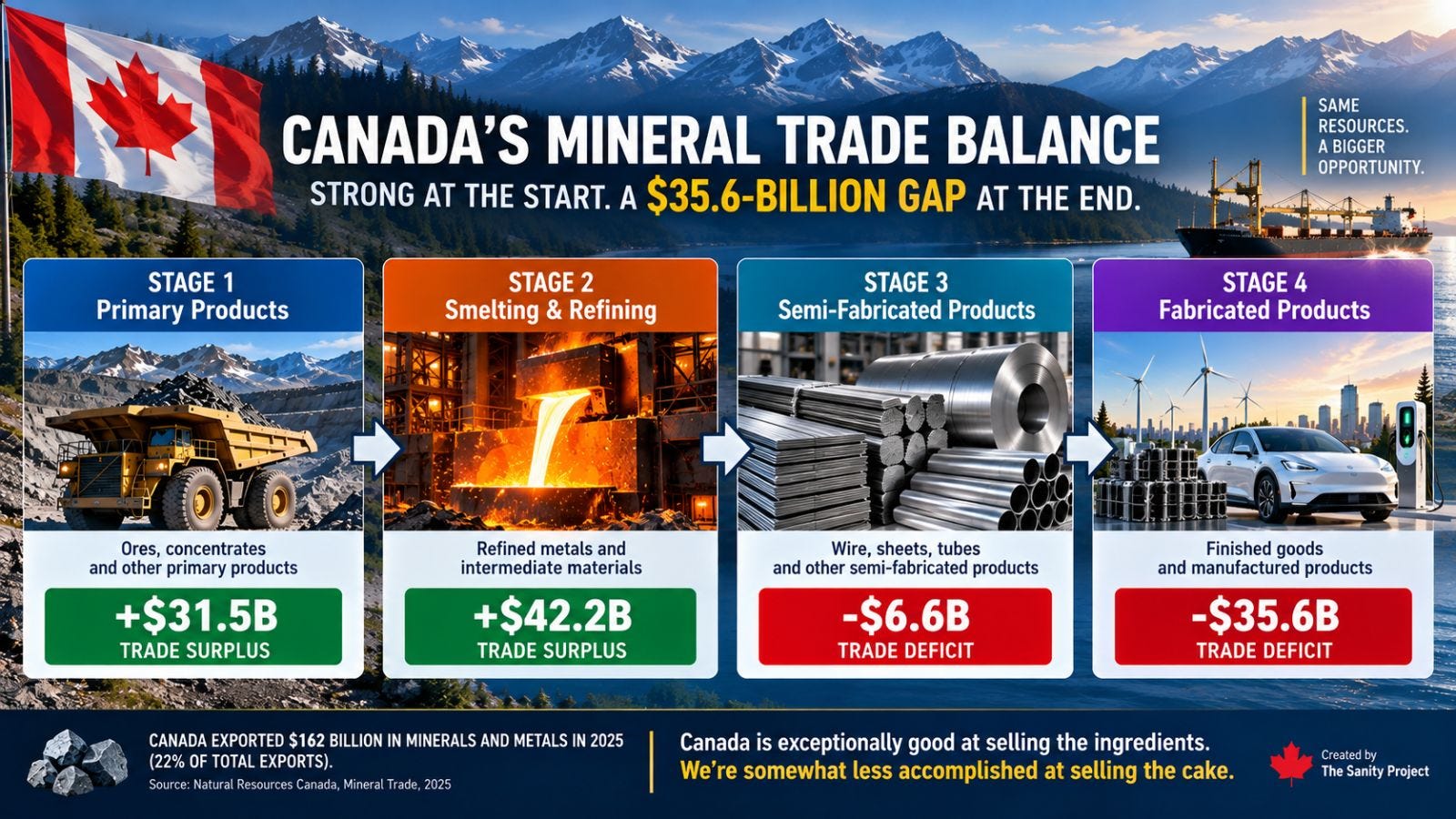
Natural Resources Canada says this pattern reflects Canada’s geological resources and strong mining and processing capabilities compared with its more limited manufacturing capacity. It also reports that Canadian critical-mineral exports remain concentrated primarily in the first two stages of the value chain.
In other words, Canada is exceptionally good at selling the ingredients. We’re somewhat less accomplished at selling the cake.
That doesn’t mean every Canadian mineral should be transformed into a finished product before crossing the border. Economics doesn’t work that way, and attempting to force the entire supply chain inside Canada would be neither realistic nor particularly sensible.
But a $35.6-billion downstream mineral-products trade deficit is a pretty good reason to ask whether Canada could capture more of that value here.
Some of the 63 are trying to do exactly that.
The Real Opportunity Starts After the Mine
Mining itself already creates enormous economic value. Statistics Canada estimated that critical-mineral production contributed $30.2 billion to nominal GDP in 2023 and supported 54,775 jobs in extraction and production.
The question isn’t whether Canada should mine. It’s whether the economic opportunity should end at the mine gate.
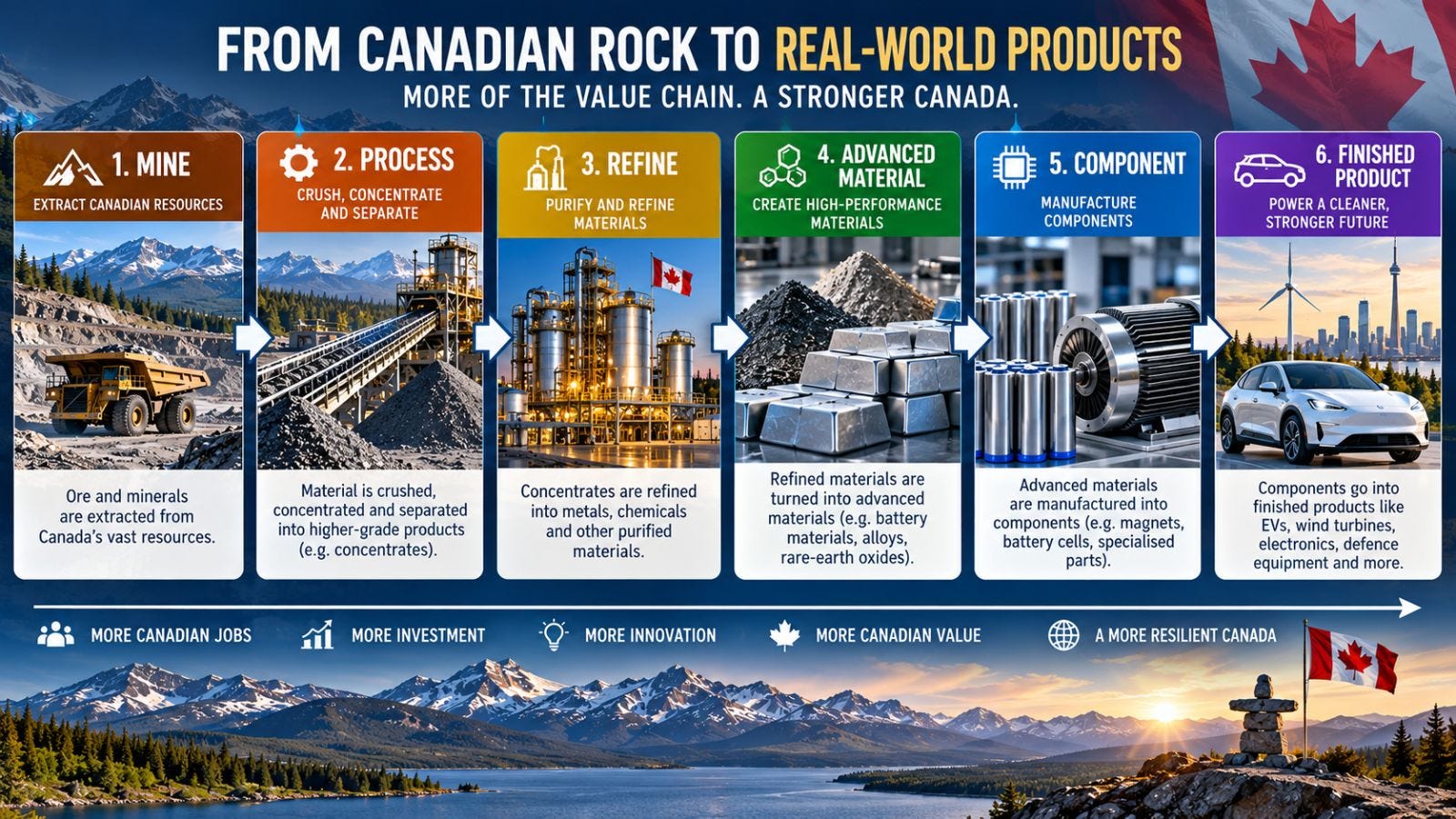
Think of the potential chain this way: Mine → Process → Refine → Advanced Material → Component → Finished Product. Every economically viable step Canada can add creates another opportunity for Canadian investment, workers, technology, intellectual property and exports.
And several projects in The 63 demonstrate exactly what that could look like.
Lithium: From Northern Rock to Battery Chemicals
Ontario’s PAK Lithium Project isn’t proposed simply as another spodumene mine. The prospectus describes it as a vertically integrated lithium development that combines a mine, a mill, and a downstream conversion facility.
The Yellowknife Lithium Project is even more interesting from a geographic perspective. Lithium from the Northwest Territories would feed a proposed 30,000-tonne-per-year lithium carbonate conversion facility in Alberta, linking northern extraction with downstream processing on the Prairies.
That’s not merely another mine. It’s the beginning of an interprovincial Canadian industrial supply chain.
And demand for the material is hardly disappearing. The International Energy Agency reported in its 2026 critical-minerals outlook that lithium demand had been increasing by roughly 25% annually over the previous two years, while its project outlook still pointed to a potential lithium supply deficit by 2035.
The larger Canadian opportunity, therefore, isn’t simply possessing lithium. It’s doing more with it before it leaves.
Graphite: From the Ground to Battery Material
Graphite provides an even clearer example because several of the 63 occupy different positions along the same industrial chain.
The Bissett Creek Graphite Mine and Battery Anode Materials project links natural graphite from Ontario to proposed battery-anode material production in Baie-Comeau, Québec. The prospectus explicitly describes the combination as an integrated graphite value chain.
Then there’s Québec’s Bécancour Battery Material Plant, which takes locally produced graphite and converts it into battery-grade active anode material for lithium-ion batteries. Ontario’s Via TWO project proposes another approach: phased synthetic graphite production in St. Thomas aimed at the North American battery supply chain.
Put those projects into the global context and their significance becomes clearer. The IEA reports that refining of several critical minerals remains geographically concentrated, meaning a new mine alone doesn’t necessarily diversify the downstream supply chain.
A Canadian graphite deposit is useful. Canadian graphite feeding Canadian processing and battery-material production represents something considerably more significant.
We’re no longer simply participating in a commodity market. We’re occupying more of the value chain.
From Rare Earths to Magnets
Rare earths may provide the best example in the entire prospectus.
The Strange Lake Rare Earth Project, spanning Québec and Labrador, is proposed as an integrated mine-to-separated-oxide development. Alberta’s proposed Critical Minerals Recovery & Rare Earth Refining Complex would occupy another part of the chain, recovering and refining rare earths, gallium, scandium and other strategic minerals.
But Saskatchewan may have the most interesting proposal of all.
The SRC Minerals to Magnet Production project would build on the Saskatchewan Research Council’s existing Rare Earth Processing Facility in Saskatoon to establish Canadian production of neodymium-iron-boron permanent magnets.
Now we’ve moved well beyond digging rocks. Permanent magnets are actual manufactured components used in electric motors, wind turbines, electronics, robotics, industrial equipment and defence technologies.
That distinction matters because the vulnerability in rare earths isn’t simply where the ore is mined. Separation, refining and magnet manufacturing are equally important links in the chain, and global capacity in those areas remains highly concentrated.
So consider the progression represented by just these projects: Canadian rare-earth deposits → Canadian separation and refining → Canadian magnet manufacturing.
Not every link is complete, and none of these proposals guarantees that Canada will eventually possess an entirely domestic rare-earth supply chain. But the direction is unmistakably different from digging up ore and loading it onto a ship.
That’s the difference between owning a mineral deposit and owning part of an industrial supply chain.
Turning More Canadian Resources Into Canadian Products
The same pattern appears elsewhere in The 63.
The proposed Scully Manganese Sulphate Plant in Newfoundland and Labrador would take manganese generated as a by-product of iron ore production and convert it into high-purity manganese sulphate for the EV and battery industries.
I particularly like this example because it demonstrates value-added economics in miniature. Something that begins as a secondary output of one Canadian industrial process becomes the feedstock for another, producing a higher-value material for an entirely different industry.
Manitoba’s Minago Critical Minerals Project provides another variation. The prospectus describes an Indigenous-owned development combining a nickel-PGM deposit with plans for domestic magnesium metal production.
And then there’s uranium.
Canada already has a formidable position in uranium mining, with The 63 containing major developments such as Rook I and PLS in Saskatchewan. But the proposed Canadian Uranium Conversion Facility caught my attention precisely because it isn’t a mine.
The proposal would establish Canada’s first new uranium refining and conversion facility in more than 40 years. Mining uranium is one stage of the nuclear-fuel chain; refining and conversion move the material further toward something the nuclear industry can actually use.
These middle stages aren’t as visually impressive as a giant open pit or as glamorous as a shiny new factory. But they’re often where much of the strategic dependency hides.
Why Processing Has Become an Economic-Security Issue
For decades, global supply chains were designed largely around efficiency. If another country could process a material more cheaply, processing tended to migrate there. If manufacturing components elsewhere reduced costs, companies moved that manufacturing there too.
That system helped produce inexpensive goods. It also produced some extraordinary concentrations of industrial capability.
The IEA’s 2026 outlook found that concentration in refining increased in 2025, with the leading refining country accounting for roughly 72% of the supply on average for key energy minerals, excluding rare earths. China dominates refining for many major minerals, while Indonesia has become dominant in nickel.
That doesn’t mean Canada should attempt to become completely self-sufficient. We’re a trading nation, and access to international markets is one reason these Canadian projects can make economic sense in the first place.
But possessing a mineral deposit doesn’t provide much strategic resilience if virtually every sophisticated step required to turn that mineral into something useful has to happen elsewhere.
A Canadian graphite deposit improves resource security. Canadian graphite feeding Canadian processing and Canadian anode-material manufacturing provides considerably more control over the chain.
Likewise with rare earths. Mining them is one step. Separating them is another. Refining them is another. Turning them into magnets takes Canada another step again.
Canada Is Deliberately Trying to Build the Whole Chain
This direction isn’t accidental. Canada’s Critical Minerals Strategy explicitly calls for building capacity through exploration, extraction, intermediate processing, advanced manufacturing and recycling, and the federal government now describes its approach as moving value “from mine all the way to market.”
The strategy also identifies exactly the problem we’re seeing in the trade statistics: rather than exporting resources for processing abroad and then importing finished goods or manufacturing inputs, Canada can develop industrial ecosystems in which more stages are integrated domestically and with trusted trading partners.
There is substantial public money behind that effort. The original Critical Minerals Strategy was backed by up to $3.8 billion in federal funding, while the government’s 2024 progress report described nearly $4 billion committed across federal budgets from 2021 through 2024.
The important question isn’t simply how much government spends. It’s whether public investment helps establish commercially viable industries capable of competing without permanent support.
Because no country becomes an advanced industrial economy by subsidising things nobody wants to buy.
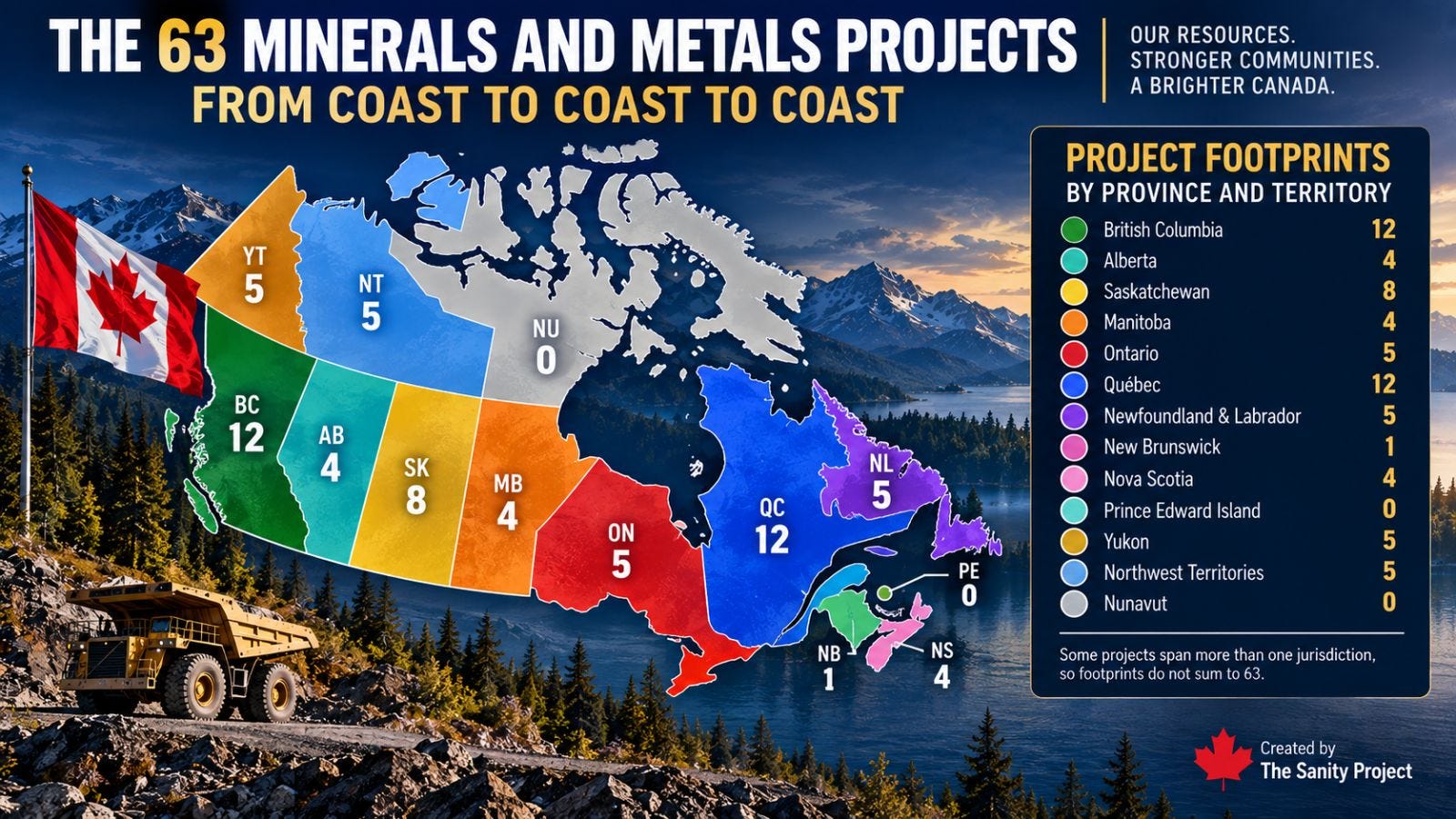
There is also a danger in looking at a prospectus full of proposed projects and mentally converting them into operating mines and factories. They aren’t. Some are advanced developments, while others remain early concepts, and inclusion in the summit prospectus does not constitute a government endorsement or guarantee that a project will be built.
Many still require financing, regulatory approvals, infrastructure, Indigenous consultation or partnerships, customers and long-term purchase agreements. Canada also faces a genuine competitiveness problem: processing and refining capacity elsewhere has often been built around enormous scale, established expertise, specialised equipment and lower costs.
Simply stamping a maple leaf on a refinery doesn’t make it competitive.
Canada will have to exploit areas where it possesses real advantages: abundant mineral resources, relatively clean electricity in many provinces, skilled workers, political stability, proximity to American manufacturing and access to major allied markets.
We don’t need to process everything here. But there is an enormous economic difference between accepting that reality and automatically exporting resources at an early stage of the value chain.
From Dig and Ship to Dig, Build and Sell
Canada’s geological advantage isn’t new. The Canadian Shield didn’t suddenly appear last Tuesday.
What may be changing is what Canada intends to do with the resources underneath it.
Among these 63 projects, we found lithium that could be mined and converted here, graphite that could be processed into battery material here, and manganese that could be processed into battery chemicals here. We found proposals to separate and refine rare earths, to manufacture permanent magnets in Saskatchewan, and to restore Canadian uranium-conversion capacity.
We also found projects connecting the Northwest Territories to Alberta, Ontario to Québec and mineral production to manufacturing industries thousands of kilometres away.
That begins to look less like a collection of mines and more like the early architecture of an industrial economy.
A country receives one kind of economic benefit from selling a tonne of mineral concentrate. It creates another opportunity when that concentrate feeds a Canadian processor, the processed material supplies another Canadian manufacturer, and that manufacturer sells a higher-value product in Canada and around the world.
For decades, Canada has been exceptionally fortunate in what nature put beneath our feet. Perhaps the next great Canadian resource story won’t simply be about discovering more of it, but becoming considerably smarter about what we do with it afterwards.
Canada doesn’t need to stop digging. We need to stop thinking that digging is where the economic opportunity ends.
Related Articles
https://www.thesanity.org/p/who-actually-owns-canadas-greenhouse
https://www.thesanity.org/p/canadas-secret-superpower-we-have
Of course…Once again. Carney has outwitted, outplayed, outlasted the Yanks to the south. WE ARE OPEN FOR BUSINESS