


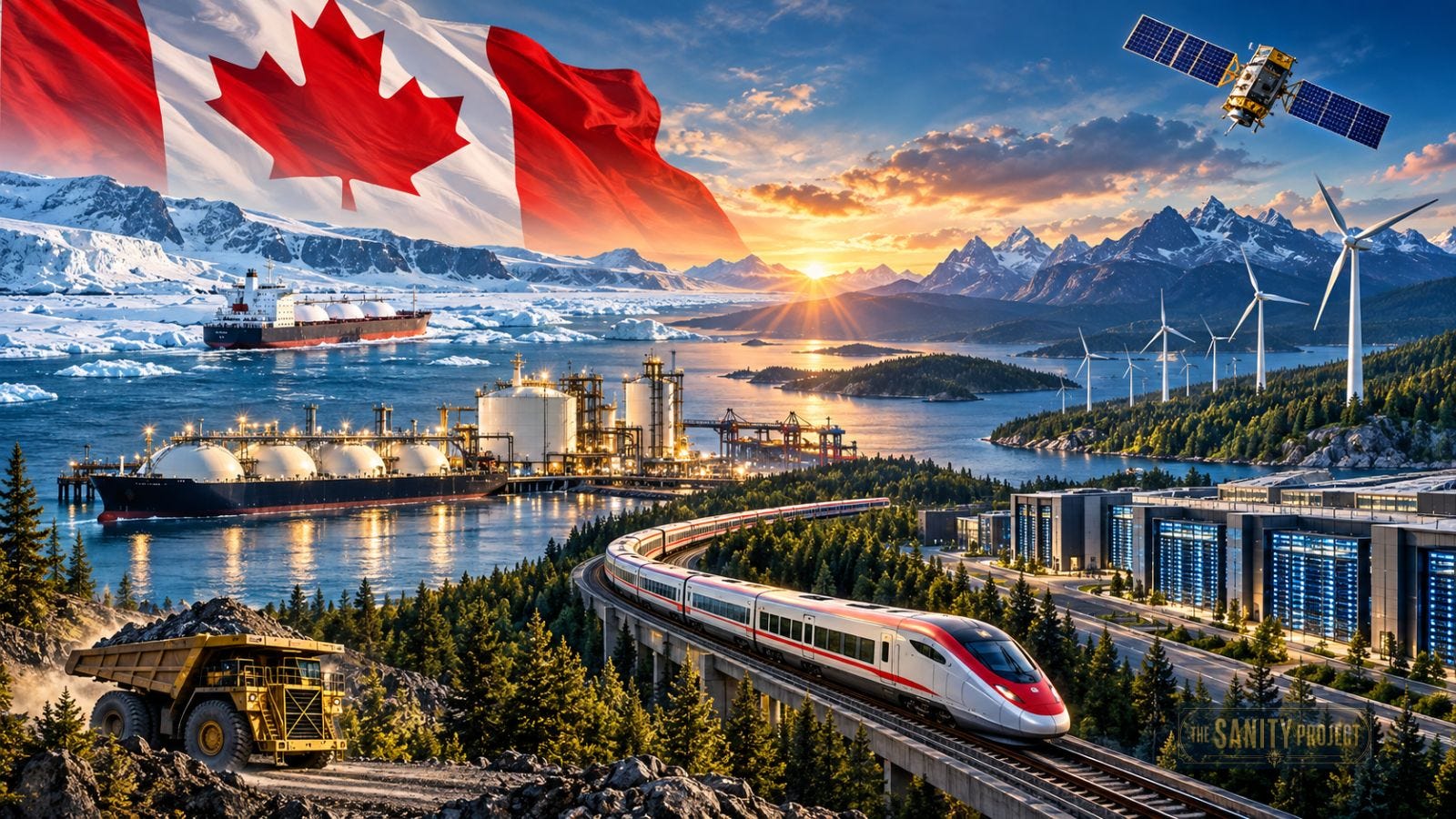
20 of Canada’s Biggest Major Projects for 2026
For years, one of the easiest criticisms of Canada was that we had forgotten how to build big things. We could study them, consult about them, commission a report about the consultation, and then commission another report explaining why the first report required further study.
Something, however, appears to be changing. At the Canada Investment Summit in Toronto, the federal government is putting a remarkable collection of Canadian investment opportunities in front of some of the world’s largest pools of capital.
The summit is part of a broader strategy to catalyse $1 trillion in total Canadian investment over the next five years. That does not mean Ottawa plans to spend $1 trillion, but rather that it wants public investment and policy to help unlock much larger amounts of private capital. (Canada Investment Summit)
We previously went through the entire 66-page investment prospectus and built a searchable database of its 167 projects. They range from mines and ports to LNG terminals, satellite constellations, AI data centres, high-speed trains and enormous renewable-energy developments.
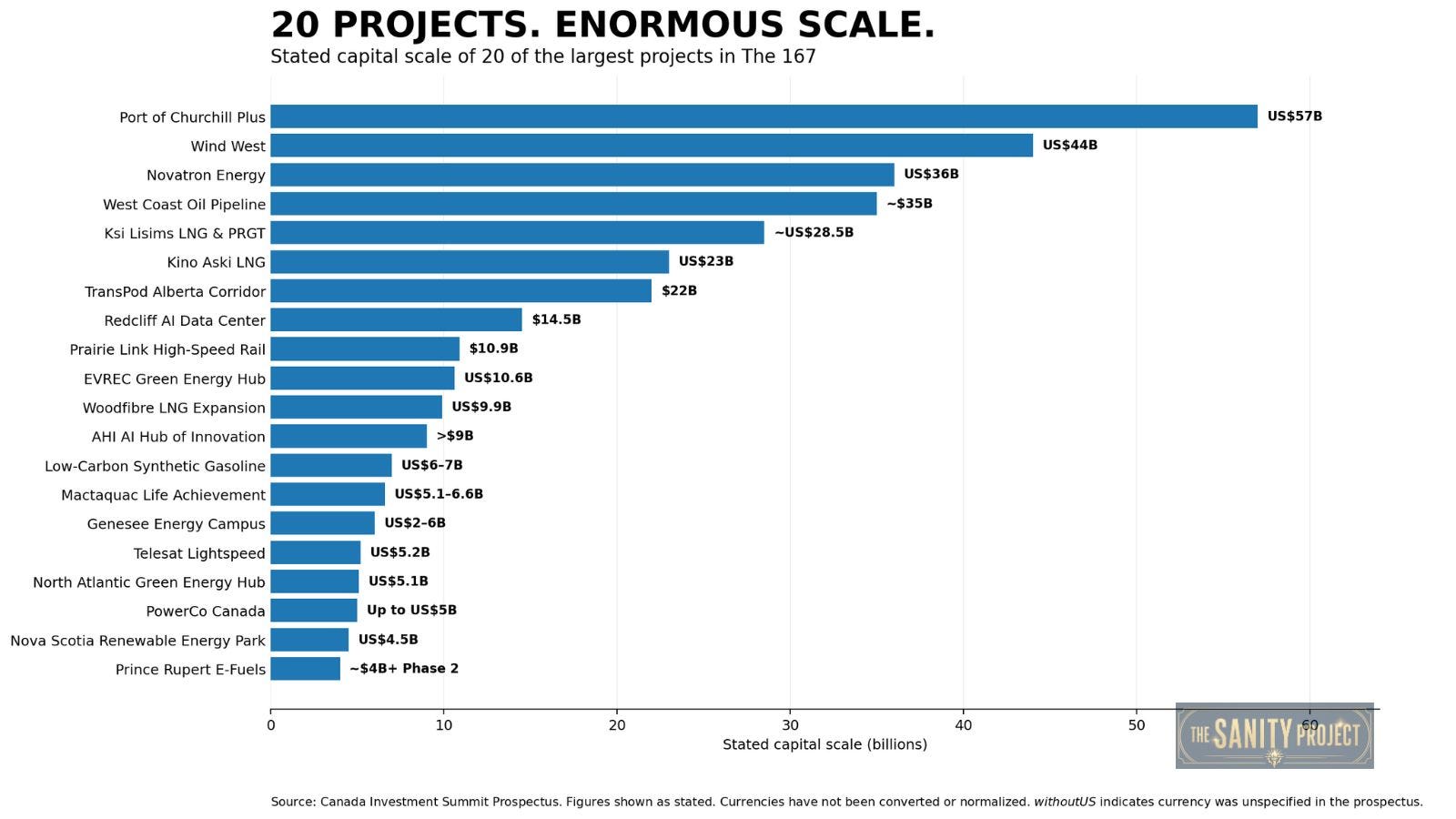
This time we’re doing something slightly different. We’re looking at 20 of the largest projects in the entire prospectus, and “large” may be something of an understatement.
The biggest carries a stated capital scale of US$57 billion. The second is US$44 billion, the third is US$36 billion, and even project number 20 comes in at roughly US$ 4 billion-plus.
These aren’t twenty government-funded projects, nor are they twenty approved construction sites waiting for excavators. Some are advanced, some are seeking investors, some are moving through environmental reviews, and others remain extremely ambitious ideas.
Taken together, however, they provide a fascinating glimpse of the country Canada could become. And after spending considerable time buried in the details, I came away thinking that the country is considerably more ambitious than most Canadians probably realise.
How We Chose the 20 Biggest Projects
Before we start throwing around billions like we’re ordering appetisers, one important qualification is necessary. The prospectus mixes U.S. dollars, Canadian dollars and figures where the currency isn’t specified, so ranking them with mathematical precision would be misleading.
We’ve therefore preserved the capital figures as presented rather than quietly converting everything. We’re also using the largest stated project or phase scale where a development is presented in stages.
This is best understood as 20 of the largest projects presented at the Canada Investment Summit, not a forensic accounting exercise determining whether project number 13 is precisely $27.42 more expensive than project number 14.
Where newer government, regulatory or proponent information is available, I’ve also used it to determine where these projects stand today. With that housekeeping out of the way, let’s go shopping for megaprojects.
The 20 Biggest Projects in Canada’s Investment Pipeline
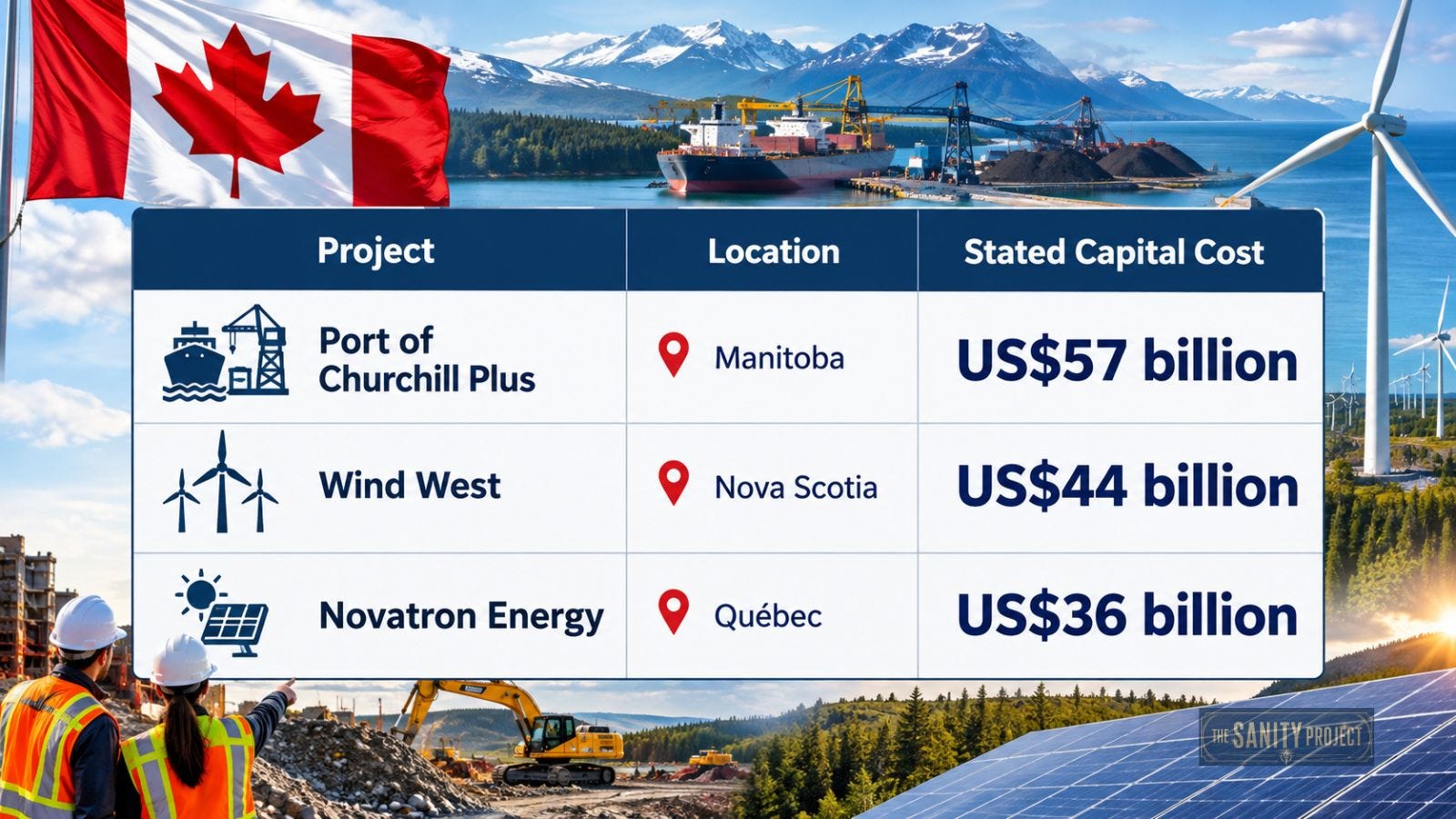
1. Port of Churchill Plus — Manitoba
Stated scale: US$57 billion
The biggest proposal in The 167 is really an entire northern economic corridor: an expanded Port of Churchill, modernised rail, an all-season road, marine icebreaking and potentially an energy corridor.
The existing port and railway are owned by the Indigenous-led Arctic Gateway Group, representing 41 First Nations and northern community shareholders. Ottawa says expansion could diversify Prairie trade toward Europe while strengthening Canada’s Arctic presence and sovereignty. Apparently, Churchill has decided that being famous for polar bears was not ambitious enough.
Major Projects Office: Port of Churchill Plus
2. Wind West — Nova Scotia
Stated scale: US$44 billion
Wind West is less a wind farm than an attempt to turn Atlantic Canada into an enormous clean-power platform. The federal Major Projects Office says the concept could tap more than 60 GW of Nova Scotia offshore wind potential, supported by new transmission connecting Atlantic and eastern markets.
The nearer-term ambition is to unlock 5,000 MW. Atlantic Canada has spent generations exporting fish, timber and people, so exporting vast quantities of electricity would be a rather welcome addition to the list.
Major Projects Office: Wind West
3. Novatron Energy — Québec
Stated scale: US$36 billion
Novatron is one of the more ambitious clean-energy proposals in the prospectus, envisioning a huge new energy platform connecting generation and markets in Québec and Atlantic Canada. At US$36 billion, this is firmly in nation-building territory rather than “let’s put a few solar panels on the warehouse.”
It is also among the projects where ambition currently outpaces publicly visible development details. That’s not necessarily bad because every megaproject begins as an idea. The trick, historically, has been getting Canada to the shovel part.
4. West Coast Oil Pipeline — Alberta and British Columbia
Stated scale: approximately $35 billion, currency unspecified
This one has moved well beyond a hypothetical line on a map. Alberta proposes a roughly 1,250-kilometre pipeline to transport one million barrels per day from the Edmonton region to a deepwater terminal in southern British Columbia.
Ottawa referred it to the Major Projects Office in July and is considering designation under the Building Canada Act. Whatever one’s feelings about oil, getting Canadian resources to customers other than the United States is becoming less an ideological question and more an economic-security strategy.
Major Projects Office: West Coast Oil Pipeline
5. Ksi Lisims LNG Terminal & PRGT Pipeline — British Columbia
Stated scale: approximately US$28.5 billion
Ksi Lisims combines a floating LNG export facility on B.C.’s north coast with the roughly 750-kilometre Prince Rupert Gas Transmission pipeline. More interestingly, the project is being developed in partnership with the Nisg̱a’a Nation, Rockies LNG and Western LNG.
The project has received major federal and provincial environmental approvals and has secured European supply agreements. This isn’t simply Canada digging something up and shipping it south; it combines Indigenous ownership, Canadian energy and overseas customers. More of that combination, please.
Major Projects Office: Ksi Lisims LNG
6. Kino Aski LNG — Québec
Stated scale: US$23 billion
Kino Aski proposes something Canada has discussed for years: moving western Canadian natural gas east and exporting LNG to Europe. The First Nations-led project envisions roughly 1,000 kilometres of new pipeline infrastructure, substantial LNG production and major port development at Baie-Comeau.
It remains in the early stages, with technical studies and consultations underway and no formal regulatory filing yet. Still, a majority-Indigenous-owned Canadian energy corridor supplying Europe is not exactly a small idea.
7. TransPod Alberta Corridor — Alberta
Stated scale: $22 billion, currency unspecified
TransPod wants to connect Calgary, Red Deer and Edmonton using ultra-high-speed transportation technology designed to carry passengers and freight. A feasibility study supported by Alberta Transportation has already examined the corridor’s economic potential.
This remains one of the more futuristic projects in The 167, and futuristic transportation projects have a habit of looking wonderful in renderings and considerably more complicated once somebody asks where everything goes. Still, Calgary-to-Edmonton transportation deserves bigger thinking than simply adding another highway lane.
8. Redcliff AI Data Centre Campus — Alberta
Stated scale: $14.5 billion, currency unspecified
Near Medicine Hat, the proposed Redcliff campus represents another emerging Canadian resource industry: computing power. The prospectus places its scale at $14.5 billion, part of a remarkable rush of proposed AI infrastructure into Alberta.
The attraction isn’t mysterious. AI requires enormous quantities of electricity, land and cooling, and Alberta would very much like to provide them. Apparently, natural gas isn’t the only thing the province intends to export in industrial quantities.
Alberta AI Data Centre Strategy
9. Prairie Link High-Speed Rail — Alberta
Stated scale: $10.9 billion, currency unspecified
Prairie Link proposes a high-speed passenger rail line connecting Calgary, Red Deer, and Edmonton, backed by a development team that includes AECOM and EllisDon. Alberta’s rapidly growing urban corridor makes the basic idea increasingly compelling, although planning a railway and actually building one remain very different accomplishments.
Canada has discussed high-speed rail for so long that it occasionally feels like part of our national heritage. At some point, one assumes, we’re legally required to stop studying fast trains and actually ride one.
10. The EVREC Green Energy Hub — Newfoundland and Labrador
Stated scale: US$10.6 billion
EVREC proposes 3.5 GW of onshore wind, as many as 530 turbines, a 150-MW solar farm and a 2.6-GW hydrogen/ammonia facility around Botwood. This isn’t simply renewable electricity; it’s an attempt to transform Newfoundland’s extraordinary wind resource into exportable industrial products.
The project is undergoing environmental assessment, and the province determined in July that its environmental impact statement required additional work. That’s useful context: enormous potential, serious scrutiny and a long road still ahead. Big projects are supposed to be difficult.
Newfoundland and Labrador Environmental Assessment
11. Woodfibre LNG Expansion — British Columbia
Stated scale: US$9.9 billion
Woodfibre’s proposed expansion builds on an LNG project already under development near Squamish, giving it something many entries on this list don’t yet have: substantial real-world infrastructure to expand.
The broader strategy is straightforward. Produce Canadian natural gas, liquefy it on the Pacific coast, and sell it to Asian markets rather than remaining overwhelmingly dependent on a single continental customer. Trade diversification, occasionally, requires actual pipes.
Woodfibre LNG
12. AHI AI Hub of Innovation — Alberta
Stated scale: more than $9 billion at full buildout, currency unspecified
AHI proposes an AI infrastructure campus ultimately reaching one gigawatt, with the prospectus describing $2.7 billion to $3.2 billion required for 300 MW by 2030 and more than $9 billion for the complete platform.
That is an extraordinary amount of computing power and an equally extraordinary electricity requirement. Alberta sees an opportunity to turn abundant energy into digital infrastructure, so the oil patch may someday have neighbours filled with GPUs instead of pumpjacks.
13. Commercial Low-Carbon Synthetic Gasoline Facilities — Alberta
Stated scale: US$6 billion to US$7 billion
This proposal would develop two commercial facilities producing lower-carbon synthetic gasoline. The intriguing part is the industrial logic: rather than simply exporting energy resources, Alberta could use its energy, engineering expertise and carbon-management capabilities to manufacture higher-value fuels at home.
That’s precisely the transition Canada needs more often: from raw resources to processing to finished products to export. We don’t necessarily need to stop being a resource economy; we need to become much better at keeping more of the value created from those resources.
14. Mactaquac Life Achievement Project — New Brunswick
Stated scale: US$5.1 billion to US$6.6 billion
Not every nation-building project needs to be shiny and new. New Brunswick’s Mactaquac project aims to extend the life of one of the province’s most important hydroelectric generating stations, with construction potentially beginning in 2027, subject to approvals.
Keeping dependable Canadian hydroelectricity operating for decades longer isn’t particularly glamorous, and there will probably be no dramatic ribbon-cutting involving robots. But reliable electricity is the infrastructure upon which virtually everything else on this list depends.
15. Genesee Energy Campus — Alberta
Stated scale: US$2 billion to US$6 billion
The Genesee concept illustrates how quickly the definition of an “energy project” is changing. Alberta’s established power infrastructure is increasingly being viewed as a foundation for new-generation digital infrastructure and energy-intensive industry.
That’s a recurring theme throughout The 167. Canada doesn’t necessarily need to abandon the industries and infrastructure it already has; sometimes the smarter move is to use those assets as the foundation for whatever comes next.
16. Telesat Lightspeed LEO Constellation — Canada-wide
Stated scale: US$5.2 billion
For the reader who asked whether telecom appears anywhere in The 167: here it is. Ottawa-based Telesat is building a Canadian low-Earth-orbit satellite communications network, and the city recently awarded it an initial C$2.3-billion military communications contract to support secure Arctic communications.
Lightspeed therefore touches commercial broadband, advanced manufacturing, national security and Arctic sovereignty. Canadian telecom competition apparently exists after all. You just have to look several hundred kilometres above Bell, Rogers and Telus.
Government of Canada: Telesat Lightspeed
17. North Atlantic Green Energy Hub — Newfoundland and Labrador
Stated scale: US$5.1 billion
Newfoundland and Labrador appears repeatedly in The 167 for good reason. It has enormous wind resources, deepwater ports and unusually favourable geography for serving European markets.
The North Atlantic Green Energy Hub proposes using those advantages to create another large-scale clean-energy and export platform. Atlantic Canada is beginning to look less like Canada’s economic edge and considerably more like Canada’s front door to Europe.
18. PowerCo Canada — Ontario
Stated scale: up to US$5 billion
Volkswagen subsidiary PowerCo is building Canada’s first large-scale battery-cell manufacturing plant in St. Thomas, Ontario, creating a crucial domestic link between Canadian critical minerals and vehicle manufacturing.
That’s exactly the value chain Canada has too often surrendered: extract the mineral here, ship it elsewhere, then buy back the expensive finished product. Digging things out of the ground is useful. Knowing what to do with them afterwards is even better.
Government of Canada: PowerCo Canada
19. Nova Scotia Renewable Energy Park — Nova Scotia
Stated scale: US$4.5 billion
Nova Sustainable Fuels proposes a renewable-energy park at Goldboro that produces sustainable aviation fuel and renewable methanol, powered in part by dedicated wind and solar generation. The project has already cleared its first provincial environmental assessment, with conditions, allowing further planning and development.
It’s another example of Atlantic Canada’s emerging industrial opportunity: don’t merely generate renewable electricity; use that electricity to manufacture something valuable enough to export. Wind is lovely. Wind transformed into aviation fuel and export revenue is considerably more interesting.
20. Prince Rupert E-Fuels Project — British Columbia
Stated scale: approximately $4 billion-plus for Phase 2, currency unspecified
Prince Rupert already possesses one of Canada’s great geographic advantages: a Pacific port sitting unusually close to Asian markets. The proposed e-fuels development would add another layer by producing lower-carbon fuels for global customers.
The prospectus describes roughly $1.3 billion for Phase 1 and more than $4 billion for Phase 2. Canada’s ports don’t simply have to ship what we’ve always produced; they can become industrial platforms for products that barely existed a generation ago.
City of Prince Rupert: Innovative Energy Hub
What These 20 Projects Tell Us About Canada
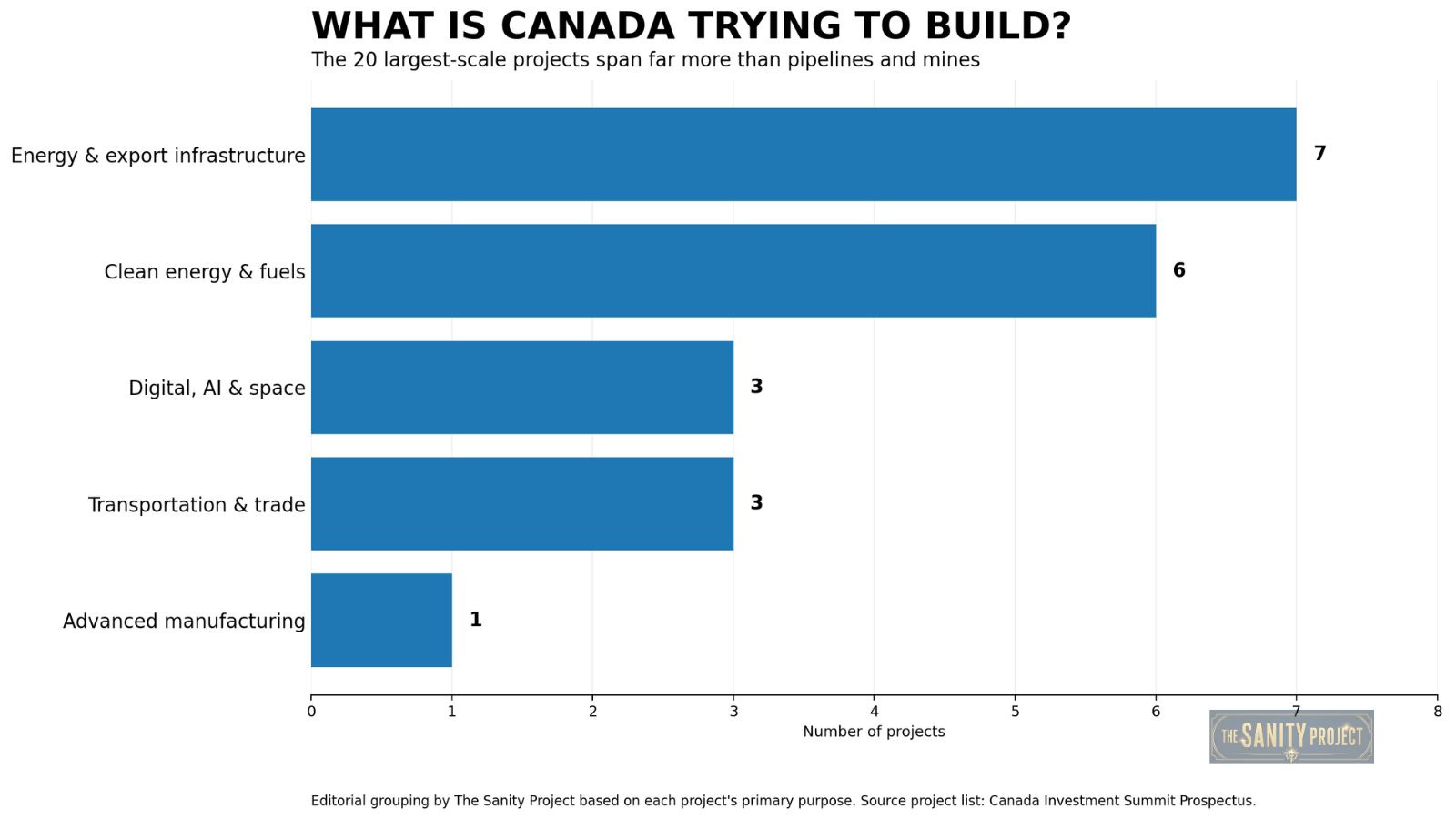
Stand back from the individual projects, and a pattern starts to appear. This isn’t twenty versions of the same mine or pipeline; we have Arctic infrastructure, offshore wind, LNG, high-speed transportation, artificial intelligence, satellite communications, batteries, hydrogen, synthetic fuels, hydroelectricity and advanced manufacturing.
There is also a striking geographic story. Atlantic Canada punches far above its weight, while Alberta is simultaneously proposing enormous conventional energy projects, AI campuses, high-speed transportation, and lower-carbon fuels.
British Columbia’s Pacific geography makes it central to Canada’s trade-diversification ambitions, while Ontario remains crucial to advanced manufacturing. Manitoba suddenly finds itself sitting on what could become one of Canada’s most strategically important Arctic trade routes.
Then there is Indigenous economic participation. Port of Churchill Plus is built around the Indigenous-led Arctic Gateway; Ksi Lisims includes the Nisg̱a’a Nation as a partner; Kino Aski is majority-owned by First Nations; and the proposed West Coast Oil Pipeline contemplates Indigenous equity participation.
That’s a very different model from the Canada of fifty years ago. It also raises something we’ve discussed before at The Sanity Project: who owns Canada’s emerging economy matters almost as much as what we build.
For more on that question: Who Actually Owns Canada’s Greenhouse?
This Is Also About Getting Away From One Customer
Another theme runs through much of this list: trade diversification. LNG to Europe and Asia, Prairie commodities through Churchill, oil to Pacific customers, clean fuels through Prince Rupert, Atlantic electricity and hydrogen, and Canadian satellites serving domestic and international customers.
None of that means abandoning the United States, which will remain an enormously important Canadian customer and trading partner. But there is a rather obvious difference between having your biggest customer and having practically your only customer.
We’ve been exploring that vulnerability throughout our coverage of the Canada-U.S. trade war, because recent events have made the cost of overdependence considerably harder to ignore.
Canada has preferential access to 1.5 billion consumers through 16 free-trade agreements covering 51 countries. Building ports, pipelines, transmission, manufacturing, and digital infrastructure is how those trade agreements become more than framed documents hanging somewhere in Ottawa. (Canada Investment Summit)
The Important Catch: Proposed Does Not Mean Built
Now comes the bucket of cold Canadian lake water. The 167-project prospectus contains everything from operating assets seeking expansion to developments still seeking investors, undergoing environmental assessment, or working through early engineering.
A $40-billion idea and a $40-billion construction site are not the same thing. It would therefore be misleading to add all these numbers together and announce that Canada is about to experience the greatest construction boom since somebody first looked at the Canadian Shield and decided it needed a railway.
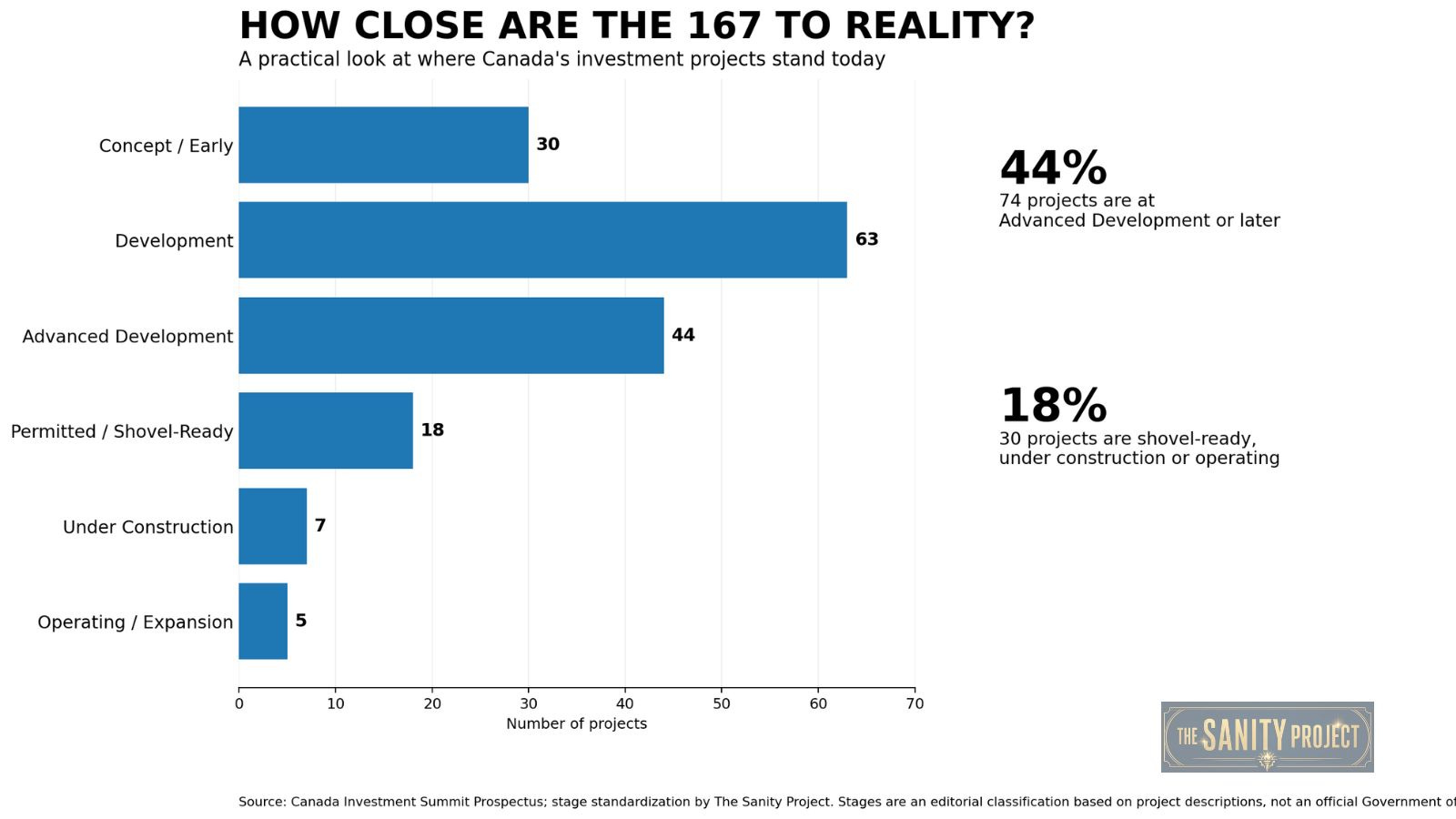
What the prospectus actually shows is what could be built. That’s part of the purpose of the Investment Summit: bringing Canadian proponents together with enormous pools of global capital and trying to turn more of these possibilities into real projects.
Ottawa’s objective is to catalyse $1 trillion in total investment over five years, not to write a trillion-dollar government cheque. The Major Projects Office is another part of that strategy, helping significant projects navigate governments, regulatory processes, Indigenous consultation and financing. (Major Projects Office)
Some projects will fail, some will shrink, and others will change ownership or design. Some will probably cost considerably more than anybody currently thinks, because megaprojects occasionally seem to regard budgets as more of a conversation starter than a binding commitment.
Others may eventually become parts of Canadian infrastructure that our grandchildren simply assume have always been there. Nobody looking at a railway, hydroelectric dam or seaway today spends much time thinking about how improbable those projects once appeared.
Canada’s Real Challenge Is Execution
That may be the most important lesson from The 167: Canada does not appear to have an ideas problem. We have energy, minerals, ports, engineering expertise, clean electricity, capital markets, universities, an educated workforce, three oceans and extensive access to global markets.
We’ve written before about those less obvious advantages in Canada’s Secret Superpower: We Have.... The more difficult question is whether we can organise all those advantages well enough to actually build things.
Can we approve major projects within reasonable timeframes while still conducting thorough environmental reviews? Can Indigenous communities become genuine owners and economic partners rather than groups consulted after everyone else has already made the important decisions?
Can we build enough electricity generation and transmission to support AI, mining, manufacturing, EVs and population growth simultaneously? Can we train enough skilled workers and maintain policies long enough for investors contemplating projects with 20-, 30- and 50-year horizons?
Perhaps most importantly, can Canadians rediscover a willingness to say yes occasionally? Not yes to everything, not without environmental safeguards, and certainly not to terrible economics simply because somebody attached the words “nation building” to a PowerPoint presentation.
But yes to projects that make sense. Yes to infrastructure that increases our independence, creates Canadian wealth, opens new markets and leaves something useful behind for the next generation.
The Canada These Projects Imagine
That’s ultimately why I find this prospectus so fascinating. The 167 projects aren’t a government construction schedule, promises or guarantees, but possibilities can still tell us a great deal about where a country thinks its opportunities lie.
Canada, as imagined here, exports energy to Europe and Asia rather than relying overwhelmingly on a single customer. It moves Prairie products through Hudson Bay, manufactures batteries in Ontario, builds satellites, develops critical minerals and processes more of them here.
It produces cleaner fuels on both coasts, builds massive computing infrastructure in Alberta and develops renewable-energy industries across Atlantic Canada. In other words, it is simultaneously a resource, manufacturing, energy, and technology economy.
That’s considerably more interesting than the tired argument that Canada must somehow choose between being a resource country or a clean-energy country, between oil and technology, or between economic growth and environmental responsibility. A country this large should be capable of doing several things at once.
Whether this ambition survives contact with regulatory hearings, financing markets, commodity prices, elections and Canadian winters remains to be seen. After spending days going through all 167 projects, however, I’ve come away considerably more optimistic than when I started.
There is no shortage of ideas, resources or opportunity, and apparently there isn’t a shortage of ambition either. The real test is whether Canada still remembers how to build big things.
500 billion has been secured in the investment summit - only half of what’s needed to build these projects so that will have an impact as well. I’m thrilled to learn how many of these projects are for renewable energy and hope they do get built but understand that for now, oil and gas will likely be prioritized. Not ideal but necessary. Especially during the Iran oil crisis.
on the Telesat project, you write that 'the city' awarded a contract for Arctic comms, methinks that might be *ultra vires* for the City of Ottawa ...