


Canada Has a New Partner in Vietnam. Can It Deliver?
A country of roughly 102 million people could help Canada widen its trade options. The test is whether agreements become sales, projects and stronger ties.
If you picture Vietnam as a small market on the other side of the world, you may want to update the picture. Its population is projected at 102.3 million in 2026, more than twice Canada’s. And Canadian businesses already trade with it every day.
This week, Vietnam’s President and Communist Party General Secretary Tô Lâm visited Ottawa. He and Prime Minister Mark Carney announced a Canada–Vietnam Strategic Partnership. The name sounds like something assembled by a committee, but the question behind it is simple: Can Vietnam help Canada build more choices beyond the United States?
There is a good reason to ask. In 2025, 71.7% of Canada’s merchandise exports went to the U.S. That share is down from 75.9% in 2024, yet the American market still dominates our export economy. A country with 102 million people and a growing industrial base deserves our attention. It cannot replace the U.S., but it can become one of many stronger alternatives.
The number that changes the story
Canada and Vietnam traded C$20.6 billion in goods in 2025. That sounds like an even partnership until you look closer: Canada sold Vietnam C$1.3 billion in goods and bought C$19.3 billion from it. Vietnam is already Canada’s largest merchandise trading partner in Southeast Asia’s ASEAN group, but most of those goods are travelling in one direction.
That gap is not proof trade has hurt Canada. Canadians buy Vietnamese electronics, clothing, furniture and footwear. It does show how much work Canadian exporters have to do in a market we already know.
The new partnership covers eight areas, including trade, transportation, technology, energy, food, defence and education. Canada and Vietnam also signed or renewed four cooperation agreements on energy, maritime transport, the environment, and food safety. Those are useful steps. They are not purchase orders. Foreign ministers must now develop an action plan to turn the partnership’s goals into work.

Start with what Vietnam already buys
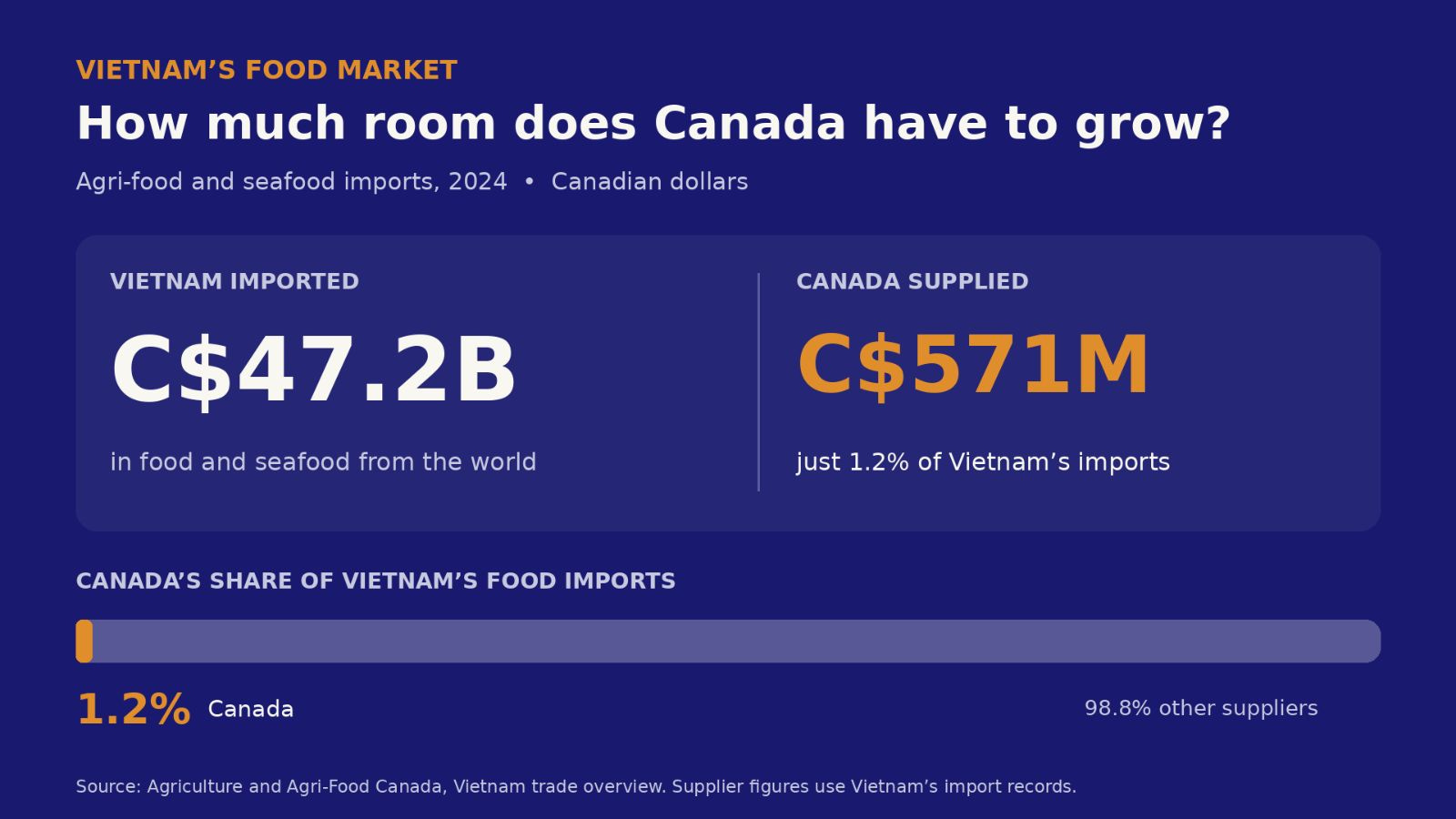
The strongest immediate case is food and farming. Vietnam imported C$47.2 billion in agri-food and seafood products in 2024, according to Agriculture and Agri-Food Canada. Canada supplied about C$571 million, or just 1.2% of that market, ranking 17th among suppliers. Canada separately recorded C$549.9 million in exports to Vietnam; import and export records use different reporting methods.
We already have evidence of demand. Canada’s 2024 exports included C$163.1 million in wheat, C$86.3 million in soybeans, C$72.1 million in frozen boneless beef and C$42.5 million in frozen crab. These are actual sales, not products someone added to an aspirational list. Vietnam buys from large competitors, including Brazil, Argentina and the U.S., so Canadian producers have a market to pursue and rivals to beat.
There is a Prairie angle, too. The department records C$35 million in Manitoba agri-food and seafood exports to Vietnam in 2024, plus C$69.2 million from Saskatchewan and C$164.7 million from Alberta. Provincial figures depend on recorded shipment origins, but this relationship already extends to farms and businesses close to home.
The leaders have established a Canada–Vietnam Agriculture Dialogue and renewed an agreement between the Canadian Food Inspection Agency and its Vietnamese counterpart. That work focuses on food safety and the rules governing whether farm and seafood products can enter the market. It may sound dry, but an exporter cannot sell what cannot clear the border.
I explored how Canada could process more of its farm products here before selling them in markets such as Vietnam:

Energy offers promise, and hard choices
Vietnam also needs reliable power as its industries grow. The partnership names Canadian cooperation on liquefied natural gas, renewable energy, hydrogen, carbon management and possible civilian nuclear work. For Canadian companies, that could mean selling fuel, expertise, equipment or services. Today, though, these are areas for cooperation, not announced contracts.
There is an honest climate question here. A Canadian LNG sale might help meet demand, but its climate impact would depend on which fuel it displaces, methane leaks, and how long the project keeps gas in use. The agreement also gives Canada a chance to help build lower-carbon power. The World Bank says Vietnam’s updated power plan aims to add significant solar and wind capacity by 2030 and points to the need for grid investment and better regulations to make that possible.
We should judge the energy component of this partnership by the projects built and the emissions reduced, not by how many technologies appear in a joint statement. Canadian engineering, clean technology and finance may ultimately matter as much as any shipment of fuel.
A flight agreement is a doorway
One practical change was announced in aviation. The expanded air agreement permits direct flights between Canada and Vietnam, allowing each country up to 14 passenger flights per week and 7 dedicated cargo flights. It also gives cargo airlines more flexibility to serve other countries on a route linked to their home country.
Permission is only the first step. An airline still has to decide to operate a route. If service does begin, it could help business travel, tourism and time-sensitive shipments. It would also make visits easier for families among the roughly 275,000 Vietnamese Canadians. Cargo space may be better suited to higher-value goods, although bulk wheat will continue to move by sea.
This is what diversification looks like. A trade agreement sets rules. Food inspection clears obstacles. Financing helps a firm enter a new market. A transport link moves people and products. Together, they make commerce possible.
Why this is bigger than one visit
Canada and Vietnam are already members of the CPTPP, a Pacific trade agreement that provides businesses with a framework for selling and investing across member countries. Export Development Canada has a presence in Vietnam and has identified opportunities in infrastructure, clean technology, agriculture and advanced manufacturing. It has also partnered with a Vietnamese investment firm to explore projects in sectors such as energy, infrastructure and health care.
The two leaders want Canada and ASEAN to complete negotiations on a broader free trade agreement. That deal has not been concluded. Ottawa estimates a future ASEAN agreement could add nearly C$2 billion to Canada’s GDP and almost 14,000 jobs, but those are projections for an agreement covering the whole region. They are not jobs created by this week’s Canada–Vietnam announcement.
Vietnam can also help Canada form supply chains that rely less heavily on any one country. That does not mean every Canadian factory can move its work there, or that a Vietnamese supplier is automatically the right choice. It means Canadian businesses may gain another option when political shocks or trade barriers disrupt their usual routes.
Our searchable guide to Canada’s 167 proposed investment projects shows what we would also need to build at home to support more trade abroad:

A partner, with differences we should name
Vietnam’s government is not a Canadian-style democracy. Human Rights Watch reports that authorities restrict political dissent and do not allow independent unions to represent workers. The joint statement promises support for internationally recognised labour rights. Canada should keep raising those rights as it pursues trade, and should measure progress by what happens to workers, not only by what appears in diplomatic language.
There are business hurdles as well. Export Development Canada warns of bureaucracy, corruption, infrastructure gaps and the influence of state-owned firms. Canadian exporters face established competitors and a long journey across the Pacific. None of this makes the market unimportant. It means a handshake in Ottawa is the beginning of the work.
The test for Canada
Here is what I will watch over the next few years: Do Canadian exports to Vietnam rise beyond C$1.3 billion? Do Prairie food producers gain dependable customers? Do the energy talks produce worthwhile projects, especially ones that support cleaner power? Does an airline actually start direct service? And does Ottawa continue to press for labour rights while building the relationship?
Vietnam’s population makes the opportunity feel large. Its purchases from Canada show how early we still are. The strategic partnership matters because it could help close that gap, one customer, project and practical agreement at a time.
Canada will not find another United States. We can build strong enough relationships so that the United States has less power to decide our economic future. Vietnam may become an important part of that work. Now comes the part that counts: making it real.
I bought clothing that was Made in Vietnam. Good quality.
No but it helps a bit