


The Easiest Way to Buy Canadian Is Sitting in Your Laundry Room
Canadian laundry detergent won’t fix the trade relationship by itself. It keeps real money here, cuts real plastic out of the picture, and asks nothing more of you than picking a different bottle.
Key Takeaways
Tide, Purex, Arm & Hammer, and Method all send your money to a foreign parent company. Genuine Canadian laundry detergent is a real alternative to each of them.
Detergent sheets carry a fraction of the plastic and shipping weight of liquid detergent, an environmental case that stands on its own, separate from where the company is headquartered.
One household switching doesn’t move a national economy. Fifteen million households making the same small, repeatable choice would redirect tens of millions of dollars a year.
Cost isn’t the barrier people assume it is, but that’s a bonus here, not the point.
Nobody hands you a referendum on trade policy. Nobody asks how you feel about foreign ownership of Canadian shelf space and lets you vote on it. What you do get, roughly once a month for the rest of your life, is a trip to the laundry aisle.
That trip deserves more attention than it gets. Every bottle of Tide or Purex sends your money to Cincinnati or Stamford, Connecticut, via Düsseldorf. Every jug of liquid detergent also ships several kilograms of mostly water across the country in a plastic container that outlives everyone who ever used it. A bag of Canadian laundry detergent sheets solves both problems in a single purchase: the money stays here, and there’s barely any plastic or water weight to haul in the first place.
This piece isn’t about whether Canadian detergent is a good enough deal to justify buying it, though it usually is. It’s about three smaller, sturdier reasons to buy it anyway: where the money goes, what doesn’t end up in a landfill or on a delivery truck, and the fact that fifteen million households making the same small choice add up to something real.
Who Gets Your Money
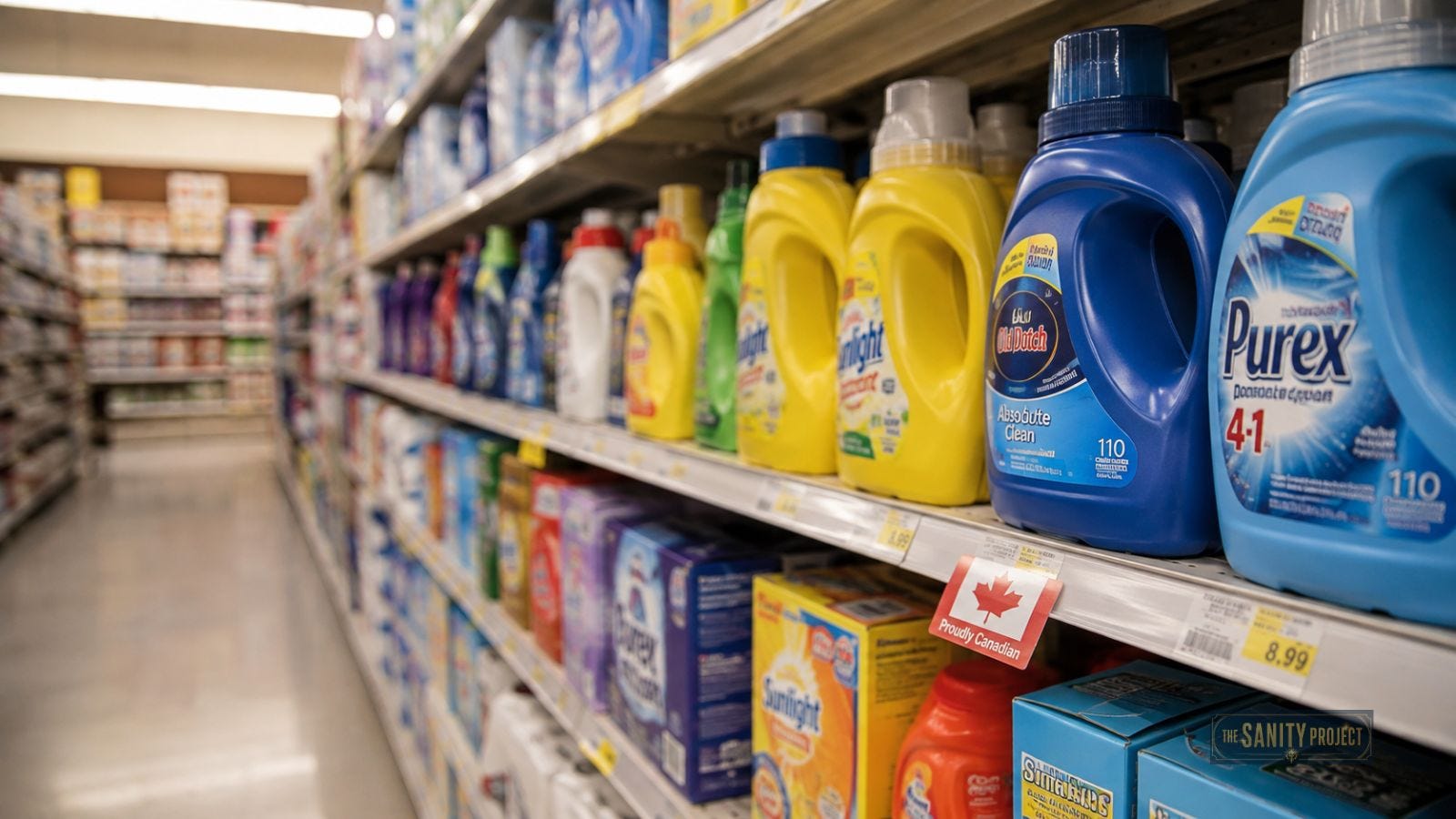
Tide, Arm & Hammer, Method, and Purex all trace back to foreign owners, and two brands that sound American, Woolite and Surf, aren’t American at all.
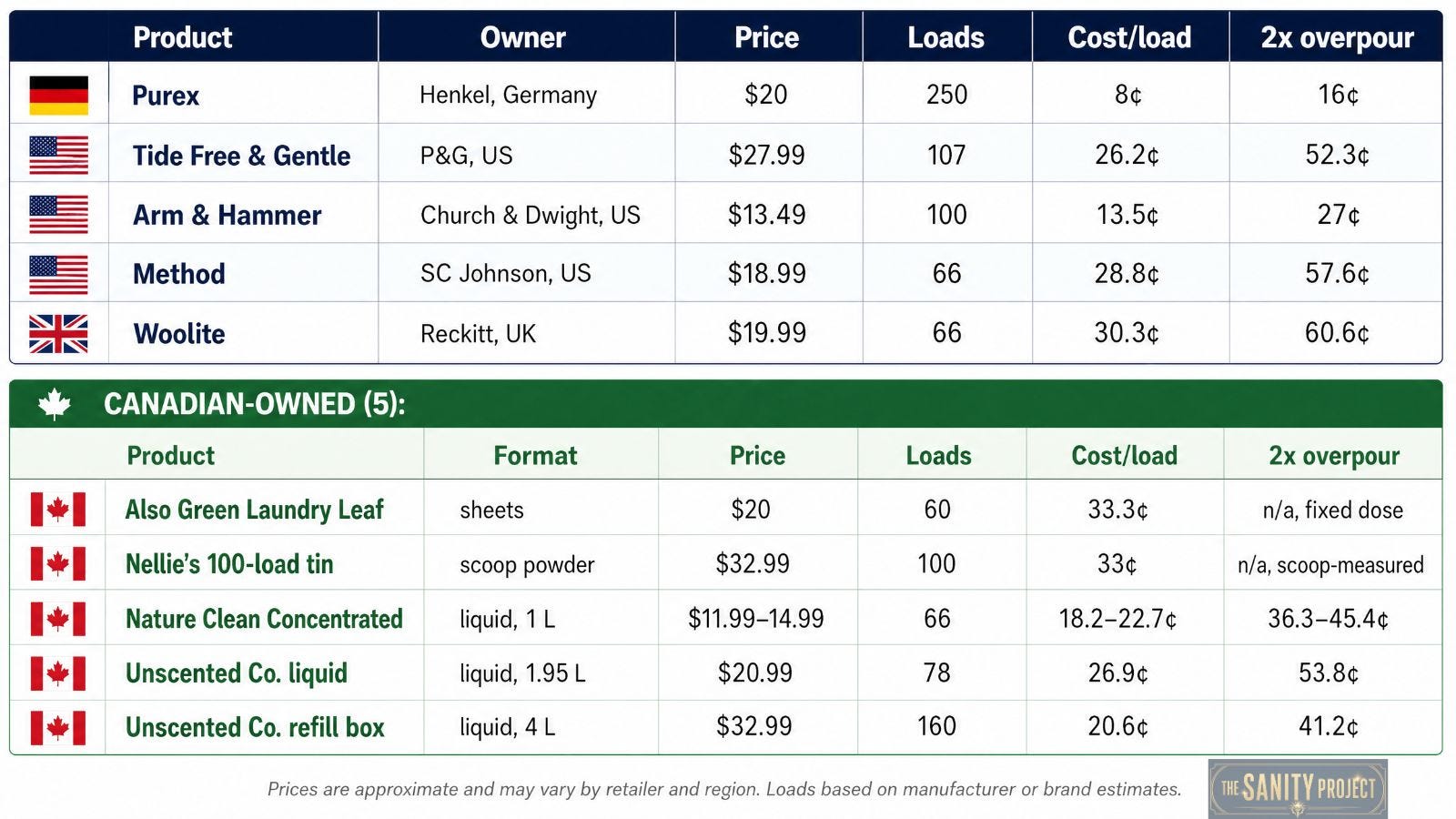
Tide is owned by Procter & Gamble, an American company. Arm & Hammer and Xtra both belong to Church & Dwight, an American company based in New Jersey. Method, the brand that markets itself as the scrappy independent alternative to big detergent, has been owned by SC Johnson, a large private American company, since 2017. Purex is part of Henkel, a German company that operates its North American consumer business from Stamford, Connecticut.
Then there’s the pair that surprises people. Woolite sounds like it was born in an American laundry room. It’s owned by Reckitt, a British company, and has been since 1991. Surf, still stocked on some Canadian shelves, also belongs to Henkel. Every “which ones are foreign” surprise points in the same direction: away from Canada.
None of that makes these companies villains. They employ people, some of them in Canada, and they make products that work. It just means every dollar spent on autopilot in this aisle could have gone somewhere else, and that somewhere else has a name and an address in this country.
The Environmental Case the Sheet Format Makes on Its Own
Liquid detergent is mostly water. Shipping water in a plastic jug is heavy, wasteful, and entirely avoidable, and that argument holds regardless of which flag is on the label.
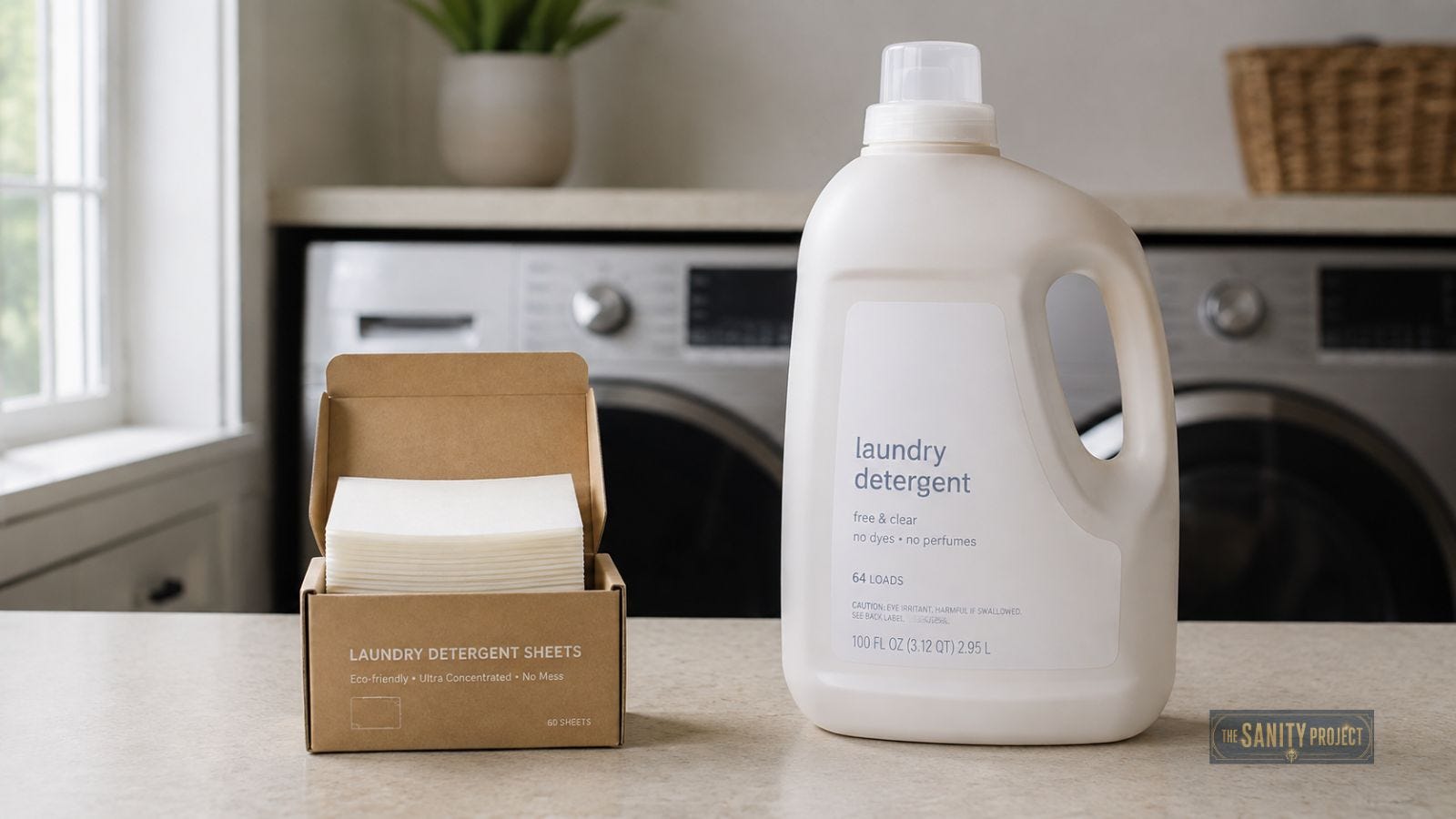
Open a bottle of liquid detergent, and most of what’s inside is water, the one ingredient your washing machine already supplies for free. Trucking that water across the country in a rigid plastic jug is expensive in fuel and unnecessary in every sense. One detergent maker’s own published comparison, ECOS, puts a box of 57 sheets at about 7 ounces total, compared with 6.6 pounds for the liquid equivalent — roughly an 8.5-fold difference in weight for the same number of loads. The box also takes up a fraction of the space: close to five sheet boxes fit into the truck space one jug of liquid occupies.
ECOS also publishes its own carbon figures: a 75% cut in packaging emissions and an 87% cut in shipping emissions compared with its liquid equivalent. Those are the manufacturer’s own numbers, not an independently audited study, so treat them as one company’s claim about its own product rather than an industry-wide fact. The plastic-jug-versus-cardboard-box difference doesn’t need a citation at all. Stand the two packages side by side, and the case makes itself.

One honest caveat is that shipping and carbon savings are strongest when the product is also made close to home. A featherweight sheet still crosses an ocean if it’s manufactured overseas. That’s precisely the open question sitting under Also Green’s own Canadian-made claim, addressed below, and it’s why buying Canadian and buying light aren’t automatically the same purchase, even when they usually point to the same bottle.
What Fifteen Million Households Could Redirect
A modest shift toward Canadian-owned laundry detergent would redirect tens of millions of dollars a year, without a single new law, tariff, or government program.
Statistics Canada reports that the average household spends $269 per year on cleaning supplies, including laundry detergent. Multiply that by the country’s roughly 15 million households, and it’s a multi-billion-dollar category. Laundry detergent sales have been estimated at close to $633 million in annual Canadian sales. This figure is a few years old and needs updating, but it’s the clearest public benchmark available.
Shift just 10 per cent of that spending from foreign-owned brands to Canadian-owned ones, and more than $63 million a year changes hands, permanently, every year the habit holds. At 25 per cent, it’s closer to $158 million. Nobody needs to pass a bill for this to happen. It happens the next time a bottle runs out, and someone reaches for a different one.
That’s the real case for this switch. Not that one household changes anything on its own, but that fifteen million households making the same small, repeatable choice adds up to a number large enough to matter. The only thing standing between where the money goes now and where it could go instead is habit.
The Canadian Laundry Detergent That Already Exists
You don’t have to wait for a Canadian company to build this. Several already have, across sheets, powder and liquid.
Also.Green, out of Kelowna, BC, makes Laundry Leaf detergent sheets, which it describes as 100% Canadian-owned and operated. I ordered a package myself and haven’t received it yet. A handful of Trustpilot reviews dispute the manufacturing claim, and the company denies it, so treat this one as promising but not yet confirmed.
Nellie’s, founded in North Vancouver, makes a four-ingredient Laundry Soda that the company says is made right here.
Nature Clean, family-owned and operating out of Markham, Ontario since 1963, manufactures most of its liquid and powder lineup domestically, though its newer detergent sheets aren’t among what’s made there.
The Unscented Company, based in Montreal, sells a fragrance-free liquid detergent carrying a Made in Canada designation on its retail listings.
Every format a household uses is already covered. Nobody has to change how they do laundry to make this switch, and if cost is the thing holding you back, it’s worth knowing that once you account for how much detergent people actually pour versus what the label assumes, several of these options end up costing about as much as the big brands anyway. That’s a bonus, not the reason to do this.
This Isn’t a Silver Bullet, and It Doesn’t Need to Be
One household won’t shift a national economy or empty a landfill. That was never the point. The point is that this is one of the few choices entirely within your control, on a schedule you don’t have to remember.
Let’s be honest about the limits here. Switching your own laundry detergent will not rebalance a trade relationship or single-handedly fix a plastic waste problem measured in the billions of jugs. Pretending every household benefits equally would be exactly the kind of overselling this publication doesn’t do.
However, we note the effect that the Liquor Boycott has had!
What’s true, instead, is smaller and more durable: a purchase made on a fixed schedule for the rest of your life, entirely within your control today. Most of the leverage Canadians wish they had over trade and plastic waste, they don’t have. This is the rare piece of it they do have, and it costs nothing but the decision to reach for a different bottle.
Editor’s View
Twenty years selling real estate in Winnipeg means I’ve stood in more strangers’ laundry rooms than most people see in a lifetime, and I never once thought about what was on the shelf above the machine. What changed my mind wasn’t a spreadsheet. I noticed how few genuine choices show up regularly where the money and the packaging both point to something better, with no compromise required.
My own order from Also Green hasn’t arrived yet. When it does, the first thing I check is the country-of-origin fine print on the box, because the pride argument in this piece only holds up if the product is actually what it claims to be.
Next, I will test the product's quality. (If it can deal with my boxers, it can handle anything!)
That update will land here under the same corrections policy, no matter how it goes.
Corrections and Updates Protocol: This article will be updated with a dated inline note once the Also Green origin check is complete, regardless of the result's direction. Market size figures and product formulas change over time; readers relying on the figures above for decisions made well after publication should confirm current numbers.
Publications Consulted: Statistics Canada (Survey of Household Spending; 2021 Census of Population), Consumer Reports, Wikipedia (Procter & Gamble, Church & Dwight, Henkel, Woolite, Surf brand entries), Henkel North America, ECOS, Made in CA business directory, Trustpilot customer reviews (also.green), Canadian Tire and Well.ca product listings, Nellie’s Clean company blog, Also Green company site.
We’ve been using Nellie’s for years. It works great!
I've been using Tru Earth from Vancouver for years, and like it. Earth Breeze is also supposed to be Canadian.