


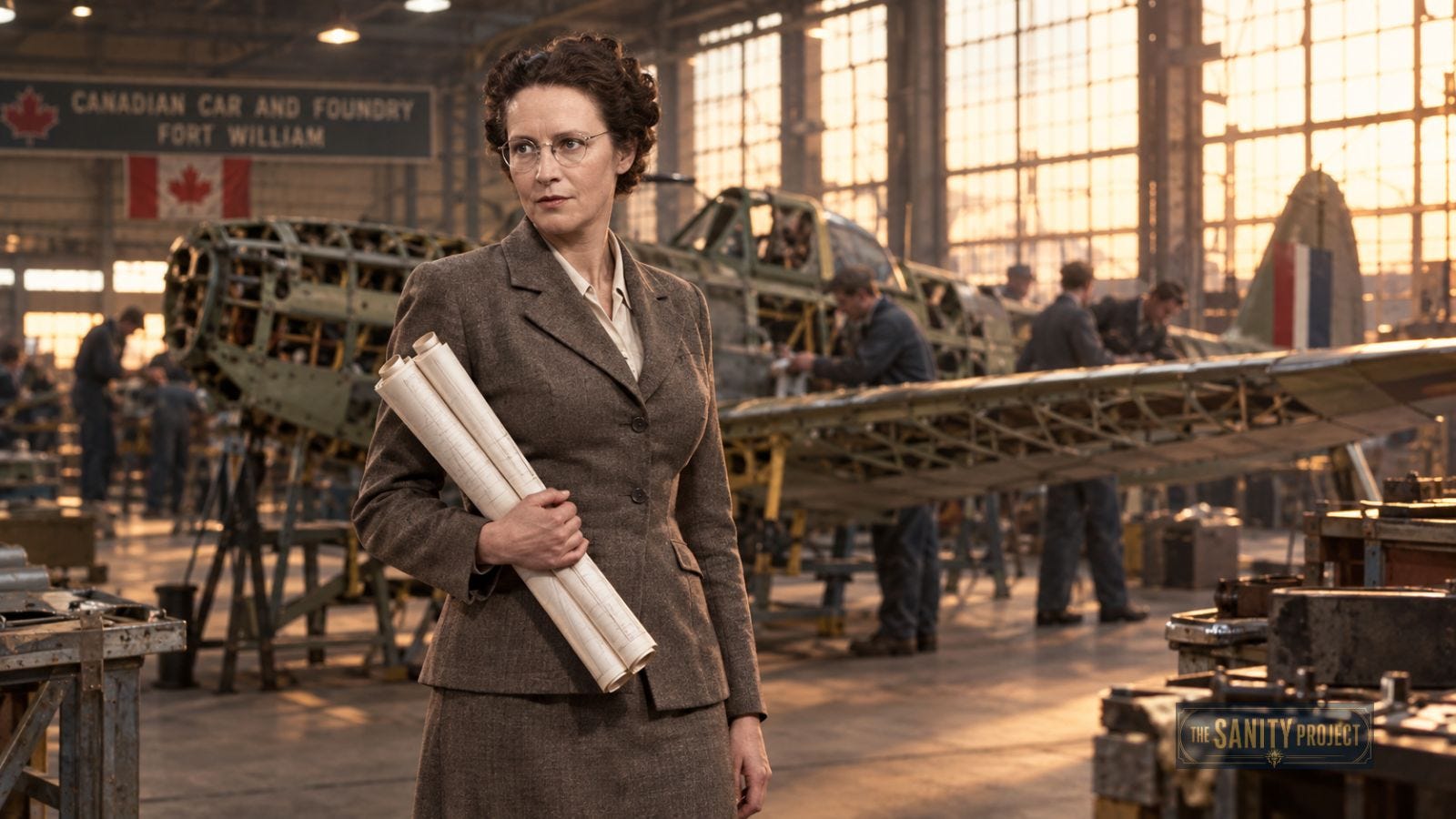
Elsie MacGill: She Built Canada's Air Force, and You've Probably Spent Her
Since August 2023, her portrait has circulated on millions of Canadian one-dollar coins: blueprints rolled under one arm, a Hawker Hurricane fighter plane on one side, the training aircraft she designed flying overhead. The Royal Canadian Mint calls her one of the most exceptional and noteworthy Canadians of the twentieth century. Ask the average person spending that loonie who she is, and the honest answer is usually a shrug.
That gap between the coin and the recognition is the story.
Key Takeaways
Elsie MacGill was the first woman in Canada to earn an electrical engineering degree (University of Toronto, 1927) and the first woman in North America, likely the world, to earn a master’s degree in aeronautical engineering (University of Michigan, 1929).
She finished that master’s degree after contracting a severe form of polio the week before graduation, then spent three years relearning to walk while continuing to work from bed and a wheelchair.
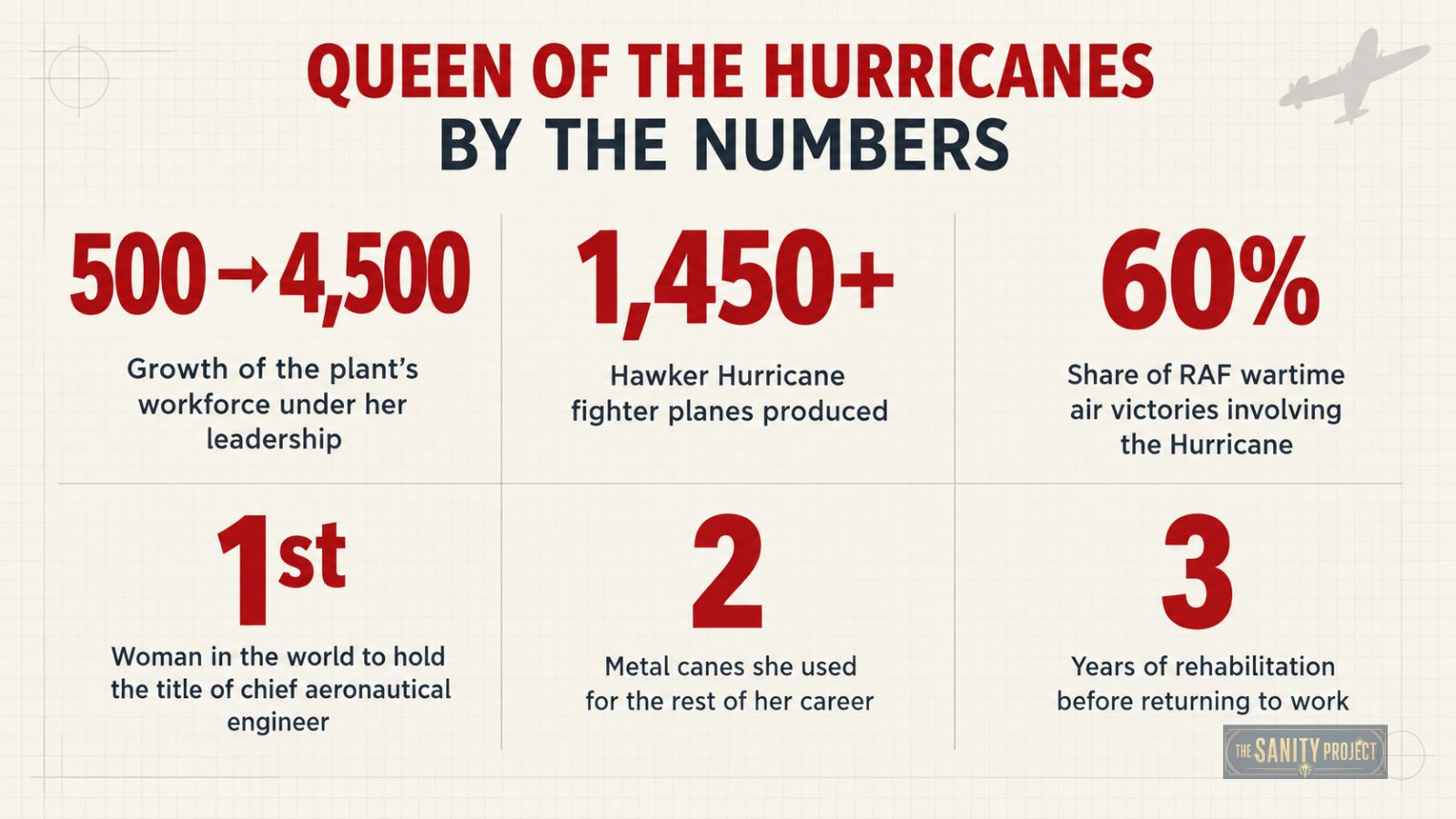
As chief aeronautical engineer at Canadian Car and Foundry, she oversaw production of more than 1,450 Hawker Hurricane fighter planes for the Allied war effort, earning the nickname “Queen of the Hurricanes.”
Her mother, Helen Gregory MacGill, was British Columbia’s first female judge, making Elsie the second generation in one family to break the same kind of ceiling.
In 2023, the Royal Canadian Mint put her on a circulating dollar coin. In 2024, women still made up only 15.8 per cent of licensed engineers in Canada.
Who Elsie MacGill Was Before the Coin
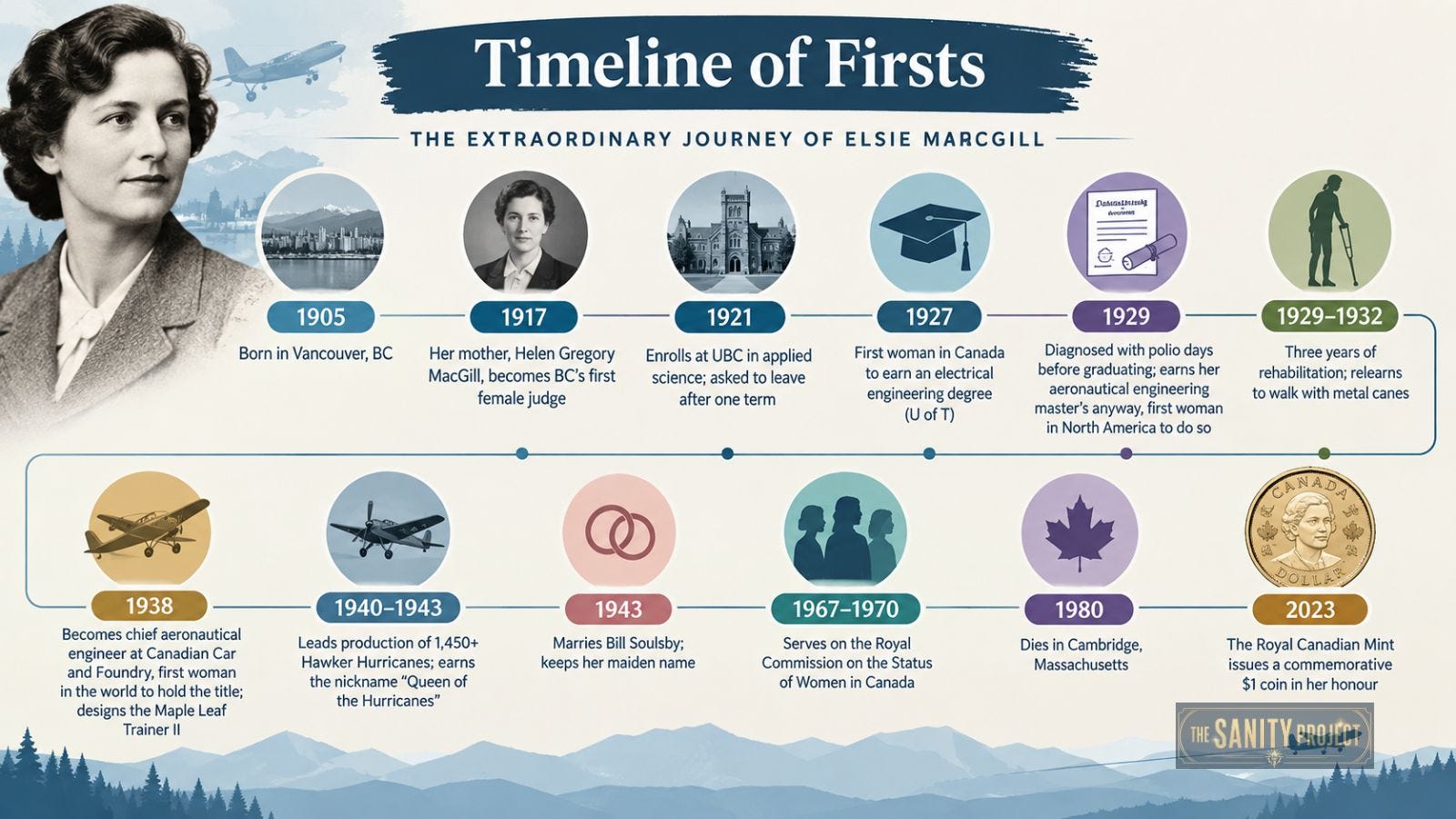
The standard version of a “woman in STEM” profile tends to move fast: brilliant, first, groundbreaking, next subject. MacGill’s actual record moves slower and hits harder, because almost every step of it happened while someone was actively trying to stop her.
She enrolled in applied science at the University of British Columbia in 1921, one of the few women in the program. According to multiple accounts of her early years, the dean of the faculty asked her to leave after her first term because he did not want a woman in engineering. She transferred to the University of Toronto and, in 1927, became the first woman in Canada to graduate with a degree in electrical engineering. Two years later, at the University of Michigan, she became the first woman in North America, and by her professors’ own account possibly the first in the world, to earn a master’s degree in aeronautical engineering.
She earned that second degree the week she was diagnosed with acute infantile myelitis, a form of polio.
Told She Would Never Walk Again
MacGill fell ill on the eve of her 1929 graduation and woke up the next morning paralysed from the waist down. Doctors told her she would likely spend the rest of her life in a wheelchair. She finished her final exams from a hospital bed anyway, and the university awarded her the degree on the strength of the work she had already done.
What followed was three years of rehabilitation at her parents’ home in Vancouver, most of it spent in bed or a wheelchair. She did not treat the time as a pause. She wrote aviation articles for popular magazines, kept up with developments in the field, and worked on aeronautical design by mail. When she regained enough strength to walk with two metal canes, she enrolled at MIT for further study and made the professional contacts that led to her first engineering job at Fairchild Aircraft in 1934. She used those canes, or a wheelchair, for the rest of her career.
In her own words, describing her approach to flight testing years later:
“Although I never learned to fly myself, I accompanied the pilots on all test flights, even the dangerous first flight, of any aircraft I worked on.” — Elsie MacGill, 1940
A Family Business of Firsts
MacGill’s insistence on doing the thing anyway did not come from nowhere. Her mother, Helen Gregory MacGill, was the first woman to graduate from Trinity College in Toronto and the first woman in the British Empire to earn a degree in music. She later taught herself law, and in 1917, the same year British Columbia granted women the vote, she became the province’s first female judge, sitting on the juvenile court for the next 23 years.
Elsie later wrote a biography of her mother, titled My Mother the Judge. When Elsie married engineer Bill Soulsby in 1943, she kept her maiden name, an unusual choice at the time and a quiet nod to the woman who raised her.
What She Actually Built
In 1938, MacGill became chief aeronautical engineer at Canadian Car and Foundry in Fort William, Ontario, now Thunder Bay, making her the first woman in the world to hold that title at any company. Her first major project there was the Maple Leaf Trainer II, believed to be the first aircraft ever entirely designed by a woman.
Elsie MacGill’s story didn’t end with the Hurricanes.
She had already beaten polio, shattered barriers in engineering, and helped build the aircraft that defended Britain. But after the war, she took on another fight, one whose effects are still being felt in Canada today.
Subscribe for free to keep reading, and discover why the Queen of the Hurricanes deserves to be far more than a footnote in Canadian history.
Thank you for sharing. I didn't know about her, but I am going to go get some loonies to check out.
I knew who she was. Women like her are heroines to Feminist groups. And we learn as much as possible about those who went before us and broke down the barriers so that we can follow in her footsteps!