


Foreign Investment in Canada: Are We Selling the Country?
Canada is expending a lot of energy right now to tell the world that we are open for business. At the Canada Investment Summit in Toronto, global investors, Canadian CEOs and public-sector representatives are gathering to discuss new investment in Canada. The federal government has set an ambitious goal of catalysing $1 trillion in total investment over the next five years, and the summit itself is being hosted by the Prime Minister in partnership with CPP Investments and PSP Investments.
In our previous investigation, The 167, we went through the entire 66-page investment prospectus and built a searchable database of all 167 projects. The list includes mines, ports, pipelines, wind farms, power projects, AI data centres, manufacturing facilities and transportation infrastructure. Some are relatively modest. Others carry proposed investment figures in the tens of billions of dollars.

Inevitably, that raises a question, particularly when much of the money being courted could come from outside Canada: Are we selling Canada to foreign investors?
It’s a reasonable question. It’s also based, at least partly, on a misunderstanding of what foreign investment in Canada actually means. Canada isn’t putting 167 mines, ports and power plants on Facebook Marketplace and waiting for Luxembourg to click Buy Now. We are looking for capital, and those are two very different things.
What Does Foreign Investment in Canada Actually Mean?
When most people hear the words foreign investment, they understandably picture a foreign corporation buying a Canadian company. That certainly can happen, and we’ll get to that. But an outright acquisition is only one form of foreign investment.
International capital can arrive as loans, bonds, minority equity investments, joint ventures, infrastructure financing, pension-fund investments or strategic partnerships. Some arrangements involve partial ownership. Others involve no ownership whatsoever. Treating all of these as equivalent to selling a Canadian company is like saying your bank owns your house just because it gave you a mortgage.
Consider a hypothetical Canadian company that discovers an enormous nickel deposit in northern Ontario. That’s potentially terrific news, but there is a small complication: turning that deposit into a working mine, processing facility, roads, transmission infrastructure, and all the other things necessary to actually produce nickel might cost $3 billion.
The company checks its chequing account and discovers it is, regrettably, short by about $2.98 billion.
So it raises capital. An Australian pension fund might lend the company $500 million. A European infrastructure fund could invest $750 million in exchange for a minority equity position. A Canadian bank might finance another portion. A Japanese automobile manufacturer could invest in exchange for a long-term agreement giving it access to some of the nickel produced by the project.
At the end of all that, Ontario has not become a Japanese prefecture. The nickel deposit remains in Canada. The mine operates under Canadian and Ontario law. Canadian workers employed there pay Canadian taxes. The company pays applicable corporate taxes and provincial mining royalties. The roads, transmission lines and processing facilities built for the project remain here.
Ideally, Canada goes one step further. Rather than simply digging nickel out of the ground and shipping it elsewhere, some of that capital is used to process, refine, and eventually manufacture higher-value products here in Canada.
Of course, the foreign investors aren’t doing any of this because they recently discovered an uncontrollable affection for Sudbury. They expect to make money. That’s how investment works. Canada gains access to the capital it needs to build productive assets, while investors receive the opportunity to earn a return by putting their capital to work here.
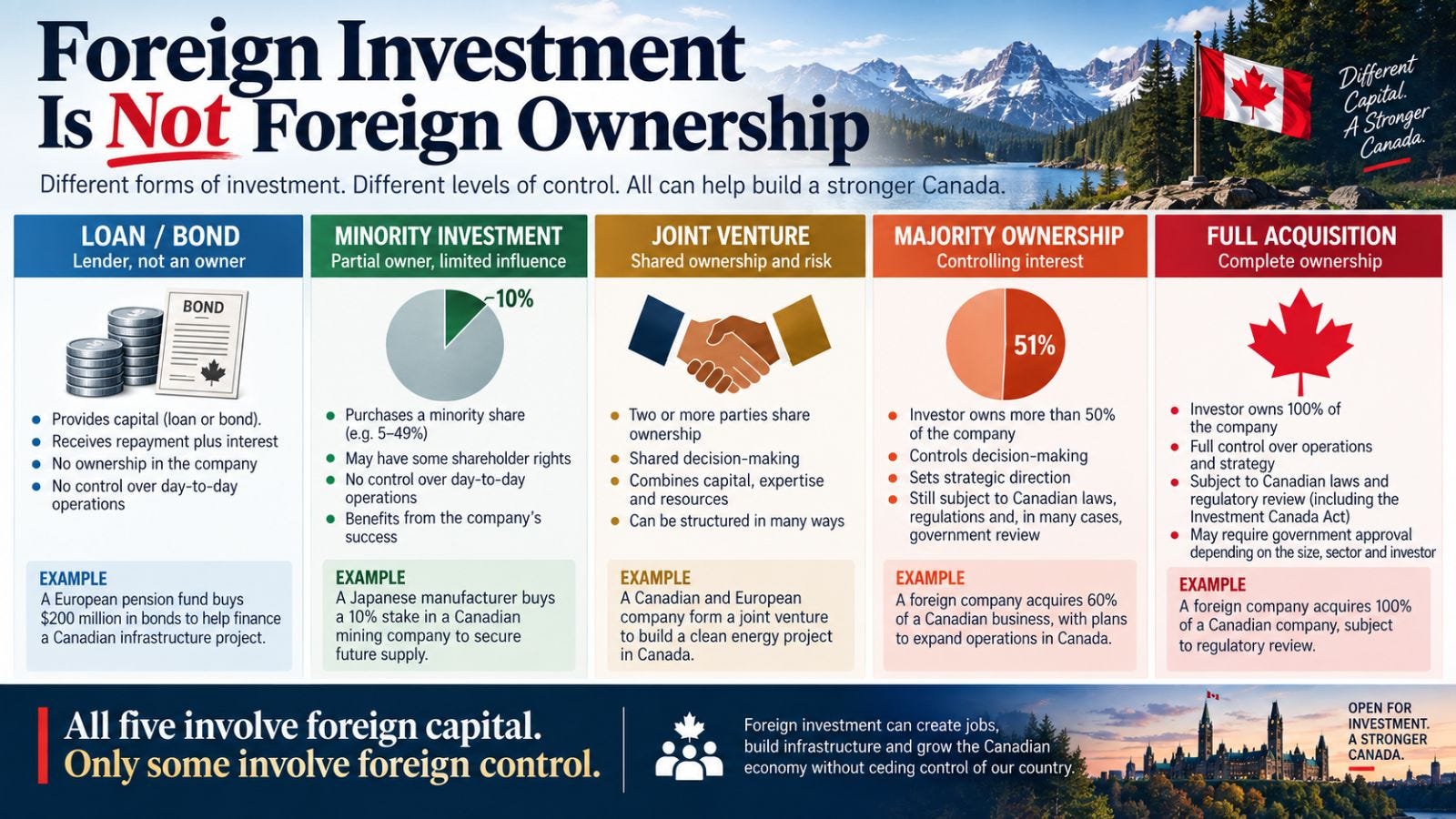
Foreign Investment Is Not the Same as Foreign Ownership
This distinction is essential to understanding the debate.
If a German pension fund buys $200 million in bonds issued to finance a Canadian infrastructure project, it has invested in Canada. It hasn’t purchased the infrastructure, much less the country. If a Japanese manufacturer buys 10 per cent of a Canadian mining company, that’s an equity investment. If it buys 100 per cent of that company, that’s an acquisition.
Those are fundamentally different transactions, and actual foreign ownership deserves more scrutiny because ownership can determine who ultimately controls a company and makes its strategic decisions.
We’ve already encountered this distinction at The Sanity Project. In our investigation, Who Actually Owns Canada’s Greenhouse Boom, we looked at a long-established Ontario family greenhouse business that had become part of Atlanta-based Cox Enterprises’ agricultural operation.
That was genuine foreign ownership. We didn’t conclude that foreign ownership automatically made the operation bad for Canada. The greenhouses were still in Ontario, Canadians were still employed, and Canadian food was still being produced. But ownership matters because it can change where strategic decisions are made and where profits ultimately flow.
That’s why a serious discussion about foreign investment needs more nuance than either side of the political shouting match usually allows. Foreign capital can be enormously beneficial, even though not every foreign acquisition is necessarily in Canada’s interest.
Can Foreign Investors Actually Buy Canadian Companies?
Yes. Foreign corporations can and do acquire Canadian companies, and pretending otherwise would be just as misleading as claiming that every foreign investment represents the sale of a Canadian asset.
Canada has an entire legal framework designed to deal with precisely this issue: the Investment Canada Act.
The federal government describes foreign investment as important to Canada’s economic success because it can contribute to economic growth, employment, new technology and access to global supply chains. At the same time, the Investment Canada Act gives Ottawa significant powers to scrutinise foreign investments when economic or national-security concerns arise.
In other words, Canada’s policy isn’t supposed to be either foreign money is bad or money, come on in and make yourself at home. The objective is to attract beneficial investment while retaining the ability to protect Canadian interests.
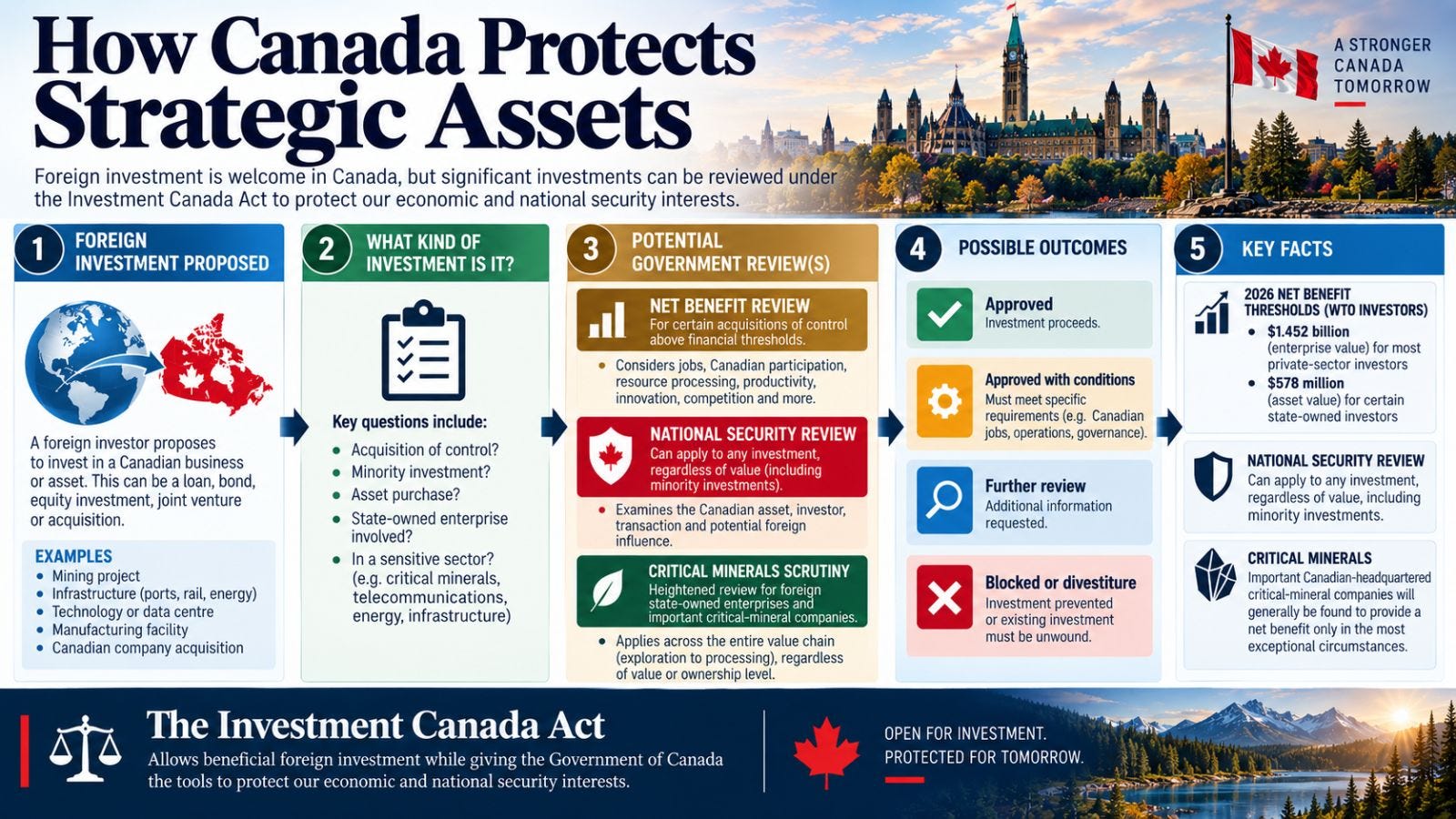
What Is the Investment Canada Act?
The Investment Canada Act, commonly called the ICA, is essentially Canada’s gatekeeping system for significant foreign investment. It does not prohibit foreigners from investing in Canadian businesses. Instead, it establishes mechanisms through which investments can be reviewed and, when necessary, subjected to conditions or rejected.
One of those mechanisms is the net benefit review. Significant foreign acquisitions of control above the applicable threshold can be examined to determine whether they are likely to provide a net benefit to Canada. The government can consider factors including Canadian employment, resource processing, Canadian participation in the business, productivity, technology and innovation, competition and Canada’s ability to compete internationally.
That’s a wonderfully Canadian concept. You may buy the company, but before you do, we’d like to have a quick chat about what you plan to do with it.
There is an important qualification. Not every foreign acquisition receives a net-benefit review. The Act uses different thresholds depending on the investor and transaction. For example, the 2026 threshold for certain private-sector WTO investors is $1.452 billion in enterprise value, while the corresponding threshold for certain state-owned WTO investors is $578 million in asset value.
That’s something we encountered in our greenhouse investigation: foreign ownership can occur without necessarily triggering a full net-benefit review.
Canada’s system, therefore, isn’t an impenetrable fortress protecting every Canadian company from foreign ownership. Nor was it designed to be.
National security, however, is another matter.
Foreign Investment and Canadian National Security
Canada’s national-security review powers under the Investment Canada Act are considerably broader than the net-benefit provisions.
The federal government states that any foreign investment can be subject to national-security review regardless of its value, and that investments not subject to mandatory filing requirements, including minority investments, can still be assessed for potential national-security harm.
The government can examine the nature of the Canadian asset, the terms of the transaction, the identity of the investor and the possibility of third-party or foreign-state influence. Depending on what that process finds, an investment can face conditions, be prevented from proceeding or ultimately be subject to divestiture.
These powers aren’t merely theoretical. In the 2024–25 Investment Canada Act annual report, Ottawa reported 30 investments that underwent extended national-security reviews. One resulted in an order to wind up the Canadian business, six were permitted to proceed based on enforceable undertakings, nine were withdrawn by the investors, and 14 concluded without further action.
So buying 10 per cent rather than 51 per cent isn’t necessarily a clever invisibility cloak. Ottawa can still look.
What About Canada’s Critical Minerals?
This brings us directly back to The 167.
Of the 167 opportunities included in the Canada Investment Summit prospectus, 63 are Minerals and Metals projects, making that the single largest category. Many involve resources that are increasingly important not merely as commodities but as strategic assets.
Lithium, nickel, copper, cobalt, graphite and rare earth elements are inputs for batteries, electricity grids, advanced manufacturing, aerospace, communications and defence. As we’ve discussed previously in our coverage of Canada’s critical-mineral advantage, these resources give Canada economic leverage at precisely the moment when governments around the world are trying to secure reliable supply chains.
Ottawa has consequently adopted tougher rules for certain foreign investments in this sector. Under Canada’s official policy regarding foreign state-owned investment in critical minerals, scrutiny can extend across the value chain, from exploration and development to production, processing, and refining. The policy explicitly states that it applies regardless of value and whether the investment is controlling or non-controlling.
The federal government went further in 2024. In its Ministerial Statement on Net Benefit Reviews of Canadian Critical Minerals Companies, Ottawa announced that acquisitions of important Canadian-headquartered mining companies engaged in significant critical-mineral operations would be found to provide a net benefit to Canada only in “the most exceptional of circumstances.”
That’s not exactly a CLEARANCE SALE: EVERYTHING MUST GO policy.
It reflects an important reality. Some Canadian assets have strategic importance far beyond the dollar value someone might be willing to pay for them.
Who Actually Benefits From Foreign Investment?
When foreign investment works well, the benefits extend well beyond the investor and the company receiving the investment.
The investor receives a financial return, while the Canadian company gains access to capital it might otherwise struggle to raise. Workers gain employment. Local businesses become suppliers. Governments collect corporate and personal income taxes and, where applicable, resource royalties. Communities can gain roads, power infrastructure and other improvements. Indigenous communities can participate through employment, procurement, partnerships, benefit agreements and, increasingly, equity ownership.
Most importantly, Canada gets productive assets built inside Canada.
That last point shouldn’t be underestimated. A $5-billion mine that never gets financed produces no minerals, employs no miners and pays no mining royalties. A proposed port sitting in a PowerPoint presentation doesn’t load many ships. Canada possesses enormous natural resources, technological expertise and human capital. What we haven’t always possessed is enough patient capital, infrastructure and speed to transform those advantages into productive assets.
Foreign investment can help close that gap.
That doesn’t mean every foreign investment is automatically good. Some acquisitions can transfer control of strategically important businesses outside Canada. Some investments can create unhealthy dependencies. Foreign state-owned enterprises can pursue geopolitical objectives rather than purely commercial ones. Poorly structured deals can result in Canada exporting raw materials while higher-value processing, intellectual property and manufacturing migrate elsewhere.
Those are legitimate concerns. The answer is scrutiny, conditions and intelligent regulation, not economic isolation.
Could Foreign Investment Actually Strengthen Canadian Sovereignty?
This is where the argument becomes particularly interesting.
Canada has spent decades with an extraordinary concentration of its international economic relationship in one country: the United States. Geography made much of that inevitable, and the relationship has delivered enormous benefits to both countries.
Recent events have also demonstrated the risk of excessive dependence on a single market.
Canada is now deliberately attempting to strengthen its economic relationships with Europe, Asia and other regions. We’ve been documenting that shift for months, including in Canada-US Trade War 2026: While Trump Watched UFC, Carney Was Winning, where we examined Canada’s expanding trade and investment relationships beyond the United States.
Now apply the same principle to investment.
Imagine a major Canadian project financed by a combination of Canadian banks and pension funds, a German infrastructure investor, a Japanese manufacturer and an Australian pension fund. Once operating, the project’s products are sold not only in the United States but also to customers in Canada, Europe and Asia.
Which Canada is more economically sovereign: the one overwhelmingly dependent on a single foreign market and source of capital, or the one connected to multiple economies, multiple investors and multiple customers?
I know my answer.
Dependence does not become sovereignty simply because we’ve grown accustomed to the dependence.
Diversification can itself be an exercise in sovereignty. The objective shouldn’t be to eliminate international economic relationships. For a trading nation such as Canada, that would be economically self-destructive. The objective should be to avoid becoming dangerously dependent on any one of them.
Canada Isn’t for Sale. But Canada Should Be Open for Investment.
That brings us back to the 167 projects being presented to investors.
The Canada Investment Summit isn’t an auction. The government’s own description says the summit brings together global investors, Canadian CEOs and public-sector representatives with the goal of accelerating new investment into Canada. It is explicitly being presented as a platform for showcasing Canada as an investment destination and connecting Canadian opportunities with global capital.
There are two equally simplistic ways of responding to this.
One is to declare that foreign investment is always wonderful, take whatever money is offered and ask no awkward questions. The other is to insist that accepting foreign capital means Canada is selling itself and should therefore pull up the economic drawbridge.
Neither position survives serious examination.
Canada should aggressively pursue foreign investment while being equally aggressive about protecting strategic Canadian interests. We should insist that major projects generate economic benefits for Canada. We should push for more Canadian processing and manufacturing rather than remaining primarily an exporter of raw materials. We should protect strategically important resources and infrastructure, scrutinise foreign state-owned enterprises and use the Investment Canada Act when ownership or national security genuinely matters.
At the same time, we should welcome investors willing to put billions of dollars into building productive assets in Canada. And we should deliberately diversify both the countries investing here and the countries buying Canada's products.
Economic sovereignty doesn’t mean building a wall around Canada and trying to finance everything ourselves. It means deciding the terms on which the world does business with us.
If international investors want to help finance mines, ports, power systems, factories, technology, and transportation infrastructure in Canada, employ Canadians, operate under Canadian law, and contribute to the Canadian economy, we should absolutely be having that conversation.
We should have it carefully and strategically, and perhaps without assuming that every European pension fund arriving with a chequebook has come to steal Saskatchewan.
Canada isn’t for sale.
But Canada’s future is absolutely worth investing in. 🇨🇦
Thanks for the explainer. It is very helpful in light of previous PRC-based acquisitions of Canadian companies under the previous Trudeau government
Canada’s future is absolutely worth investing in! 🇨🇦
And with a Brilliant Proven Track Record Economist as our PM and the registered smart folks he's surrounded himself with, 100% trust our Country is in the exact right hands scrutinizing which "investors and investments" will positively and safely contribute to our economic stability and ensure Canada, our Sovereignty and Investments Portfolio becomes ever Stronger!