


Mark Carney’s Mandate: What the Election and Parliament Actually Say
The Liberals told voters they would build a less U.S.-dependent economy. The rules of Parliament explain what happens next.
You have probably heard it: Mark Carney has “no mandate” to reshape Canada’s trade relationships, pursue major projects or make deals abroad. The accusation sounds decisive. It becomes much less convincing when we ask one simple question: No mandate to do what, exactly?
Canadians can disagree about a particular agreement or bill. But the broad direction Carney is pursuing was put before voters in 2025, and the authority to govern does not vanish because opponents dislike the result. We need to separate those arguments before they can be judged fairly.
Key takeaways
Canadians do not vote directly for a prime minister. A government governs while it retains the confidence of the House of Commons.
Carney faced voters in April 2025. The Liberals won the most seats, and he won his own riding.
Trade diversification and faster major projects were explicit commitments of the Liberal campaign. They were not sprung on voters after election day.
An election is not a blank cheque. International agreements and changes to Canadian law pass through different stages, with Parliament playing a crucial role.
The “Unelected Prime Minister” Argument Has an Expiry Date
Carney became prime minister in March 2025 after winning the Liberal leadership. At that moment, he did not hold a seat in the House of Commons. It was fair to point that out, but it was never proof that the government was unconstitutional.
Canada does not hold a separate national election for prime minister. As the House of Commons explains, the person most likely to obtain and maintain the House’s confidence becomes prime minister, usually the leader of the party with the most seats. Governments answer to the elected House.
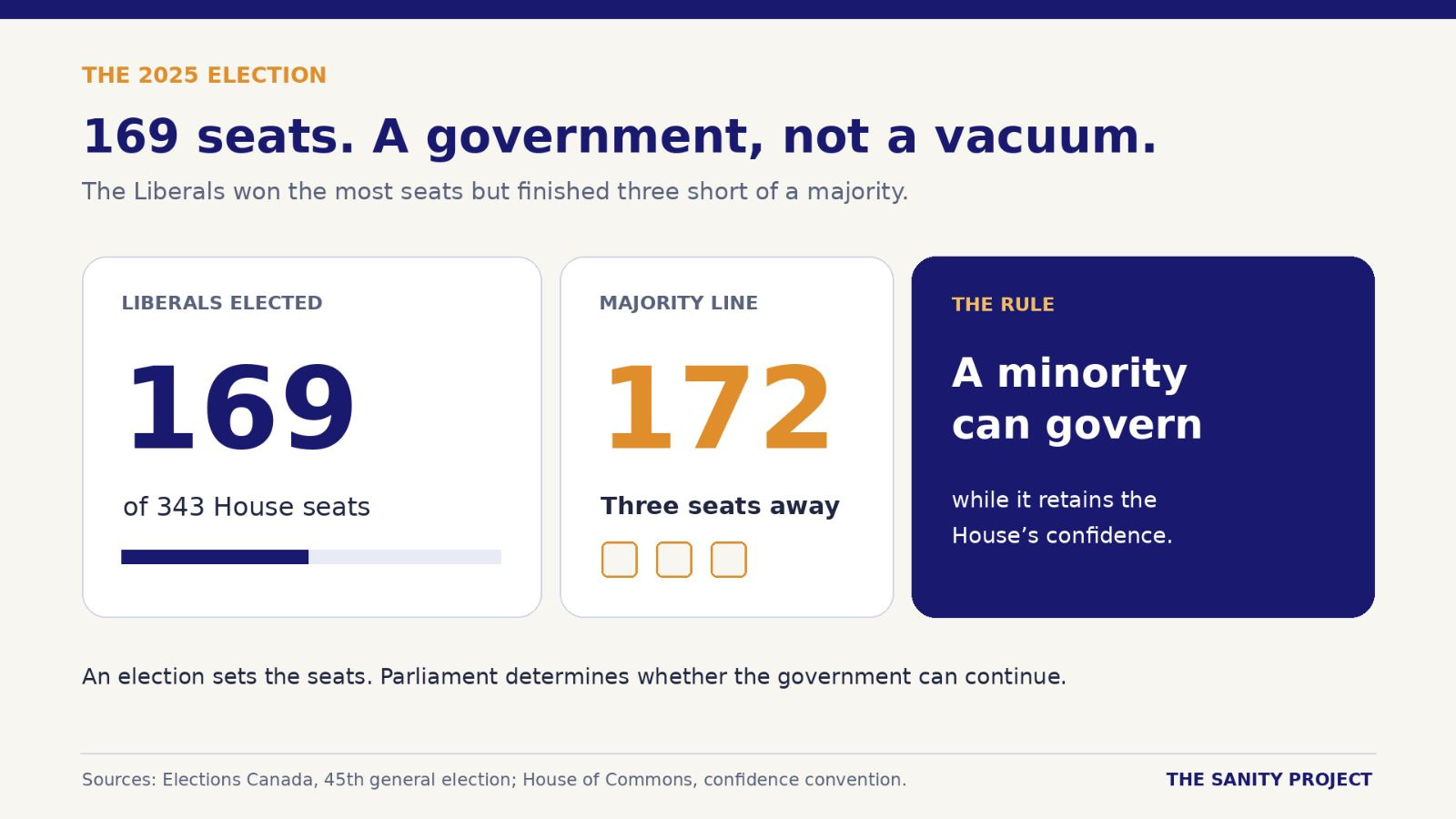
Then came the general election on April 28, 2025. The official results gave the Liberals 169 of 343 seats, more than any other party. Carney was also elected in Nepean with 63.8 per cent of the vote.
That election did not give the Liberals a majority. It did, however, give Canadians a chance to judge Carney and his party. Nearly 69 per cent of registered electors voted, the highest official turnout since 1993.
We can debate what voters wanted from the result. We cannot keep describing Carney as a leader who has never faced them.
A Minority Government Is Still a Government
The next version of the argument was that 169 seats fell short of a majority, so Carney had no mandate to act. But a minority result does not put the country in a constitutional waiting room.
The House of Commons’ account of the confidence convention says it applies whether the governing party holds a majority or a minority of seats. A minority government must work with other MPs to win votes and remain in office. It can govern as long as it retains the House’s confidence.
That is a real constraint. Budgets, spending and proposed laws face Parliament, and a government defeated on a confidence question is expected to resign or seek an election. A minority has less room to manoeuvre, but it does not have less right to govern.
There is a useful distinction here. The election gave Carney’s government parliamentary legitimacy. To find out whether Canadians were told about the particular direction now under attack, we need to look at what the Liberals actually offered during the campaign.
The Direction Was in the Platform
The 2025 Liberal platform, Canada Strong, did not bury the plan to reduce Canada’s economic dependence on the United States. Its section on building new markets promised to help Canadian businesses diversify away from the U.S., make better use of existing trade agreements, and pursue new deals with ASEAN and MERCOSUR.
It also promised a $5-billion Trade Diversification Corridors Fund for ports, railways, airports, highways and other infrastructure. Elsewhere, the platform proposed a Major Federal Project Office and faster decisions on major projects, while promising environmental protection and Indigenous consultation.
Those are campaign commitments, not a detailed voter endorsement of every agreement or project that might follow. Still, they make one claim especially hard to sustain: that Carney won an election and only then revealed an interest in diversifying trade and getting big projects built.

After the election, Carney issued a public mandate letter to his ministers. Its first priority was a new economic and security relationship with the United States alongside stronger ties with reliable trading partners. Its second was one Canadian economy and expedited nation-building projects.
The letter is Carney’s direction to his cabinet, not a substitute for the voters’ decision. Its importance lies in the continuity: the campaign, the election, and the government’s stated priorities all point in the same broad direction.
We still have to ask what powers a government can use to turn that direction into reality. That is where the “no mandate” argument usually skips the most useful part of the story.
After the Handshake, Who Actually Has the Final Say?
The election explains why Carney can govern and the direction he promised. It does not tell us whether an agreement announced abroad binds Canada, whether MPs get a vote, or whether a House majority gives any prime minister a free pass.
In the second half, we follow a deal from the negotiating table to Canadian law. We explain the 21-sitting-day treaty rule, when Parliament must approve changes, how the Liberals gained their majority, and why Bill C-39 is a revealing test of the difference between a campaign promise and its details.
Subscribe for free to keep reading. You’ll see where Carney’s authority is strongest, where Parliament can still say no, and how to tell a real accountability question from a “no mandate” slogan.

Thank you for the explanation of what a mandate is in a parliamentary democracy such as ours🍁.
Thank you particularly for dumbing it down enough that, hopefully, those who were asleep in their civics class or are confused with a different system of government like the one currently running amok below us, are able to comprehend what an election is and what a mandate means.
However, as my dear departed friend Joy would say when I railed against the idiots who weren't willing to learn and believed they knew it all, "Let it go, Cath. You can't cure stupid."
Thanks for trying! ❤️🇨🇦