


The Numbered Treaties: The Promises That Built Western Canada
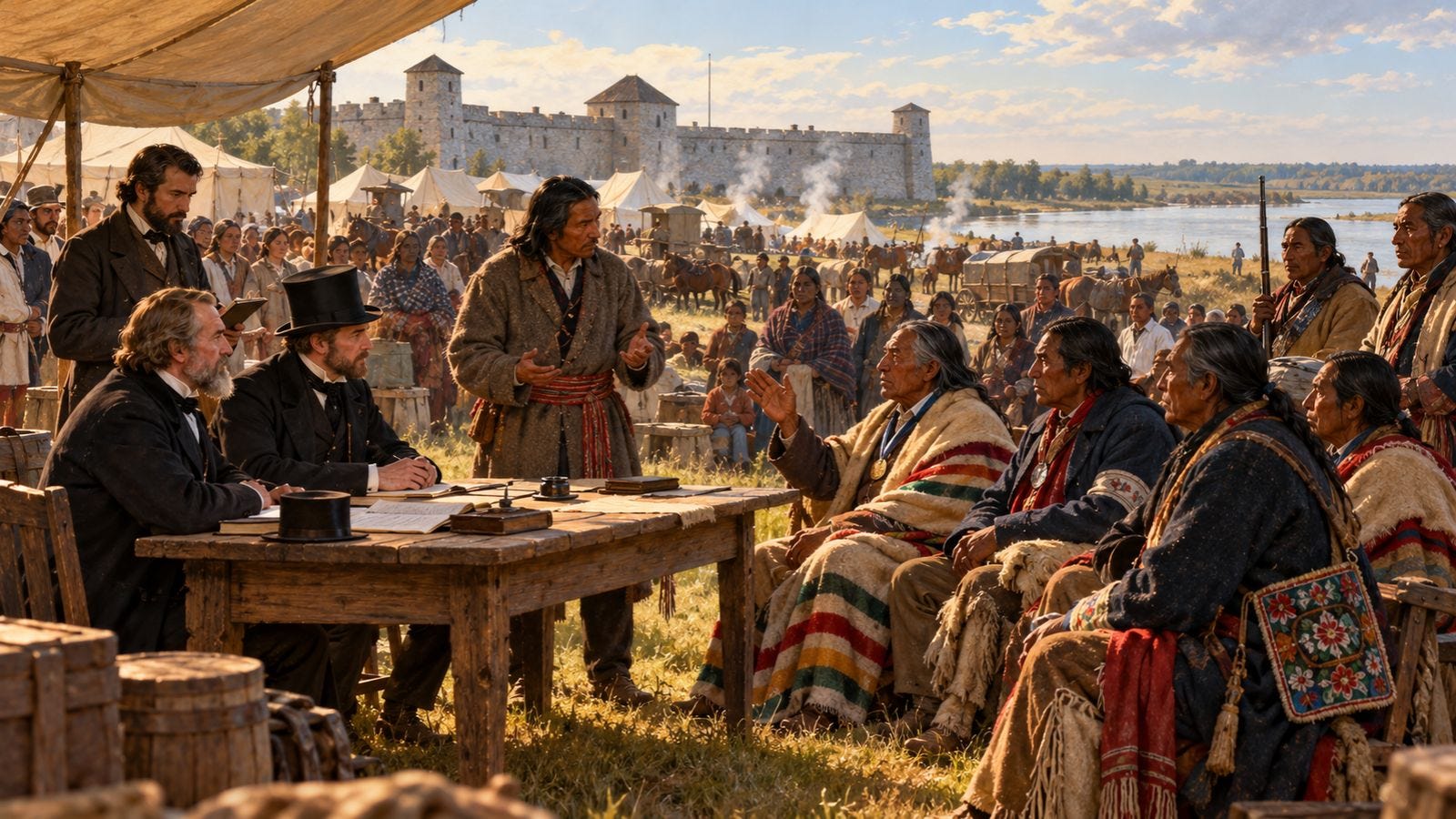
In the summer of 1871, the tents stood in rows below the stone walls of Lower Fort Garry, north of where Winnipeg is today. Smoke from a hundred cooking fires hung over the Red River. The Anishinaabe and Swampy Cree of southern Manitoba had come in great numbers to hear what a brand-new country called Canada wanted from them.
What Canada wanted was the land.
On 3 August 1871, after eight days of hard talks, the chiefs signed Treaty 1, the first of the Numbered Treaties. In my new book, a young hunter asks his uncle that night whether they had just sold it. The uncle is quiet for a long time. Then he says: “We agreed to share it. That is what I agreed to.”
The young hunter and his uncle are invented. The question they’re asking is not. Canadians have been arguing about the answer for more than 150 years, and that argument is still in our courts today.
What are the Numbered Treaties, and why did Canada need them?
The story starts with a real estate deal. In 1869, the Hudson’s Bay Company surrendered Rupert’s Land, a territory covering much of what is now western and northern Canada, to the new Dominion for £300,000. No one who actually lived there was asked.
Ottawa had big plans for that land: farms, settlers and a railway to the Pacific. But it had a problem, and the problem was its own law. The Royal Proclamation of 1763, issued by King George III, said that Indigenous land could not simply be taken. Only the Crown could acquire it, in a public meeting, and only if the nation agreed. If Canada wanted the West, it had to sign treaties.
The First Nations had their reasons to talk too. The bison herds that had fed the Plains for centuries were collapsing. Settlers were coming, treaty or no treaty. A treaty at least promised help through hard times, and land that could not be taken away.
How many Numbered Treaties are there?
Between 1871 and 1921, the Crown and First Nations signed eleven. Historians call them the Numbered Treaties because Ottawa numbered them in order, one through eleven. Together they cover a vast area, from northern Ontario west to the Rocky Mountains and beyond, and north to the Beaufort Sea. Here is the treaty map of Canada that most of us never saw in school.
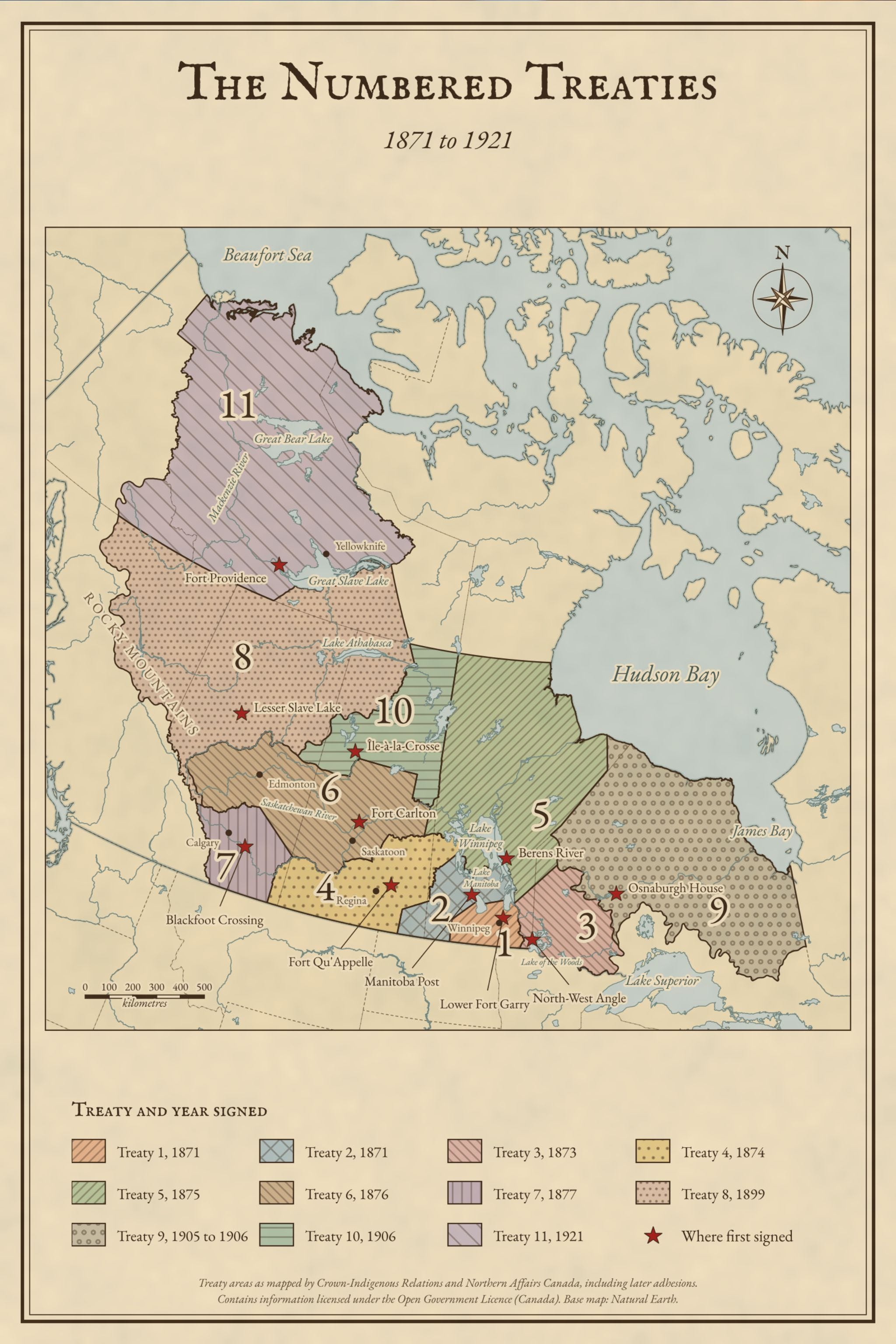
Look at the map, and a pattern jumps out. The treaties followed whatever Canada wanted next.
Treaties 1 through 7, signed between 1871 and 1877, cover the Prairies and the routes leading to them, which was the land Canada needed for farms and the railway. Treaty 1 and Treaty 2 took in southern Manitoba in 1871. Treaty 3 followed in 1873, covering the route west from Lake Superior. Treaty 4 covered southern Saskatchewan in 1874, Treaty 5 covered central and northern Manitoba in 1875, and Treaty 6 covered the parklands of central Saskatchewan and Alberta in 1876. Treaty 7, signed with the Blackfoot Confederacy and their neighbours in 1877, covered southern Alberta.
Then Ottawa stopped for more than twenty years. The North could wait.
It waited until gold turned up. The Klondike Gold Rush sent thousands of prospectors north through First Nations land in the late 1890s, and in 1899 Canada signed Treaty 8, covering northern Alberta and parts of what are now British Columbia, Saskatchewan and the Northwest Territories. Treaty 9 covered northern Ontario in 1905 and 1906, and Treaty 10 covered northern Saskatchewan and Alberta in 1906 and 1907.
The last one, Treaty 11, was signed in 1921 along the Mackenzie River. The reason was oil, discovered at Norman Wells the year before.
So the map of the Numbered Treaties is also a map of Canada’s ambitions: farmland first, then gold, then oil.
What the Numbered Treaties promised
The treaties differ, but most made similar promises. Each band would receive reserves, starting at 160 acres for every family of five in Treaty 1 and rising to a square mile per family of five in most of the later treaties. Every member would receive an annual payment, forever. There would be schools, farming tools and animals, and the right to keep hunting and fishing on land the Crown had not taken up.
Some treaties went further. Treaty 6 promised a medicine chest, kept at the Indian agent's home, and help in times of famine and pestilence. First Nations have argued ever since that this was a promise of health care.
Not every chief signed willingly. The Plains Cree leader Mistahimaskwa, known in English as Big Bear, refused to sign Treaty 6 in 1876. He held out for six years, pressing for better terms. In 1882, with the bison gone and his people starving, he signed.
What the treaties actually say
Here is where the trouble starts.
The talks were held in Cree, Anishinaabemowin, Blackfoot, Dene and other languages, through interpreters. Crown lawyers wrote the treaties in English. And the written versions say the nations agreed to “cede, release, surrender and yield up” their lands to the Crown.
Few of the chiefs could read those words. Many First Nations, then and now, say that is not what they agreed to. They understood the treaties as agreements to share the land and live side by side, not to give it away.
Even the Crown’s own promises did not always make it onto the page. At Treaty 1, the commissioners promised oxen, cows and ploughs. None of it appeared in the written treaty. The chiefs complained year after year until, in 1875, Ottawa added the “outside promises” to the treaty and raised the annual payment from $3 to $5 per person.
Treaty Day: five dollars a year, forever
That payment is still made. Every year, on Treaty Day, most descendants of the Numbered Treaty signatories receive $4 or $5 each.
The amount has not changed in well over a century. In the 1870s, five dollars meant something. Today it buys a coffee, if you skip the muffin. First Nations in Alberta and Ontario have now gone to court to make Canada bring the payments in line with what the promise was worth when it was made.
That’s the thing about the Numbered Treaties. They aren’t history in the way the Plains of Abraham is history. They are living agreements. They still decide who has rights to land across much of the country, and their meaning, written and spoken, is still being argued in Canadian courts.
In Saskatchewan, you’ll hear a phrase used to explain it: we are all treaty people. If you live in Winnipeg, Regina, Saskatoon, Edmonton or Calgary, you live on treaty land. The deal made at Lower Fort Garry, and the ten that followed, are part of your story whether you have ever seen the map or not.
Read the whole story, free
This article grew out of one chapter of my new book, 40 Events That Forged Canada: The Most Important Events in Canadian History. It tells the story of this country in forty short chapters, from the Haudenosaunee Great Law of Peace to the Truth and Reconciliation Commission. Each one opens with a scene and puts you in the room with the people who lived it. Every event is real, and each chapter takes about five minutes to read.
The Numbered Treaties chapter comes with the full map, made for the book from Government of Canada data. Around it are the Royal Proclamation that made the treaties necessary, the Indian Act that followed five years after Treaty 1, and Louis Riel and the Red River Resistance that came just before.
You can get your copy at ashwoodpublishing.com/canadian-history-events.

And if you know someone who has never seen this map, send them the link.
Sources checked: Numbered Treaties, The Canadian Encyclopedia · Treaty Day, The Canadian Encyclopedia · Numbered Treaties, Indigenous Studies (eCampusOntario) · Unadjusted Treaty Annuities, JFK Law (October 2025) · Treaty 8, The Canadian Encyclopedia · Treaty 11, The Canadian Encyclopedia
Fabulous. Thank you for this. I will check it out.
Thanks~ Excited to read the book Bo!