


Canada-EU Future — Part 3 of 3
How Canada-EU Trade Can Build a More Independent Canada
Europe cannot replace the United States. It can help Canada reduce its dependence on it.
Key Takeaways
CETA has eliminated duties on 99 per cent of tariff lines between Canada and the European Union.
Canada-EU merchandise trade grew by more than 77 per cent between 2016 and 2025.
Despite that growth, 71.7 per cent of Canadian merchandise exports still went to the United States in 2025.
Canada and the EU are building critical-mineral, battery, defence and Arctic partnerships that go well beyond conventional trade.
Canada’s goal should not be to replace the American market. It should be to make American political pressure less dangerous.
Donald Trump offered Canada the privilege of becoming the 51st state. Europe offered us a seat at the table.
That distinction captures the choice Canada now faces. We can remain overwhelmingly dependent on a neighbour whose president treats tariffs as leverage, alliances as invoices and Canadian sovereignty as material for a punchline. Or we can build deeper connections with democratic partners who see Canada as a country rather than an acquisition.
This does not mean moving Canada across the Atlantic or pretending geography no longer matters. The United States will remain our largest customer, closest neighbour and most integrated economic partner.
Geography will always bind Canada and the United States together. But proximity should not require submission.
In Part 1 of this series, we examined why Canada’s parliamentary democracy looks more like Europe than the American presidential system. In Part 2, we showed how Canada’s European-style social contract helps Canadians live longer and experience fewer firearm homicides.
Part 3 asks the practical question: what can Canada’s relationship with Europe actually deliver?
Shared values are comforting. Shared factories, ports, supply chains and defence contracts are power.
CETA Built the Bridge
Canada does not have to invent an economic relationship with Europe. We already spent a decade building one.
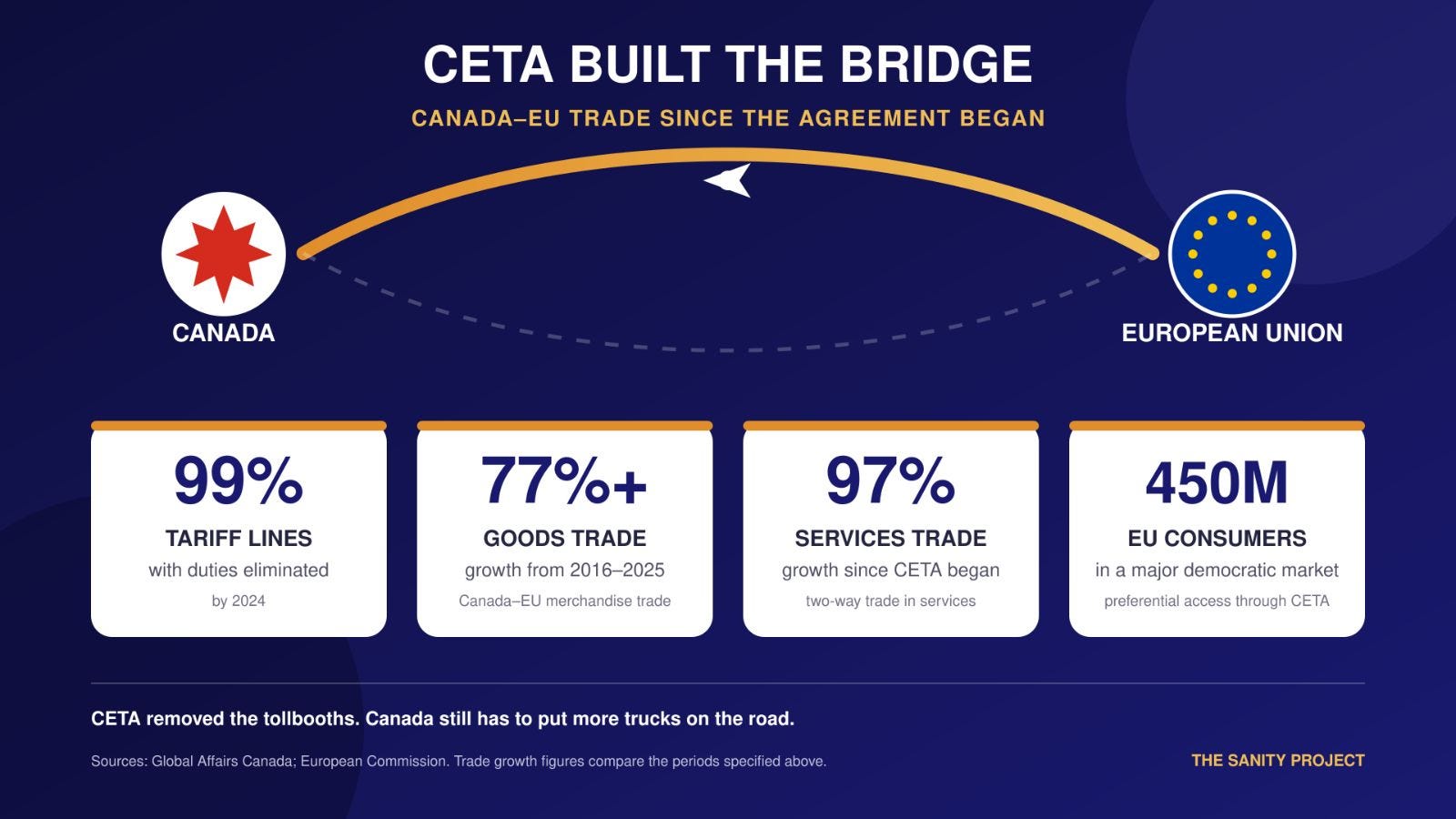
The CETA trade agreement, formally known as the Comprehensive Economic and Trade Agreement, entered provisional application in September 2017. According to the European Commission, 98 per cent of tariff lines disappeared immediately. By 2024, duties had been abolished on 99 per cent.
That gave Canadian companies preferential access to an EU market of roughly 450 million people.
The results are measurable. Global Affairs Canada reports that bilateral merchandise trade between Canada and the EU grew by more than 77 per cent between 2016 and 2025. Since provisional application began, two-way trade in services has grown by 97 per cent.
That is not a theory. It is a functioning bridge, although we should be careful with the victory lap.
Growth in two-way trade does not automatically mean Canadian exports grew equally, that every Canadian industry benefited or that CETA created a precise number of jobs.
Germany, for example, was Canada’s largest EU merchandise-trading partner in 2025. Two-way trade reached $34.3 billion, with Canadian exports totalling $9.2 billion and imports totalling $25.1 billion.
CETA opened the door. It did not guarantee that Canadian businesses would walk through it.
Small exporters still face unfamiliar regulations, shipping costs, language barriers and complicated rules of origin. Some agricultural producers continue to encounter European restrictions and quota problems. Canadian forest-product exporters have also raised concerns about how new EU deforestation rules may affect market access.
Those are not reasons to abandon CETA. They are reasons to use it properly.
Canada needs more trade commissioners to help small and medium-sized businesses identify European customers, navigate standards,s and claim the tariff preferences they are already entitled to. Export Development Canada and the Canadian Commercial Corporation should be judged partly on how many Canadian firms they help enter non-American markets.
A trade agreement is infrastructure. It only creates prosperity when somebody builds on it.
CETA removed the tollbooths. Canada still has to put more trucks on the road.
Stop Exporting the Best Jobs
Canada has spent generations digging valuable things out of the ground, shipping them elsewhere and buying back the expensive products made from them.
That model creates work. It also exports much of the value.
Europe’s need for secure critical-mineral supplies gives Canada an opportunity to change it.
Canada possesses cobalt, graphite, lithium, nickel, copper, uranium and rare earth elements needed for batteries, electrical systems, nuclear energy, aerospace equipment and modern weapons. Europe wants those materials from stable democracies rather than from authoritarian suppliers who could restrict access when political disputes arise.
The Canada-EU Strategic Partnership on Raw Materials is designed to connect Canadian resources with European investment, technology and industrial demand. Its objectives include integrating value chains, supporting research and establishing stronger environmental and labour standards.
The important words are “value chains,” because Canada should not aspire to become Europe’s quarry.
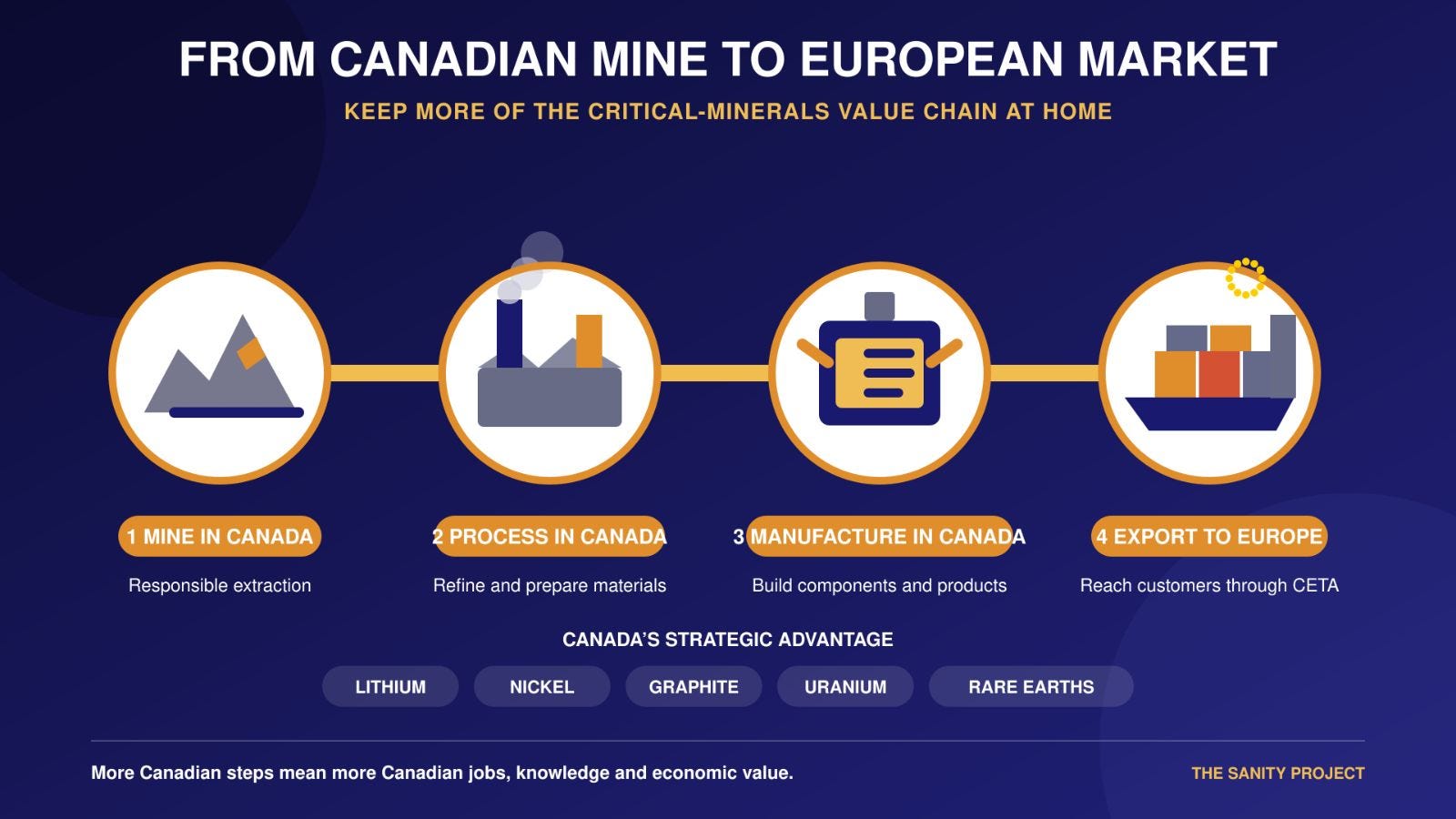
We should mine the nickel, process it here and manufacture battery components here. We should extract graphite and produce battery-anode material here. We should develop rare earth deposits while building Canadian refining capacity.
Some of that transition is beginning.
Northern Graphite, which operates near Montreal, has pursued an offtake and processing relationship with Italy’s Alkeemia. The arrangement could connect Canadian natural graphite with European purification expertise.
Norway-based REEtec has an agreement involving rare earth material from the Nechalacho mine in the Northwest Territories. German industrial partnerships are supporting Canadian battery and mineral-processing research. Italian energy company ENI has explored investments in Canadian lithium, graphite, rare-earth refining, and battery recycling.
In 2026, Canada and the EU also renewed their commitment to expanding responsible production, processing and downstream manufacturing. Those last two stages matter most because that is where better-paid industrial jobs and proprietary technology tend to accumulate.
Canada’s choice is straightforward. We can sell Europe rocks, or we can sell Europe the advanced materials and finished products those rocks make possible.
The Arctic Is More Than a Map
The Canada-EU relationship is no longer limited to containers crossing the Atlantic.
In June 2025, Prime Minister Mark Carney and European leaders signed a Canada-EU Security and Defence Partnership. The agreement covers maritime security, cybersecurity, space, military mobility, defence industries and Arctic cooperation.
Canada later became the first non-European country admitted to the EU’s €150-billion SAFE defence-procurement system.
That gives Canadian defence companies a chance to participate in a market far larger than Canada could create on its own. It also gives Europe access to Canadian capabilities in aerospace, shipbuilding, artificial intelligence, surveillance, and critical minerals.
The Arctic makes the partnership more urgent. Russia has continued to expand its northern military infrastructure, while climate change is extending shipping seasons and increasing interest in Arctic resources.
Canada has an enormous northern territory, a limited population and decades of unfinished infrastructure promises. European partners such as Denmark, Finland and Sweden bring Arctic experience, ice-capable technology and modern defence industries.
Norway, while outside the EU, is also a crucial NATO Arctic partner with extensive expertise in northern operations and offshore energy.
Cooperation cannot mean allowing Europeans to determine Canada’s Arctic future from Brussels. Indigenous communities must be decision-makers and economic partners, not names added to the consultation section after the contracts are written.
It does mean Canada does not have to defend, monitor and develop the North alone.
The proposed transformation of Churchill into a four-season port offers one example. Better rail, energy, communications and marine infrastructure could serve northern communities, strengthen sovereignty and create another route for Canadian products heading toward Europe.
Ports in Halifax, Saint John, Montreal and Quebec City also give Canada something no trade agreement can manufacture: Atlantic geography.
For most of our history, we treated the Atlantic as the space separating Canada from Europe. It is time to treat it as the route connecting us.
Diversification Is Insurance, Not Divorce
Canadian merchandise exports to the United States fell from 75.9 per cent of the total in 2024 to 71.7 per cent in 2025, according to Statistics Canada.
That is movement, but it is not independence. No realistic European strategy can replace the scale, speed and convenience of the American market.
A Manitoba manufacturer can put a product on a truck and have it in Minneapolis that afternoon. Sending the same product to Munich involves an ocean, more paperwork and considerably less forgiving logistics.
The United States also remains deeply integrated with Canadian energy, automotive, agricultural and manufacturing supply chains. Deliberately tearing those relationships apart would damage Canadian workers and consumers.
The objective is leverage, not divorce. A business with one customer has a customer, but it may also have a boss.
When nearly three-quarters of Canada’s merchandise exports go to one country, an American president can threaten to cut off access to that market and expect Ottawa to panic. Every additional customer in France, Germany, Italy, the Netherlands or Scandinavia reduces that vulnerability.
Europe should be one pillar of a broader strategy that also includes the United Kingdom, Japan, South Korea, Australia, India and the growing economies of Southeast Asia.
Canada’s goal is not to become less connected. It is to become much harder to bully.
🔒 So What Does Canada Do Now?
The opportunity is real. But signing trade agreements is the easy part.
Below, we look at what Canada must actually do to turn its growing relationship with Europe into Canadian jobs, stronger industries and greater economic independence.
That means critical minerals, ports and railways, defence manufacturing, Canadian exporters and one larger question:
How does Canada make sure no single foreign government can ever hold our economy hostage again?
The rest is free. You just need to be a free subscriber.
I’m sold on trying to expand exportation of finished or semi-finished products to new markets BUT… it is not as easy as it may appear.
First, let’s deal with standards. Over the past 100 years or so we developed and/or used North American standards based on those of the US. We manufacture and sell many of our goods in Imperial not Metric but there have been changes over the past 20 years. A sheet of plywood is 3/4in, not 19mm and a screw is sold in inches and gauges not mm. The same for electrical as we use 120v, much of the rest of the world is on 220v. Radios operate on different frequencies in America vs Europe/Africa or Asia. The list goes on and on but it means that manufacturers must modify their products or create new ones for selling abroad. Understanding the standards, adapting the product, getting certification is a lengthy and costly process.
Second, we have language barriers. Selling abroad means specs and user manuals being translated. It also means you need to develop a sales force that can service these customers in their language, find local distributors, etc.
Third, unless you have a unique product, you will need to displace current suppliers with their established network, you may need to join existing supply chains. If you are part of a just-in-time supply chain, how do you ensure you can deliver on schedule or on short notice?
A long time ago, I worked in support of international trade and it often takes years for a Canadian manufacturer to enter the market, it requires maintaining a local presence, having staff that speaks the local language. These are things that are very difficult to build and maintain in hope of entering a market. Several tried and a significant number pulled the plug.
All this to say that while commodities can find markets quickly, manufactured products are at another level.