



Canada’s First Sovereign Wealth Fund Just Hired a Wall Street Heavyweight
On Monday, Prime Minister Mark Carney named Karen Karniol-Tambour the first CEO of the Canada Strong Fund, the country’s first national sovereign wealth fund. If her name doesn’t ring a bell, it rings plenty of them on Wall Street. Until this week, she was co-chief investment officer of Bridgewater Associates, the Connecticut hedge fund founded by Ray Dalio that manages roughly US$102 billion.
Bloomberg said the hire lends Wall Street credibility to one of Carney’s signature economic projects. Fair enough. But for most Canadians, a more basic question comes first: what exactly is the Canada Strong Fund, and why should anyone outside Bay Street care?
Let’s start there. Then we’ll get to the question the press release didn’t answer.
What is a sovereign wealth fund?
A sovereign wealth fund is a pool of money owned by a country and invested for the long haul. Carney has called Canada’s version a “national savings and investment account,” which is a decent way to picture it: savings that get put to work in companies and projects instead of sitting idle.
A famous example is Norway. The Norwegians took their oil revenue, invested it around the world, and built a fund that has surpassed $2 trillion. Singapore, Saudi Arabia and the UAE run big ones too. Canada has had provincial versions for decades, like Alberta’s Heritage Savings Trust Fund, but until this spring there was nothing at the national level.
Grab a free, Romance e-book

How the Canada Strong Fund works
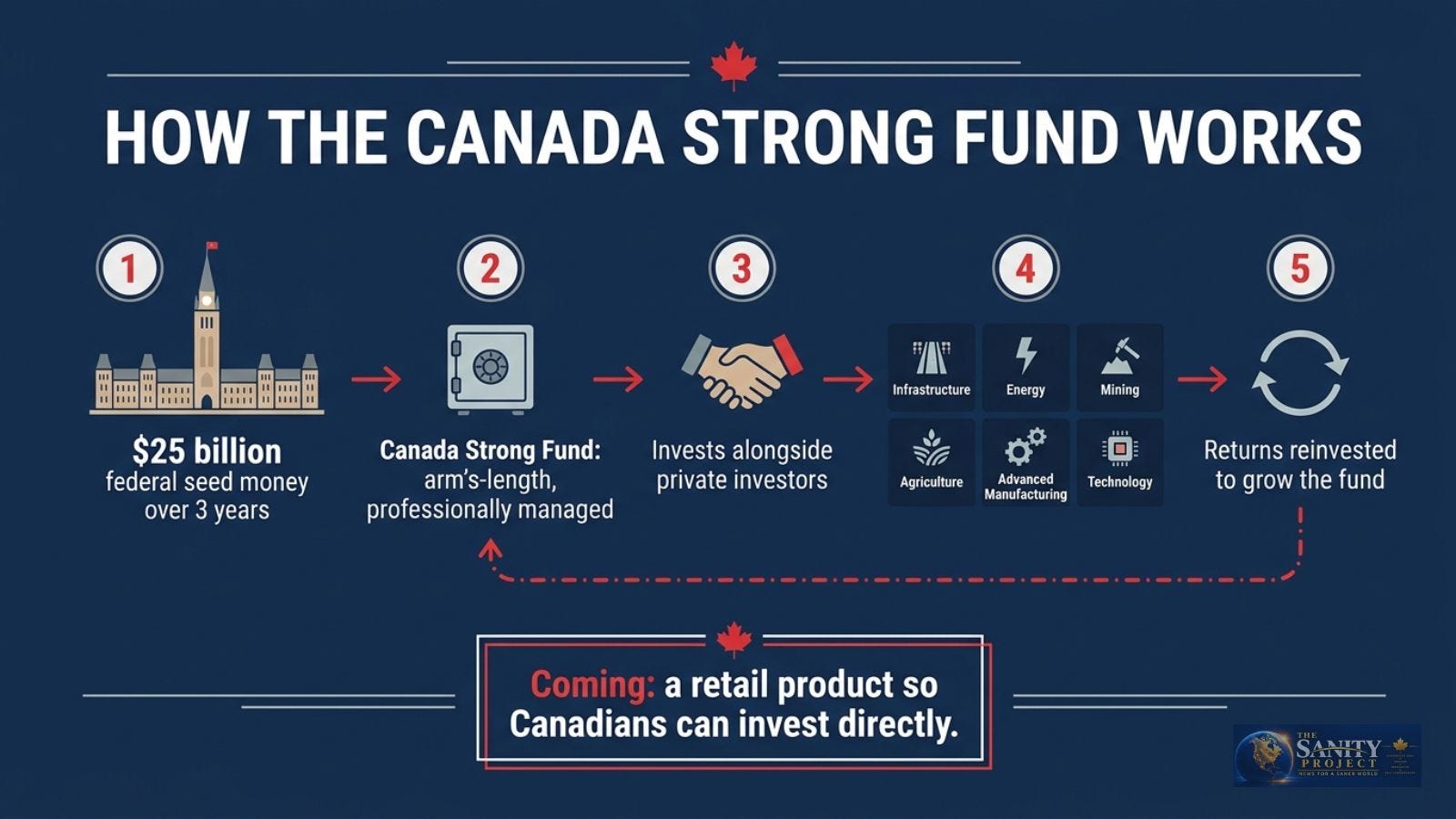
Carney announced the Canada Strong Fund on April 27, 2026, with $25 billion in federal seed money over three years. We’ve looked at the politics of a Canadian sovereign wealth fund before, but the design details matter more now that someone is about to run it. A few of those choices make it unusual among sovereign wealth funds.
First, it invests only in Canada. Norway spreads its money across the globe. Canada’s fund is built to invest at home, in infrastructure, energy, mining, agriculture, advanced manufacturing and technology, the same sectors behind the biggest projects Canada wants to build. That puts it closer to Singapore’s Temasek, which helps shape domestic industry, than to Norway’s passive global portfolio.
Second, it invests alongside private money. The fund takes minority stakes next to private investors, with a mandate to earn commercial, market-rate returns. On paper, at least, this is an investment fund and not a grant program with a nicer name.
Third, it runs at arm’s length from Ottawa. The government says the fund will be professionally managed with its own board of directors. Budget 2026 laid out plans to make it an independent Crown corporation. Until then, it operates as a wholly owned subsidiary of the Canada Development Investment Corporation.
And fourth, regular Canadians will be able to invest in it. This is the part that should get your attention.
Can you invest in the Canada Strong Fund?
Eventually, yes. Most sovereign wealth funds are closed shops: the government puts money in, and citizens never get a direct piece. The Canada Strong Fund is designed as a retail investment product so individual Canadians can put some of their savings into it. Carney compared it to buying a government bond, with your initial investment protected.
Here’s the honest caveat for anyone searching how to invest in the Canada Strong Fund: the product isn’t on the shelf yet. The government set up a transition office to finalise the fund’s governance, investment mandate and retail offering, and Monday’s announcement still describes that offering in the future tense. No Canada Strong Fund interest rate or guaranteed return has been published. If someone online is selling you “Canada Strong Fund units” today, close the tab and keep your wallet in your pocket.
How the fund could help Canada
The first benefit is ownership. When a new port, mine or transmission line gets built, the equity returns flow to whoever put up the money, and that’s often a foreign pension fund or a private equity firm. That isn’t automatically a bad thing, as we found when we asked what foreign investment in Canada really means. But Carney’s pitch is that Canadians, through their government and through the retail product, should also get a cut of the returns from projects built on Canadian soil. With trade relations with the United States as rocky as they’ve been this year, keeping more Canadian assets in Canadian hands is as much a sovereignty argument as a financial one.
The second benefit is compounding. Returns get reinvested to grow the fund instead of being spent, so its capacity to back new projects grows over time.
The third is access. Most Canadians will never get a seat at the table in a major infrastructure deal. A protected retail product would give ordinary savers a way into the kind of long-term investments usually reserved for pension giants.
That’s the case for the fund. Now for the part most coverage is skipping: whether $25 billion in borrowed money can actually pay off, what two decades at Bridgewater says about the woman now running it, and the citizenship question Ottawa hasn’t fully answered.
That’s below, for subscribers. It’s free. It just takes an email, and the next one lands straight in your inbox.
Keep reading, it’s free
Up next: whether $25 billion in borrowed money can actually pay off, how Karen Karniol-Tambour climbed to the top of one of the biggest hedge funds in the world, and the citizenship question Ottawa still hasn’t answered.
Click “Become a free subscriber”, and you’re in. No credit card, no catch. Just facts-first Canadian news in your inbox.
