


Canadian Pride Without the Scoreboard
An Inuit artist, a Newfoundland community, and the achievements we don’t need anyone else to validate.
In 1970, a Canadian postage stamp featured an owl whose feathers looked as though they’d declined to follow the usual rules. Kenojuak Ashevak had created The Enchanted Owl ten years earlier, giving the bird a direct gaze and a magnificent spread of sweeping curves. It was recognisable, strange and assured. You could encounter it while mailing an envelope, which is a rather lovely way for art to enter ordinary life.
The stamp was an honour. It was also an introduction. Whether anyone took that introduction further, learning about the artist, her community or the work behind the image, was another matter. Countries are quite good at putting people on things. Remembering what they did takes a little more effort.
That gap is worth considering when we talk about Canadian pride. We often reach for a comparison, a ranking or a famous name whose Canadian origins can be produced like a receipt. There’s nothing wrong with enjoying an international success. But surely we can explain why something matters without first establishing that we beat somebody else at it.
What would we celebrate if nobody were keeping score? Ashevak’s owl offers one answer. A community on Fogo Island offers another. Both become more interesting when we look past the familiar version of the story.
Look past the stamp
The Inuit Art Foundation’s profile of Kenojuak Ashevak places The Enchanted Owl within a much larger career that depicts animals, people, and spirits. The famous image was part of a working life, rather than a single inspired moment followed by decades of accepting congratulations. That distinction can get lost when an artist becomes shorthand for a country’s cultural achievements.
The Montreal Museum of Fine Arts’ collection record brings two more people into view. Alongside Ashevak, it credits Eegyvudluk Pootoogook as printmaker and Iyola Kingwatsiak as printer. Those names tell us something about how the work reached its audience. An individual vision became a finished print through the contributions of other skilled people.
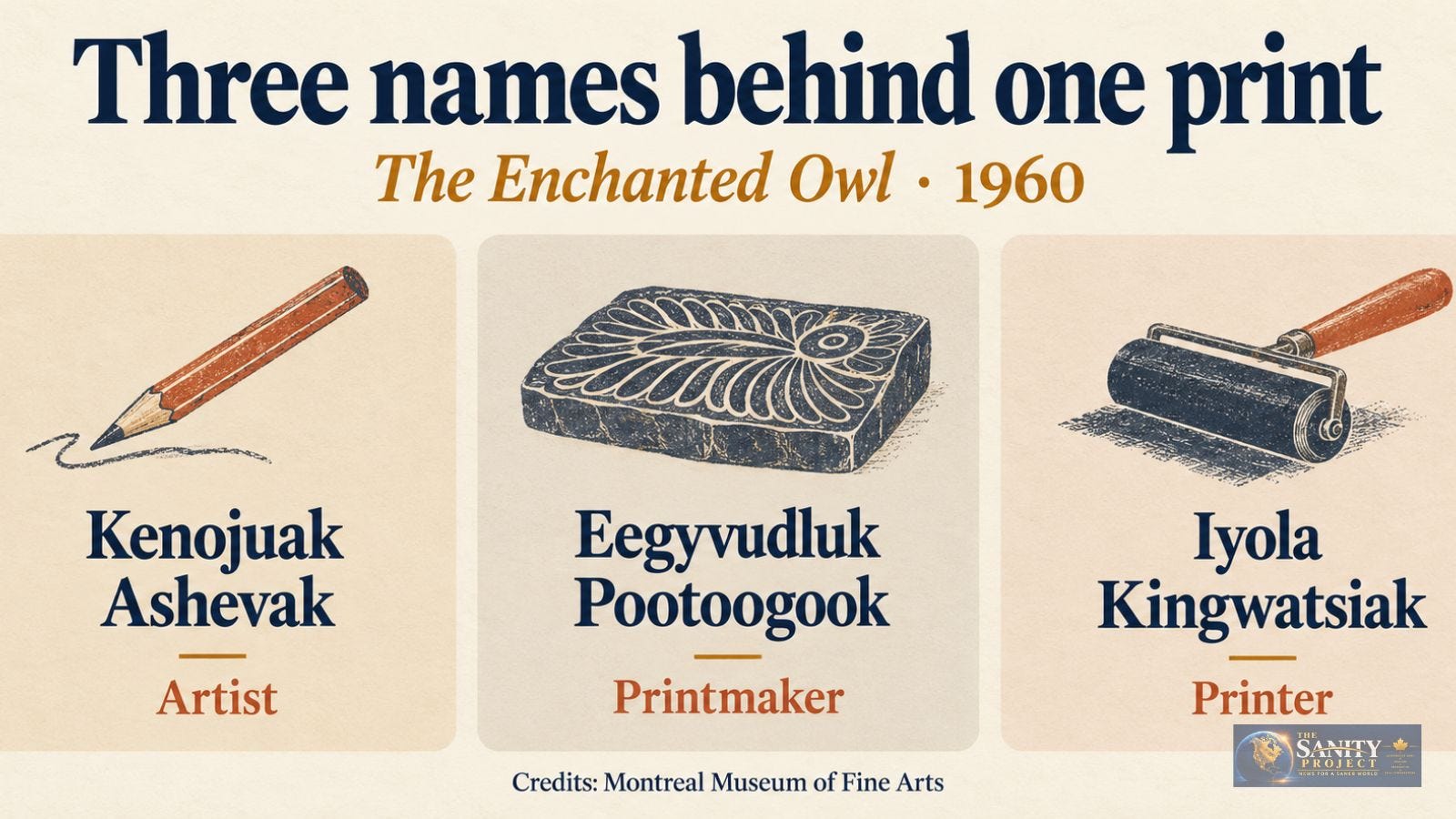
Giving them credit makes the accomplishment more substantial. We can admire Ashevak’s imagination and become curious about the craft around it. The museum describes her interest in creating images that brought viewers happiness, an ambition that seems quite capable of justifying itself without a league table.
There’s also something refreshingly plain about her explanation for continuing to draw. The Inuit Art Foundation records her saying, “This is my job and my love. I cannot imagine life without art.” Behind the honours was a person attached to her work. It provided purpose, pleasure and a livelihood. Recognition belongs in that story, but it shouldn’t crowd out the person who earned it.
Her Inuit identity belongs at the centre of the account, too. Celebrating her work as part of Canada should draw our attention toward its origins, its community and its meaning. Otherwise, national pride risks becoming a habit of collecting accomplishments while taking remarkably little interest in the people responsible for them.
The stamp gave Canadians an opportunity to look. We can still decide how closely.
When a community helped shape the picture
On Fogo Island, Newfoundland, cameras became part of a different achievement. In 1967, the National Film Board and Memorial University’s Extension Service undertook a film and community development project that produced 27 short films. Islanders discussed their future as they worked toward establishing a fisheries and boatbuilding co-operative.
The subjects were practical. The NFB’s description of Some Problems of Fogo lists fishermen’s unions, the fish plant, education and school consolidation. These were decisions about work and family, with consequences that would remain long after a film crew packed up its equipment.
The way the films were made deserves attention as much as what they recorded. In a later NFB interview, director Colin Low recalled community screenings in which participants could request that material be removed from rough cuts. People could challenge how they were represented. Anyone who has ever seen a complicated situation reduced to a convenient public account can appreciate the value of that.
Still, there’s a temptation to turn the project into a comfortable story about a filmmaker arriving and helping a community find its expression. It gives us a recognisable central character and a satisfying arc. It can also push other people toward the edge of the frame.
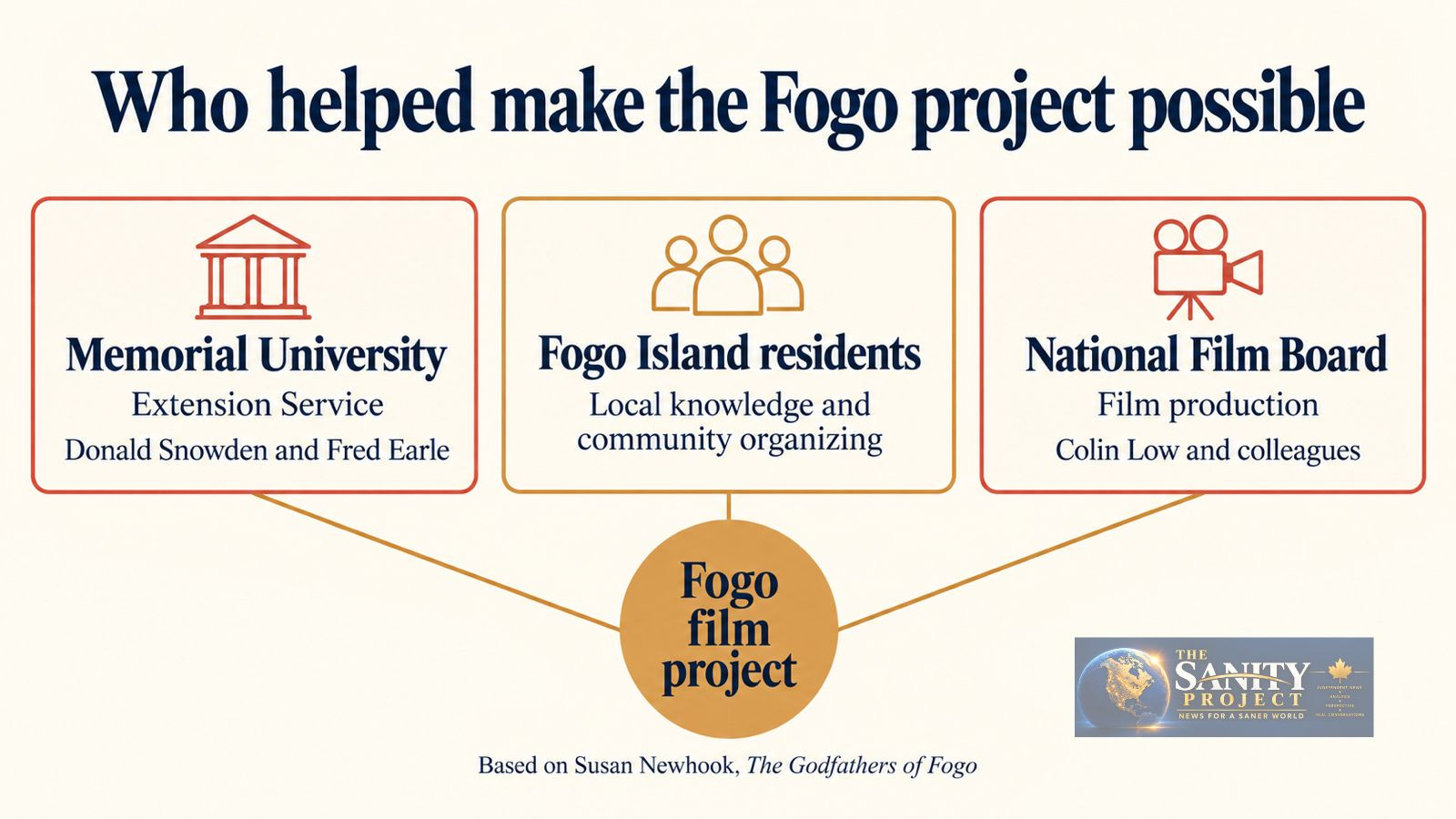
Susan Newhook’s research, The Godfathers of Fogo, examines the contributions of Memorial University’s Donald Snowden and Fred Earle. These accounts place too much of the project’s origins on the director. Her work gives us a fuller account of the relationships and effort around the films.
Low’s contribution remains worth celebrating. So do the islanders and the university workers whose involvement makes the story harder to fit into a single-person legend. Public achievements often depend on that wider circle. Remembering it is part of understanding what actually worked.
Who survives the telling?
The owl and the island raise a question that runs through much of Canadian history: who gets remembered when a complicated achievement becomes a familiar story?
We’ve approached it before. In our profile of Elsie MacGill, a circulating dollar coin invites you to learn about the engineer pictured on it. The coin can pass through your hand in a second. Understanding the person requires a little more time. Our history of Labour Day in Canada takes us back to a comfortable long weekend of workers, organising, and conflict. Familiarity may conceal quite a lot.
Neither achievement is improved by smoothing away the difficult parts. We can admire what people accomplished while asking who was excluded, whose contribution disappeared from the account, and who carried the cost. Those questions help us decide what deserves admiration in the first place.
That seems especially useful for a country trying to understand itself. A national success doesn’t prove that every institution involved behaved well. A celebrated person doesn’t stand in for everyone who shared their circumstances. Pride becomes sturdier when we can explain what was achieved and remain honest about its limits.
There’s room to bring that attention closer to home. A local archive people can actually use, a language program with committed teachers and learners, or a community organisation that keeps doing useful work after the opening photograph may contain a story worth telling. We would need to examine the evidence: what it accomplishes, who benefits, what it costs and what allows it to continue. The absence of an international award shouldn’t end the investigation before it begins.

What we choose to keep
I think Canadian pride becomes more useful when appreciation asks something of us. If we admire artists, we should care about whether they can keep working and whether their collaborators receive credit. If we praise community participation, we should ask how much influence people retain after the consultation ends. If history matters to us, we should be willing to learn enough of it to recognise a story that has become a little too convenient.
That doesn’t require every cultural achievement to become a policy debate. Sometimes looking carefully at a work of art is enough for an afternoon. But over time, what we choose to notice helps shape what we choose to support. Attention is a beginning.
What Canadian achievement deserves a closer look? Leave a comment with a person, project or place, and tell us what it made possible. Local stories are welcome. If someone comes to mind while you’re reading, share this article with them. You can also subscribe to The Sanity Project for more stories about the people, ideas and decisions shaping Canada, from history and culture to politics, economics and our position in the world.
Ashevak’s owl was worth looking at before it was sent in an envelope. The Fogo Islanders’ concerns mattered before a camera recorded them. Recognition helped carry both stories outward. Our part is to look closely enough that the people who made them don’t disappear behind the symbol.