



Is Canada Really Broken? Four Claims Meet the Facts
Spend enough time online, and you can get a pretty bleak impression of this country. Canada is broken. Canadians are among the most heavily taxed people in the world. Crime has never been worse. The CPP won’t be there when you retire. We don’t make anything anymore, and apparently we can’t sell anything unless an American buys it.
You’ve probably heard some version of all of them. And here’s the thing: statements like these don’t necessarily begin with something completely invented.
Canada does have issues. Housing affordability is one. Healthcare systems are under pressure. Productivity deserves attention. Governments waste money. Crime matters, particularly if you or someone you love becomes a victim. Pretending otherwise wouldn’t make this a Reality Check. It would make it a brochure.
But somewhere between identifying an issue and sharing it for the thousandth time on social media, something happens. An issue becomes a crisis, a trend becomes a catastrophe, and eventually a complicated country of more than 40 million people gets reduced to two words: Canada’s broken.
I wanted to know how well some of these claims survived when we stopped arguing about them and simply checked the numbers. That little exercise eventually became The Canadian Reality Check, an illustrated guide examining 11 claims Canadians regularly encounter online and elsewhere.
For this article, I’ve pulled out four of the ones I found most interesting. And I’ll admit that at least one of the answers surprised me.
1) “Canadians Are Among the World’s Most Heavily Taxed”
I suspect this is one of those statements many Canadians accept almost instinctively. Taxes are high. Everybody knows that.
Except international tax comparisons are considerably more complicated than that.
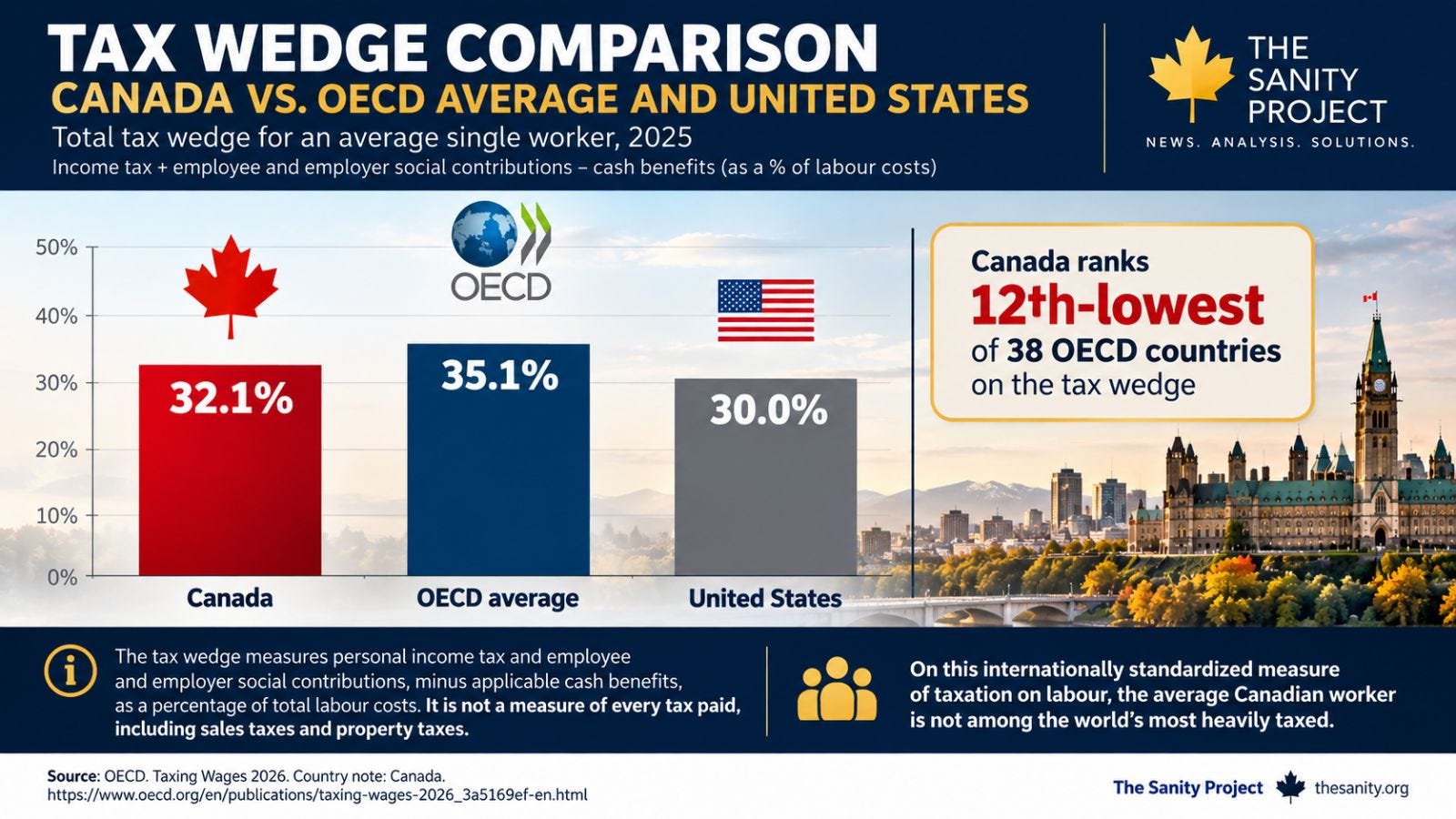
The Organisation for Economic Co-operation and Development, better known as the OECD, is an international organisation of 38 member countries that produces standardised economic data so countries can be compared using the same methodology. One of its measures is the tax wedge, which captures personal income tax plus employee and employer social contributions, minus applicable family benefits, as a percentage of the total cost of employing someone. OECD
For a single person earning the average wage in 2025, Canada’s tax wedge was 32.1 per cent. The OECD average was 35.1 per cent, while the United States came in at 30.0 per cent.
Here’s the part that caught my attention: Canada had the 12th-lowest tax wedge among all 38 OECD countries. Not the 12th highest. The 12th lowest. OECD
Now comes the important qualification, because I don’t want to replace one misleading statement with another. This does not mean Canada has the 12th-lowest overall taxes in the OECD. The tax wedge doesn’t capture all the taxes Canadians pay, including sales and property taxes. For Canada, the OECD calculation includes federal and provincial income taxes, using Ontario as the representative province, as well as employee and employer social contributions.
So I’m not arguing that Canada is a low-tax country. I’m saying something narrower and much more defensible: on one of the OECD’s standardised measures of labour taxation, the average Canadian single worker is nowhere near the most heavily taxed among OECD countries.
That’s quite different from what we’ve been hearing.
Taxation is only one area where Canada’s economic reality can get lost in the rhetoric. The same thing happens when we talk about investment and whether Canada is still capable of attracting the capital needed to build major projects.

2) “Canadians Have Never Been Less Safe”
Crime is an emotional subject, as it should be. Statistics mean very little to someone whose home has just been broken into or whose family has been affected by violence. But the claim we’re examining isn’t that Canada has crime, or even that some forms of crime have increased. It’s the much broader suggestion that Canadians have never been less safe.
Fortunately, we have decades of Canadian data against which to test that idea.
In 1975, Canada’s homicide rate was 3.02 per 100,000 people. In 2025, according to Statistics Canada, it was 1.61. That’s roughly 47 per cent lower. Statistics Canada recorded 672 homicides in 2025, 125 fewer than the year before, with the national homicide rate falling 16 per cent in a single year. Statistics Canada
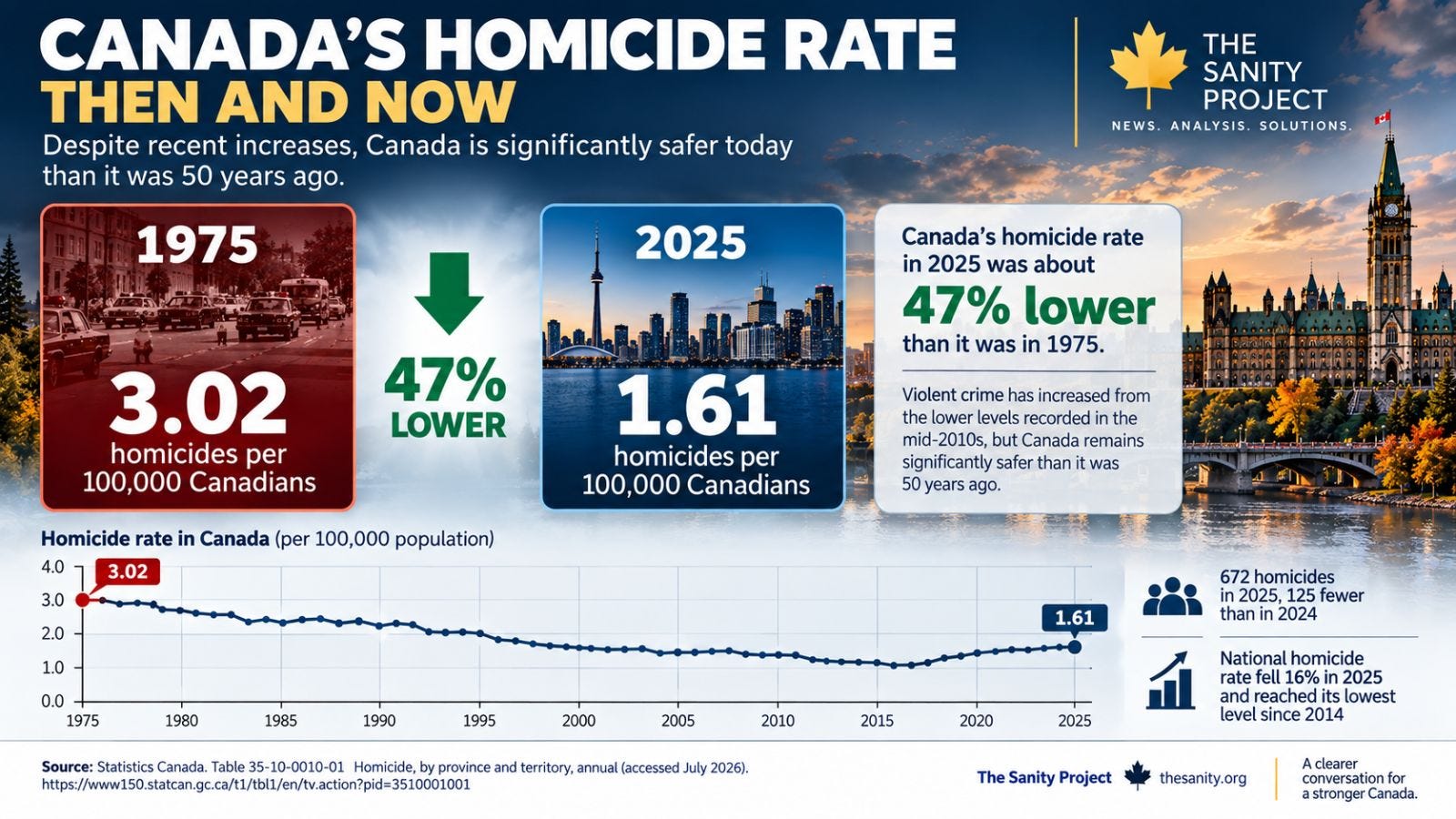
And once again, context matters. Statistics Canada also reports that the overall police-reported violent-crime rate in 2025 was 35 per cent higher than in 2015. The rate was essentially unchanged between 2024 and 2025, but there is no question that violent crime increased substantially from the relatively low levels Canada experienced a decade ago. Statistics Canada
Both things can be true at the same time. Canada has experienced a meaningful increase in violent crime compared with a decade ago, and Canada’s homicide rate can still be dramatically lower than it was 50 years ago.
That’s why I think the wording matters. The claim that “Violent crime has increased from the lows of a decade ago” is supported by the evidence. Saying Canadians have never been less safe is much harder to square with the historical record.
3) “The CPP Won’t Be There When I Retire”
I’ve heard variations of this one for years, particularly from younger Canadians. Why bother paying into CPP? By the time I retire, all the money will be gone anyway.
There’s just one problem. The people whose job it is to actually calculate this stuff aren’t seeing the same thing.
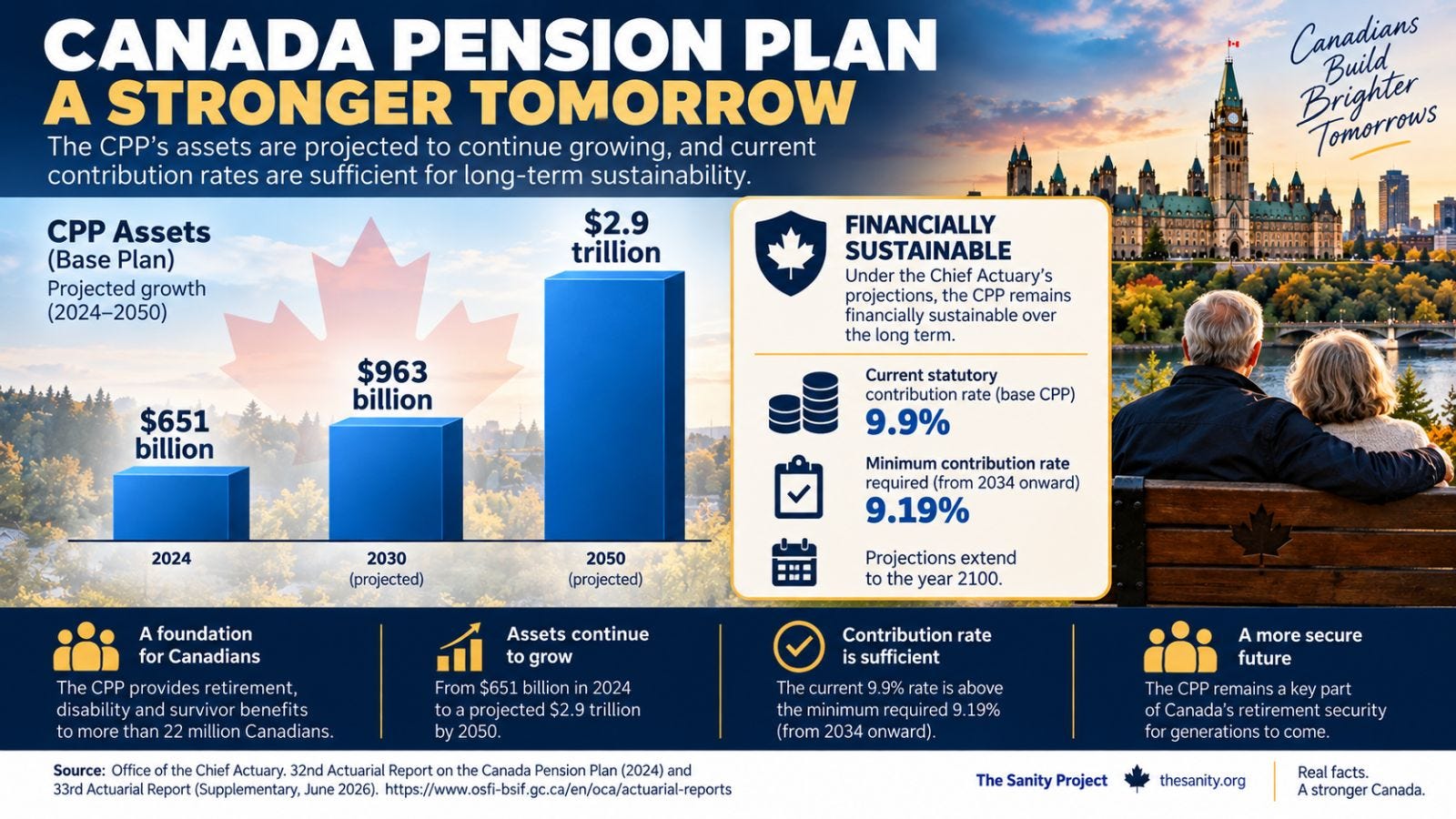
Canada’s Chief Actuary recently completed the 32nd Actuarial Report on the Canada Pension Plan, based on the plan’s financial position at the end of 2024. The base CPP held $651 billion in assets at that point. Those assets are projected to reach $963 billion by 2030 and approximately $2.9 trillion by 2050. OSFI
The more important number, however, isn’t the enormous pile of money. It’s the contribution rate required to sustain the plan.
The current statutory contribution rate for the base CPP is 9.9 per cent. The Chief Actuary calculated a minimum contribution rate of 9.21 per cent from 2028 through 2033 and 9.19 per cent from 2034 onward. Under the report’s assumptions, the current legislated rate is therefore above the minimum required to sustain the base plan, with projections extending to 2100. OSFI
That doesn’t mean anyone can guarantee what Parliament will do 30, 50 or 70 years from now. Governments can change laws, economic conditions change, and actuarial projections depend upon assumptions about everything from wages and demographics to investment returns.
But that’s a very different conversation from the one about the CPP running out of money. Under the Chief Actuary’s current projections, assets continue to grow, and the legislated contribution rate remains above the minimum required for the base plan.
Apparently, nobody told the CPP that it’s supposed to be disappearing.
The CPP is also a reminder that some of Canada’s largest pools of capital are easy to overlook when we talk about whether this country has the financial capacity to build things. That question came up repeatedly when I examined how Canada’s next generation of major projects could actually be financed.

4) “Canada Doesn’t Make Anything Anymore”
This one might be my favourite because it’s so easy to say, even when surrounded by evidence to the contrary.
There is a serious conversation to be had about Canadian manufacturing. We’ve lost factories. Global supply chains have changed. Competition is intense. U.S. tariffs have created new challenges, and some Canadian industries are facing difficult transitions. But somewhere along the way, “Canadian manufacturing faces serious challenges” became “Canada doesn’t make anything anymore.”
Let’s start with cars.
According to Innovation, Science and Economic Development Canada, Ford, General Motors, Honda, Stellantis and Toyota assembled more than 1.31 million light-duty vehicles in Canadian plants in 2024. The industry is supported by nearly 700 automotive parts suppliers, while Canada also produces medium- and heavy-duty vehicles, buses and specialised vehicles.
Then there’s aerospace. Canada’s aerospace sector contributed close to $34 billion to the economy in 2024 and supported more than 225,000 jobs, according to ISED. ISED Canada
And those are just two industries.
Canada still makes things. The much more interesting question is whether we’re making enough of them, whether we’re keeping enough of the processing and value-added work here, and what needs to happen for Canadian manufacturers to become more competitive.
That’s a discussion worth having. Declaring that we don’t make anything saves considerably more time, but it doesn’t help much.

And Those Are Only Four
Those four Reality Checks are part of a much larger exercise. I looked at 11 common claims about Canada, including whether Canada is drowning in debt, whether the federal bureaucracy really consumes the lion’s share of government spending, whether Canada can sell anything without the United States, and whether our economy is basically just oil.
Some of the claims became difficult to defend once I started digging into the numbers. Others contained considerably more truth than I expected and required important qualifications. A few sent me back to the research because the answer depended entirely on which measurement was being used.
And that’s really the point.
I didn’t set out to create a pamphlet explaining why everything in Canada is wonderful. It isn’t. I wanted to know what happened when we took statements we’ve heard hundreds of times and forced them to sit quietly beside the actual numbers for a few minutes.
The result became The Canadian Reality Check, a free illustrated guide containing all 11 claims, the numbers behind them, the context that matters and the sources so you don’t have to take my word for any of it.

Click the image above to access the free Canadian Reality Check.
Issues Deserve Facts Too
Canada has issues. Housing affordability is serious. Healthcare systems are under strain. Productivity matters. Governments make bad decisions and public money gets wasted. Crime deserves attention, and industries employing thousands of Canadians face enormous competitive pressure.
We should talk about those things. In fact, we need to talk about them, because pretending they don’t exist would be every bit as misleading as exaggerating them.
But we don’t improve those conversations by turning every setback into evidence of national collapse. And we certainly don’t improve them by repeating something so many times that repetition itself becomes the evidence.
Perhaps that’s one of the stranger things about the way we talk about Canada today. Acknowledging that the country has strengths can sometimes sound suspiciously like you’re ignoring its weaknesses, while declaring the entire place “broken” can pass for serious analysis without anyone stopping to ask what, precisely, that means.
I don’t think either optimism or pessimism deserves a free pass. Both should have to survive contact with the evidence.
Canada has issues. Some of them are serious. But before we decide the country is broken, perhaps we should check the numbers.
Same Country. A Clearer Conversation.
No, but Ontario is broken under Doug Ford and enough Ontario voters seem to like it
Bo, this, is SO POWERFUL.
Thank you.
We live in a time of great uncertainty + great fear, and because people are feeling so powerless in the face of so many burgeoning challenges all seemingly requiring immediate action that seems overwhelming and still impotent, it is so easy to fall into blaming + complaining + attacking + getting distracted by arguments & rabbit holes....
To speak calm groundedness to such fear-based reaction is one of the most powerful. empowering. choices. we can make.
You do this, and I am deeply grateful for your effort and your actions.
Right now, Mark Carney is taking Canada & Canadians to the next level of the commitment required to Co-Create Canada into a Strong & Free Canada, a State of National Being that holds great potential for demonstrating to the rest of world how it can be done (we are after all immersed in global community where, as we have all learned, actions and perspectives on the seemingly smallest level impacts in magnified ways on the greatest planetary level...). John Shedd, an American businessperson & philanthropist, made this well-known observation:
“A ship in harbour is safe, but that is not what ships are built for.”
He also said this:
“Opportunities are seldom labeled.”
Forging a new path is fraught with uncertainty and a need to just keep taking one step at a time in spite of that one step seemingly leading into fog and more fog. Essentially, the journey at this time is about Canadians trusting themselves to navigate this new path with fortitude, strength & that beautiful innovative Canadian spirit... Canada needs us, and we need to just keep asking: "How can I help? What can we do to help? How can I help to build upon all those opportunities that are sprouting up left, right & centre? What do I bring to this Co-Creation that is a Canada Strong & Free Shaping Its Own Destiny? What do we bring?... ..."
Your writings are a powerful example of answering those questions in a constructive, building-upon, growth-oriented, way.
Thank you so much for alll your hard work & your commitment to helping shape this great country's destiny. Thank you.