



LNG Canada Phase 2: What Canada Could Gain From a $33-Billion Expansion
LNG Canada Phase 2 is a $33 billion private investment that could help Canada reach more customers. The project faces a crowded market, but it gives Canada a reason to compete.
Canada has spent plenty of time discussing what we could build, where we could sell it, and why we should rely less on one customer. This week, that conversation gained something concrete: a $33 billion investment decision.
On September 29, Ottawa welcomed LNG Canada’s decision to expand its export facility in Kitimat, British Columbia. The federal announcement describes the investment as private capital, making it a significant commitment from companies willing to back Canada’s export potential.
A reader raised a fair concern: what if the expansion opens just as the world faces a glut of liquefied natural gas? We should take that warning seriously, while remembering that tougher competition does not erase the case for this project.
There is good news here, with conditions attached. We can welcome the investment, examine the market, and expect strong environmental standards without losing sight of the main point: this project matters.
What LNG Canada Phase 2 Actually Builds
LNG is natural gas chilled into a liquid so it can be shipped. With that basic definition in place, the practical significance for Canada is clear: it provides another way to deliver our gas to customers overseas.
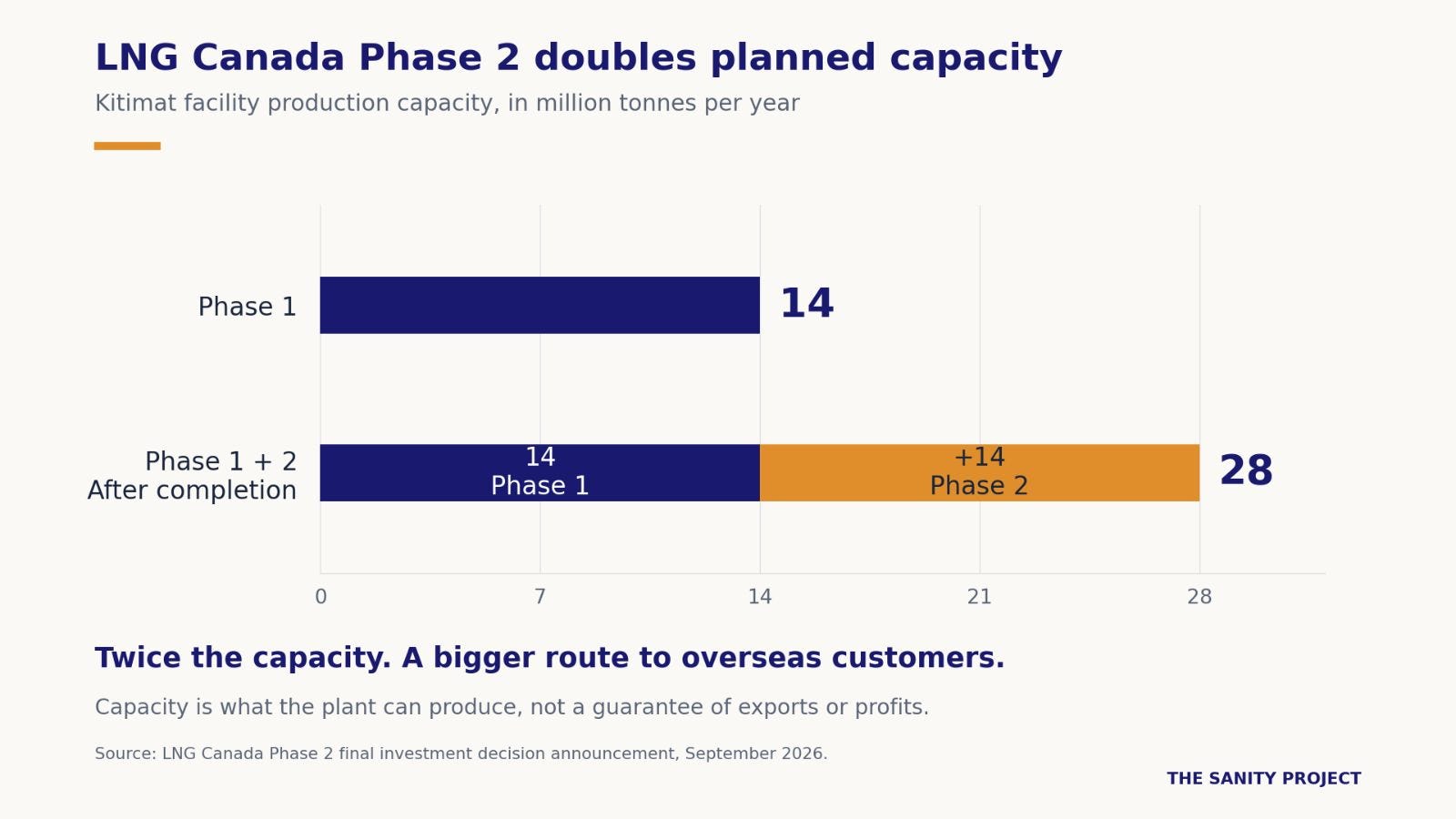
Phase 2 adds two processing units, called trains, and doubles this facility’s annual production capacity from 14 million to 28 million tonnes. Shell expects commercial operations to begin in the early 2030s.
That is a major expansion, but capacity is what a facility can produce, not a guarantee of what it will sell. So doubling LNG Canada’s capacity also does not mean doubling every Canadian LNG export from every terminal.
The expansion builds on an existing site and infrastructure designed for further development. LNG Canada’s announcement also describes five new compressor stations to increase capacity along the existing Coastal GasLink pipeline, rather than constructing an entirely new pipeline route.
Who Is Putting Up the Money?
Shell goes further than announcing approval. It says the expansion is projected to produce double-digit investment returns and clear its internal investment threshold. That is Shell’s forecast, with all the uncertainty it entails, but it gives us a concrete commercial case to assess as we move from approval to financing.
We should not treat a corporate forecast as a guarantee. Equally, we should not assume the people committing capital have somehow failed to notice that other countries are building LNG terminals too.
Ottawa’s announcement indicates support from the Major Projects Office following a referral in September 2025. Governments can help projects advance through coordinated decisions, even when companies supply the headline capital.
Private financing does not answer every question about public support. Tax measures, infrastructure commitments and any guarantees still deserve examination on their own terms.
As we explored in what foreign investment really means for Canada, capital arriving from overseas can help build productive assets here. From there, the useful questions concern where the work happens, what Canadians gain, and the terms governing the investment.

The Benefits Reach Beyond the Terminal
LNG Canada forecasts up to 4,000 construction jobs in Kitimat, including approximately 2,100 for compressor-station work. Those are separate estimates, so we should avoid presenting them as a guaranteed combined peak.
For households, construction work means wages. For communities, it can mean business for suppliers, contractors, and service providers, though the extent to which it stays local depends on procurement and hiring decisions.
The company also expects roughly 90 additional full-time roles and 150 contractor positions once the expansion is operating. That is a smaller continuing workforce than the construction numbers, a distinction worth making clear.
LNG Canada estimates Phase 2 could generate more than $50 billion in lifetime government revenues associated with the project. That is a projection, not money already available for a hospital budget, and its value depends on the project’s performance.
This fits into the broader picture we examined in the 20 biggest projects Canada wants to build. The opportunity is to turn this investment into useful work and operating businesses, and then ensure the benefits reach Canadians.
Five First Nations Have an Ownership Opportunity
One of the most promising parts of this story concerns five neighbouring Nations: Gitga’at, Gitxaała, Haisla, Kitselas and Kitsumkalum. Through MNT Investments LP, they can invest up to $1 billion for majority ownership of an entity that would own the new storage tank, creating a direct ownership path.
Under the agreement announced in July, the tank would be leased back to LNG Canada for the project’s operating life, while the Nations’ entity would own it. LNG Canada would continue to operate and maintain it.
That creates a route to ownership and income from a specific piece of infrastructure. More precisely, it is an ownership option for the tank entity, rather than a full purchase of the terminal.
The financing and lease terms will determine the financial benefits and risks. But the opportunity itself deserves attention, because ownership gives participating Nations a different economic relationship with the development.

Canada’s Pacific Location Has Value
In his September 29 remarks, Carney put the voyage to Asian markets at eight to ten days, less than half the duration of the comparable journey from the U.S. Gulf Coast. The comparison depends on the destination, but the geographic advantage is clear, and it leads directly to the question of competitiveness.
We assess that shorter voyages can help Canada’s competitive position. They will not make us the cheapest supplier in every market, but they strengthen the case for building this route to customers.
Still, having another route to customers gives Canada more choices. A trading country should welcome that flexibility, as long as the business can deliver competitively.
A Bigger Opportunity Deserves a Closer Look
Canada’s expansion comes with advantages, but what happens if the global LNG market gets crowded? Subscribe for free to explore why this investment still matters, what could challenge it, and the signs that will tell us whether it is delivering.
Could Canada Come Out Ahead Even in an LNG Glut?
A crowded market could squeeze profits. But it could also make Canada’s advantages matter more, especially when buyers can choose whom they trust with their energy supply.
In the second half, we examine what could give Canada an edge, why the forecasts point in different directions, and the three signs that will reveal whether this investment is delivering. The glut warning deserves attention, but there’s more to Canada’s opportunity than that headline suggests.
Subscribe for free to read the rest and see how this investment could turn into lasting Canadian prosperity.
