


When Should Ottawa End a Strike?
Bill C-39 offers a better process for major labour disputes. It still needs a clearer definition of “national interest.”
A strike is supposed to be uncomfortable. That is not a flaw in the system. It is the leverage workers have when talks fail.
But Canada also has industries where a dispute can spread far beyond the people at the bargaining table. A grocery-store strike is serious for workers, customers and the company. A rail, port or airline strike can stop grain shipments, delay medicine, strand travellers and hit businesses across the country.
That is where this debate becomes difficult. Workers have a right to strike. The public also has a right not to become collateral damage in a labour dispute it did not create.
Bill C-39 tries to draw that line. It does not get everything right, but it is a better starting point than the law Canada has now.
Section 107 Was Already a Problem
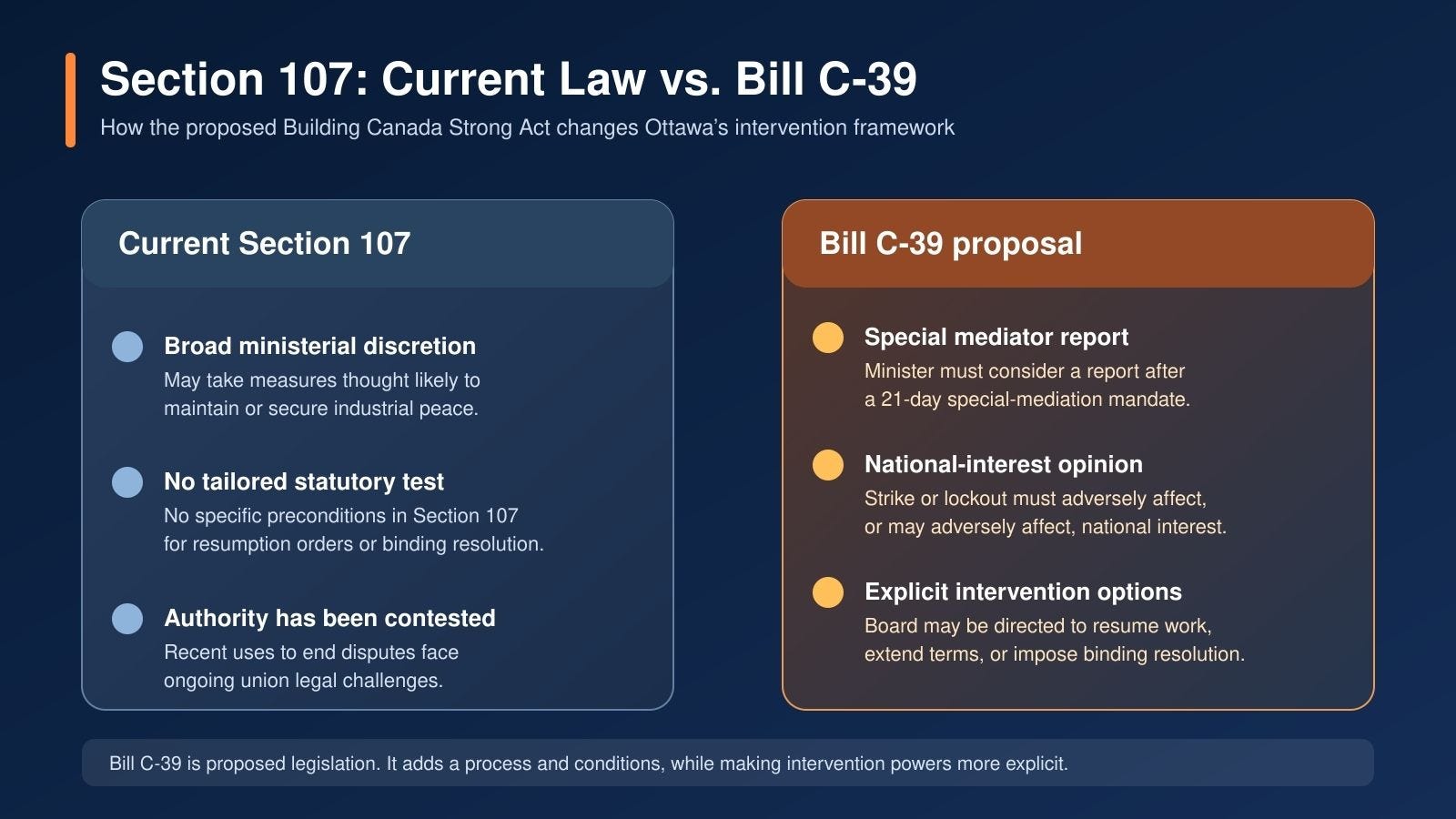
Section 107 of the Canada Labour Code gives the federal labour minister broad power to act during labour disputes in federally regulated industries. The minister can refer questions to the Canada Industrial Relations Board and direct it to take steps meant to maintain industrial peace.
That language is broad enough to drive a truck through. And in Canada, trucks often carry something important.
In practice, Section 107 has been used to end strikes or lockouts by directing work to resume, extending a collective agreement, or imposing binding arbitration. The government used it once in 2023, eight times in 2024 and once in 2025. Those cases included major rail, port, postal and airline disputes.
That sharp rise is why unions are worried. A legal strike has value only if it creates real pressure on an employer. If Ottawa steps in whenever a strike becomes economically painful, workers can lose that leverage at the very moment it matters most.
The government’s answer is simple: negotiated deals are always better, but some disputes can hurt the country far beyond the two sides involved. That is also true.
The problem is that the old Section 107 did not clearly define where the line should be drawn
What Bill C-39 Would Change
Bill C-39 is a proposal, not law yet. It would amend Section 107 to require a more formal process before Ottawa could exercise its strongest intervention powers.
First, the minister would have to consider a report from a special mediator. That mediator could be appointed late in the conciliation process to work with both sides for a defined period and report on the remaining issues, the parties’ positions and the chances of a settlement.
Second, the minister would have to form the opinion that a legal strike or lockout is harming, or may harm, the national interest. Only then could the minister direct the labour board to order work to resume, temporarily extend the old agreement, or impose a binding method for resolving the dispute.
That is an improvement. It replaces a vague, open-ended power with a clearer sequence. It also puts more information on the public record.
But it is not a complete answer. “National interest” remains a very large phrase. Almost any major transportation strike has an economic impact. That cannot be enough on its own.
A strike is meant to have consequences. If it had none, it would be little more than a strongly worded group vacation.
Canada Is One Economic System
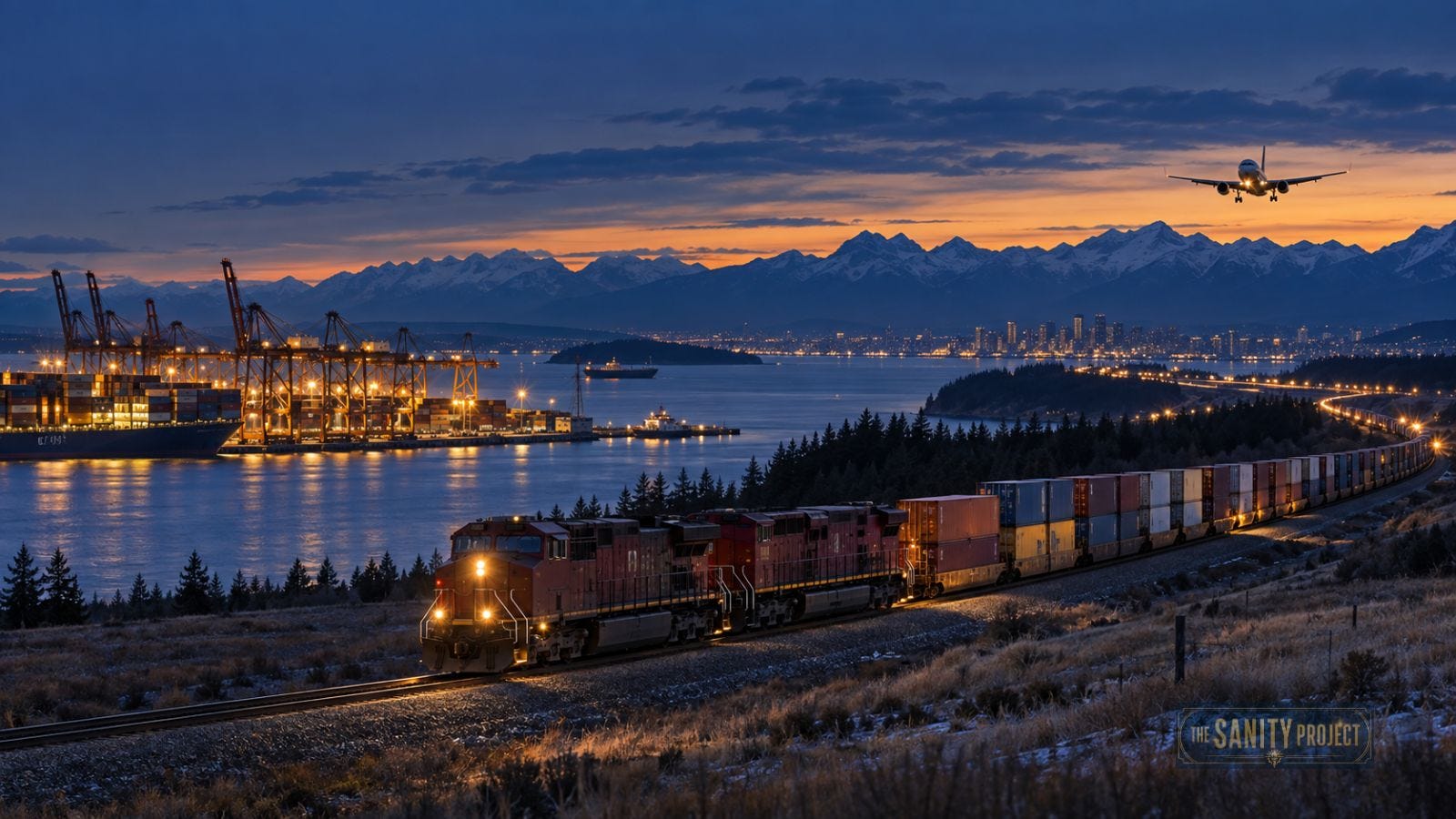
Canada is a big country with a surprisingly small number of key trade routes. Railways, ports, airports and border crossings are not isolated businesses. They are part of one national system.
When a rail line stops, grain may not reach port. When a port shuts down, manufacturers may not receive the parts they need. When flights are cancelled, people can miss medical appointments, family events, or connecting flights to places where winter is warmer and more tolerable.
That does not mean every disruption requires Ottawa to act. It means the government must show that the harm goes well beyond inconvenience or lost profits.
This previous article explains why Canada’s transportation and trade network is a national economic system rather than a collection of separate provincial or corporate concerns:

Bill C-39 also includes useful worker protections. It would expand successor rights in certain airport and air-transport contract changes, support earlier bargaining in high-risk disputes, require post-dispute relationship-building, and create authority for future penalties for bad-faith bargaining.
The government has also announced related work on wage theft, misclassification and workplace safety. Those are welcome steps, but they should not all be described as measures contained directly in Bill C-39.
The Union Argument Is Stronger Than It Sounds
The union concern is not that every strike should be free from public consequences. The stronger argument is that workers lose their bargaining power if the government routinely steps in once a strike begins to hurt.
That concern is real.
If an employer believes Ottawa will rescue it after a few difficult days, it has less reason to make a serious offer before the strike begins. The same danger exists if either side treats bargaining as a waiting room for government intervention.
Bill C-39 partly addresses that problem. It would allow future regulations to create administrative monetary penalties for failures to meet specific bargaining duties. Those penalties could apply to employers, unions or individuals.
But deliberately waiting for Ottawa to intervene is not automatically an offence under the bill. It could, however, become evidence of bad-faith bargaining. That judgment should be based on facts and made through the labour-relations system, not by a minister simply deciding who the villain is.

The Right to Strike Still Matters
The Supreme Court of Canada has recognised that the right to strike is part of meaningful collective bargaining. That does not mean the right has no limits. It does mean governments should be careful before taking it away.
Binding arbitration can settle a dispute. It can also change the balance of power.
Once arbitration replaces a strike, the employer no longer faces the same pressure to bargain. Workers lose the ability to withhold their labour. A neutral process may produce a fair result, but it is not the same as a freely negotiated deal.
That is why government intervention should be a last resort, not a standard operating procedure for any nationally visible dispute.
For a concrete example of how a single trade bottleneck can create costs far beyond one company or industry, read

Where I Draw the Line
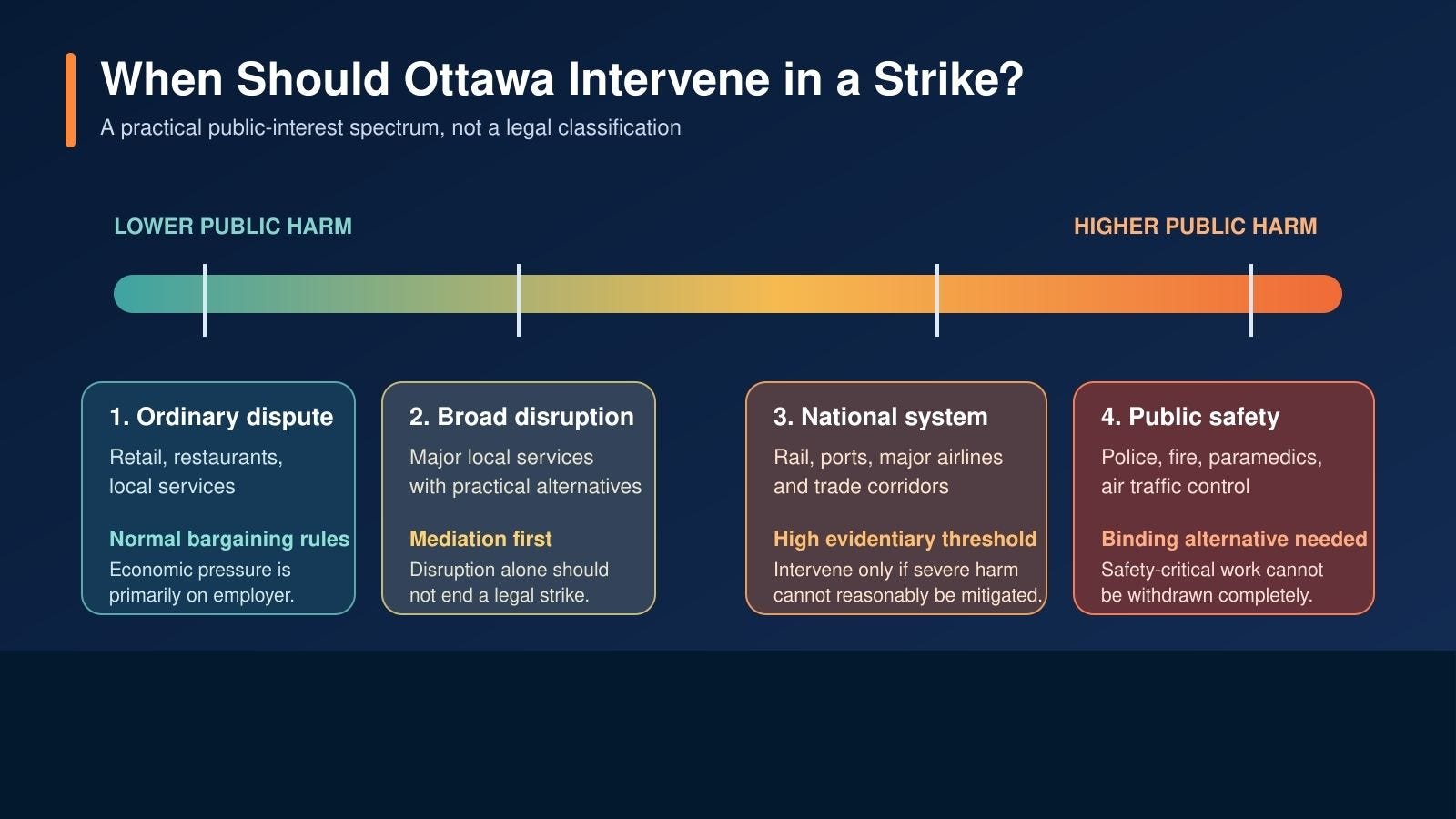
Ottawa should be able to intervene in a legal strike only when the public harm is serious and clear, and cannot reasonably be reduced in another way.
That should mean four things.
The strike or lockout must be legal.
Both sides must have made a genuine effort to bargain.
The government should publish the evidence showing serious harm beyond the parties.
Ottawa should show that practical alternatives, such as rerouting, partial service or emergency planning, cannot protect the public.
The minister should also provide written reasons. Canadians should be able to see why the government acted, what evidence it relied on and why it believed a lesser step would not work.
That would not satisfy everyone. Unions will still worry that “national interest” can become a political escape hatch. Employers will still argue that Canada cannot afford to let major trade routes shut down.
Both concerns are understandable. But neither should be allowed to settle the question on its own.
The Better Balance
Bill C-39 moves Canada in the right direction because it adds a process where there was too much discretion. It recognises that a major strike can cause real harm outside the workplace.
But the bill should go further. It should define a higher threshold for intervention and require more transparency before Ottawa takes away the strongest tool workers have.
The right to strike is not a blank cheque. Neither is ministerial power.
Canada needs a system that protects workers’ ability to bargain, protects the public from serious harm, and forces governments to explain themselves when they choose to step in. That is not radical. It is simply what fairness looks like when the whole country is affected.
Editor’s Note
I come to this debate with a little personal baggage. I spent 24 years as a police officer, and I believe some services are simply too important to public safety and the basic functioning of society to be withdrawn completely during a labour dispute.
That belief does not make the right to strike less important. It makes the need for clear, fair and transparent limits even more important.
Solidarity