



The $6.4 Billion Bridge Nobody Could Drive On
Picture a finished bridge. Cables gleaming, pavement fresh, toll booths wired and ready to go. Now picture concrete barriers blocking the entrance, and not a single car crossing it. Not a construction delay. A deliberate, political closure of the world’s most expensive skateboard park.
That was the very real scenario on the table earlier this year for the Gordie Howe International Bridge, the new crossing between Windsor, Ontario and Detroit, Michigan. The bridge opened to traffic on July 27, 2026, after a long political fight that came down to the wire. This piece, drawing on the investigative reporting of Rachel Bennett and the financial analysis of Michael Reeves, asks the question that almost didn’t need answering: what would it actually have cost Canada if that deal had never come together?
The Trap Set in 2012
It’s tempting to look at the 2012 Canada-Michigan crossing agreement and call it a blunder. How do you build an international bridge without a legal guarantee that the other country’s federal government will actually open its side of the border?
But the deal wasn’t careless. It was pragmatic, almost desperate. Michigan needed this infrastructure badly for its auto industry, but the state couldn’t put up the capital. So Canada financed the whole thing:
Land acquisition on the American side
The highway interchange connecting the bridge to Interstate 75 in Detroit
The physical bridge itself
All told, roughly $6.4 billion Canadian — a figure confirmed even amid construction delays — to be repaid through tolls collected on the Canadian side.
The catch is that Michigan is just a state. Its governor doesn’t command US Customs and Border Protection. Its legislature doesn’t fund federal border agents. It’s the equivalent of paying to build a beautiful driveway for your house, only to discover your neighbour legally controls the curb cut connecting it to the street. You own the driveway. They own the access.
The 2012 framework built the crossing but never secured the authority to operate it, leaving a wide-open door for future federal leverage — one the Trump administration used in 2026, threatening to delay the federal certifications needed to open the bridge unless the US received a greater economic stake in the project.
What a “No Deal” Actually Looks Like
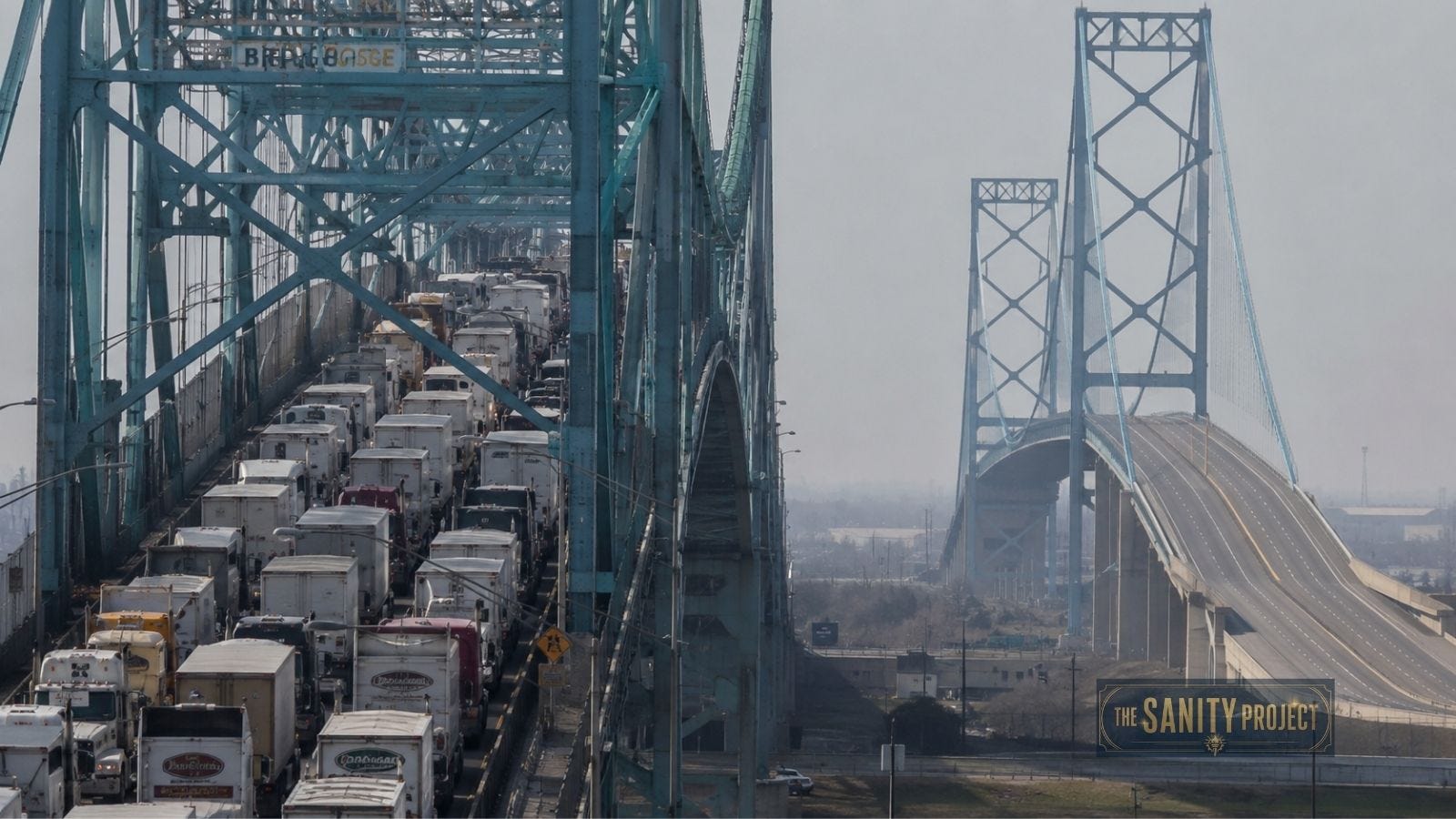
A failure to open the Gordie Howe Bridge was never going to mean a brick wall across the entire border. The Ambassador Bridge and the Detroit-Windsor Tunnel would keep running. Trucks would keep moving. The real damage lives in the margins: lost capacity, missing redundancy, and the brutal carrying costs of a stranded, six-billion-dollar asset.
The Cost of a Ghost Bridge
You can’t just turn off the lights and walk away from infrastructure this size. Canada built the bridge through a public-private partnership, meaning private investors and bondholders expect their debt serviced on schedule — whether or not tolls are flowing. With the barriers up, that revenue is zero, but the obligations march on regardless.
Layer on the physical cost of maintaining a finished, unopened structure:
Ongoing cost: Why it doesn’t stop
Electricity & systems: Sensors, lighting, and safety systems can’t be powered down
Insurance Premiums: on a multibillion-dollar asset, open or not,
Anti-degradation maintenance: Fresh infrastructure still weathers and needs upkeep
24/7 security: Empty asphalt still needs guarding against vandalism
Standby staff: Operations crews kept on payroll for a deal that could land at 2 a.m.
According to Anderson Economic Group’s own risk analysis, a delayed opening carried a price tag of roughly $7 million a week — about $5 million in lost toll revenue the Windsor-Detroit Bridge Authority should have been collecting, plus another $2 million in ongoing taxpayer and customs-plaza costs, a figure widely reported across Canadian and Michigan outlets. Annualized, that’s a $364 million burn rate.
Worth noting: the Windsor-Detroit Bridge Authority has said it wasn’t involved in that study and hasn’t independently verified the methodology. Treat the $364 million figure as a serious extrapolation, not an official government forecast — but the underlying mechanism, bleeding money while collecting zero tolls, was never in dispute.
The Bottleneck Penalty
Here’s where the damage gets harder to see and easier to ignore. With the old bridges still open, trucks keep crossing — just on aging, overcapacity infrastructure. That means businesses absorb the cost of wasted time, wasted fuel, and unpredictable labour schedules.
Economic analysis tied to the project projected the new bridge, with its direct freeway-to-freeway connections, would save roughly 850,000 truck driver hours a year compared to existing routes — described elsewhere as roughly 25 million road-minutes saved. In the logistics world, time isn’t just money — it’s survival, and this corridor is the lifeblood of North American auto manufacturing.
Modern auto plants don’t warehouse months of parts; it’s too expensive. Instead, they run on just-in-time delivery, where a door panel stamped in Ontario might be scheduled to bolt onto a car in Michigan a few hours later.
A single assembly plant can coordinate over a thousand precisely timed truck deliveries a day
Miss a fifteen-minute delivery window because of a bottleneck, and the line starves
The resulting penalties can run into the thousands of dollars per minute
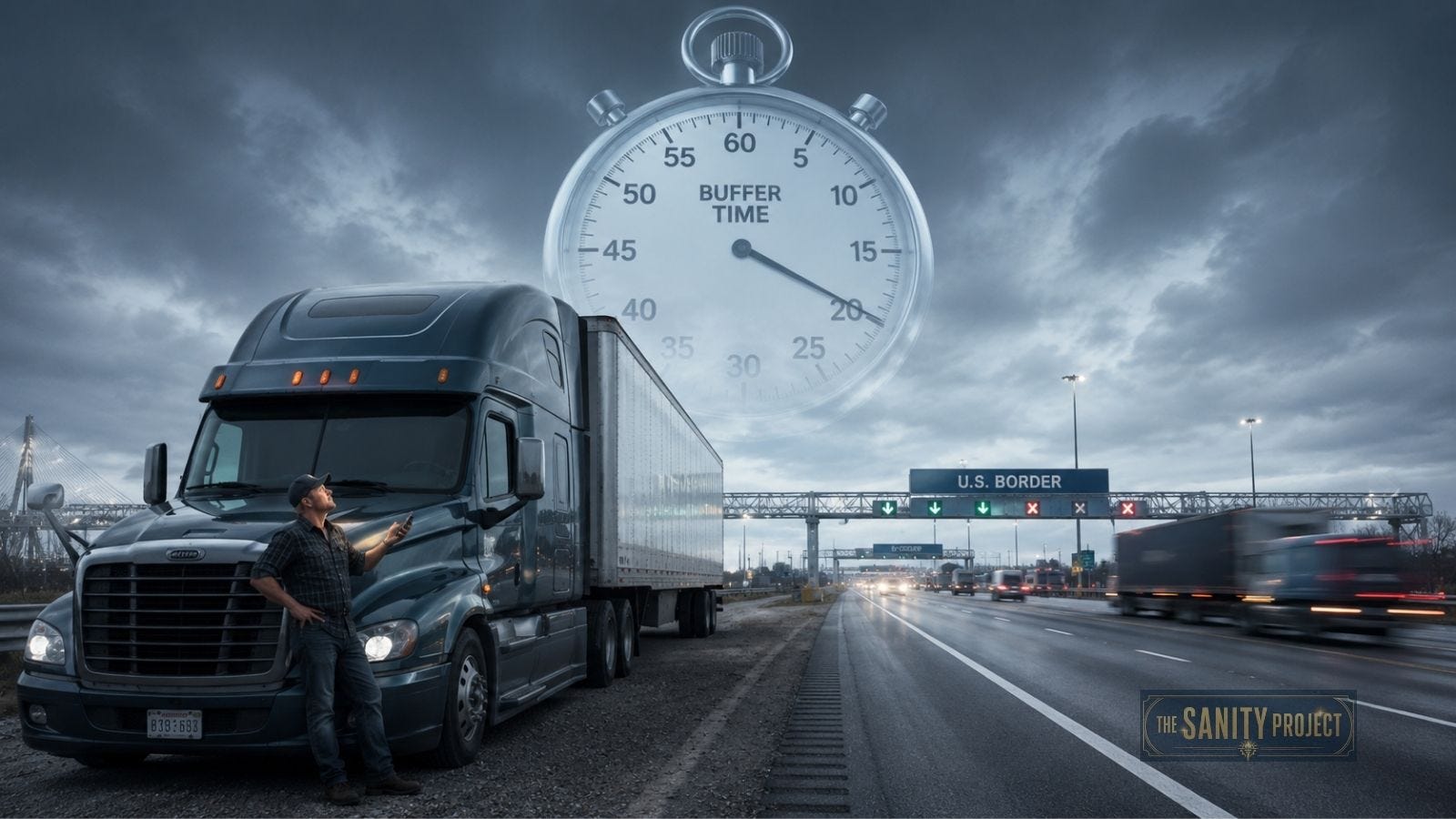
So trucking companies build in buffer time: if a route should take two hours, they schedule the driver to leave four hours early, just in case. If there’s no backup, that truck and driver just sit idle in a parking lot, tying up capacity that could be moving other freight. Buffer time is really just a polite industry term for deliberate, baked-in inefficiency.
That ripple extends well beyond auto parts:
Agriculture — an extra two hours in the sun means real spoilage of fresh produce
Tourism — a two-hour delay at a congested tunnel is often enough to make a family cancel a weekend trip across the border
The Redundancy Problem
The Ambassador Bridge is a private asset, nearly a century old, and it currently carries roughly 30% of all Canada-US trade transported by truck. That’s a single point of failure. A structural anomaly, a severe weather event, or a major accident forcing its extended closure would send all that traffic detouring hours north to the Bluewater Bridge in Sarnia, which would buckle under the volume and become a multi-day parking lot.
The Gordie Howe Bridge is, in effect, an insurance policy against that exact scenario, with the Cross-Border Institute placing the value of a redundant heavy-duty crossing at roughly $8.4 billion over forty years. But an insurance policy is worthless if you’re not allowed to use it. A finished, closed bridge provides zero supply chain resilience.
Option A vs. Option B
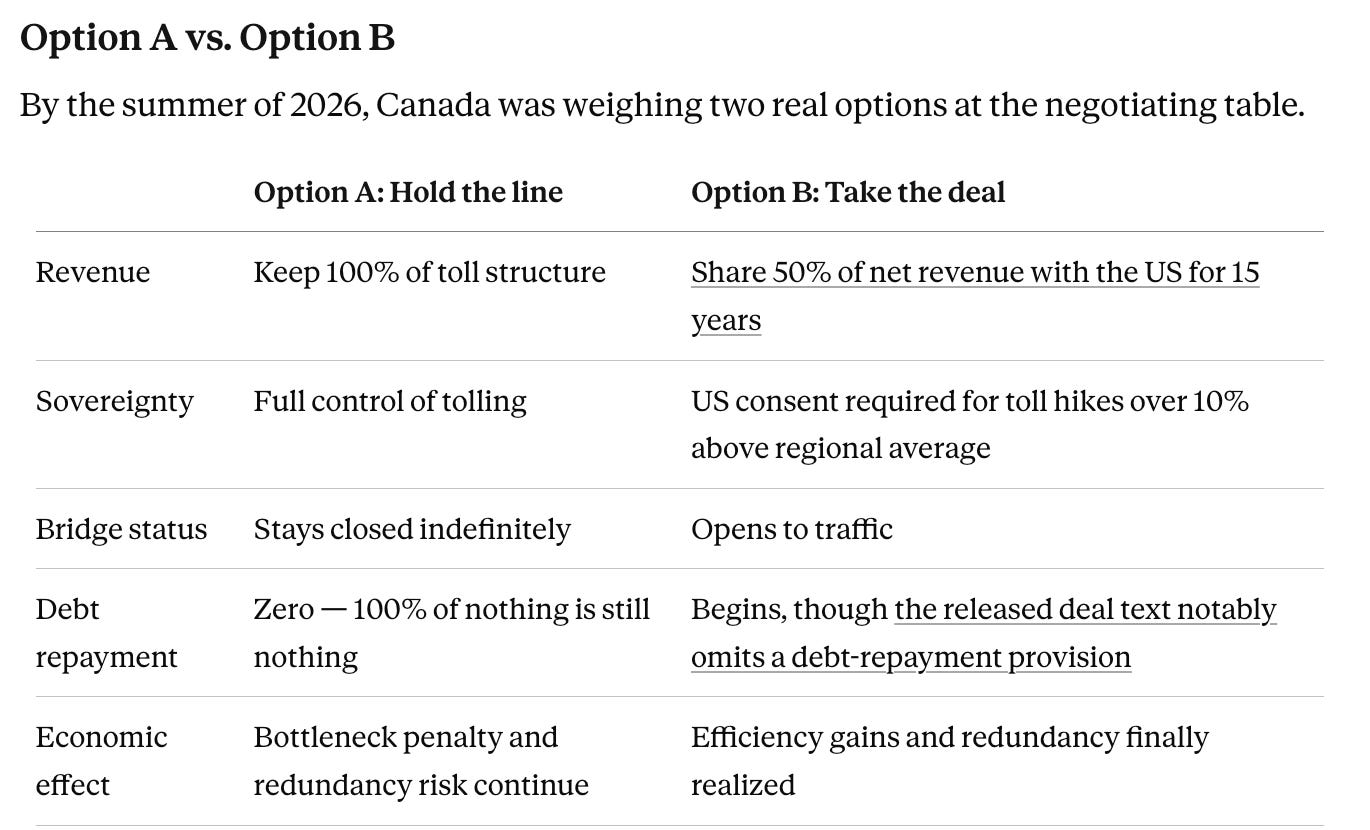
Under Option B, the revenue-sharing money doesn’t go into the general US treasury — it’s directed into a newly established United States-Canada Economic Development Fund, controlled by the US government.
It’s easy to read a headline that says “Canada surrenders 50% of bridge revenue” and feel outraged. But physical ownership of an asset means nothing without operational sovereignty. Half a loaf beats an empty, multibillion-dollar driveway.
The Verdict
A no-deal scenario would not have destroyed the Canada-US trading relationship overnight. But it would have imposed a severe, measurable, and compounding economic penalty on Canada while indefinitely delaying the benefits of a bridge it had already sacrificed so much to build.
For context on where things landed: the bridge’s tolls came in at $8.75 per axle, well under the Ambassador Bridge’s roughly $20 per axle — a competitive edge that should start pulling commercial traffic toward the new crossing almost immediately.
If you want to dig into the full investigative math behind these numbers, read the original research by Rachel Bennett and Michael Reeves at the Sanity Project.
And if this raises a bigger question for you, it should. The next installment in this series zooms out from this one bridge to ask what Canada should demand the next time it builds critical infrastructure that depends on another country’s political permission to operate. Pipelines, power grids, fibre optic links — how many of them are sitting on the same kind of hidden fault line, unknown to the taxpayers funding them?
Subscribe to The Sanity Project, and let us know: would you have taken Option B to get the bridge open, or held out on Option A — principle intact, gate still closed?


