



Canada’s Unemployment Rate Just Fell to 6.4% — So Why Doesn’t It Feel Like a Recovery?
Jobs are up, GDP is growing, and the trade surplus just hit a four-year high. Here’s why so many Canadians still don’t feel it — straight from this week’s Sunday Sanity Check.
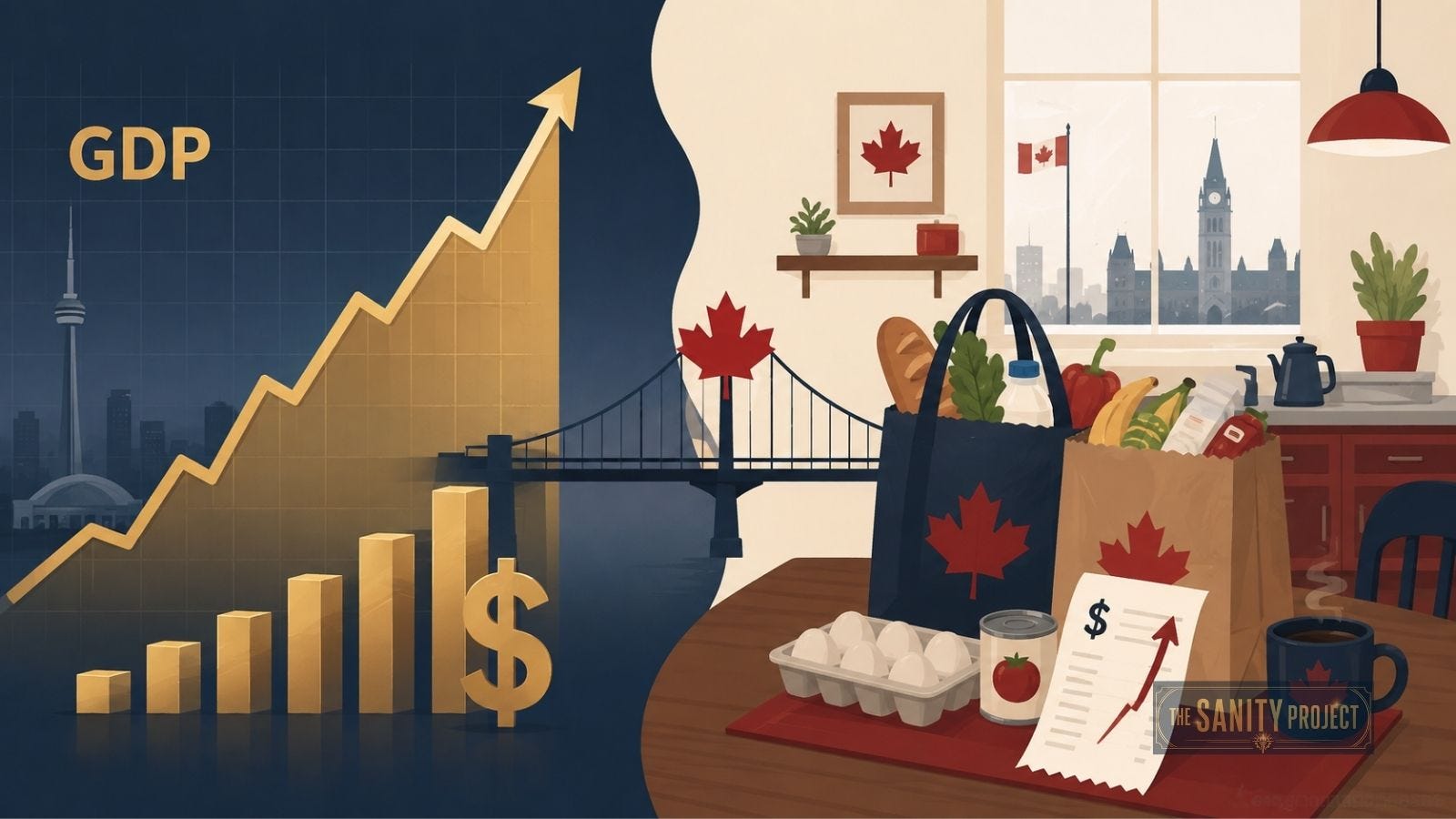
Stats Canada dropped a surprisingly upbeat report this month: the country added roughly 75,100 jobs in July, and Canada’s unemployment rate fell to 6.4%. Add in resilient GDP growth and a trade surplus sitting at its highest level in four years, and the headline numbers paint a picture of an economy quietly having a good run. But talk to actual Canadians about housing costs, grocery bills, or their ability to save, and you’ll hear something closer to a squeeze than a recovery. On this week’s Sunday Sanity Check, I sat down with my AI research assistant, Abby, to pull apart what’s really going on — and whether the spreadsheet and the kitchen table can both be telling the truth at the same time.
Canada’s Unemployment Rate Drop: What the July Jobs Numbers Actually Show
Canada’s unemployment rate fell to 6.4% in July 2026 after the economy added roughly 75,100 jobs, with the private sector driving nearly all of the gains. That’s a meaningfully stronger showing than most forecasters expected heading into the report, and it follows a stretch of shakier labor market data earlier in the year.
“I just checked the latest statistics Canada released. July was much stronger than expected. Canada added 75,100 jobs, and the unemployment rate dipped to 6.4%. So on its face, that’s a solid report.” — Abby
The gains weren’t concentrated in one corner of the economy either. Growth showed up across wholesale and retail trade, finance and real estate, professional and technical services, and construction — a spread that suggests something broader than a one-off blip. Statistics Canada published the full breakdown in its July Labour Force Survey, and it’s worth a look if you want to see the industry-by-industry numbers for yourself.
Canada Jobs Report: Was It Just Tim Hortons Shifts and Summer Students?
No — the July gains were split almost evenly between full-time and part-time positions, and hiring was broad-based across multiple industries rather than concentrated in seasonal or minimum-wage work.
That pushback showed up almost immediately on social media the day the jobs report landed: skepticism that 75,000 jobs meant much if most of them were part-time retail or student summer gigs.
It’s a fair question, and the data doesn’t fully wave it away. Job quality and wages remain a real, open issue — even a strong headline number in the Canada jobs report can sit atop a labor market where pay hasn’t kept pace with the cost of living for many workers. The Globe and Mail’s coverage of the report notes that economists were caught off guard by how far the numbers beat expectations, which is part of why the skepticism was so loud in the first place. The July numbers were broader than the skeptics feared, but “broad” isn’t the same as “generous.”
Canada GDP Growth: Is the Rebound Real, or Just a Good Month?
Canada’s GDP growth turned positive again in April and May 2026, and June’s early estimate points toward a stronger second quarter, with exports doing much of the heavy lifting. Early 2026 growth had been weak enough to raise real concerns, making the recent turnaround notable rather than just noise.
Exports are the piece worth watching most closely here, because they connect directly to the next part of the story: how Canada managed to post a strong trade number while tariffs were supposedly squeezing the economy from every direction. The full monthly breakdown is in Statistics Canada’s Gross Domestic Product by Industry release, which also carries the advance estimate for June.
Canada Economy Growth: How a Trade Surplus Survived the Tariffs
Canada’s trade surplus recently reached its highest level in four years, even as tariffs squeezed parts of the economy, because exporters adapted, a weaker Canadian dollar helped, and sectors like autos and manufactured goods held their ground.
Tariffs hurt — that part isn’t in dispute — but they didn’t shut the export economy down the way a lot of the doom-and-gloom commentary implied.
“Tariffs hurt parts of the economy, but they don’t shut everything down. Canada’s exporters have adapted, and some sectors such as autos and some manufactured goods have stayed strong. A weaker Canadian dollar also helps exports.” — Abby
The honest read isn’t that tariffs don’t matter. It’s that Canada’s economy has proven more resilient to them than a lot of people expected — which is a very different, and more useful, story than either “tariffs are destroying us” or “tariffs don’t matter at all.” CBC News reported that the surplus was led largely by a jump in exports to the U.S. itself, and Statistics Canada’s international merchandise trade release confirms it’s now stretched into a fourth consecutive monthly surplus.
How Is Canada’s Economy Doing, Really? The Four Numbers That Matter More Than GDP
The clearest read on how Canada’s economy is doing for ordinary households comes from four indicators — real wages, productivity, housing affordability, and disposable income — not the topline GDP or jobs numbers. Macro figures can improve while day-to-day life still feels heavy, and these four come closest to what people actually experience.
Real wages — pay after inflation — are starting to rise again, which helps explain why consumer spending has held up better than expected. Productivity is the clear weak spot, a stubborn, long-running challenge with no quick fix — the Bank of Canada’s July Monetary Policy Report flags weak business investment and productivity as one of the main drags on the growth outlook. Housing affordability is still extremely tough and is probably the single biggest reason for the disconnect between the statistics and the mood. And disposable income is improving on paper, but high debt-servicing costs are eating into a lot of that gain before it ever reaches a household’s actual budget.
Total GDP vs. GDP Per Person: Why the Difference Matters
Total GDP measures the size of the whole economic pie; GDP per person measures the size of each individual slice. If the population grows faster than the economy itself, total GDP can rise while the average Canadian doesn’t actually get ahead.
That distinction is exactly why some commentators—often arguing that Canada is underperforming compared with the U.S.—lean so heavily on the per-capita figure rather than the topline figure. Neither number tells the whole story on its own; the more useful move is to look at both and ask why they’re diverging.
Statistics Canada’s quarterly GDP release tracks per-capita GDP alongside the topline figure for exactly this reason — population growth and economic growth don’t always move together.
Canada Housing Affordability: The Real Reason the Recovery Doesn’t Feel Real
Housing affordability is the single biggest reason Canada’s improving economic numbers don’t translate into a feeling of prosperity for many households.
Jobs can be up, GDP can be growing, and trade can be strong — but if rent or a mortgage payment eats an outsized share of income, none of that registers as progress at the kitchen table.
Short-Term Fix vs. Long-Term Fix
In the short term, increasing housing supply is the most significant source of relief. Longer term, it’s a mix of faster zoning and permitting, infrastructure investment, more skilled trades, and financing conditions that don’t price ordinary buyers out entirely.
Lower interest rates help with monthly payments, but without more homes actually getting built, price relief just gets pushed right back up. As Abby put it during our conversation, the goal isn’t to make homes cheaper — it’s to make them more plentiful. That’s not just a talking point — CMHC’s own housing supply framework estimates Canada needs roughly 430,000 to 480,000 new homes built every year through 2035 just to restore affordability.
Whose Job Is It to Fix Housing?
Housing responsibility is genuinely split across all three levels of government. Cities control zoning and permitting. Provinces handle building codes and infrastructure. The federal government still matters through immigration levels, mortgage rules, tax policy, and infrastructure funding — but day-to-day housing supply is heavily a local and provincial matter.
Pinning the entire problem on one level of government oversimplifies something that only gets fixed if all three actually pull in the same direction.
Canada’s Economy Outlook: The Report Card and What Comes Next
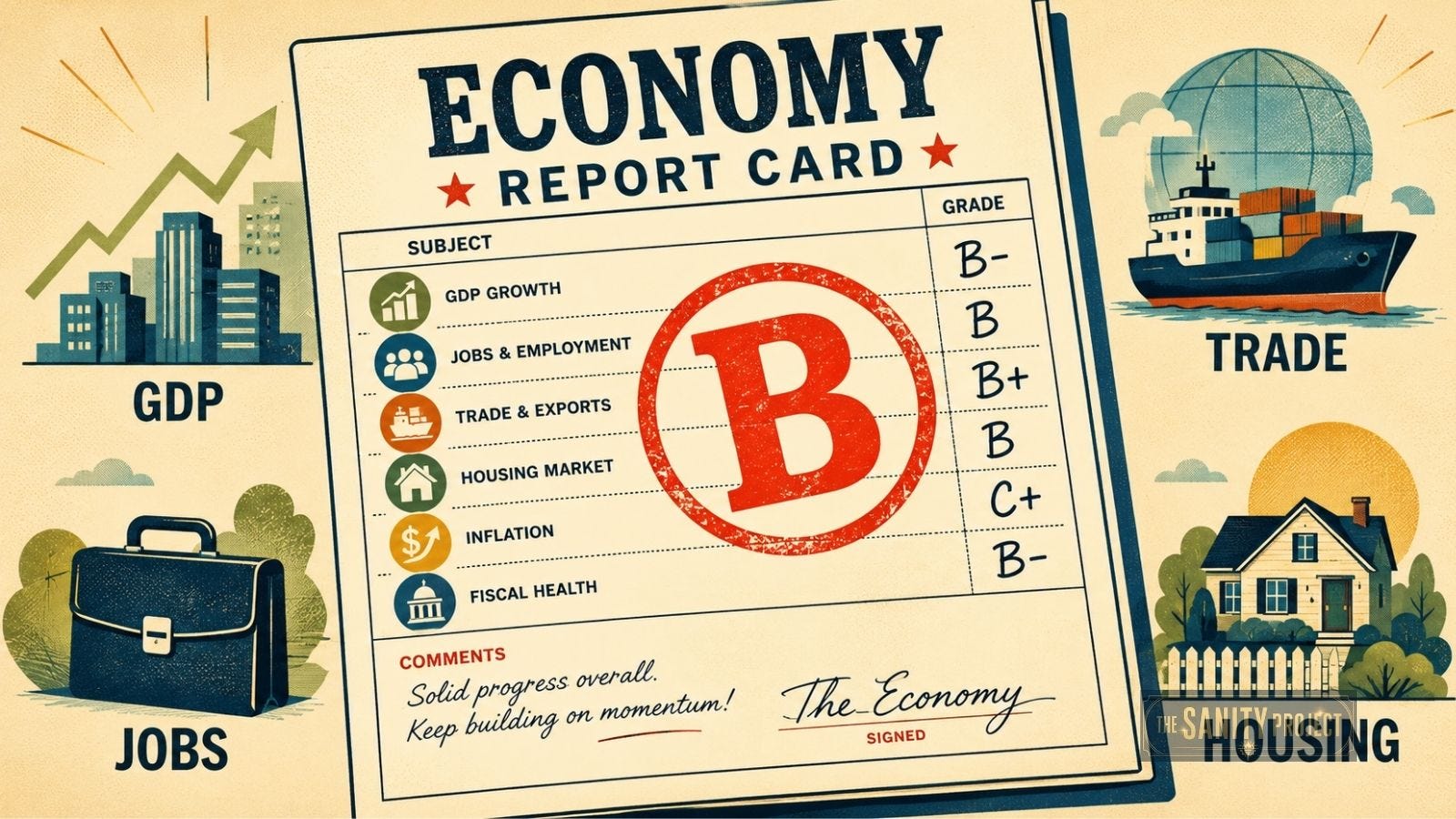
Abby graded Canada’s current economy a B — resilient enough to avoid a C, but not yet strong enough for most households to feel genuinely prosperous — and pointed to trajectory, not any single headline number, as the real signal to watch.
“I’d give it a B, not a C, because the economy has clearly been more resilient lately. Jobs are up. Growth has picked up. Exports are strong. But not an A either, because housing, productivity, and cost pressures are real and weighing on people.” — Abby
“The direction is encouraging. The destination is still a ways off.”
Over the past twelve months, the trajectory has clearly shifted upward — three straight months of labor market improvement, a GDP rebound, and stronger exports all point in the same direction, even if the pace is closer to steady improvement than a rocket launch. The risks that remain are the same ones running through this entire piece: housing, productivity, and the possibility of a global shock knocking things off course.
Two dates are worth circling on the calendar. The July inflation report is due on August 17, and it will show whether prices are staying stable or heating back up. Then on August 28, Statistics Canada releases official second-quarter GDP numbers — the release that will confirm whether the rebound we’ve been discussing actually materialized or turns out to be a temporary bounce.
The honest answer to “Is Canada’s economy good or bad?” isn’t a single number. It’s whether the right things are being measured, and whether they’re moving in the right direction together. Canadians can feel real pressure on their household budgets even while the country’s broader economic indicators improve — and those two things aren’t a contradiction.
They’re just two different measurements of the same economy, taken from two different vantage points. Don’t just trust the headlines, and don’t just trust an AI’s read on them either. Trust the numbers, and keep watching where they’re heading.


