


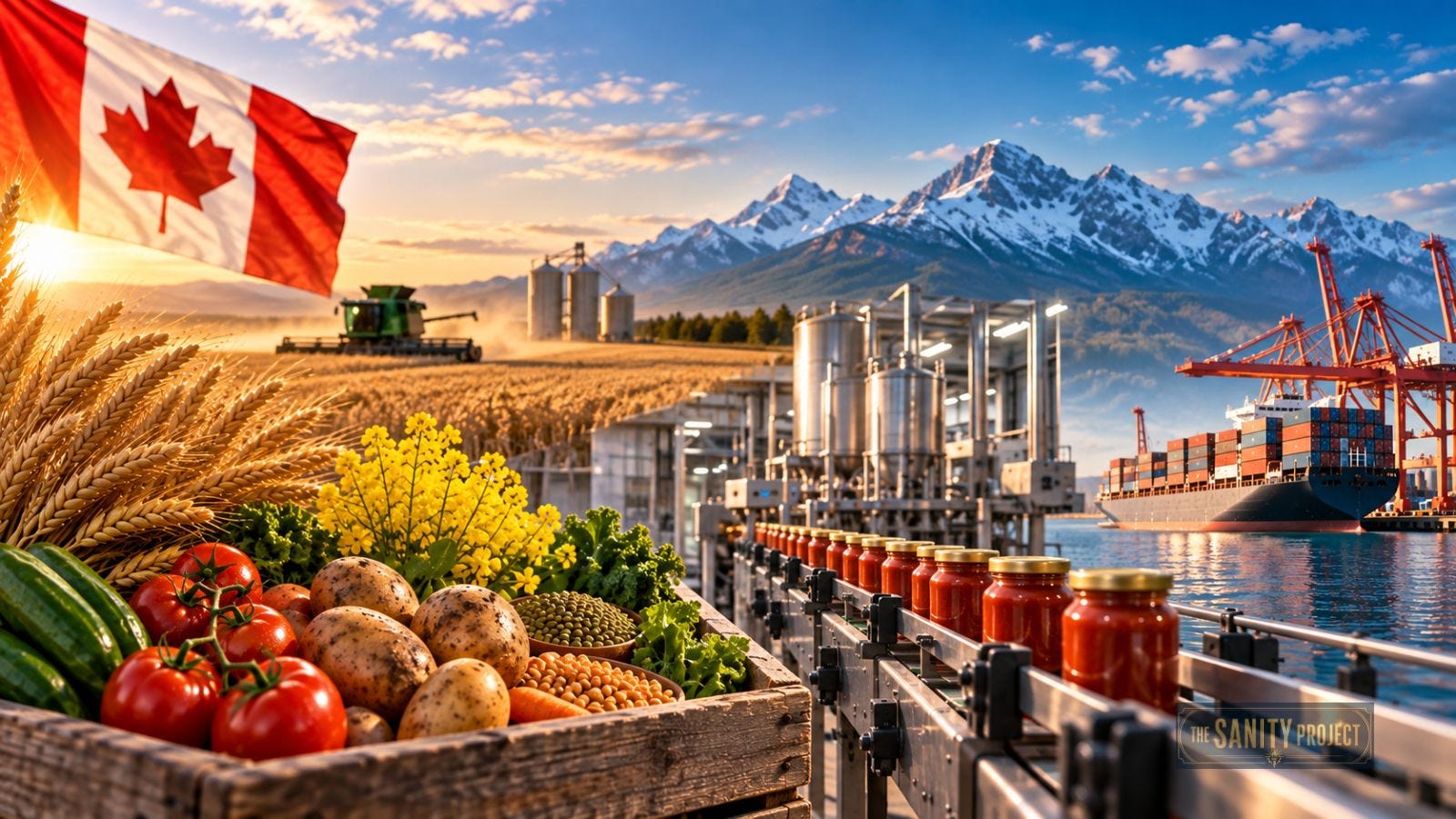
Canada Grows the Food. Now Let’s Finish the Job.
A few days ago, Canadian entrepreneur and investor Arlene Dickinson published an article called “Canada’s Handshake Means Something”, one of the clearest explanations I’ve read of a problem hiding in plain sight in Canadian agriculture.
Her argument begins with two numbers. Canada ranks fifth in the world in agricultural commodity exports, she writes, but only 11th in processed food exports.
The precise rankings vary somewhat depending on how agricultural and processed-food exports are defined, but Dickinson’s larger point is difficult to dispute. Canada is extraordinarily good at growing food, but considerably less successful at capturing all the economic value that comes after the harvest.
We grow the wheat, and someone else can turn it into pasta. We grow the peas, and someone else can extract the protein, manufacture the food and put a brand on the package. We raise the livestock and, in some cases, literally ship the animal across the border for processing.
Dickinson calls this the difference between being an agricultural superpower and becoming an agrifood superpower. Her article got me wondering about the obvious next question:
If we know what the problem is, what would it actually take to fix it?
So I went looking.
What I found was surprisingly encouraging. Many of the solutions Dickinson is calling for are no longer theoretical. Canada has begun putting serious money behind them.
Canada Already Has the Hard Part
Let’s begin by dispensing with one misconception. Canada does not need to become an agricultural powerhouse. We already are one.
We have the land, water, farmers, technology, expertise and international reputation. Canadian agriculture produces enormous quantities of wheat, canola, pulses, beef, pork, potatoes and other products for both Canadians and the world.
Nor does Canada lack a food-processing industry. According to Agriculture and Agri-Food Canada, food and beverage processing is already Canada’s largest manufacturing industry, with $173.4 billion in manufacturing sales in 2024. It employs about 318,400 Canadians, while processed food and beverage exports reached a record $59.8 billion.
The problem is what happens between our enormous agricultural industry and that enormous processing industry.
Canada’s own National Food Security Strategy now acknowledges that Canada does not process nearly as much of the food grown or harvested here as it could. Instead, some of it leaves the country for processing, taking potential jobs, investment and economic activity with it.
We’ve already looked at this strange Canadian food paradox: we can be major food producers while still importing enormous quantities of products we could grow, process, or store here.
And that’s where things get interesting.
Grow It Here. Ship It Away. Buy It Back.
Consider tomatoes. Canada exported more than $724 million worth of fresh tomatoes in 2025, while importing more than $511 million worth of processed tomato products.
Or consider livestock. In 2025, Canada exported 24% of our live hogs and 20% of our live cattle to the United States. Meanwhile, imported beef accounted for about 26% of Canadian consumption, and imported pork accounted for about 30%.
We are obviously not importing the same tomato we exported with a fake moustache and a new passport. International food supply chains are considerably more complicated than that.
But the underlying economic problem is real.
When Canada exports the raw agricultural product, we may surrender some of the processing, manufacturing, packaging, transportation, branding and ultimately profit that can be captured farther up the value chain.
So how do we change that?
Solution One: Stop Exporting So Much of the Value
The answer is not to stop exporting Canadian agricultural commodities. That would be economic lunacy. Our farmers are among the world’s great agricultural producers, and global commodity markets will remain enormously important to Canadian agriculture.
The opportunity is to process a larger share of what we produce before it leaves Canada.
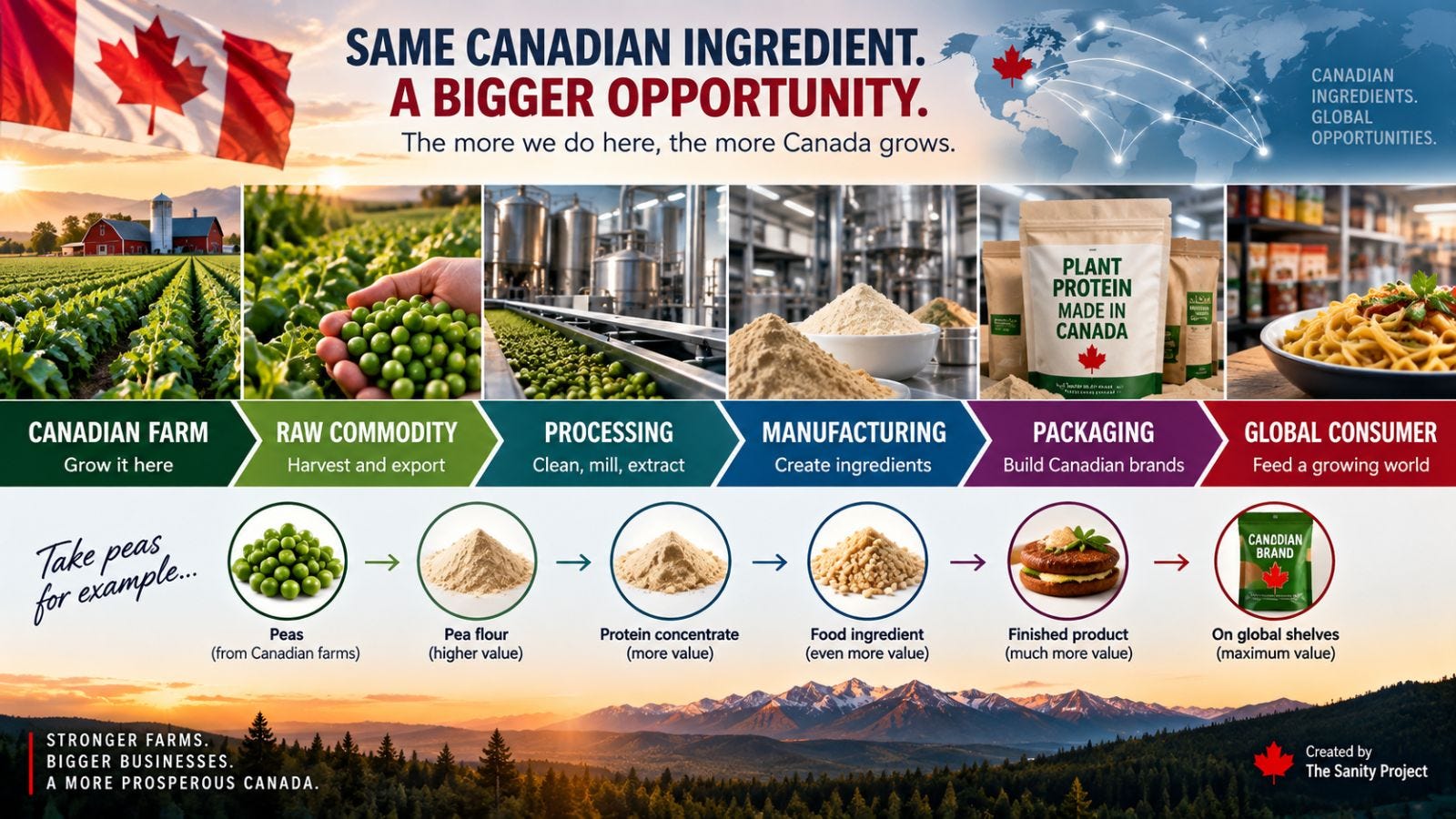
Take peas. Canada is a global leader in dried pea exports, but RBC research found that approximately 88% of Canadian pea production over the past five years was exported as a raw commodity.
A pea, however, doesn’t have to remain a pea. It can become flour, starch, protein concentrate, protein isolate, an ingredient in manufactured foods and eventually part of a branded consumer product. Every additional step represents another opportunity for Canadian investment, Canadian jobs and Canadian economic activity.
We already have proof that this model can work.
Statistics Canada reports that Canada processed a record 11.6 million tonnes of canola domestically in 2025, producing 4.9 million tonnes of canola oil and 6.8 million tonnes of meal. Just over half of Canadian canola is now processed domestically.
That’s moving up the value chain.
Now imagine applying that thinking more aggressively across Canadian agriculture.
Solution Two: Build the Plants
Of course, saying “process more food in Canada” is considerably easier than actually doing it. Food-processing plants aren’t built with a hammer, a Costco membership and an enthusiastic Facebook group. They require enormous amounts of capital.
That’s why one of the most interesting developments happened just as Dickinson was making her argument.
On September 14, Farm Credit Canada launched a $1-billion Agri-food Project Finance initiative to finance major Canadian food-processing and manufacturing projects.
This isn’t money looking for another PowerPoint presentation. FCC says the financing is aimed at construction-ready infrastructure projects that can expand Canadian food processing and manufacturing capacity.
That matters because FCC identifies precisely the problem Dickinson does: some transformative food-processing projects are simply too large, complex or capital-intensive for conventional financing.
Canada also needs to examine the regulatory barriers involved in building and expanding these facilities. That doesn’t mean abandoning environmental protections, worker safety or food standards. Those aren’t bureaucratic annoyances. They’re part of why Canadian food has such a strong international reputation.
But safe and thorough does not have to mean unnecessarily slow and complicated.
The National Food Security Strategy specifically identifies regulatory approaches that increase costs and limit growth, while proposing ways to reduce unnecessary barriers without sacrificing health and safety standards.
That’s exactly the balance we should be pursuing.
Solution Three: Help Canadian Companies Become Big Canadian Companies
There’s another bottleneck hiding between the family business and the multinational corporation. Canada has plenty of small food processors. What we don’t have enough of are companies in the middle that successfully scale into large international competitors.
The numbers are striking.
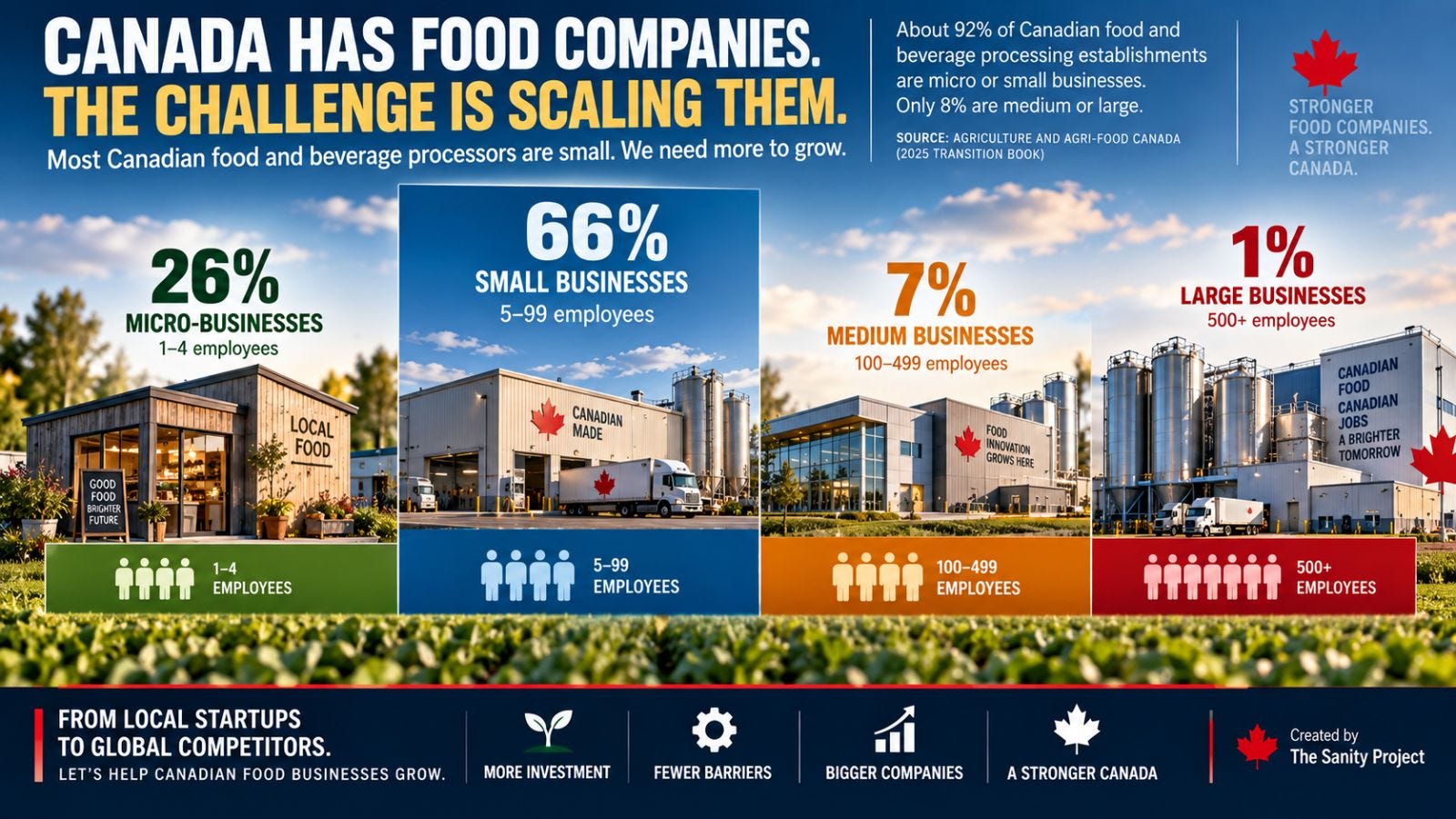
About 26% of Canadian food and beverage processing establishments are micro-businesses, employing between one and four people. Another 66% are small businesses with fewer than 100 employees. Only 7% are medium-sized, while just 1% are large.
Agriculture and Agri-Food Canada specifically identifies access to capital as one reason companies struggle to make that leap.
RBC has reached a similar conclusion. Its research found that agrifood companies captured only about 4% of Canadian growth capital investment over the past five years, despite Canada's clear competitive advantages in agriculture and food.
And this is where Arlene Dickinson re-enters the story.
She hasn’t simply identified the problem.
She’s putting money behind fixing it.
Arlene Dickinson Is Betting on Her Own Argument
Dickinson’s new Velocity Agri-Capital Partners has received a $150-million anchor investment from Farm Credit Canada. Velocity is now in discussions with Canadian and international investors about additional commitments of up to $350 million, potentially bringing the fund to $500 million.
According to the Government of Canada’s announcement, Velocity will back promising Canadian agrifood and ag-tech companies while helping expand processing capacity, accelerate commercialisation, diversify supply chains and create export pathways into Southeast Asia.
That’s important because it’s easy to write that Canada needs more investment. It’s considerably more persuasive when the person making the argument turns around and helps create the investment vehicle.
Velocity is also only part of a much larger movement of capital. FCC says it has convened more than 20 investment organisations collectively prepared to deploy up to $5 billion into Canadian agriculture and food innovation by 2030.
For perhaps the first time in a while, Canada doesn’t appear to be merely admiring the problem from a safe distance.
Money is beginning to move.
Solution Four: Keep America. Add the World.
Dickinson also makes an important distinction about trade. Canada should not abandon the United States. That would be foolish. America is our largest customer and will almost certainly remain an enormously important market for Canadian agriculture and food.
The problem isn’t trading with America. The problem is depending too heavily on America.
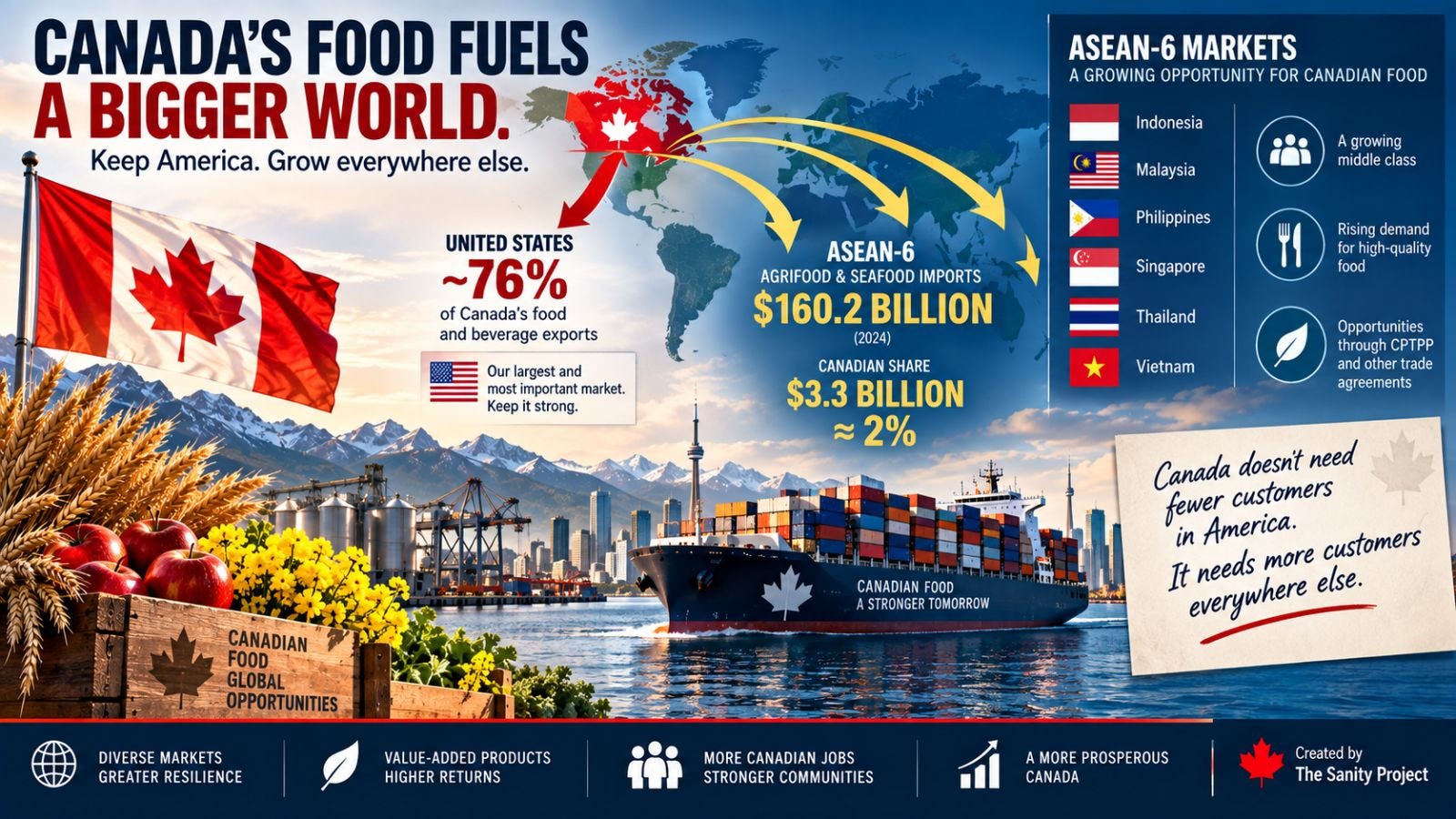
FCC has identified approximately $12 billion in Canadian food and beverage exports that could potentially be diversified into non-U.S. markets. Its research found that more than three-quarters of Canadian food and beverage exports were going to the United States.
There’s nothing anti-American about wanting more customers.
If one customer buys three-quarters of what your business sells, you don’t have diversification. You have a relationship status.
Recent events have demonstrated the danger of building an export economy around a market where trade conditions can suddenly change. The answer isn’t to sell America less simply for the sake of it. The answer is to sell more to everyone else.
And Southeast Asia represents an extraordinary opportunity.
Solution Five: Use the Trade Deals We Already Have
The six major ASEAN markets imported approximately $160.2 billion worth of agrifood and seafood products in 2024, according to Agriculture and Agri-Food Canada’s ASEAN trade analysis.
Canada supplied only about $3.3 billion.
That’s roughly 2% of the market.
Canada has also already negotiated significant market access through agreements including the Comprehensive and Progressive Agreement for Trans-Pacific Partnership, or CPTPP. It provides preferential access for Canadian agricultural and processed food products to major markets, including Japan, Vietnam, and Malaysia.
In other words, Canada has spent years negotiating doors into some of the world’s most important markets.
Now Canadian businesses need more products to carry through them.
That’s another reason domestic processing matters. A shipload of Canadian wheat is valuable, but Canadian flour, pasta, cereal, baked-food ingredients and branded consumer products represent additional opportunities to capture value before that ship ever leaves Vancouver.
Dickinson has spent considerable time developing relationships in Southeast Asia, and Velocity will have teams in both Canada and Singapore.
That’s the kind of thinking Canada needs more of.
Don’t just negotiate the trade corridor. Fill it.
Solution Six: Build the Infrastructure Behind the Food
This also connects directly with something we’ve been examining extensively here at The Sanity Project: Canada’s extraordinary pipeline of 167 major investment projects.
Ports, railways, cold storage, reliable electricity, trade corridors and manufacturing infrastructure all matter to agriculture. A Canadian agrifood superpower doesn’t end at the farm gate. It requires an entire system capable of moving ingredients into processing facilities and finished products from those facilities to Toronto, Tokyo or Singapore efficiently and competitively.
We reached much the same conclusion when we examined the Dutch food system: its real advantage isn’t simply greenhouses. It’s the integration of growers, processors, research, energy, storage and logistics into one functioning system.

That’s why Canada’s broader infrastructure push and its agricultural ambitions shouldn’t be viewed as separate economic stories.
They’re pieces of the same strategy.
A billion-dollar food-processing plant isn’t particularly useful if its products can’t reach a port efficiently. And a modernised port isn’t nearly as valuable if we’re not producing more high-value Canadian goods to ship through it.
Connect the pieces, and the economic picture starts to look considerably different.
Solution Seven: Turn “Canadian” Into a Global Food Brand
There’s one final advantage Canada may be undervaluing: our reputation.
Dickinson puts it beautifully when she argues that Canada’s handshake means something. In a world increasingly defined by geopolitical uncertainty, unpredictable trade relationships and concerns about food security, Canada offers something valuable beyond wheat, beef or canola.
Reliability. Safety. Quality. Traceability. Political stability.

Other countries have transformed national reputation into commercial advantage. Germany became synonymous with engineering. Switzerland with precision. Italy with food and design.
Canada should deliberately work toward making Canadian food an international quality signal.
Not simply ingredients that disappear into someone else’s product, but products carrying Canadian names, Canadian brands and Canadian ingredients.
That's the same distinction we've been exploring in our Made in Canada series: where something is manufactured and who owns the brand are different questions, but both determine how much economic value ultimately remains in Canada.
40 Canadian Products - One Free Guide. No Guessing

“Made in Canada” Products You Didn’t Know Were Canadian
Made in Canada. Sold to the world.
The Economic Prize Is Enormous
This isn’t merely an exercise in national pride.
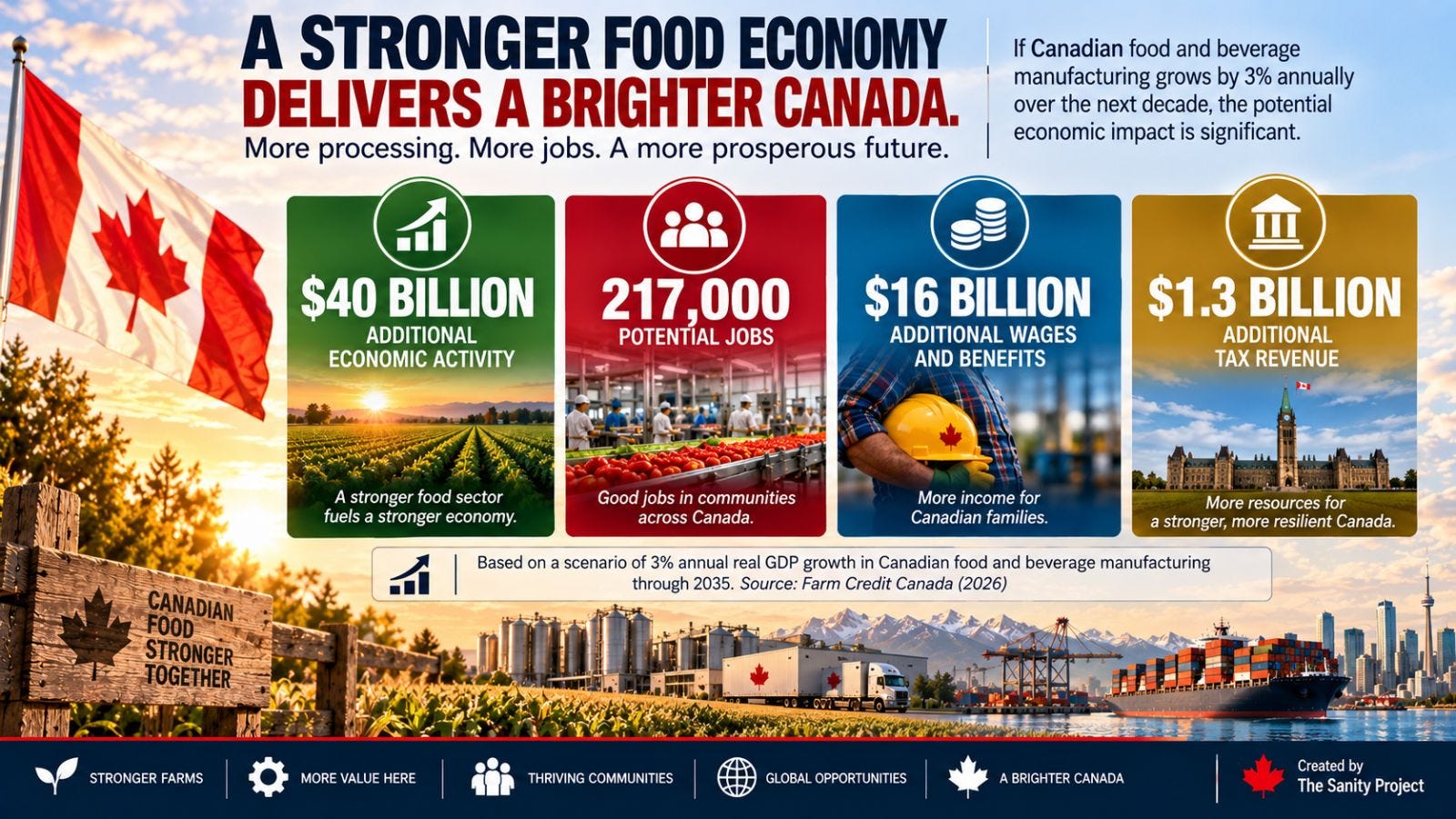
Farm Credit Canada recently modelled what could happen if real GDP in Canadian food and beverage manufacturing grew by 3% annually over the next decade.
The potential result is up to $40 billion in additional economic activity, 217,000 new jobs, $16 billion in additional wages and benefits, and $1.3 billion in tax revenue.
Those are modelling estimates, not promises. No one has found 217,000 jobs stuffed behind a grain elevator waiting to be released.
But the estimates demonstrate the scale of the opportunity.
Canada doesn’t need to discover some exotic new industry, invent agriculture or figure out whether Canadians can grow food. Our farmers settled those questions generations ago.
The opportunity lies in the fields all around us.
From Agricultural Superpower to Agrifood Superpower
Which brings us back to Ms Arlene Dickinson.
Her article inspired this one because she framed the problem in a remarkably simple way: Canada has become exceptionally good at growing the ingredients, but we haven’t always finished the job.
The encouraging discovery from looking deeper into her argument is that Canada may finally be starting to do exactly that.
A billion dollars in specialised project financing is being aimed at major processing and manufacturing facilities. Hundreds of millions in growth capital are being assembled for Canadian agrifood companies. Billions more in public and private investment are potentially being mobilised.
Canada already has trade agreements providing access to enormous international markets. Infrastructure investment is moving, and Canadian agriculture remains among the strongest in the world.
None of this guarantees success. Plants still have to be built, companies still have to scale, and investors still have to take risks. Governments still have to eliminate unnecessary barriers, while Canadian businesses still have to get on planes, enter unfamiliar markets and compete.
But the destination is becoming remarkably clear:
Grow it here. Process more of it here. Manufacture it here. Brand it Canadian. Then sell it to the world.
Arlene Dickinson started this conversation by pointing out the uncomfortable distance between Canada’s strength in agricultural commodities and our weaker position farther up the food value chain.
More importantly, she’s now putting capital behind closing that gap.
Perhaps it’s time the rest of Canada did the same.
Because Canada doesn’t need to become an agricultural superpower.
We already are one. Now let’s finish the job.