


Sanofi’s Toronto Vaccine Facility Rebuilds Canadian Capacity
There was a moment throughout COVID that I suspect most Canadians would rather not revisit.
We had money. We had scientists. We had an advanced economy and one of the world’s better medical care systems. What we didn’t have was enough capacity to manufacture the vaccines we desperately required here at home.
Canada was forced into the same global scramble as everybody else.
Five years ago, Ottawa looked at that vulnerability and essentially said, "Never again.”
Last week, we got to see what “never again” looks like when somebody actually builds it.
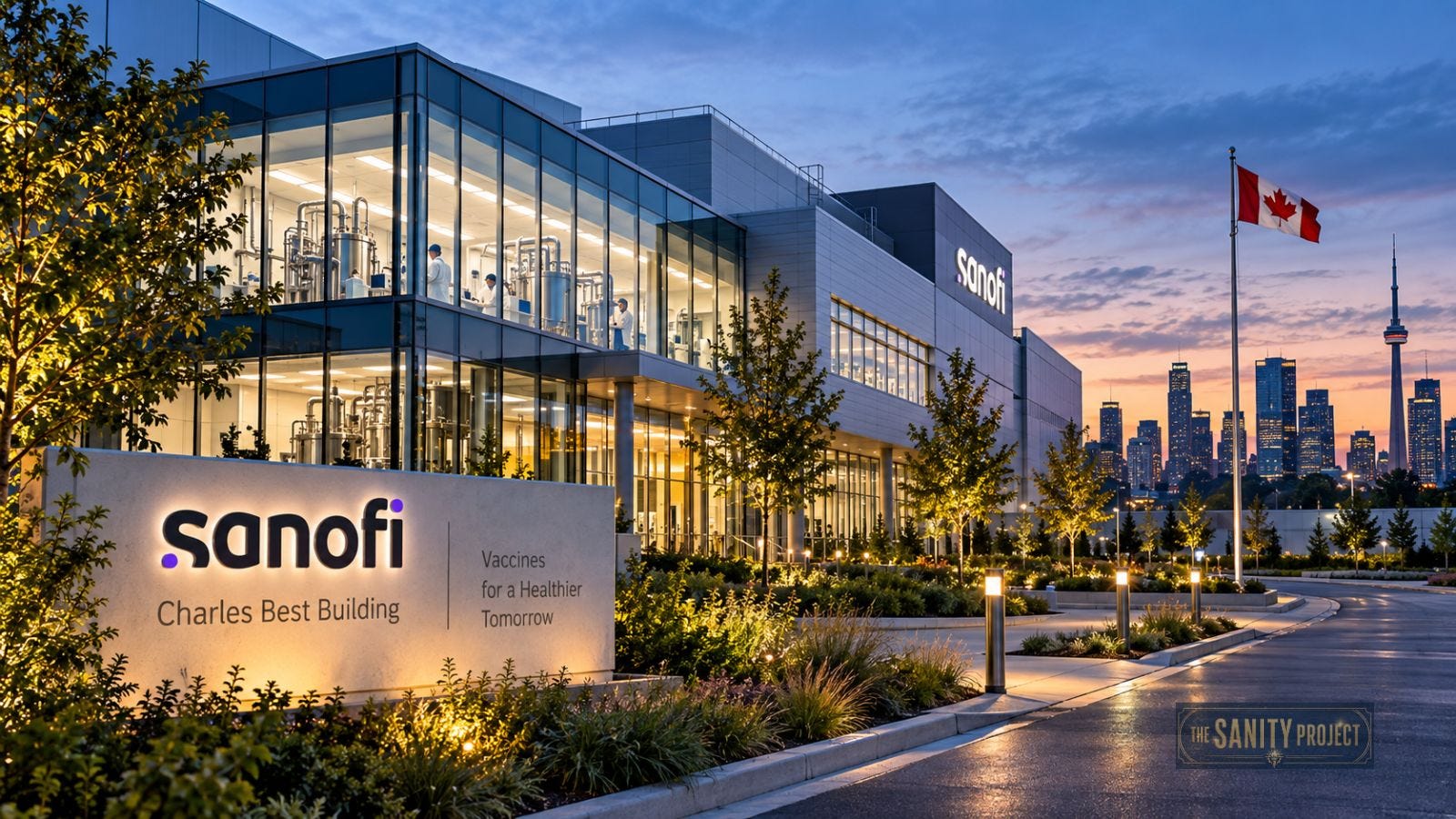
Sanofi officially opened the new Charles Best Building on its 52-acre Toronto campus, a $925-million vaccine manufacturing facility and what the company describes as the largest single investment in a biomanufacturing facility in Canadian history. (Sanofi Canada)
This isn’t a proposal. It isn’t a memorandum of understanding. And nobody is standing beside a map pointing at where something might eventually go.
The building is finished.
A Lesson Canada Learned the Hard Way
To understand why this matters, we need to go back to 2020.
COVID exposed a weakness that had been developing quietly for decades. According to the federal government’s own assessment, a roughly 40-year decline in Canada’s domestic biopharmaceutical industry had left the country without the large-scale, flexible manufacturing capacity needed to quickly produce COVID vaccines at home. (Government of Canada)
That’s a rather uncomfortable position for a G7 country.
Canada ultimately secured vaccines from international suppliers, but the experience demonstrated the difference between being able to buy something and being able to make it.
Those are not the same kind of security.
In March 2021, Ottawa announced up to $415 million toward a new Sanofi end-to-end influenza vaccine facility in Toronto. Ontario added another $55 million, while Sanofi committed more than $455 million, bringing the project to $925 million. The first agreement also included Sanofi creating and maintaining 1,225 highly skilled Canadian jobs and investing at least $79 million annually in Canadian research and development. (Government of Canada)
Five years later, that investment is concrete, steel, laboratories, production equipment and people.
What Canada Actually Got
The new Charles Best Building will manufacture Fluzone High-Dose, an influenza vaccine specifically designed for people 65 and older. It contains four times the antigen of a standard-dose influenza vaccine. (Sanofi Canada)
But the more important part of this story is what sits behind that particular product.
The facility provides Canada with industrial-scale, end-to-end vaccine manufacturing capacity on Canadian soil, including capacity to support the country’s response to a future influenza pandemic. It is fully operational now and, pending regulatory approval, production is expected to begin in early 2027 for the 2027-28 flu season.
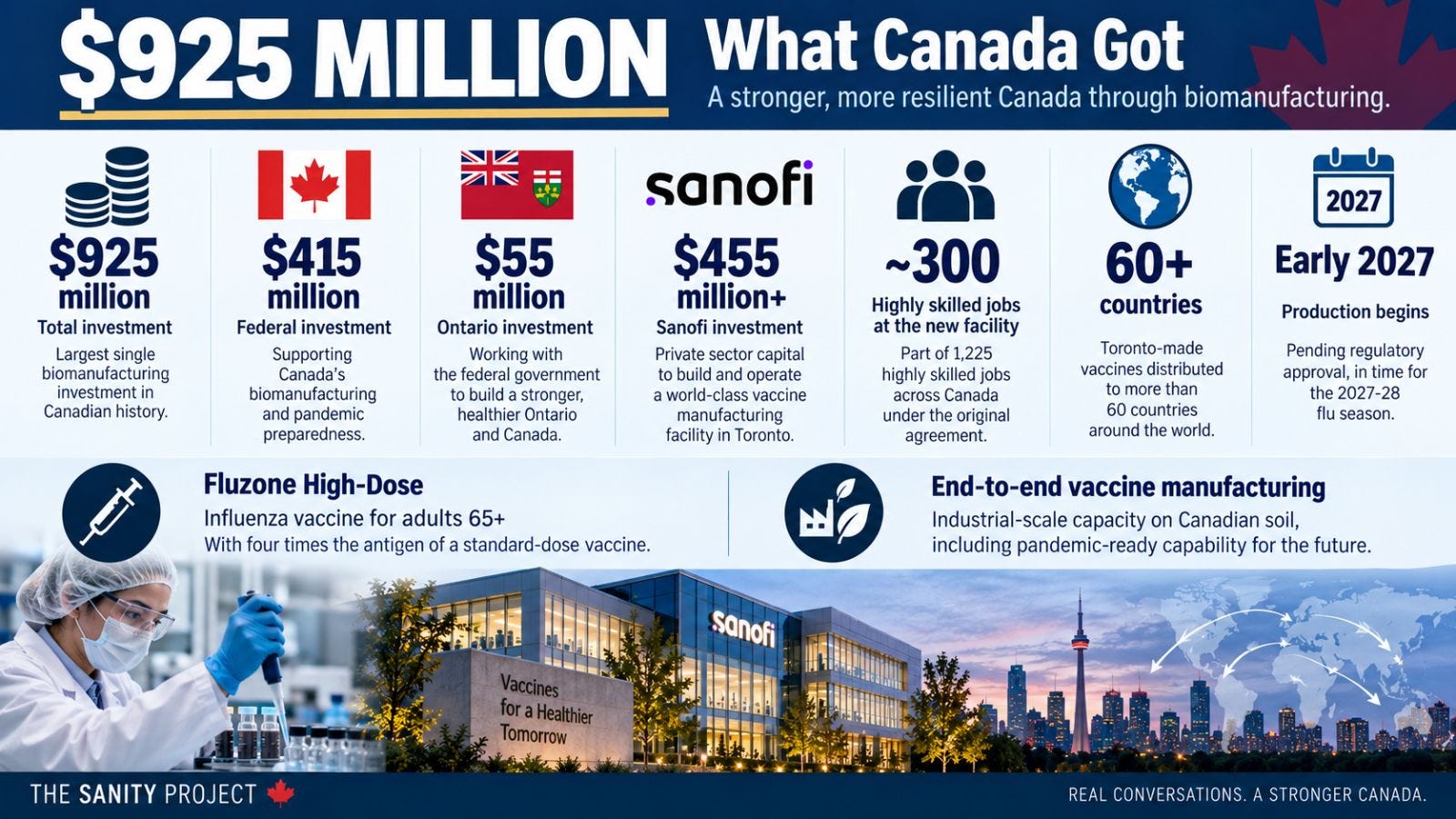
About 300 highly skilled advanced-biomanufacturing jobs are being created at the facility. Meanwhile, Sanofi’s Toronto operation already produces vaccines distributed to more than 60 countries.
That last number matters.
This isn’t simply about building a factory so Canadians can consume what comes out the other end.
It’s about developing something in Canada that the rest of the world wants to buy.
We’ve been following the same economic idea in Canada’s critical minerals sector. The bigger opportunity isn’t simply possessing valuable resources. It’s capturing more of the processing, manufacturing, technology and higher-value work that happens after extraction. A vaccine plant is a very different industry, but the economic principle is remarkably similar.

Digging something out of the ground or growing something on a farm is valuable. But the real economic opportunity comes when we do more processing, engineering, manufacturing, and research here as well.
Vaccines are an unusually sophisticated example of the same principle.
Yes, Sanofi Is Foreign-Owned
There is an important distinction here.
Sanofi isn’t Canadian. It’s a French multinational pharmaceutical company.
But economic autonomy doesn’t require building a wall around the country and insisting that every company operating here have a maple leaf tattooed on its balance sheet.
The more useful question is: Where does the productive capacity live?
Where are the factories? Where are the researchers? Where are the highly skilled jobs? Where is the intellectual expertise being developed? And when the world suddenly discovers it desperately needs the product, where are the machines to make it?
In this case, a significant piece of that capacity now lives in Toronto.
That distinction between foreign investment and simply “selling Canada” is one we’ve examined in much greater detail. Foreign capital can take very different forms, and investment that builds factories, infrastructure and productive capacity inside Canada deserves to be understood differently from simply transferring ownership of an existing Canadian asset.

Sanofi says it employs more than 2,000 people in Canada and is on track to deliver more than $2 billion in new Canadian infrastructure investments by 2028. Earlier this year, it also announced a further $ 294 million expansion of its Toronto AI Centre of Excellence.
That’s the kind of foreign investment Canada should understand very clearly: capital coming into the country to build productive assets here.
From Insulin to the Next Pandemic
There is also something wonderfully Canadian about the name on the building.
It honours Dr Charles Best, who co-discovered insulin with Frederick Banting and later served as an early medical director of what became Sanofi’s Toronto campus.
The campus stands on the historic site of Connaught Laboratories, where Best worked and where generations of Canadian researchers contributed to vaccine development and public health. Connaught scientists later played an important role in the development and large-scale testing of Jonas Salk’s polio vaccine. (Sanofi)
That makes the Charles Best name more than corporate decoration.
A century ago, Canada was helping push medical science forward.
Perhaps we should be doing more of that again.
This Is What Rebuilding Capacity Looks Like
One factory doesn’t make Canada self-sufficient in pharmaceuticals, and that shouldn’t be the goal. Modern supply chains are international, and Canada’s biomanufacturing strategy itself recognises that resilience requires multiple technologies, suppliers, research abilities and manufacturing platforms. (Government of Canada)
But there is a world of difference between participating in international supply chains and being completely dependent upon them.
COVID taught us that distinction rather brutally.
When Mélanie Joly attended the opening last week, she recalled the critical urgency of those early pandemic days and the vulnerabilities Canada discovered in vaccines, medical supplies and supply chains.
Her summary was considerably shorter than mine:
“Never again.” (CityNews)
Five years ago, that constituted a promise.
Today, on 52 acres in Toronto, part of it is a factory.
Which we did have before Connaught Labs was shut down in the 90s
What are the safeguard to ensure that the same fate does not happen again? It was Institut Merieux now Sanofi that purchased Connaught labs and shut down production.