


China Isn’t Building a Better Battery. It’s Building a Better Grip on the Grid.
The supply-chain deep dive behind this week’s episode of the Sanity Project
Every few months, a headline about a new Chinese battery breakthrough shows up in the tech press, gets a day of attention, and disappears. This one shouldn’t disappear. Because underneath the sodium-ion story is a much bigger question: who ends up controlling the physical infrastructure the AI economy runs on, and what happens to everyone who doesn’t.
The battery that isn’t the point
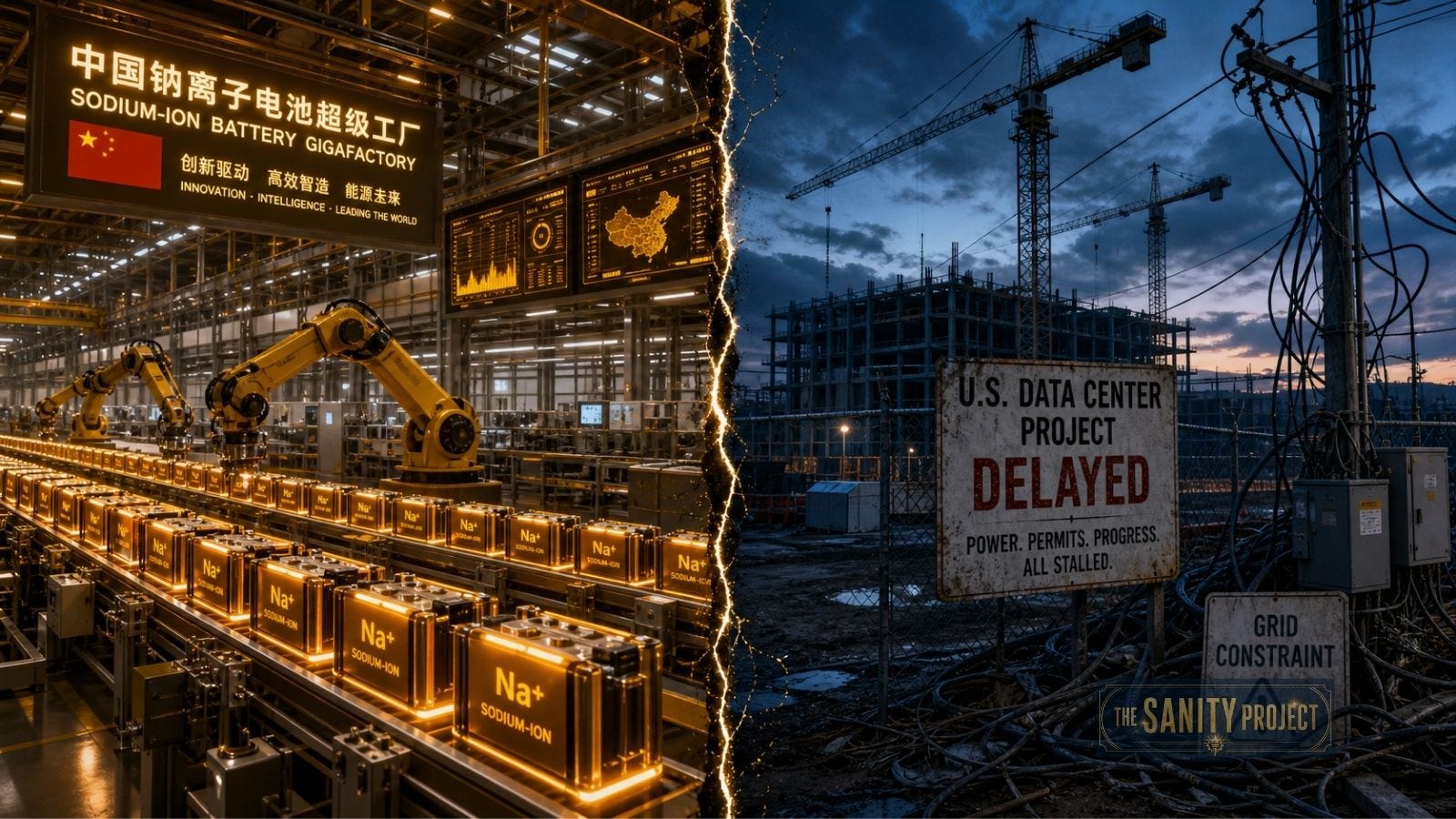
Sodium-ion batteries aren’t new science. What’s new is that they’ve crossed the threshold from lab curiosity to industrial product. According to reporting from CarNewsChina, CATL — the world’s largest battery manufacturer — confirmed at its December 2025 supplier conference that it would deploy second-generation sodium-ion cells at commercial scale across passenger vehicles, delivery trucks, battery-swap networks, and grid storage, all in 2026.
The cells reportedly clear China’s national safety standard for EV traction batteries and support real-world range comparable to entry-level lithium packs. First-generation sodium cells are already running an estimated 250,000 urban delivery vans on Chinese roads, per the same reporting. Pricing is already near $70 per kilowatt-hour, with the industry projecting a drop toward $40 as two new 30-gigawatt-hour factories — one from CATL, one from BYD — reach full output.
The reason sodium matters isn’t performance. It’s supply. Lithium is geographically concentrated and price-volatile. Sodium can be extracted from seawater and common minerals almost anywhere on Earth. That single fact removes the raw-material bottleneck that has constrained every other country’s grid-storage ambitions — and it means China can scale storage for its power grid without competing against its own EV industry for lithium.
Wiring the power straight to the compute
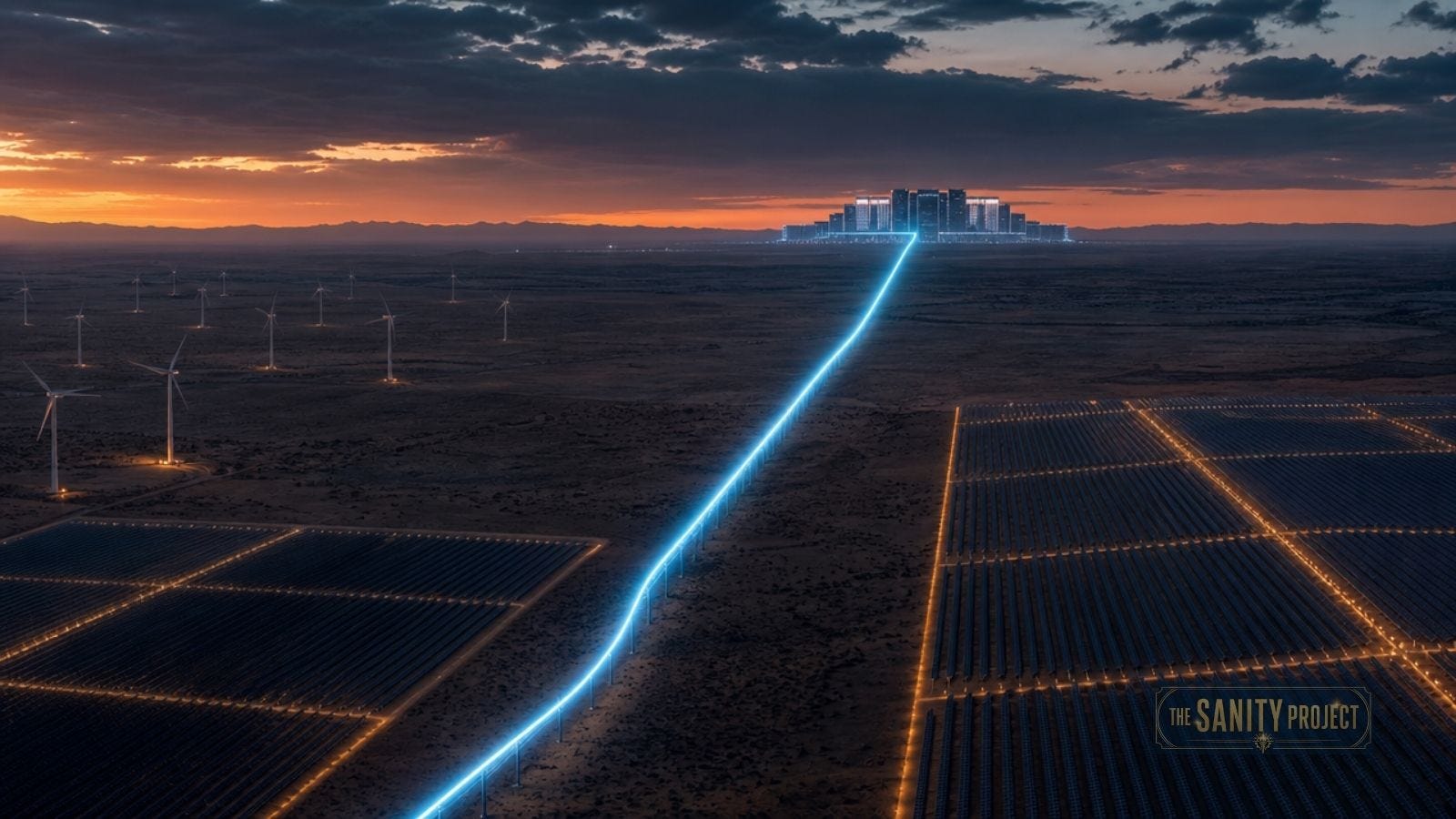
The battery is only half the story. In 2026, China brought online its first large-scale renewable energy project wired directly into a data center, bypassing the public grid entirely. The South China Morning Post reported the Ningxia site launched with 500 megawatts of solar capacity, with 1.5 gigawatts of wind power scheduled to come online by the end of the year. CGTN covered the same region’s first AI data center running on 100% green electricity, which began operating in June 2026.
This isn’t an isolated demonstration project. China’s 2026 government work report explicitly called for tighter integration between computing infrastructure and power supply networks, and a national action plan now requires new data centers inside China’s eight designated computing hubs to source at least 80% of their power from renewables. The sector-wide target is 80% renewable power by 2030, up from just 11% in 2023.
Put the two pieces together — cheap, abundant sodium-ion storage and a policy mandate wiring renewables directly into compute — and you get something more significant than a green-energy milestone. You get a government solving, on a national timeline, the exact problem currently strangling its chief competitor.
Meanwhile, on this side of the Pacific
American data center growth is running into the power wall China just engineered around. Roughly 12 gigawatts of new U.S. data center capacity are expected to come online this year, but only about a third of that is actively under construction, largely because grid capacity can’t absorb the rest fast enough.
Tom’s Hardware reported that roughly half of planned U.S. data center builds have been delayed or cancelled outright, tracing a meaningful share of the delay back to shortages of power infrastructure — transformers, switchgear, grid hardware — that are themselves bottlenecked by supply chains running through China.
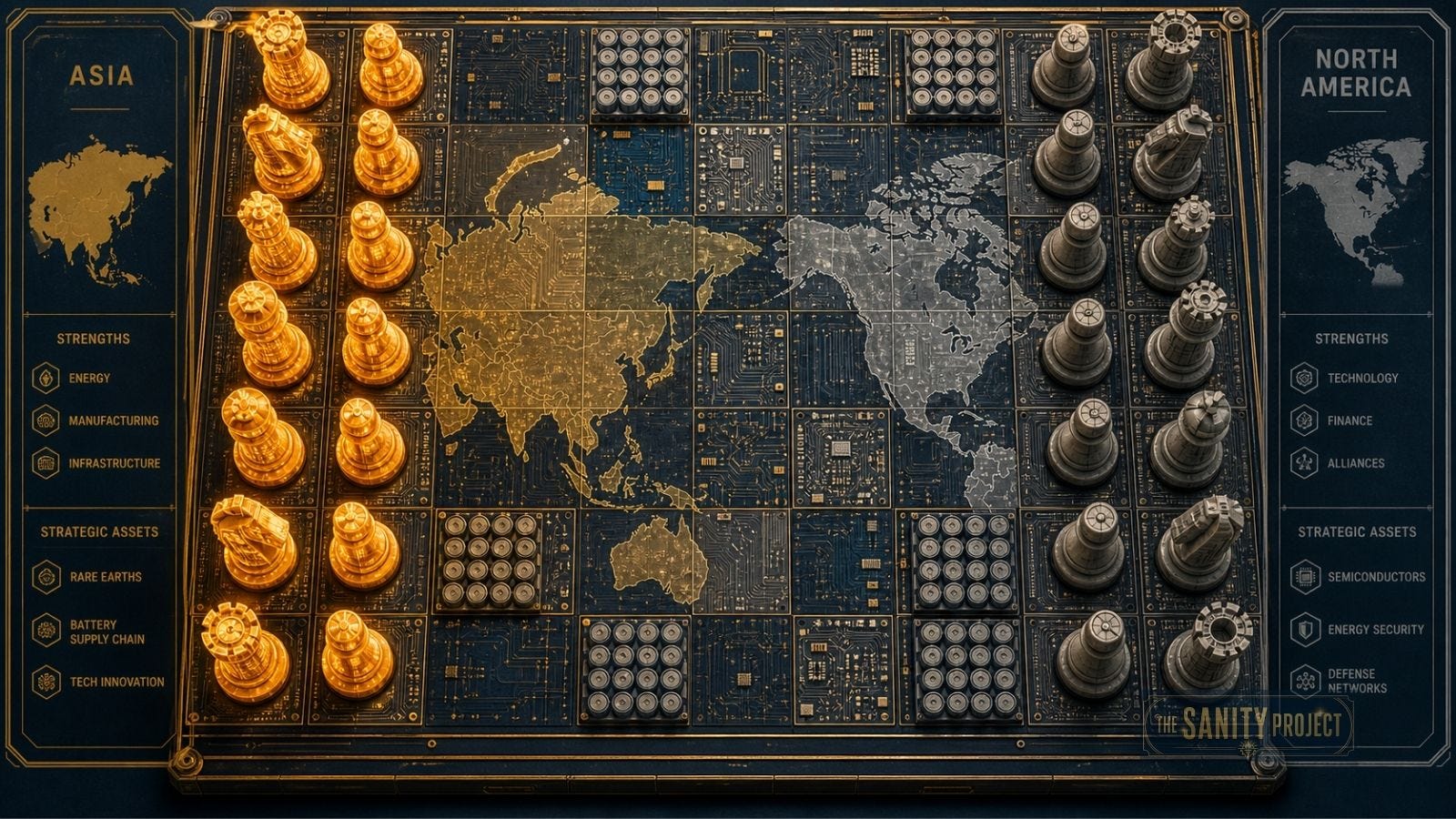
That’s the part worth sitting with. It isn’t only that China is out-building the U.S. on clean power for compute. The components America needs to fix its own bottleneck are frequently sourced from the same country prioritizing its own build-out. According to an analysis published by GovFacts, China supplies 14 of the 33 critical minerals the United States depends on most, including gallium, tungsten, and rare earths — materials that show up directly in grid hardware and battery systems. Copper, the literal wiring of the entire AI power buildout, hit a record price above $14,500 per metric ton in January 2026, a shock partly driven by the scale of global demand this sector alone is creating.
Vertical integration versus piecemeal building
Strip away the tech-headline framing and the picture is straightforward. One state is building generation, storage, and compute as a single, deliberately integrated system, on a government-set timeline. A rival economy is trying to build the same stack through fragmented private markets, using components partly sourced from the very country it’s competing against.
This is why the sodium-ion story isn’t really a battery story. It’s a story about who controls the choke points in the infrastructure that will run the next decade’s economy — and, by extension, a meaningful share of its national security posture. Energy independence, in this framing, isn’t just about drilling more oil or installing more panels. It’s about whether the hardware, minerals, and manufacturing capacity to do either of those things sits inside your own borders or a rival’s.
There’s a policy response underway. Washington is pushing toward a critical minerals trading bloc with partners including Japan and the European Union, aimed at reducing exposure to China-controlled mineral processing and building pricing mechanisms less vulnerable to single-supplier leverage. Whether that response moves fast enough is the open question — and it’s one this build-out isn’t going to wait around for.
This piece accompanies this week’s episode of the Sanity Project. Subscribe at thesanity.org for the weekly breakdown, and for deeper written dives like this one.


